O. Henry
Human Design Chart
Biography
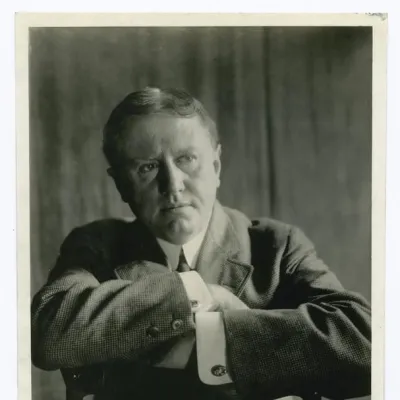
The second of three sons, young William was a few days past age three when his mother died of tuberculosis, with his infant brother following a few days later. He and his older brother were raised primarily by Grandma Porter, known as a local character. Their physician father was a caring parents but a bit odd, his absent mindedness apparently aided by a bit of whiskey. To supplement the family income, Will worked in the family drugstore while becoming a registered pharmacist, relishing dime-novels about cowboys, Indians and the Wild West for recreation.
In 1881, he made a trip to Texas that changed his life. He learned to ride and rope and speak Spanish with the ranch hands while writing stories in his spare time. A few years later he returned to city life and a variety of jobs, finally serving as a teller at the First National Bank of Austin, TX. He already loved a drink, card playing, and singing in the choir, and added another love to his life, that of 17-year-old Athol Estes. The couple eloped. Athol was a good influence, encouraging Will to submit his stories for publication and he began to make sales. However, Athol was weakened by two pregnancies, a boy who died and a daughter, Margaret Worth Porter.
Bored with the bank, Will went to work for the Houston Daily Post.
O. Henry as a Manifesting Generator 3/5 in Human Design
Manifesting Generator 3/5 — Design at a Glance
O. Henry revealed himself as someone who quickly drew things into his life and often pursued several projects simultaneously. His Design as an Manifesting Generator combined the constant sacral energy of a Generator with the direct connection to the Throat Center, typical for Manifestors. This hybrid configuration allowed him to skip steps and move forward rapidly. However, this speed sometimes led him to miss important stages that he had to return to later to complete – a process that could cause frustration if internal approval was lacking.
His strategy involved not initiating himself but responding to impulses. He should act only when his sacral center responded with a clear “yes”. As long as he sought this resonance and regularly checked whether his authority still supported the paths he had begun, he could draw deep satisfaction from his work. For O. Henry, seeking variety and falling into a playful mode was not an obstacle but a necessity, rather than sticking to one task alone. His creative power flared up precisely when he utilized this diversity and did not fight against the urge for parallelism.
Emotional Authority
O. Henry's Design inclined towards emotional wave motion, which significantly shaped his perception and decision-making. He was someone whose inner authority lay in the defined Emotional Center – a mechanism that always took precedence over all other defined centers. This meant that he was under constant emotional waves, manifesting as continuous ups and downs of his feelings. The world appeared to him colored by his current mood; enthusiasm could quickly turn into deep skepticism within moments. His immediate feeling was only a snapshot, not a final judgment. Quick, spontaneous decisions made in this emotional heat often proved disadvantageous, missing the deeper truth. O. Henry needed time to gain clarity. By letting decisions mature and sleeping multiple nights over them, intense feelings gradually subsided. Only then did an emotional distance set in, followed by calmness and true insight. This process of “polishing” – repeatedly questioning himself – was essential for him, particularly when making long-term pivotal decisions with significant influence on his life course. Through this patience, he could distinguish the transient emotional coloring from the enduring inner truth and take grounded steps into his future.
The 3/5 Profile — Martyr / Heretic
O. Henry's Design inclined towards a heroic adventurous spirit paired with the role of the cool storyteller. As someone with Profile 3/5, he initially believed little and had to test everything himself. This line of the experimenter drove him to learn from his own actions – and failures. The practical knowledge thus acquired, he gladly presented to others, making him attractive. Line 5, the Hero Line, fulfilled itself in addressing other people's problems with this self-acquired experience-based solutions. This role flattered his self-image but could be painful when experiments before an audience failed.
His inner dynamics were further shaped by specific lines. The third line of Gate 47 brought a tendency towards self-blame and martyrdom, involving adapting to emotional waves and often unjustified assumption of guilt. The key point of this configuration was the realization that one is okay – a process meant to stabilize self-worth when the immature, self-destructive side was overcome.
Simultaneously, Line 5 from Gate 45 emphasized leadership and crisis resolution. It endowed him with genetic leadership requiring respect. Practical solutions in times of crisis were paramount. Uranus elevated this leadership through intuitive intellect and talent for innovation. O. Henry thus revealed himself as someone who became an authority through personal experience to guide others during difficult moments – a hero distilling wisdom from his own failures for others.
Triple Split Definition — Defined & Open Centers
O. Henry's design laid a tendency towards constant mental pressure to ask questions and form concepts that he then articulated with clear speech. The definition between Head Center and Ajna Center generated a permanent stream of inspiration; however, since these centers do not have their own energy source, it was crucial for him not to act on his own but rather inspire others through his thoughts. His defined Throat Center enabled him to reliably transform these mental processes into communication and manifestation.
In addition to this cognitive structure, O. Henry possessed a strong will (defined Heart Center) and a reliable inner identity and direction (defined G Center). This gave him the ability to keep promises and offer others an orientation point without being dependent on their approval. His emotional authority stemmed from his defined Solar Plexus Center; he needed time to go through his emotional wave before achieving clarity. Impulsive decisions based on emotional highs or lows were counterproductive for him.
At the same time, O. Henry was exposed to certain vulnerabilities due to open centers. His open Spleen Center made him susceptible to survival fears and the temptation to cling to uncertain situations simply because they provided a false sense of well-being. Spontaneous decisions here were risky as he easily perceived foreign intuitions as his own. Additionally, his open Root Center absorbed external stress and adrenaline from the environment. This could lead to a cycle of overactivity in which he tried to rid himself of foreign pressure rather than simply recognizing it as not his own and moving away. The challenge was trusting mental and emotional rhythms without being thrown off by external stress or internal fears.
Channels for determination, emotional depth, love and abstraction.
O. Henry's Design inclined towards emotionally driven social behavior that was heavily dependent on his inner wave. The Channel of Openness 22-12 connected his Solar Plexus Center to the Throat Center. This meant that his ability to articulate and engage socially depended directly on his current mood. Gate 22 brought passion and drama, while Gate 12 added a cautious restraint. He performed best when waiting for the right emotional resonance; forced social contacts often led to misunderstandings or abruptness. His voice could touch others, but only if timing and feeling aligned.
Parallel to this, his design showed deep competitive energy aimed at individualization. The Channel of Initiation 51-25 connected the Heart Center through Gate 51 of Shock with Gate 25 of Self Spirit. This configuration drove him to test boundaries and reach new levels of consciousness through "shock moments." It was not mere ambition, but a mystical process of initiation where he had to learn to accept invitations for change rather than force them. His success depended on surviving transformative encounters from his own strategy and thus serving as an example for others.
His life path was also marked by the Channel of Discovery 29-46, which connected the Sacral Center with the G Center. Gate 29 promoted a positive yes to offers, while Gate 46 strengthened the self's determination. O. Henry had to let go of expectations and fully immerse himself in experiences to later recognize their meaning. Only through persistent perseverance without mental control could he make discoveries that expanded collective understanding.
Additionally, his mind constantly processed complex patterns. The Channel of Abstraction 64-47 connected Head Center and Ajna Center. Gate 64 brought mental confusion through endless possibilities, while Gate 47 sought comprehension. O. Henry's mind filtered experiences through a kaleidoscope of images to uncover stories. He could not solve his own problems rationally but found inspiration and clarity later on, which he shared as unique perspectives. Individual gates like Gate 26 (Innovation) or Gate 27 (Nurture) supported this dynamic with impulses for further development and nurturing warmth without dominating the overall picture.
Collective Circuitry — Circuit Signature
O. Henry's design revealed a tendency towards inner strength and emotional reflection, which manifested in three separate energetic strands. As a Triple-Defined individual, he did not have a continuous connection between these areas; they operated independently alongside each other as distinct forces.
The Knowledge Circuit connected his Throat Center to the Solar Plexus via the Openness Channel (Gates 12–22). This allowed him to directly translate emotional waves into words and thus find personal expression. The Authority Circuit formed an isolated unit from Identity and Heart Centers through Initiation (Gates 25–51). Here, a deep, individual affirmation of self-worth and courageous convictions emerged, though they remained without direct access to the means of expression. Finally, the Definition Circuit linked two separate segments: Head with Ajna Center (Abstraction, Gates 64–47) as well as Identity with Sacral Center (Discovery, Gates 46–29). This configuration promoted the ability to reflect on past experiences and derive meaning from them, linking intuitive understanding of connections with life energy. Thus, O. Henry was someone who felt inner truths emotionally and articulated them while his identity rested on a solid yet not always verbalized internal foundation.
Right Angle Cross of Rulership 3
O. Henry's design was characterized by a specific and often contradictory dynamic in the realm of authority and influence. The configuration 'The Right Cross of Governing 3' indicated a tendency towards an intense but frequently internally torn leadership claim. This structure did not describe the calm aura of an established ruler, but rather the constant struggle for legitimacy and control in a world that often appeared resistant or chaotic.
For O. Henry, this meant that he did not simply possess authority but had to actively, sometimes even aggressively, assert it. The 'Right Cross' in Human Design symbolizes a kind of fateful blow or profound transformation through conflict. In the context of governing, this was seen as a constant pressure to defend one's position and exert influence, often driven by fear of losing power or being ignored. It was not a gentle path of leadership but one marked by crises that forced O. Henry to redefine his role.
This mechanism shaped his experience of responsibility: it rarely came as a clear calling but rather as an unavoidable necessity imposed by external circumstances or internal compulsions. O. Henry lived in the tension between the desire for dominant influence and the real experience that this influence could always be fought for and remain unstable. This created a lifestyle marked by strong willpower, but also by a deep awareness of the fragility of every position.
Saturn Return · Uranus Opposition — Life Cycles
O. Henry's design indicated a tendency towards sudden, often externally initiated upheavals that fundamentally changed his life path. This dynamic was evident in 1901: at age 39, he was released from prison and immediately took up a job as a journalist with the Houston Post. For his system, this moment marked the peak of an Uranus opposition, a constellation pattern indicating abrupt liberations or forced redirections that dissolve old structures and impose new paths. His release was not a gradual transition but a sharp cut to freedom, followed by an immediate realignment of professional identity. Such Uranus influences work like an electric shock on life's structure; they break ingrained patterns and demand rapid adaptation to changed realities. O. Henry's step into the world of journalism after his incarceration illustrates this mechanism: the external pressure of imprisonment lasted until the opposition completed its effect, forcing him out of the old context. His new role as a reporter was not a long-planned career decision in traditional terms but a direct response to sudden availability and the need for reorientation. The design shows how external events can impose inner restructuring, where the person must learn to navigate the shock wave of change rather than fight against it.
Manifesting Generator · Emotional Authority — Synthesis
O. Henry was a Manifesting Generator whose life was marked by a constant tension between rapid initiation and the need for emotional maturity (Manifesting Generator, Emotional Authority). He often acted impulsively, drawing opportunities into his life – as evidenced by his professional rebirth after release (Uranus opposition, career) – but this frequently required returning to fundamental considerations. This dynamic reflected in his ability to tell stories that were both surprising and profound, as he constantly oscillated between trying out new paths (Line 3) and sharing gained insights with others (Line 5).
A central paradox lay in the fact that his defined mental environment (Head Center) pushed him towards constant inspiration while simultaneously urging him through emotional waves not to rush decisions. This constellation led to being innovative and creative (Knowledge Circuit), but also struggling with internal pressure and doubts – a dance between the need for expression and the necessity of processing one's own feelings (Channel 22-12).
4 Defined Channels
Incarnation Cross - Right Angle Cross of Rulership 3
Solar Return
The Solar Return shows the moment when the sun returns to its exact birth position - your personal solar year.
Life Cycles
Discover the life cycles with a detailed triple view (birth chart, cycle chart, composite).
Human Design Profile
- Strategy
- To respond - wait for something to respond to
- Authority
- Emotional Authority
- Profile
- 3/5 - Martyr / Heretic
- Definition
- Triple Split
- Incarnation Cross
- Right Angle Cross of Rulership 3
- Date of Birth
- 11.09.1862 21:00
- Place of Birth
- Greensboro, NC, United States
Frequently Asked Questions
What was O. Henry's Human Design type?
Which Profile did O. Henry have in his Human Design?
What Authority guided O. Henry's decisions?
What incarnation cross determined O. Henry's life path?
When was O. Henry born?
Discover your own Human Design
Are you also a Manifesting Generator? Find out in a personal reading how to unfold your multi-talents and direct your energy wisely.
More Personalities
Back to overviewAlain-Fournier

Aldair

Alizée

Angeli

Arletty

Artus