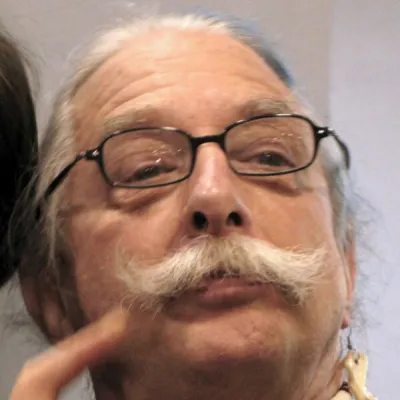
Patch Adams
Human Design Chart
Biography
A former mental patient himself who went back to school to become a doctor, Adams is founder of the Gesundheit Institute. He puts out a newsletter, "Achoo!" and is the author of two books, "House Calls: How We Can All Heal the World One Visit at a Time," and "Gesundheit: Bringing Good Health to You Through Complimentary Therapies, Humor, and Joy." He has been featured in countless newspaper article and a film about him, starring Robin Williams, was released in December 1998, "Patch Adams."
The younger son of a WW II Army officer who died in 1961 and his wife Anna, a schoolteacher who died in 1989, Patch does not remember how his nickname began in college. He grew up as an Army brat in Japan, Germany and the U.S. He was deeply shaken by his dad's death at 52 but it was his uncle's suicide in 1963 that pushed him into despair. He dropped out of school and made the first of several suicide attempts. He was 18 when his mom checked him into a mental ward at Fairfax Hospital in Virginia. He turned his own emotional corner by helping his roommate conquer hallucinations and a fear of squirrels. A few weeks later Adams left the ward and enrolled at the University in Washington DC. He became a conscientious objector to the raging Vietnam war.
Linda Edquist fell in love with that "incredibly charismatic person" in 1971 while volunteering at the same clinic where he worked in his final months of training. They moved in together the following year and married in 1975. Their son Atomic Zagnut (now known as Zag) was born in 1976, and Lars Zig in 1987.
Human Design Analysis: Patch Adams as Generator 2/4
Generator 2/4 — Design at a Glance
Patch Adams revealed himself as someone with remarkable endurance and the ability to provide energy over long periods. His design suggested a foundational structure that made him less of an impulsive initiator and more of a powerful responder. The mechanics behind this stance lie in his nature as a Generator: He had high, enduring sacral energy, similar to a strong workhorse that can only effectively deploy its strength when responding to external impulses.
For Patch Adams, the key to success was not constantly pushing projects forward from his own drive but waiting for signals from life and then reacting. When his inner center signaled a clear “yes,” he could release this energy and translate it into concrete actions. This led to a deep sense of satisfaction and fulfillment. Conversely, ignoring this principle – whether by forcing tasks without internal resonance or suppressing the urge to work on heart projects – quickly resulted in frustration and exhaustion. His strength lay in responding from his gut to what truly spoke to him rather than fighting against the current of his own nature.
Emotional Authority
Patch Adams exhibited an inner decision-making structure that required time as an indispensable factor; spontaneous impulses were misleading here. His inner authority resided in a defined Solar Plexus Center, meaning that feelings were not just accompanying phenomena but the actual compass for important decisions. This emotional authority follows a wave motion: moods permanently swing between enthusiasm and skepticism. What appears absolutely right at one moment can look completely different in the next, colored by another emotional tint. A quick decision captures only this fleeting snapshot, not the deeper truth.
Therefore, patience is required. Quick reactions based on current mood often lead to errors as judgment is still clouded by the intense wave of emotion. Patch Adams’ design suggested consciously letting decisions rest – “sleeping on it” was no delay but a necessary process step. Only when initial emotional heat subsided and repeated weighing took place did the waves subside. In this phase of calm, clarity and composure set in based on a more comprehensive understanding. This path through emotional ups and downs was the only reliable filter for long-term orientation.
The 2/4 Profile — Hermit / Opportunist
Patch Adams revealed himself as someone shaped by an inner rhythm that swung between a deep need for withdrawal and the urge towards community. His design suggested he needed time alone to gain internal clarity before re-engaging in his social network. This dynamic corresponds to Profile 2/4: Line 2 grants a selective stance and skillfulness but requires energy not to be perceived as cynical; line 4 brings leadership qualities through exemplary behavior and providing resources for the community.
For Patch Adams, it was crucial to create a safe environment where he could transparently communicate these needs – clearly signaling when he sought company or needed silence. In his “me-time,” he reflected on knowledge from his network, evaluated it, and developed new ideas. Only after satisfying the need for solitude did he return with renewed energy to his favorite people. This cycle allowed him to balance tensions between traditional leadership (line 4) and individual self-preservation (line 2). Through this conscious management of closeness and distance, he could live by his principles in everyday life and serve as an example without overburdening himself or slipping into cynicism.
Split Definition — Defined & Open Centers
Patch Adams was characterized by a massive, constant energy foundation. His defined Heart Center gave him self-determined presence and the drive to keep promises and be recognized for his contributions. This willpower was reinforced by the vital endurance of his defined Sacral Center; here, the necessity of reacting rather than initiating was required to avoid frustration. The also defined Solar Plexus Center functioned as emotional authority, meaning he had to wait out emotional waves before making decisions. His defined Spleen Center provided spontaneous intuition and protection in the 'now', while the defined Root Center delivered a constant pressure for movement.
This combination created a strong, self-responsible leadership personality. At the same time, open centers revealed situational receptivity. The open Head Center made him vulnerable to mental confusion and the attempt to answer questions that were not his own. Similarly, the open Ajna Center led to taking up concepts from the environment instead of having firm theories of his own. The open Throat Center meant that communication flowed through him spontaneously rather than being planned; he tended to feel a pressure to speak when he did not wait. Finally, the open G Center resulted in identity and direction being shaped by the environment; Patch Adams did not actively seek a fixed path but was initiated by places and people who showed him who he was at that moment.
Channels for focus, logic, community and maturation.
Patch Adams exhibited a deep, root-driven ability for intense focus and refinement. His design placed a calm, steady pressure to logically penetrate details and step-by-step improve patterns. This attitude arose from the Concentration Channel 52-9's format energy, which linked non-action (Gate 52) with focusing on facts (Gate 9). It kept him still to avoid distractions and precisely apply energy, influencing his entire design.
This concentrated work was supported by the juxtaposed Judgment Channel 58-18. It connected the drive for vitality (Gate 58) with the art of correcting (Gate 18). This combination ensured that he not only focused but also judged what was healthy or balanced to perfect patterns. Both channels originated from the Root Center, giving this energy a permanent, formative quality.
The concentrated analysis often found expression in interpersonal contexts, shaped by the defined Community Channel 37-40 of his design. This channel linked emotional clarity (Gate 37) with the willpower to make agreements (Gate 40). It embedded perfect work into relationships where emotional waves and mutual recognition played a role.
Additional nuances were provided by Gates 51 (Will Power/Shock), 54 (Success/Enlightenment), Gate 6 (emotional friction), and Gate 19 (resources). The Personality Sun in Gate 16 added that this refinement was often advanced through experimenting with new processes. Patch Adams identified with mutative changes, which he always subjected to logical scrutiny.
Collective Circuitry — Circuit Signature
Patch Adams exhibited a basic attitude that combined cool, future-oriented logic with emotional reflection on the past. His design suggested sharing rational insights free from conditioning and improving societal structures – an Understanding Circuit energy connecting Sacral, Root, and Spleen Centers. This 'emotionless ratio' contrasted with the Meaning-making Circuit, which processed and reflected emotions from the past in wave-like patterns; here, his Sacral and Root Centers were connected.
The split definition of his chart separated these energetic systems into two parallel groups: on one side, logical-strategic power (Sacral, Root, Spleen), on the other, emotional resonance between Heart and Solar Plexus Centers. The latter belonged to the Ego Circuit, which promoted cooperation and balance in giving and taking – concretely through Channel 37-40 between Heart and Solar Plexus. Since this circuit lacked a connection to the Sacral Center, there was no constant life force; instead, resource-oriented collaboration required necessary rest periods for recovery. Patch Adams' design thus presented a tension between strategic future planning and cyclical emotional learning, embedded in cooperative interaction with clear boundaries for energy preservation.
Right Angle Cross of Planning 2
Patch Adams demonstrated a pronounced ability to penetrate complex situations and develop strategic plans that extended far beyond the immediate horizon. His design inclined him towards long-term orientation, where he did not just focus on the here and now but grasped connections in their entirety.
This attitude stems from what is known as the right cross of Planning 2. In Human Design mechanics, this configuration represents a specific kind of strategic thinking. It enables one to look beyond the obvious surface of problems and recognize underlying structures. Those with this element tend to see solutions not just as short-term repairs but as part of a larger coherent whole.
This is an inner alignment that requires patience and foresight. Patch Adams could analyze situations by integrating various perspectives and fitting them into a meaningful overall plan. This helped him make decisions based on a well-founded insight into the nature of things, rather than just reacting. The mechanics support distinguishing the essential from the non-essential and focusing on goals that have lasting impact. Thus, an approach was formed that was both practical and visionary, allowing clear progress even in uncertain times.
Saturn Return · Uranus Opposition · Chiron Return · 2nd Saturn Return — Life Cycles
In 1972, at age 27, Patch Adams showed himself as someone who translated inner visions into concrete structures: the founding of the Gesundheit! Institute. This marked the beginning of his first Saturn Return cycle. This cycle describes the transition from an experimental youth phase to a stable adult identity with responsibility. During this period, internal values and ideals no longer exist merely as thoughts but are transformed into tangible structural realities. The establishment of the institute was not a random step but the direct result of this cyclical maturation. His design indicated that Patch Adams was now ready to anchor his personal convictions and use them as a solid foundation for future work. The Saturn Return acts here as a catalyst, condensing the groundwork of youth into a stable form. It is the phase where the individual learns to take responsibility for their own creations and sustainably carry them into the world. Through institutionalizing his ideals, Patch Adams created a framework that strengthened his values beyond personal action. This step signaled the end of a learning phase and the beginning of an era of consolidation and targeted development.
Generator · Emotional Authority — Synthesis
Patch Adams’ design reveals a central red thread of cyclic, profound engagement with experiences (Channel 53-42). His defined sacral energy (Sacral Center) and root (Root Center) provide the power for these processes, while his open G-Center (G Center) continuously recalibrates him to new influences. He is not fixated on a fixed identity but learns through repeated cycles of engagement, reflection, and adaptation – an ongoing process of maturation and development that allows him to realign himself repeatedly and grow. This ability to fully experience and gain wisdom from experiences shapes his actions and interactions with others.
A central paradox in his design lies in the tension between a need for community (Channel 37-40) and an inner necessity for individual reflection (Line 2). He is destined to form connections and maintain relationships, yet also requires phases of withdrawal and self-discovery. This interplay between social engagement and solitude demands clear communication of his needs to find balance – a constant dance between giving and taking, sharing experiences while preserving internal freedom.
4 Defined Channels
Incarnation Cross - Right Angle Cross of Planning 2
Solar Return
The Solar Return shows the moment when the sun returns to its exact birth position - your personal solar year.
Life Cycles
Discover the life cycles with a detailed triple view (birth chart, cycle chart, composite).
Human Design Profile
- Type
- Generator
- Strategy
- To respond - wait for something to respond to
- Authority
- Emotional Authority
- Profile
- 2/4 - Hermit / Opportunist
- Definition
- Split Definition
- Incarnation Cross
- Right Angle Cross of Planning 2
- Date of Birth
- 28.05.1945 20:15
- Place of Birth
- Washington, DC, United States
Frequently Asked Questions
What is Patch Adams' Human Design type?
What profile does Patch Adams have in Human Design?
Which authority influences Patch Adams' decisions?
Which incarnation cross is active for Patch Adams?
When was Patch Adams born?
Discover your own Human Design
Are you also a Generator? Find out in a personal reading how to use your sacral energy correctly and discover deep satisfaction.
More Personalities
Back to overviewAaliyah

Alain-Fournier
Alexia

Angèle

Angeli

Anne-Marie