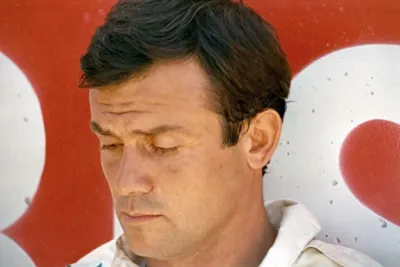
Patrick Tambay
Human Design Chart
Biography
Since retiring from full-time racing, Tambay worked as a commentator for French television. He also served as the deputy mayor of Le Cannet, a suburb of Cannes.
He was godfather to 1997 World Champion Jacques Villeneuve, while his son Adrien raced in the DTM championship between 2012 and 2016. After suffering from Parkinson's disease for several years, Tambay died on 4 December 2022 at the age of 73.
Patrick Tambay — Manifestor with Profile 6/2
Manifestor 6/2 — Design at a Glance
Patrick Tambay revealed himself as a pioneer and leader, whose design was predestined to lead the world into a new future. His Human Design type is the Manifestor, a configuration often compared to an emperor in ancient Rome: He had the vision of a great empire but did not wage the necessary wars and battles himself; instead, he sent others to conquer foreign lands for him. This role came with a specific pain body: Patrick Tambay was misunderstood because he often thought further ahead than his surroundings. His big dreams polarized people; some loved and followed him, while others disliked or even hated him due to these visions. For the right followership to find him, it was crucial that he informed others about his plans in a timely and precise manner. This formed the ideal strategy for his design. If Patrick Tambay followed this path of informing as well as his inner authority, he was rewarded with a feeling of inner peace. Conversely, if he lived against this design, he likely felt a persistent, deep-seated anger within him. His life energy worked best when he communicated clearly before acting to minimize resistance and effectively advance his visions.
Emotional Authority
Patrick Tambay's design showed a tendency towards emotional wave movement that significantly influenced his perception and decision-making. As the carrier of Emotional Authority, he was subject to constant ups and downs in his feelings; the world appeared colored by his current mood. In one moment, he could be totally enthusiastic about something, only to see it negatively in the next. His immediate feeling was merely a snapshot, an initial impression that did not necessarily represent his truth yet. Quick, spontaneous decisions based on such emotions often had negative consequences.
The mechanics of his inner authority required patience: The more time he took for a decision to mature, the deeper and more comprehensive could he see things. This involved sleeping over choices multiple times. He should take his time and ask himself several times. Over time, intense feelings subsided, emotional distance was gained, and clarity as well as calmness set in. Only then had he gone through the process. This rule applied regardless of what else was defined in his chart; the active Emotional Center always determined his inner authority. This process was crucial for long-term decisions that could have a significant impact on his life course. Through this delay loop, he secured himself enough distance to not act impulsively but choose from an emotionally stabilized clarity.
The 6/2 Profile — Role Model / Hermit
Patrick Tambay's design showed a tendency towards experimental behavior in youth, followed by a phase of intense withdrawal and reflection. Before the age of thirty, the sixth line acted like a third: Trial and error shaped his early experiences, with setbacks often providing reasons for temporary retreats. Around the age of thirty, the full dynamics of the 6/2 configuration ("Role Model / Natural Talent") were activated. Then there was a need for distance – metaphorically retreating to a "cave on the mountain." This period served healing and deep self-awareness by looking back at earlier experiments from a distance.
The mechanics of this line combine self-defense and humility (sixth line) with discernment and the polarity between serving and ruling (second line). Patrick Tambay learned to recognize weaknesses and drain them out, while simultaneously projecting what was most valuable to him. The second line of Gate 17 emphasized that true leadership rests on the ability to serve; those who wish to rule must first be able to serve. His shy side could transform into clear, outward authority. Once the introspective phase was complete, he emerged as a wise figure. Others sought him out to partake in his life wisdom and learn the skill of deep self-observation. Thus, his development followed the path from reckless experimentation through silent reflection to the recognized role of Role Model.
Single Definition — Defined & Open Centers
Patrick Tambay's design was characterized by a consistent, trustworthy mental function. His defined Ajna Center ensured that he always created concepts and theories in the same way; his mind was an ongoing process of data processing, acting as an external authority figure. This mental structure directly flowed into his communication: The also defined Throat Center allowed him to reliably express what he thought. His voice was not a mere impulse but rather the transformation of his conceptual clarity into words and actions.
Despite this cognitive stability, Tambay lived with a deep emotional wave. His defined Solar Plexus served as an inner authority; he had to exercise patience to achieve emotional clarity before making decisions. Impulsiveness here was the trap, as truth only revealed itself over time. This was complemented by his defined Spleen Center, which gave him spontaneous and intuitive body awareness. It provided trustworthy signals in the present moment that he could not rationalize but simply had to trust.
At the same time, Tambay was vulnerable to external conditioning in his open centers. His open Head Center tended to take on mental pressure and others' questions as its own problems, leading to confusion if he did not rely on his inner authority. The open G Center meant that he did not carry a fixed identity; he adapted to his environment and found direction only through correct places and initiations from the outside. Furthermore, in his open Heart Center, he lacked the consistent energy for willpower and promises, making him vulnerable to the pressure of having to prove his worth. His open Sacral Center absorbed the vital energy of the surroundings, which could lead to exhaustion if boundaries were neglected. Finally, his open Root Center took on external stress that he did not generate himself but amplified – a pressure he had to learn not to interpret as his own life impulse.
Channels for emotional depth, intuitive perfection and logical clarity.
Patrick Tambay's design tended towards emotionally driven expression, heavily dependent on his inner wave. The Openness Channel 22-12 connected his Solar Plexus Center with the Throat Center. This meant that his social interaction and articulation were not constant but determined by ebbs and flows of his mood. He had the ability to achieve emotional impact through the quality of his voice, yet only when he felt like it. Coercion led him to harshness; patience allowed him to deeply touch others and create transformative moments. His openness was thus not a constant offer but a mutative potential that unfolded in the right moment of mood.
Alongside this emotional dynamics, Patrick Tambay exhibited a deep, instinctive search for perfection. The Wavelength Channel 48-16 connected his Spleen Center with the Throat Center. Here, Gate 48 constantly sought life-critical information and intuition, while Gate 16 transformed these insights into technical skill through repeated experimentation and practice. This mechanism described the path from intuitive depth to masterful control of a skill. Talent did not arise out of nowhere for him but through the connection of inner intelligence with outer precision. Recognition and resources were essential to maintain this process of refinement.
Furthermore, his thinking was marked by a need for logical order. The Accepting Channel 17-62 connected Ajna Center with Throat Center. Gate 17 visualized patterns while Gate 62 translated these into detailed language. Patrick Tambay mentally organized information to understand and accept it. Anything that did not logically fit into his inner system remained incomprehensible for him. This gave him the gift of clearly explaining complex connections and teaching, provided he was invited to speak. The combination of emotional openness, technical perfectionism, and logical structuring formed his unique way of communicating and interacting with the world.
Collective Circuitry — Circuit Signature
Patrick Tambay's design combined rational analysis with emotional authenticity. As a simply defined person, he had a coherent energetic flow between Throat, Solar Plexus, Spleen, and Ajna Centers. This unity allowed him to directly translate logical strategies into authentic expression.
The Understanding Circuit shaped his mental attitude. Through the channels 'Accepting' (Gates 17/62) and 'Wavelength' (Gates 48/16), he connected Ajna, Throat, and Spleen Centers. This created a focused visual intelligence that sought logical connections free from conditioning. Patrick Tambay used this energy to structure rational insights and strategically apply them for future improvements. The connection to the Spleen gave him an instinct for what is essential, while the Ajna channel provided analytical depth.
Parallel to this, the Knowledge Circuit worked through the 'Openness' Channel (Gates 12/22). It directly connected Throat and Solar Plexus Centers. This generated a pulsating acoustic energy that responded to emotional waves. Patrick Tambay expressed his unique identity by not only thinking new insights but also articulating them through his body into words. The inspiration from this field supported him in initiating changes through personal expression.
Both circuits converged at the Throat Center. Here, cold logic of the mind merged with warm emotion of knowledge. Patrick Tambay was someone who did not just understand complex ideas but communicated them with a deep, individual resonance. His design promoted clear, strategic communication that was always driven by inner truth and thus embarked on new paths of self-expression.
Left Angle Cross of Prevention 1
Patrick Tambay's Human Design suggests a tendency towards precautionary action. He was someone who recognized potential risks early on and took measures before problems became acute. This approach stemmed from the influence of his left preventive cross 1 in his chart, fostering a deeply rooted need for security and stability through foresight planning. Instead of reacting to crises, he sought ways to prevent or mitigate them proactively. His energy was directed towards creating structures resilient against unexpected adversities. This did not necessarily mean fear of the future but rather a pragmatic attitude: preparation was key to success and maintaining his achieved status. In his lifestyle, this mechanism shaped a style focused on avoiding errors and optimizing existing processes. Patrick Tambay used his intuitive ability to identify weaknesses to develop proactive solutions. This approach often gave him control over his environment by minimizing surprises. The underlying dynamic was one of protection – both from external dangers and internal uncertainties. Through this preventive strategy, he could create stability in areas that would otherwise be chaotic or unpredictable. His focus always lay on securing results and minimizing losses through clever foresight.
Saturn Return · Uranus Opposition · Chiron Return · 2nd Saturn Return — Life Cycles
Patrick Tambay's Human Design indicates a tendency towards structural anchoring, particularly evident during phases of maturity and consolidation. He lived as someone who defined his position through consistency and clear boundaries, focusing on building something lasting. This attitude became concrete in 1977 at the age of 28: His first Formula-1 race in Silverstone marked the beginning of his career at the highest level. For his Human Design, this was a typical moment of Saturn Return. This cycle condensed years of groundwork into a solid result and established a new stable foundation for further development. The mechanics of this return promoted the ability to take responsibility and create structures beyond short-term impulses. Patrick Tambay used this energy to secure his place in Formula 1 as an expression of his inner need for validation through performance and presence. Saturn Return here did not act as a limitation but rather as a catalyst for realizing his potential in competitive sports. His response to this challenge underscored the connection between personal discipline and external recognition, a pattern that shaped his further path.
Manifestor · Emotional Authority — Synthesis
Patrick Tambay was a Manifestor whose life was marked by an internal tension between the drive to lead and the necessity of emotional maturity. His defined Ajna Center indicated a persistent way of thinking that created concepts and inspired others – a King who developed visions (Manifestor type). This ability for conception was strengthened by the open channel 22/12, which combined emotional expressive power with a certain caution, making him particularly effective in interactions with mutative potential.
The profile as role model and natural talent points to a cycle of experimenting and reflecting; the first decades of his life were characterized by trying out things followed by an intense phase of self-reflection. This development corresponded with his emotional authority, which required a deep processing and maturing of decisions – an inner wave that forced him to process experiences and draw wisdom from them (emotional center). Thus, a tension field emerged between the impulsive pioneer and the necessity to take time for emotional clarity.
3 Defined Channels
Incarnation Cross - Left Angle Cross of Prevention 1
Solar Return
The Solar Return shows the moment when the sun returns to its exact birth position - your personal solar year.
Life Cycles
Discover the life cycles with a detailed triple view (birth chart, cycle chart, composite).
Human Design Profile
- Type
- Manifestor
- Strategy
- To inform others before acting
- Authority
- Emotional Authority
- Profile
- 6/2 - Role Model / Hermit
- Definition
- Single Definition
- Incarnation Cross
- Left Angle Cross of Prevention 1
- Date of Birth
- 25.06.1949 12:00
- Place of Birth
- Paris, France
Frequently Asked Questions
What is Patrick Tambay's Human Design type?
What profile did Patrick Tambay have in Human Design?
Which authority guided Patrick Tambay?
What incarnation cross was assigned to Patrick Tambay?
When was Patrick Tambay born?
Discover your own Human Design
Are you also a Manifestor? Find out in a personal reading how to use your initiation power peacefully and dissolve resistance.
More Personalities
Back to overviewChristian-Jaque
Kesha

Laurent-Eynac
Lucebert
Masaccio
Papus