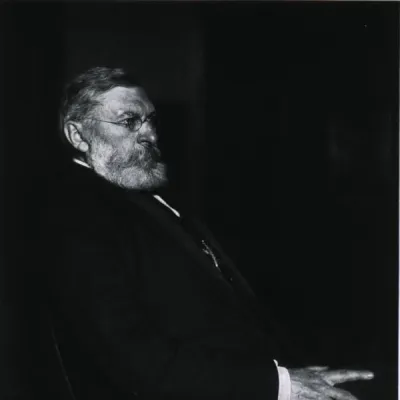
Paul Flechsig
Human Design Chart
Biography
The Human Design of Paul Flechsig: Projector 4/6
Projector 4/6 — Design at a Glance
Paul Flechsig revealed himself as someone with a dense, focused aura that strongly influenced his surroundings. As a Projector, he did not have a constant internal energy source but worked in phases of high intensity followed by necessary rest periods for regeneration. His design predisposed him to immediately recognize systemic errors – similar to a flashlight uncovering darkness. Direct confrontation with these insights would often have provoked resistance. Instead, he was most effective through his own harmony and clarity, which naturally drew others and prompted them to seek advice. The central strategy involved waiting for honest invitations from the environment before sharing his knowledge. This protected him from overexertion and ensured appreciation of his contributions. If he did not live up to this orientation, bitterness emerged as a primary non-self-experience. In alignment with his design, however, he was rewarded for his precise leadership. His undefined Sacral Center meant that he drew energy from interaction and recognition rather than producing it independently. This dynamic required selective dedication: Only where he was invited could he fully unleash his potential without burning out. Thus, his ability to illuminate others' paths was not a constant act of effort but a targeted use of his focused perception at the right places and times.
Emotional Authority
Paul Flechsig displayed a fundamental attitude of emotional patience. His inner authority lay in his defined Emotional Center, meaning he could never make decisions immediately or should not do so. His design marked him by wave-like mood swings: In one moment, he felt enthusiastic about something, only to see the same situation negatively in the next. These feelings were merely transient impressions, not ultimate truth. Spontaneous reactions to these initial impulses would often have led him astray. Instead, he needed time to gain clarity. He let decisions mature overnight, consciously delayed action and asked himself multiple times before acting. This process served to allow intense emotions to subside and create emotional distance. Only when this wave subsided did calmness set in and the true nature of the situation became visible. For him, this strategy of waiting was essential, especially for long-term life decisions with significant consequences. Through conscious delay, he protected himself from misjudgments arising from temporary moods. His path to the right answer always led through distancing from immediate emotional reactions to a calm, thoughtful perspective.
The 4/6 Profile — Opportunist / Role Model
Paul Flechsig's design was characterized by a fundamental inner conflict: the tension arc between the deep desire for community and the wish for detached wisdom. In his first thirty years, before Saturn returned, his sixth profile line still appeared like a third one. This led him to experiment intensively in his youth, particularly in the realm of relationships and friendships, driven by the social energy of the fourth line.
Once the sixth line became active, a characteristic dilemma emerged. On one hand, Paul Flechsig sought connection with the collective; on the other hand, he was drawn back onto a metaphorical mountain to ponder the meaning of life. His life thus revolved around the friction between heart and head. The fourth line in Gate 52 demanded absolute self-discipline and silence, yet stood in opposition to social activity that maintains connections. Doubts generated by Jupiter had to be carefully managed here to avoid undermining trust.
In his later years, he was expected to serve as a wise role model. The sixth line in Gate 17 represented perfected leadership and succession, akin to the stance of a Bodhisattva who only speaks when asked. This configuration described the end of personal learning towards collective responsibility. Paul Flechsig's great heart remained cautious throughout; it did not open indiscriminately to avoid being hurt by false people. His task was to navigate this discrepancy between social engagement and inner distance without sacrificing necessary self-discipline.
Split Definition — Defined & Open Centers
Paul Flechsig was characterized by a persistent mental activity that asked questions and formed concepts. His defined Head and Ajna Centers generated a constant pressure to understand; he was not designed to implement these ideas directly himself, but rather to offer them as inspiration. At the same time, he possessed deep emotional authority through his defined Solar Plexus Center. His truth did not reveal itself in the moment but only after experiencing an emotional wave. Patience was essential for him to gain clarity and prevent impulsive decisions. His defined Spleen Center allowed him to react intuitively to signals here and now, supporting his well-being and health. The defined Root pressure gave him endurance to move forward in the world.
In contrast, Paul Flechsig was vulnerable to conditioning through several open centers. His open Throat Center tended to feel pressured to seek attention or speak inappropriately; however, he learned to wait for an invitation to speak. The open G Center meant that he did not carry a fixed identity but needed to be initiated by relationships and places to find his direction. He often questioned whether he was at the right place rather than taking on a role himself. His open Heart Center was not designed for consistent willpower; he avoided making promises or proving his worth through competition, as this led to self-doubt. Finally, his open Sacral Center meant that he did not possess constant generative energy. He tended to overextend himself on borrowed energy from others and had to learn to set boundaries and rest rather than work continuously.
Channels for logic, judgment and emotional recognition.
Paul Flechsig was characterized by a mind that used skepticism as a tool to examine patterns. The Logic Channel 63-4 connected the Head and Ajna Centers; here, doubt filtered persistently for consistency until questions demanded answers. This mechanism created an attitude that rejected unfounded beliefs and only accepted functioning, verifiable structures.
Another defining element was his drive for correction. The Judgment Channel 58-18 connected Root with Spleen Center. Gate 58 drove the insatiable impulse to be better and more, while Gate 18 restrained this through correction. Paul Flechsig thus judged whether patterns were joyful for the collective or needed adjustment. His logic served the control of patterns to ensure satisfaction.
Emotionally and energetically, the Recognition Channel 30-41 was at work. It connected Root with Solar Plexus. The pressure from Gate 41 generated restlessness and fantasy scenarios that were intensified by the emotional wave of Gate 30. This created a strong desire for new experiences but required patience to gain clarity.
Additionally, specific Gates influenced him: Gate 52 demanded silent concentration for pattern correction; Gate 17 organized for the future based on service and doubt; Gate 48 recognized deep connections but often remained stuck in theory. Gate 61 sought inner truth through thought mutations. In his design, Gate 57 promoted intuitive clarity here and now, Gate 6 fostered biological evolution through friction, and Gate 37 supported organic community structures and support. These configurations shaped a person who navigated between logical scrutiny, emotional intensity, and intuitive perception.
Collective Circuitry — Circuit Signature
Paul Flechsig's design tended towards rational analysis, which manifested in two separate, non-directly connected streams. As Shared Definitions, these forces existed parallel to each other without forming a common energetic flow. The Understanding Circuit connected the Head with Ajna Center (Head-Ajna), describing a capacity for logical structuring and strategic future orientation. Parallel to this, the same circuit linked Spleen and Root Centers in him, signaling an instinctive judgment of essentials—always free from emotional influence.
Independently, the Meaning-Finding Circuit worked through the connection between Solar Plexus and Root Center. Here it was not about cold ratio but a cyclical process of learning emotionally from the past. Thus, Paul Flechsig appeared as someone who formulated logical insights for the future on one hand, while also experiencing deeper emotional waves to reflect upon and grasp the meaning of past experiences. These two aspects—the rational projection forward and the emotional processing backward—shaped his inner self as separate, independent mechanisms each with their own dynamics without directly driving or disturbing each other.
Right Angle Cross of Service 2
Paul Flechsig's design was characterized by the configuration 'The Right Cross of Service'. This structure established a fundamental orientation towards support and care, often linking one's own well-being with the benefit for others. It wasn't abstract selflessness but rather a specific energetic mechanism: The power to act primarily arose when it was put into service for a larger community or a concrete individual.
In this pattern, there was a tendency to set aside personal needs as long as the focus remained on helping. The design created an internal logic where fulfillment and validation were predominantly found through working for others. It wasn't a passive stance but rather an active impulse towards support that was closely tied to the context of service. Without this reference point, energy could become scattered or inefficient. Paul Flechsig thus moved within a dynamic in which 'I' was always defined in relation to 'We' or 'Other'. This orientation significantly shaped his interactions and decisions as it provided a framework for meaningful action.
Saturn Return · Uranus Opposition · Chiron Return · 2nd Saturn Return — Life Cycles
Paul Flechsig's design inclined towards structured, intellectually grounded achievements. In 1875, at the age of 28, he habilitated with a work on the nerve tracts in the human brain and spinal cord. For his Human Design, this was a typical moment: the first Saturn Return marks often the point where years of groundwork condenses into a solid, public result. The energy of this cycle demands endurance and discipline to pour inner convictions into external structures.
Later, another development line became apparent: In 1894, at age 47, Paul Flechsig led the University of Leipzig as rector. This fell within the period of Chiron Return (around 49-51 years), a fulfillment cycle. Within Human Design mechanics, this is not a phase of mythological wound healing but rather a 'bloom', in which one's incarnation cross unfolds. If the person has followed their strategy and authority, here the inner purpose becomes experiential and visible. Paul Flechsig's assumption of this leading position reflects this deepening: Life was not only lived but shaped and represented according to the design. The mechanics show how personal integrity transitions into societal responsibility when the internal structure is mature enough to carry it.
Projector · Emotional Authority — Synthesis
Paul Flechsig was a Projector whose life was marked by a profound drive to recognize patterns and shed light on darkness (Channel of Logic: Gate 63-4). This ability to penetrate other systems' functioning showed in his work and thinking – he constantly sought connections and structures to gain understanding. Emotional authority, however, required time for feelings to mature, creating an internal conflict between the immediate perception (Projector) and the need for considered decisions.
This tension field between immediate perception and emotional maturation shaped his lifestyle. The profile as a Networker/Role Model suggests he longed for connection (Line 4), while Line 6 simultaneously inclined him towards independent thinking and some distance. The repeated professional peaks (habilitation, rectorate) showed how he lived this paradox: by sharing knowledge and creating structures but always focusing on his own inner truth.
3 Defined Channels
Incarnation Cross - Right Angle Cross of Service 2
Solar Return
The Solar Return shows the moment when the sun returns to its exact birth position - your personal solar year.
Life Cycles
Discover the life cycles with a detailed triple view (birth chart, cycle chart, composite).
Human Design Profile
- Type
- Projector
- Strategy
- Wait for the respectful invitation
- Authority
- Emotional Authority
- Profile
- 4/6 - Opportunist / Role Model
- Definition
- Split Definition
- Incarnation Cross
- Right Angle Cross of Service 2
- Date of Birth
- 29.06.1847 19:07
- Place of Birth
- Zwickau, Germany
Frequently Asked Questions
What was Paul Flechsig's Human Design type?
What profile did Paul Flechsig have?
What authority did Paul Flechsig possess?
What incarnation cross did Paul Flechsig have?
When was Paul Flechsig born?
Discover your own Human Design
Are you also a Projector? Find out in a personal reading how to unfold your leadership qualities and recognize the right invitations.
More Personalities
Back to overviewSissy Spacek

Alain-Fournier

Anémone

Ann-Margret

Bourvil
Hergé