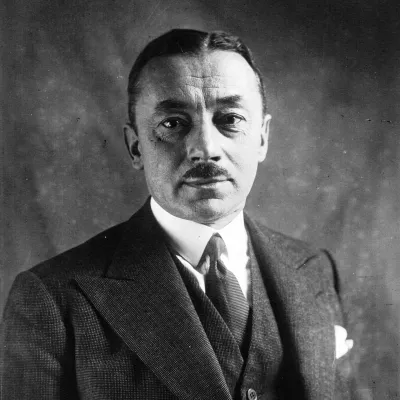
Paul Reynaud
Human Design Chart
Biography
On 21 March 1940, he was made President of the Council and Minister of Foreign Affairs. Within three months, due to political stress, Reynaud resigned on 16 June 1940. He was arrested in September by Pétain's government and sentenced to life in prison in October 1941. With the Allies' victory, he was released in 1945 and became one of the main witnesses against Pétain at the Marshal's trial.
Reynaud died on 21 September 1966, Neuilly-sur-Seine, France.
Paul Reynaud as a Projector 2/4 in Human Design
Projector 2/4 — Design at a Glance
Paul Reynaud's design inclined towards precise system analysis. As a Projector, he did not have a constant intrinsic energy source but rather acted like a focused flashlight: He immediately saw where there were failures or "dark spots" in his environment or within other structures. This ability to identify errors in the system was his core characteristic.
The challenge lay in the nature of communication. When he addressed these deficiencies directly, it often felt like glaring light to those around him – uncomfortable and confrontational. His design showed that direct criticism quickly provoked resistance. A more elegant strategy for him was to attract others through his own harmonious actions so they would inquire about his insights on their own. His best tactic involved waiting for a respectful and honest invitation before he offered his knowledge or leadership.
Without this recognition, his system tended to lose energy. Since Projectors must alternate phases of high activity with necessary rest periods to avoid burning out, external validation was crucial for his endurance. Living by the principle of invitation and waiting led to successful rewards. Ignoring this strategy and trying to work against the current or lead without consent often resulted in bitterness – the typical non-self theme of this type internally. His influence thus directly depended on whether his environment actively sought his leadership.
Self-Projected Authority
Paul Reynaud's design laid an extreme openness that made him vulnerable to distraction by external motoric energies. As a Projector with the rare authority in Self, his greatest danger lay in losing himself in this receptivity and constantly chasing after energy. His inner truth did not lie in thinking but in his identity. Decisions came to him in two ways: through spontaneous expressions – whether in self-talk or invited dialogues – or through a physical pull towards a specific geographic or thematic direction. Crucial was the distinction between the spontaneous expression of his true essence and the considerations of the mind. Only the unreflected, that which came without thinking, revealed his uniqueness. By following this inner guidance, he became recognizable to others and could act as a directional guide. His specific potential for success showed where he remained loyal to his own direction rather than being overwhelmed by surrounding activity. This mechanism required him to listen to himself in order to separate the voice of Self from that of the intellect.
The 2/4 Profile — Hermit / Opportunist
Paul Reynaud's design suggests a tendency towards oscillating needs between deep withdrawal and close social exchange. As a person with Profile 2/4, he constantly fluctuated between two fundamental needs: Line 2, which demanded solitude and ascetic processing, and Line 4, which sought community and contact with familiar people. This tension shaped his daily life; he needed secure moments to retreat into his "cave" undisturbed, where he clarified internal processes and organized details. Only when this inner calm was satisfied did he return to his network to share insights.
The second line in his configuration projected an expectation outward regarding control and finances without always recognizing his own uncertainty. This could lead to frustration if this projection did not mature. Simultaneously, the fourth line demanded patience: it waited for the right moment to express orderly details. If Paul Reynaud was pulled too early out of his ascetic phase, corrections and unrest threatened. His path involved clearly communicating when he sought company and when he needed silence. In this balance, he could reflect on the knowledge of his network in solitude and develop clear strategies from it rather than being overwhelmed by the conflicting demands of both lines.
Split Definition — Defined & Open Centers
Paul Reynaud's design indicated a tendency towards constant mental pressure and a firm internal identity. The definition between Head Center and Ajna Center created a persistent impulse to question and form concepts. This was not an arbitrary activity but a structurally anchored thought process that predisposed him to stand under the pressure of inspiration – often accompanied by uncertainty, as ideas initially appeared only as questions. His defined G Center gave him a stable self-identity and a clear sense of direction. He possessed the ability to show others paths without being dependent on their expectations. This combination of mental sharpness and inner compass allowed him to penetrate complex connections and communicate them with a certain constancy, since his Throat Center was also defined.
At the same time, his design revealed specific vulnerabilities. His open Heart Center meant that he did not have a constant source for willpower. He tended to confront himself later on with the feeling of failing to keep promises or meet others' expectations – a classic pattern of an open heart trying to prove worth through performance rather than simply possessing it. His open Sacral Center made him susceptible to the energy of his environment; he could easily overload by taking in foreign vitality and understanding it as his own, leading to exhaustion if he did not pause. Additionally, his open Solar Plexus absorbed the emotions of those around him. This led him to fluctuate between excitement and depression without always clearly distinguishing which feelings were truly his and which he was merely reflecting. These opennesses required him not to fall into the cycle of constant proof or emotional over-identification but rather to make decisions from his inner authority instead of reacting to external pressure or emotional waves.
Channels for logical leadership, reflection and inner clarity.
Paul Reynaud's design indicated a tendency towards collective, logical leadership. The Alpha Animal Channel 7-31 connected G Center with Throat Center. Gate 7 provided the role of 'power behind the throne', while Gate 31 acted as a collective leader. This configuration required Paul Reynaud to gain his authority through tested patterns and be invited by the majority for leadership. His authority was not based on sole rule but rather understanding existing societal trends and logically guiding them.
Parallel to this, profound reflective ability showed through the Lost Son Channel 13-33. Here too, G Center connected with Throat Center. Gate 13 gathered information and secrets while Gate 33 urged withdrawal and patient observation. Paul Reynaud had to let experiences fully ripen before passing them on as wisdom. This created a tension between the need for immediate logical leadership (Channel 7-31) and the desire for delayed, reflective truth (Channel 13-33).
Mentally, he was marked by the Channel of Awareness 61-24. It connected Head Center with Ajna Center. Gate 61 brought spontaneous inspiration and 'white noise', while Gate 24 rationalized until sudden knowledge ('Satori') appeared. Paul Reynaud could not control his thinking; he had to wait for inner truth to reveal itself.
Additionally, Gates like Gate 32 (Continuity, material success), Gate 42 (Completion of processes) and Gate 62 (logical pattern recognition) were at work. These elements underscored a focus on stability, detailed fact-checking and ending old cycles. Paul Reynaud's challenge lay in unifying the patient collection of Channel 13-33 with the urgent logical demand of Alpha Animal without being overwhelmed by the uncontrollable mental knowledge of Channel 61-24. His design showed someone who could only successfully exercise leadership when he received an invitation from the community and based his decisions on mature, collected experiences.
Collective Circuitry — Circuit Signature
Paul Reynaud's design indicated a tendency towards isolated, not directly connected energetic islands. As a person with split definition, he possessed two separate power centers: one connecting Head Center and Ajna Center, the other linking Throat Center with Identity Center. These areas did not flow into each other; they existed as parallel, independent forces in his system.
In the Knowledge Circuit, only Channel 24-61 (Awareness) was active for Paul Reynaud. This connected Head Center with Ajna Center and promoted innovative flashes of insight along with the ability to transform new knowledge. It was about expressing a unique identity through creative impulses that remained emotionally unconnected since Solar Plexus Center was not involved.
Parallel to this, in the Understanding Circuit, Channel 31-7 (The Alpha Animal) was present for Paul Reynaud. This connected Throat Center with Identity Center and drove the will to strategically carry logical insights into the world. This energy aimed at future-oriented structuring free from emotional influence since Solar Plexus Center was absent here too.
Similarly structured was the Meaning Circuit with Channel 33-13 (The Lost Son). It also connected Throat and Identity Centers but focused on the past. Paul Reynaud cyclically reflected recurring emotional waves to learn from earlier experiences and share these insights with the collective. Both lower circuits utilized the same channel flow (Throat-Identity), yet their themes – rational future versus emotional past – remained energetically separate from the creative impulses in Head-Ajna area.
Right Angle Cross of Maya 3
Paul Reynaud's design featured a specific and often perceived as fateful structure: the right cross of the Maya. This configuration did not establish a general life philosophy but defined an extremely narrow, non-negotiable focus. It described a person whose entire energy and attention was concentrated on one clear goal or theme. Everything else receded into the background; distractions were barely tolerable for this design as they disturbed the necessary intensity of dedication.
In Human Design, the right cross marks a 'needle eye' situation. It's not about exploring many paths or being flexible but rather following one path with absolute consequence. This focus was no everyday choice but a structural necessity of the system. Those who followed this pattern often appeared as someone unshakable in their field, yet also inflexible, since any deviation from the core goal was felt as a threat to their own integrity. The power of this design lay in this radical reduction: by limiting himself to what mattered most, Paul Reynaud could achieve depth and penetrating force that broader personalities often lacked. It was a design of ultimate specialization where success was only possible through total dedication to one point.
Saturn Return · Uranus Opposition · Chiron Return · 2nd Saturn Return — Life Cycles
Paul Reynaud's design indicated a tendency towards structured milestones that solidified through external validation and public recognition. This configuration is often seen as a life rhythm in which inner maturity corresponds with visible career stations. In 1908, at the age of 30, he was admitted to the bar – a typical moment for the first Saturn return when years of groundwork often condense into a viable result and personal authority is strengthened through formal recognition.
Later, his chart showed a phase of expansion and transformation driven by the necessity to take on new roles in public life. This was reflected in 1919 when he was elected at age 41 for his home department Basses-Alpes into the National Assembly. This event coincided with the Uranus opposition, a cycle often marking sudden changes or entry into new, more responsible positions. For Paul Reynaud, this meant transitioning from individual practice to political representation, where the mechanics of the chart here focused on integrating new tasks into existing life structures. Both events underscore a pattern: significant life turning points for him did not manifest solely as internal reflection but through concrete, external stations of vocation and responsibility.
Projector · Self-Projected Authority — Synthesis
Paul Reynaud was a projector whose life was marked by a deep ability to recognize the potential and weaknesses of others (Projector Type, Gate 7). This gift went hand in hand with the necessity to express himself authentically – through self-dialogue or exchange with others – to find his inner truth (Authority in Self). The defined Mental Center amplified this internal pressure, constantly questioning and seeking understanding.
This process unfolded in a constant interplay between the need for withdrawal and the longing for community (Profile 2/4), generating tension. He sought clarity in solitude to then inspire others with his insights – a pattern evident in documented career events (Saturn Return, Uranus Opposition). Reynaud thus lived a dynamic where his ability to shed light on darkness was inseparable from his own need for inner reflection and authentic expression.
3 Defined Channels
Incarnation Cross - Right Angle Cross of Maya 3
Solar Return
The Solar Return shows the moment when the sun returns to its exact birth position - your personal solar year.
Life Cycles
Discover the life cycles with a detailed triple view (birth chart, cycle chart, composite).
Human Design Profile
- Type
- Projector
- Strategy
- Wait for the respectful invitation
- Authority
- Self-Projected Authority
- Profile
- 2/4 - Hermit / Opportunist
- Definition
- Split Definition
- Incarnation Cross
- Right Angle Cross of Maya 3
- Date of Birth
- 15.10.1878 06:00
- Place of Birth
- Barcelonnette, France
Frequently Asked Questions
What was Paul Reynaud's Human Design type?
What profile did Paul Reynaud have in Human Design?
What authority did Paul Reynaud possess?
What incarnation cross did Paul Reynaud have?
When was Paul Reynaud born?
Discover your own Human Design
Are you also a Projector? Find out in a personal reading how to unfold your leadership qualities and recognize the right invitations.
More Personalities
Back to overviewSissy Spacek

Alain-Fournier

Anémone

Ann-Margret

Bourvil
Hergé