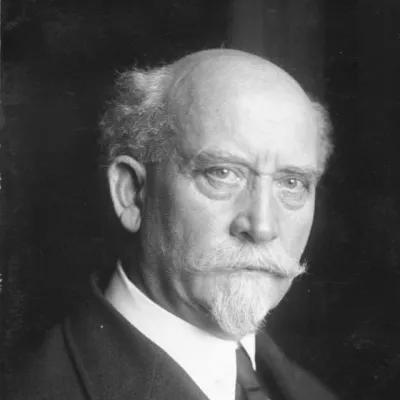
Philipp Scheidemann
Human Design Chart
Biography
A journalist and (from 1903) member of the Reichstag for the Social Democrats, Scheidemann joined the majority of his party in supporting Germany’s participation in World War I. Toward the war’s end, he was appointed minister without portfolio in the last imperial cabinet (October 1918). Although the Social Democrats had planned to support a constitutional monarchy in Germany, Scheidemann’s proclamation of a republic, made in the face of leftist uprisings, was irreversible. From November 1918 to February 1919 he served on the six-member ruling council of the interim republican government. After serving as first chancellor (February–June 1919) of the Weimar Republic, he resigned rather than give his assent to the Versailles Treaty. Serving subsequently as mayor of Kassel (1920–25), Scheidemann maintained an outspoken opposition to all government attempts at accommodation with the military and with reactionary parties. In 1922 an attempt to assassinate him miscarried. He emigrated from Germany at the beginning of the National Socialist period (1933)
He died 29 November 1939, Copenhagen.
Human Design Analysis: Philipp Scheidemann as Manifesting Generator 2/5
Manifesting Generator 2/5 — Design at a Glance
Philipp Scheidemann's design shows a tendency towards hybrid energy: He possessed the constant power of a Generator, yet also had Manifestor traits. This configuration allowed him to skip steps when taking action and quickly draw results into his life. However, this speed carried risks. If he moved too fast, he would miss important stages, leading to having to backtrack later to fill in missing pieces. This could cause frustration as the non-self theme of the Manifesting Generator often roots in such feelings. Furthermore, his design tended to pursue multiple projects simultaneously by reacting to different impulses. Without inner consent, this creative drive could quickly turn negative. The strategy was not to initiate himself but to respond to external stimuli and only start when the sacral center gave a clear 'yes'. With proper application of this reactive tactic, he could draw deep satisfaction from his work. Variety was no obstacle for him; it was necessary to enter a productive play mode and use his energy effectively.
Sacral Authority
Philipp Scheidemann's design shows a tendency towards direct physical resonance. As a Generator, he had sacral authority, which simplified his decision-making process: strategy and inner guidance merged here. This configuration requires an open emotional center to avoid being misled by passing moods. Scheidemann responded to external stimuli with a clear 'gut feeling'—noticeable through bursts of energy or vocal sounds like grunts or affirmations. When his sacral motor kicked in, he felt vital and had inexhaustible energy that allowed him to engage enthusiastically in activities without needing an external purpose. If the spleen center was activated or directly connected to the sacral center, it served as supporting authority. This gave him the ability for especially quick and spontaneous reactions and immediate access to instinctive perception of his physical well-being, which he could reliably follow. This mechanism shaped how he moved through life: with joy in the activity itself and a deep connection to the physical moment of 'now'.
The 2/5 Profile — Hermit / Heretic
Philipp Scheidemann's design shows a tendency towards an ambivalent role: He was someone who needed both deep withdrawal as well as being sought out from outside for solutions. This Profile 2/5, the 'Natural Talent' or 'Hero and Savior', created an internal conflict between the need for solitude (Line 2) and the expectation of others to help immediately (Line 5). Scheidemann had to carefully weigh where he wanted to invest his energy so as not to forget himself.
His natural leadership ability came from Gate 31, Line 2. This position gave him the power to lead the collective but required development to avoid being perceived as a 'paper tiger' or arrogant. Acting without regard for collective consent risked corruption and loss of authority.
At the same time, Gate 27, Line 5 showed his ability to manage foreign resources effectively in times of crisis. This Jupiter energy allowed him to offer practical solutions and take responsibility for other means. However, this position was limited by Saturn: Without fulfilling these responsibilities, he risked losing power and accusations of fraud. Scheidemann's challenge lay in using his alone time to clearly define when he could act as a hero without endangering his own foundation or risking a negative reputation. His strength lay in the balance between withdrawal for self-preservation and engagement for others' welfare in crises.
Split Definition — Defined & Open Centers
Philipp Scheidemann's design inclined towards clear, strong-willed communication. His defined Throat Center acted as a focal point for messages; it transformed information into speech and action. Linked with the also defined Heart Center, he spoke from a position of 'I want'; this configuration gave him the strength to make promises and keep them, bolstering his self-esteem. He enjoyed being successful and using his willpower to provide for family and community.
As a Generator, he had a defined Sacral Center, a source of immense vitality. His energy was not available for mental initiatives but responded to external stimuli with a yes or no tone. This protected him from overexertion and frustration as long as he waited rather than initiated. His defined Spleen Center provided spontaneous intuition in the present moment; it delivered trustworthy judgments about health and well-being that he could not rationalize, yet had to follow to remain safe.
At the same time, Philipp Scheidemann was vulnerable to conditioning in other areas. His open Head Center lacked a consistent way of processing mental information; it tended to be overwhelmed by doubts and confusion from others or seek inspiration that wasn't his own. The open Ajna Center meant he absorbed concepts and opinions from the environment without needing to identify them as personal truth. His open G Center lacked a firm identity; he often adapted to those around him or sought direction through external initiations. Additionally, his open Solar Plexus absorbed foreign emotions and his open Root Center took on external stress, leading to cycles of taking on pressure and trying to release it.
Channels for ambitious leadership and caring preservation.
Philipp Scheidemann's design inclined towards authoritarian responsibility in material matters. The Money Line channel 21-45 connected his Heart with the Throat Center, shaping a will for control and a need for independence. He showed himself as someone who wanted to work hard but was only successful when he could set his own rhythm. This channel demanded balance between work and rest; Gate 21 sought control to protect the heart while Gate 45 claimed the final word on resources. Scheidemann had to learn to take responsibility without overloading himself or wanting to overly control others.
Simultaneously, the Preservation channel 27-50 between Sacral and Spleen Center was active. This connection conveyed an aura of trust and the ability to protect the family through care and traditional values. Gate 27 provided selfless support while Gate 50 watched over stability and laws. Scheidemann was inclined to take responsibility for others but had to always check if his own energy sufficed to carry this burden. Only through proper self-management could he sustainably provide.
Additionally, further gates shaped his orientation: Gate 31 emphasized the transmission of leadership and identity in the collective. Gate 41 propelled evolutionary changes often accompanied by crisis phases while Gate 28 evaluated risk in the here and now. In the background, Gate 42 with its focus on completion processes, Gate 29 with its persistence in saying yes, and Gate 40, which traded work only for recognition and recovery, were active. Gate 26 enabled him to implement innovations by convincing the conservative family. The design gates 3, 23, 12, and 32 added mutation, individual creativity, and a drive towards material continuity. This constellation created a person navigating between authoritarian leadership and caring preservation, always striving to create order out of confusion and secure resources for the survival of the family.
Tribal Circuitry — Circuit Signature
Philipp Scheidemann's design inclined towards pragmatic resource security and instinctive preservation. His chart featured a Split Definition, meaning two energetically separate power fields existed in parallel without directly communicating with each other.
The first field formed the Ego Circuit, which at him connected Heart to Throat Center. Here, the 'Money Line' (Channel 21–45), an energy for accumulating material wealth and resources, was active. Since this circuit lacked a connection to the Sacral Center, constant life force was missing; instead, this configuration required regular rest breaks to generate the necessary forces for communal creation in the family.
The second independent field originated from the Archer Circuit and connected Sacral with Spleen Center. Active here was the 'Preservation' channel (27–50), which cared for preservation and care for family and genetics. This primordial energy served to protect survival through instinctive action, fueled by the life force of the Sacral Center.
These two systems – resource-oriented give-and-take in the first part as well as instinctive preservation in the second – ran parallel in Philipp Scheidemann. They formed no cohesive experience but two separate, equally powerful sources: one for material security through communication and action, the other for fundamental protection of personal assets.
Right Angle Cross of the Unexpected 2
Philipp Scheidemann's design showed a tendency towards unexpected turns that often proved to be decisive moments. This configuration, known as the right cross of the Unexpected, described a life dynamic in which sudden insights or external circumstances abruptly changed his previous path. It was not random chaos but rather a specific mechanism aimed at breaking entrenched patterns and opening up new perspectives. For Philipp Scheidemann, this meant that he found himself in situations where the seemingly impossible or unexpected became the key factor. This energy often worked behind the scenes, laying the groundwork for changes that were not immediately foreseeable on the surface. It shaped his way of dealing with challenges: instead of pushing against resistance, he used these moments of surprise as catalysts for deep transformations. The right cross of the Unexpected manifested in him as a force that made him flexible in critical situations and open to new circumstances rather than clinging to old plans. This ability to accept the unforeseen and benefit from it was a central aspect of his character and his capacity to act effectively during uncertain times.
Saturn Return · Uranus Opposition · Chiron Return · 2nd Saturn Return — Life Cycles
Philipp Scheidemann's design showed a tendency towards strategic turning points triggered by external events. In 1903, at age 38, he entered the Reichstag for the first time – a moment of Uranus opposition, which often forces unexpected breaks and new directions. This configuration describes a life stage in which old structures dissolve to make way for novel forms of expression.
His development culminated in 1912 with his election as Vice President of the Reichstag and a speech in Paris. This fell during his Chiron return (approximately ages 47–51), a fulfillment cycle where one's incarnation cross unfolds and meaning becomes tangible – provided one lives according to strategy and authority. Here, healing was not shown but rather bloom: the realization of inner purpose through public recognition.
His second Saturn return in 1920 marked another condensation. At age 55, he took office as Mayor of Kassel. This cycle often demands a reorganization of responsibility and structuring earlier achievements. Scheidemann's path illustrates how planetary cycles – Uranus as impulse giver, Chiron as meaning creator, Saturn as stabilizer – shaped his career. Each step corresponded to a specific mechanical dynamic: breaking with the old, unfolding essence, and finally institutional anchoring. His life stations were not coincidences but expressions of these cosmic rhythms that guided and formed his actions.
Manifesting Generator · Sacral Authority — Synthesis
Philipp Scheidemann was a Manifesting Generator whose life was marked by a dynamic interaction between rapid initiation and sacral reaction. His defined Sacral Motor (and the associated authority) gave him a constant energy source, yet the connection to the Throat Center allowed him to skip steps and quickly instigate changes – a pattern evident in events throughout his career. This ability to push things forward rapidly was reinforced by his profile role as a natural talent and hero (2/5), where he repeatedly sought solutions and took responsibility while simultaneously maintaining a deep need for withdrawal and inner orientation.
A central paradox lay in the tension between his drive for active shaping and the need for quiet phases. The ego circuit pointed to a tribal orientation requiring cooperation and resource distribution, yet the lack of direct sacral connection within this circuit underscored the necessity of pauses for regeneration. This is reflected in the cyclical nature of his career: periods of intense activity (such as entering parliament) followed withdrawal and inner reflection phases to recharge new energy and set direction for future steps.
2 Defined Channels
Incarnation Cross - Right Angle Cross of the Unexpected 2
Solar Return
The Solar Return shows the moment when the sun returns to its exact birth position - your personal solar year.
Life Cycles
Discover the life cycles with a detailed triple view (birth chart, cycle chart, composite).
Human Design Profile
- Strategy
- To respond - wait for something to respond to
- Authority
- Sacral Authority
- Profile
- 2/5 - Hermit / Heretic
- Definition
- Split Definition
- Incarnation Cross
- Right Angle Cross of the Unexpected 2
- Date of Birth
- 26.07.1865 21:00
- Place of Birth
- Kassel, GER
Frequently Asked Questions
What is Philipp Scheidemann's Human Design type?
What Profile did Philipp Scheidemann have in Human Design?
Which Authority guided Philipp Scheidemann?
What incarnation cross determined Philipp Scheidemann's design?
When was Philipp Scheidemann born?
Discover your own Human Design
Are you also a Manifesting Generator? Find out in a personal reading how to unfold your multi-talents and direct your energy wisely.
More Personalities
Back to overviewAldair

Alizée

Angeli

Arletty

Artus
Balthus