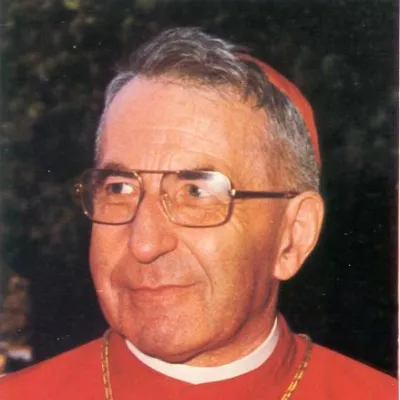
Pope John Paul I
Human Design Chart
Biography
After serving as a Bishop in 1958, he was named Patriarch of Venice by Pope Paul VI. He was selected as Pope on 26 August 1978.
John Paul had a history of weak health with tuberculosis in his youth. He died on 28 September 1978 at age 65, listed as a heart attack but there were rumors of murder.
On 4 September 2022, he was beatified by Pope Francis.
Pope John Paul I — Manifesting Generator with Profile 4/6
Manifesting Generator 4/6 — Design at a Glance
Pope John Paul I was characterized by a hybrid nature combining the speed of Manifestor and the energy of Generator. His design tended to skip steps and pursue multiple projects simultaneously, leading to frustration when strategy was ignored. As a manifesting generator, he had constant sacral energy similar to classic generators but also possessed Manifestor traits due to his Motor Centers connecting to Throat Center. This allowed for lightning-fast actions in life, yet posed risks: often his impulses were too quick, essential steps were skipped and needed to be retraced later. Additionally, he tended to pursue multiple things at once by reacting to various impulses. Without strict adherence to the strategy – responding rather than initiating – this creative drive quickly turned into frustration. Only when his sacral center responded with a clear 'yes' and his inner authority agreed could he use his speed without frustration. Under these conditions, Pope John Paul I derived deep satisfaction from his work. Parallel work on different projects then became no obstacle but fostered a productive play-mode that combined variety and fun in creation. The necessity to wait for impulses rather than starting himself channeled his lightning-fast power into sustainable fulfillment.
Emotional Authority
Pope John Paul I was subject to an emotional wave that colored his perception of the world through the lens of his current mood. His design foresaw experiencing emotions in a constant up-and-down; what appeared inspiring at one moment could turn negative in the next. This emotional authority was defined by the Solar Plexus Center and had priority over all other defined centers, regardless of further configurations.
This mechanism meant that his immediate feeling was just a snapshot, not the final truth. Quick, spontaneous decisions from this emotional heat risked negative consequences as the first impression had not yet matured. Instead, his inner authority required patience and allowing the process of 'ripening'. Decisions needed to be reconsidered multiple times and slept on to gain emotional distance.
Over time, intense feelings subsided, bringing clarity and calmness. This period was essential for gaining deeper insights and ensuring that a choice truly came from the core, not just as a reaction to a passing impulse. Thus, Pope John Paul I showed himself in a stance that needed time to penetrate from the surface of emotion to the depth of true insight, especially regarding decisions with long-term implications for his life path.
The 4/6 Profile — Opportunist / Role Model
Pope John Paul I was someone whose life was marked by a clear developmental line: from an experimental networker to a disciplined role model. His design indicated a tendency in the first three decades before Saturn return to explore diverse relationships and friendships driven by Line 3 in Profile 4/6 (Networker/Role Model).
This early phase gave way later to intense inner tension. Pope John Paul I constantly stood between the emotional need for belonging and community from his heart as Line 4, and the intellectual drive for distance, reflection, and high positioning from his Head as Line 6. This conflict of Heart versus Head profoundly shaped his internal stance.
In his later years, he was expected to meet the high standards of a wise role model. His authority rested less on dominant power but primarily on cooperation with others. Self-discipline played a central role; it showed in his ability for detail work and correct communication. Line 6 demanded material as well as moral integrity from him. At the same time, his 'big heart' as Line 4 had to be cautious not to be hurt by false trustworthiness. This balance between open connectedness and necessary distance to preserve one's principles defined his specific life dynamics until the end.
Split Definition — Defined & Open Centers
Pope John Paul I had a massive internal structure through six defined centers, giving him high energy capacity and reliable mechanisms in communication, identity, vitality, emotions, intuition, and stress management. His defined G Center created a firm self-identity and clear sense of direction; he knew where he came from and where he was going without being dependent on others. The defined Sacral Center provided immense generative life force energy, but it was only available through reaction to life – not by initiation. His defined Solar Plexus Center required waiting for the emotional wave for true clarity; decisions were made after running through the feeling cycle.
At the same time, there were three open centers: Head, Ajna, and Heart. The open Head and Ajna Centers meant no constant mental focus or conceptual truth. He tended to be influenced by others' inspiration and was vulnerable to doubt or confusion when trying to exercise mental control rather than trusting his inner authority. The open Heart Center lacked consistent willpower for commitment; here there was a risk of feeling worthless and becoming frustrated through excessive attempts to prove his worth – such as making promises without energetic backing. His strength lay not in mental imposition or willing struggle, but in the confident use of his sacral energy and emotional depth while using the mental and egoic environment as a mirror rather than losing himself in it.
Channels for ambition, rhythm, intimacy and intuitive clarity.
Pope John Paul I showed himself to be someone who felt driven to work his way out of his social background through constant effort and proven competence. His design tended towards ambition, motivated by the desire for visibility and recognition for loyalty to the tribe. This attitude was particularly shaped by Channel 54-32 (Transformation): Gate 54 (Ambition) pushed him to improve his position in life while Gate 32 (Continuity) used fear of collective failure to demand talent and dedication. Work was a means of proving himself; he sought confirmation through promotion and proof of value.
Parallel to this, Channel 5-15 (Rhythm) worked: Through Gate 5 (fixed rhythms), Pope John Paul I held onto habits while Gate 15 (Extremes) integrated the diversity of society into his life flow. This gave him an inner timing that vitalized him with the natural flow of life and made him appear stable to others.
Interpersonally, Channel 59-6 (Coupling) shaped his interactions: Tor 59 (Sexuality) and Tor 6 (Friction/Emotional Wave) created potential for deep intimacy and merging. He sought closeness, but it was time-controlled by the emotional wave of Gate 6; only after waiting for clarity could true connection arise.
Channel 57-20 (Flash of Insight) allowed him intuitive insights in the moment: Tor 57 (intuitive insight) from the Spleen found expression through Tor 20 (Now), enabling spontaneous truths to be articulated and encouraging others to use their own survival intelligence.
Additionally, Gates like 42 (Completion/Commitment), 61 (Inner Truth/Mutation), and 62 (Detail Work/Logic) influenced him. Gate 9 promoted detail focus in the Sacral Center while Gate 50 protected traditional values. These configurations underscored his focus on experience, logical pattern recognition, and enduring limitations as a path to transcendence.
Tribal Circuitry — Circuit Signature
Pope John Paul I showed a fundamental attitude based on the drive to acquire new transformative knowledge and express his unique individuality. This tendency resulted from his Knowledge Circuit, active through Channel 20-57 (Flash of Insight). This channel connected the Throat Center with the Spleen Center, generating pulsing, acoustic, and creative energy that allowed him to generate innovative flashes of insight and express them emotionally through the Throat Center to initiate change in his environment.
Additionally, Pope John Paul I had the Understanding Circuit via Channel 15-5 (Rhythm). This connected his Identity Center directly with the Sacral Center. As both centers belonged to the same group, a constant life force flowed here enabling him to share logical and rational insights as well as improve things through focus and strategy. This connection contrasted with his Ego Circuit, present but lacking direct connection to sacral energy (Channel 32-54 Transformation). Instead, it connected Spleen and Root Centers, indicating the need to create resources through cooperation while taking breaks since no constant life force flowed from the Sacral Center into this area.
The Protector Circuit completed his design with Channel 59-6 (Coupling), connecting the Sacral Center with the Solar Plexus Center. Both centers belonged to the same group as Identity, creating a strong, primal energy for protecting and preserving family and genetic continuity. Through this combination of creative expression, rational rhythm, and instinctive protection, Pope John Paul I showed a complex interplay between individual innovation and tribal duties.
Right Angle Cross of Maya 3
Pope John Paul I carried the archetypal imprint of the Right Cross of Maya 3. This configuration acted as a structuring element of his character and significantly determined his inner orientation. The Right Cross of Maya 3 connects specific energetic channels that suggest a profound identification with spiritual or transcendent themes. It is not about superficial interest, but rather a fundamental life task expressed in the search for higher meaning and connection to the divine.
For Pope John Paul I, this meant that his actions and decisions were deeply rooted in this spiritual dimension. The mechanics of this cross describe a path defined by dedication and the desire to embody a message or truth beyond the everyday. It is an energetic signature that encourages the carrier to build bridges between the material and the spiritual. Pope John Paul I lived in resonance with this energy, which profoundly shaped his personality. Identification with this cross created an inner compass guiding him on a path of spiritual depth regardless of external circumstances or expectations. This was not a conscious act of will but a natural consequence of his human design configuration.
Saturn Return · Uranus Opposition · Chiron Return · 2nd Saturn Return — Life Cycles
Pope John Paul II's life journey followed a clear cyclical structure marked by the return of planets Chiron and Saturn. These cycles structured his development into phases of inner maturation and outer confirmation. In 1958, at age 46, he experienced his first Chiron Return. During this period, he was appointed as a bishop. The Chiron Return in Human Design signals the phase of bloom: one's incarnation cross unfolds increasingly if lived according to strategy and authority. Meaning and purpose become experiential; it is not about healing wounds but realizing deepest potential. This appointment marked the moment when his inner calling took concrete form.
Following this, in 1971, he experienced his second Saturn Return at age 59, when he was elected Pope John Paul I. The Saturn Return stands for structure, responsibility, and condensing long-term work into a sustainable result. While Chiron heralded the purpose's bloom, Saturn solidified this achievement through institutional recognition and highest authority. His election as pope was thus not a sudden turn but the logical consequence of a life orientation that had aligned with his inner rhythms over years. Both events show how Pope John Paul I channeled his energy into ordered paths: first by unfolding his destiny (Chiron), then by anchoring it institutionally and exercising responsibility (Saturn). His design promoted development where personal maturity and public role intertwined.
Manifesting Generator · Emotional Authority — Synthesis
Pope John Paul I lived a life marked by deep inner dynamics—a constant interplay between the need for connection and the longing for individuality. As a Manifesting Generator with defined Sacral Center, his design provided him with a constant energy source but required a process of maturation and weighing through emotional authority. This led to a life where he could seize opportunities swiftly yet felt the necessity to emotionally digest decisions over longer periods (emotional center). The profile as Networker/Role Model suggests that throughout his life, he moved between the desire for belonging and the role of independent thinker.
A central paradox in his design lay in the combination of sacral energy and emotional wave. The constant availability of life force (Sacral Center) seemed to prompt quick action, yet emotional authority required patience and sleeping on decisions. This inner conflict between the impulsive flow of Sacral (Channel of Rhythm) and emotional depth led him to always grapple with the consequences of his decisions—a dynamic that shaped and propelled his development.
4 Defined Channels
Incarnation Cross - Right Angle Cross of Maya 3
Solar Return
The Solar Return shows the moment when the sun returns to its exact birth position - your personal solar year.
Life Cycles
Discover the life cycles with a detailed triple view (birth chart, cycle chart, composite).
Human Design Profile
- Strategy
- To respond - wait for something to respond to
- Authority
- Emotional Authority
- Profile
- 4/6 - Opportunist / Role Model
- Definition
- Split Definition
- Incarnation Cross
- Right Angle Cross of Maya 3
- Date of Birth
- 17.10.1912 12:00
- Place of Birth
- Canale d'Agordo, Italy
Frequently Asked Questions
What was Pope John Paul I's Human Design type?
Which Profile did Pope John Paul I have?
What Authority guided Pope John Paul I?
What incarnation cross was assigned to Pope John Paul I?
When was Pope John Paul I born?
Discover your own Human Design
Are you also a Manifesting Generator? Find out in a personal reading how to unfold your multi-talents and direct your energy wisely.
More Personalities
Back to overviewAldair

Alizée

Angeli

Arletty

Artus
Balthus