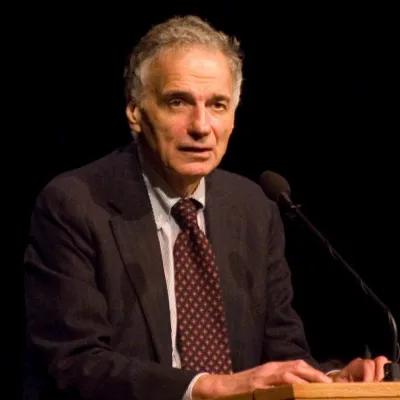
Ralph Nader
Human Design Chart
Biography
Born to Nadra and Rose, Lebanese immigrants who operated a restaurant and bakery, Nader learned at a young age the duties of citizenship and justice during dinner discussions with his brother Shafeek and sister Laura. He graduated from the Gilbert School in 1951, entered Princeton, and graduated magna cum laude in 1955 with a major in government and economics. He enrolled in Harvard Law School, became editor of the Harvard Law Review and graduated with honors in 1958.
After serving in the Army, Nader set up a small legal practice in Hartford, CT and traveling widely. With a highly developed social consciousness, he became distressed at the indifference of American corporations and the abuse of their power. Idealistic and modest, the lanky 6'4" Nader is known for his Spartan habits and for working 16 hours a day, seven days a week.
He moved to Washington DC in 1964, writing "Unsafe At Any Speed" the following year in which he accused the auto industry of producing unsafe vehicles. This led to the passage of the National Traffic and Motor Vehicle Safety Act in 1966. Nader played a key role in the creation of the Environmental Protection Agency, the Occupational Safety and Health Administration, the Freedom of Information Act and the Consumer Product Safety Commission. He was at his peak in 1977 when he guest hosted "Saturday Night Live," and lampooned his own obsession.
Time magazine included Nader on their list of 100 most influential Americans in the 20th century. His agenda of product safety and greater corporate accountability became the nation's agenda. When he set his Raiders loose with exposes of federal agencies, Congress created the Environmental Protection Agency and the Freedom of Information Act. He founded the Center for Responsive Law, Public Citizen, Inc.
Ralph Nader — Projector with Profile 3/5
Projector 3/5 — Design at a Glance
Ralph Nader's design showed a tendency towards precise system analysis: He was someone who immediately spotted structural weaknesses. As a projector, he did not have an intrinsic energy source like other types but had phases of intense workability followed by necessary rest periods for regeneration. His aura appeared focused and dense – comparable to a bright flashlight directed specifically at dark spots in the surroundings. This quality allowed him to identify errors in complex contexts swiftly.
The challenge lay in communicating these insights. A direct hint about deficits in others is often perceived as condescending or unpleasant, similar to a light beam directly into someone's face. The optimal strategy for projectors was not to act on their own initiative but to wait for a respectful and honest invitation from others. Through this recognition, his specific expertise was legitimized and effective.
If Ralph Nader lived according to the pattern of waiting and targeted illumination, it led to success and reward. If he ignored the necessity of an invitation or neglected the required pauses for regaining energy, the non-self theme 'bitterness' emerged. This manifested as a feeling of injustice or being worn out when his clarifying impulses were not respected or appropriately honored. His influence thus depended significantly on whether he left the initiative to others and carefully dosed his energy.
Emotional Authority
Ralph Nader's design showed a tendency towards deep emotional penetration, where intuitive clarity only emerged after initial waves subsided. His inner authority was Emotional Authority carried by the defined Solar Plexus Center. In Human Design mechanics, this authority is prioritized: Once the Emotional Center is defined, it takes charge in decision-making regardless of other defined centers in the chart.
This configuration meant that Ralph Nader was subject to a constant wave of emotional ups and downs. His perception of the world was always colored by his current mood; a topic could appear absolutely convincing at one moment but negatively assessed the next. Such immediate emotional reactions were only snapshots, not the final truth. Quick decisions made from such an emotional peak would often prove misleading or harmful.
His design strategy required patience and conscious delay. By allowing time – ideally through multiple 'sleeping on' of options – Ralph Nader could let the emotional wave subside. Only when intense feelings had subsided and emotional distance was gained, deep clarity set in. This process of maturation was crucial for long-term direction setting as it ensured decisions were not based on transient moods but a stable, thoughtful inner truth.
The 3/5 Profile — Martyr / Heretic
Ralph Nader's design is characterized by the configuration of the experimenter and hero. He showed a fundamental stance where preconceived opinions were rejected; instead, he had to try everything himself to develop practical wisdom. This Line 3 of his profile means that learning primarily happens through trial and error. The experience gained then served to solve other people's problems – the role of Line 5, the rescuer or hero.
This dynamic is reinforced by specific gates. Gate 37 emphasized adaptability and management of commitments as well as resources. Here it was about focusing on essentials to secure loyalty and productivity while sensitivity in dealing with others was crucial. Parallel to this, the energy of Gate 9 strengthened belief in recurring patterns in the future. This promoted strict concentration on details and loyalty to established rules or laws.
The interplay of these energies created a person who learned through their own failures to later present informed knowledge. The attractiveness of this knowledge drew others who wanted to benefit from his experiences. However, this configuration also carried the risk that public experiments could fail, which is particularly painful for the 3/5 type as the hero status directly depends on perceived competence. His path was marked by the necessity to maintain impartiality while simultaneously examining details precisely to recognize valid patterns.
Single Definition — Defined & Open Centers
Ralph Nader's design inclines towards self-determined, strong-willed leadership based on inner emotional clarity. His defined Heart Center provides a constant source of willpower and the need to control his life and resources independently. He is someone who knows his own worth and insists on keeping promises to build trust. This energy drives him to be successful and competitive, learning to use his ego strength appropriately in situations without overburdening others.
This strong-willed nature was filtered through his defined Solar Plexus Center, which functions as an inner authority. Nader is designed not to seek the truth at the moment of impulse but to wait patiently until emotional clarity sets in. His decisions arise from the depth of an emotional wave he must go through before acting. This gives his judgments a certain charm and depth; he strategically uses this waiting period to make carefully considered agreements rather than impulsively jumping into situations.
The constant pressure of his defined Root Center supports this process by providing existential drive to move forward in the material world and correct what does not work. This stress is for him a healthy source to initiate material advancements or corrections, as long as he is guided by his emotional authority.
In contrast, his open Head Center reveals a vulnerability to mental pressure and confusion when he does not trust his inner guidance. He tends to engage with questions that actually belong to others or seeks external inspiration to fill mental voids. His open Ajna Center allows him a flexible mind capable of embracing many perspectives but also makes him susceptible to interpreting other people's opinions as his own truth or pretending to be more certain than he is.
His open Throat Center shows a tendency to seek attention through speaking under pressure rather than waiting for the invitation to speak. The open G Center means that his identity and direction are not fixed; he gathers them through interactions with others and places, making him vulnerable to false environments where he can feel trapped. Finally, his open Sacral Center reveals fluctuations in vital energy: He is prone to absorbing other people's work energy and overburdening himself until exhaustion due to lacking a constant inner rhythm for work and rest. His open Spleen Center ultimately makes him sensitive to well-being or illness in his environment, leading him to cling to unhealthy people or situations just to feel the sense of security that a defined Spleen emits.
Channels for community spirit and syncretic life principles.
Ralph Nader's design inclines towards deep tribal consciousness paired with strategic distancing. This configuration creates a tension between the desire for belonging and the necessity of individual integrity.
The Synthesis Channel 19-49 connects the Root Center to the Solar Plexus. Through the Claim Gate (19), there is strong pressure to foster unity, while the Principles Gate (49) rejects anything that does not meet the highest ideals. This acts as an emotional glue for communities based on loyalty and resource protection. Ralph Nader was sensitive to his position in the whole; he sought a balance between feasibility and fairness to ensure the survival of his "tribe."
At the same time, the Community Channel 37-40 shaped his actions. It connects Solar Plexus and Heart Center through the Friendship Gate (37) and the Solitude Gate (40). Here lies the ability to build bridges between individuals but only after careful scrutiny. A good deal or connection could not be made spontaneously; it required time for emotional clarity and willpower. Ralph Nader waited for the right invitation through personal contact to find his place in an organization.
Individual gates complemented this picture: Gate 9 promotes detailed work and perfection through repetition, while Gate 16 supports experimenting and mastery in the collective. On the design side, Gate 38 acts as resistance against harmful forces to preserve individual integrity, along with Gate 60, which demands acceptance of limitations as a prerequisite for transcendence. Gate 22 allows for calm openness and mutation in social environments through listening. This combination creates a person deeply involved in community processes but always defending the boundaries of their identity and only acting when the emotional wave is clear.
Tribal Circuitry — Circuit Signature
Ralph Nader's design inclines towards cooperative action where mutual support and the exchange of resources are prioritized. This orientation stems from his Simple Definition: The Heart Center, Solar Plexus Center, and Root Center were directly connected, creating a continuous energetic flow.
Within the Ego Circuit, two specific channels operate. Channel 37-40 (Community) links the Heart Center to the Solar Plexus Center, promoting a fair balance between giving and taking – the idea that support given today will be returned tomorrow. Simultaneously, Channel 19-49 (Synthesis), located in the Solar Plexus Center, contributes to emotional processing where feelings often arise in waves or "bursts" and seek consistency and tradition.
Since Ralph Nader has no connection to the Sacral Center, this center's constant life force is absent from his overall design. This means that energy is not continuously available; instead, rest periods are necessary to regenerate power for joint ventures and resource creation. The Sensitivity Stream of consciousness flows through the Solar Plexus Center, shaping his emotional perception. The combination of the Community channel and Synthesis creates a Profile aimed at stable, mutual dependencies in groups but always requiring pauses to avoid exhaustion.
Right Angle Cross of Planning 1
Ralph Nader's design indicated a tendency towards strategic, long-term planning. This was not seen as impulsive action but rather as well-thought-out approaches where goals were clearly defined and steps carefully weighed. The configuration 'The right cross of Planning 1' describes this attitude precisely: it grants the ability to oversee complex situations and realistically assess options before making a decision. It is about cool analysis and pragmatic implementation, not spontaneous inspiration. Ralph Nader often appeared as someone who kept an overview and sought solutions that were sustainable rather than just short-term successes. This energy supported him in navigating structured environments and pushing projects with clear goals forward. The mechanics of this cross emphasize the importance of preparation and discipline; without these elements, potential remains untapped. Ralph Nader's approach was characterized by a calm persistence that allowed him to steer a steady course even in uncertain times. He sought ways that were both practical and ethically defensible, relying on logical argumentation rather than emotional appeals. This combination of planning talent and assertiveness significantly shaped his work.
Saturn Return · Uranus Opposition · Chiron Return · 2nd Saturn Return — Life Cycles
Ralph Nader's design indicated a tendency towards structural renewal and breaking down outdated systems. This energy does not push for mere adaptation but demands radical restructuring when existing orders are felt to be inefficient or unjust. The Uranus opposition marks a turning point in Human Design mechanics, where the individual breaks free from collective expectations and imposes its own often disruptive vision. It is a moment of liberation from old patterns towards a new, independent orientation.
In 1971, at age 37, Ralph Nader launched his initiative Public Citizen. This event illustrates the effect of this astrological configuration: the energy of opposition did not result in inner conflict but led to a concrete institutional response to societal shortcomings. Instead of integrating into existing structures, he created a new framework for citizen participation and oversight. This shows the typical dynamics of this phase – the old is consciously left behind to make way for an innovative, often controversial solution. The founding of Public Citizen was no coincidence but an expression of a deeply rooted need to reform systems that had ceased to fulfill their original purpose. Through this step, his inner conviction towards change was translated into an external, sustainable project that continues to have impact.
Projector · Emotional Authority — Synthesis
A central red thread runs through this design: the ability to recognize systems and point out their weaknesses (Channel of Synthesis, Gate 19/49), combined with the need to make these insights accessible to others (Projector Type, Profile 3/5). The defined willpower (Heart Center) gives the endurance to confront these systems and mobilize resources for change – always in the context of tribal needs (Ego Circuit). This constellation points towards a life task of recognizing patterns, initiating solutions, and bringing others along in this process.
The central paradox lies in the tension between being a Projector and emotional authority. While the bright flashlight of the projector tends to directly illuminate errors, the emotional wave requires time for decision maturation. This discrepancy leads to an internal field of tension: the impulse towards immediate action versus the necessity of experiencing and validating emotions first. The right cross of Planning 1 underscores this conflict between spontaneous recognition and careful approach.
2 Defined Channels
Incarnation Cross - Right Angle Cross of Planning 1
Solar Return
The Solar Return shows the moment when the sun returns to its exact birth position - your personal solar year.
Life Cycles
Discover the life cycles with a detailed triple view (birth chart, cycle chart, composite).
Human Design Profile
- Type
- Projector
- Strategy
- Wait for the respectful invitation
- Authority
- Emotional Authority
- Profile
- 3/5 - Martyr / Heretic
- Definition
- Single Definition
- Incarnation Cross
- Right Angle Cross of Planning 1
- Date of Birth
- 27.02.1934 04:52
- Place of Birth
- Winsted, CT, United States
Frequently Asked Questions
What is Ralph Nader's Human Design type?
What profile does Ralph Nader have in Human Design?
Which Authority guides Ralph Nader?
What incarnation cross is assigned to Ralph Nader?
When was Ralph Nader born?
Discover your own Human Design
Are you also a Projector? Find out in a personal reading how to unfold your leadership qualities and recognize the right invitations.
More Personalities
Back to overviewSissy Spacek

Alain-Fournier

Anémone

Ann-Margret

Bourvil

Hergé