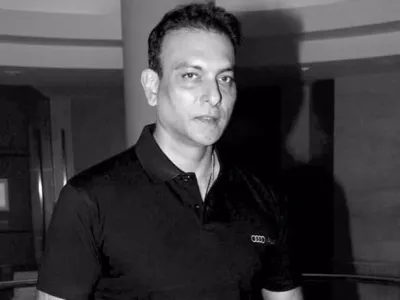
Ravi Shastri
Human Design Chart
Biography
As a batsman, he was essentially defensive with his trademark "chapati shot" (a flick off the pads), but he could raise his strike rate when required. Due to his above-average height (he stood 6' 3" tall) and an upright stance, he had a limited number of shots against fast bowling, but was able to put the lofted shot to good use against spin bowling. Shastri played either as an opening batsman or in the middle order.
The highlight of his career was when he was elected Champion of Champions in the World Championship of Cricket in Australia in 1985. In the same season, he equalled West Indian Garry Sobers's record of hitting six sixes in an over in first class cricket. He was regarded as a potential captain, but his image outside cricket, injuries and tendency to lose form at crucial times meant that he captained India in only one Test match.
In domestic cricket, he played for Bombay and led them to the Ranji Trophy title in his final year of playing. He also played four seasons of county cricket for Glamorgan. He was forced to retire aged 31 due to a recurring knee injury. He now does commentary on behalf of BCCI in the matches that India plays. In 2014, he became the director of Indian Cricket team for a period of eight months from India's tour of England till the World Cup 2016.
Ravi Shastri — Manifesting Generator with Profile 6/2
Manifesting Generator 6/2 — Design at a Glance
Ravi Shastri's design exhibited a tendency towards hybrid dynamics: He had the constant energy source of a Manifesting Generator but also possessed the ability to skip steps and quickly draw results into his life. This configuration described him as someone who drew deep satisfaction from his work when everything ran smoothly, especially when pursuing multiple projects simultaneously and falling into a playful mode.
The underlying mechanics of the Manifesting Generator explain this duality: With the defined Sacral Center, he had access to constant energy, which required responding to impulses rather than initiating independently. At the same time, connections between Motor Centers and the Throat Center allowed for accelerated execution. However, this speed carried two specific risks. First, Ravi Shastri could overlook important intermediate steps, leading him to have to backtrack to fill gaps – a process that caused frustration if not accepted. Second, his system tended to respond simultaneously to numerous impulses and handle multiple tasks in parallel.
His internal stability thus depended on whether this complexity aligned with his inner authority. If the Sacral Center signaled a clear 'yes' at each step, it paralleled the source of his creative power. Without this confirmation or ignoring the need to react to external triggers, his natural energy quickly turned into frustration. His design therefore demanded a conscious balance between enjoying variety and the discipline to pursue only what was authentically supported from within.
Emotional Authority
Ravi Shastri showed an internal decision-making structure that did not rely on immediate clarity but rather on a rhythmic process of emotional deepening. His inner authority lay in his defined Solar Plexus Center, meaning that his feelings and moods determined important life decisions – regardless of which other centers were also defined in his design. This emotional authority is subject to natural waves of ups and downs; the current mood always colored his perception of the world. What appeared inspiring at one moment could seem negative the next. Since this initial impression was only a snapshot and not necessarily reflective of deeper truth, spontaneous decisions based on emotion often carried risks and could have negative consequences.
The mechanics of his authority thus required patience and time. Ravi Shastri had to allow himself to let decisions ripen ideally through multiple nights' reflection. Only when intense feelings subsided and emotional distance was gained did true clarity and calm set in. This process was particularly crucial for long-term, life-defining decisions. By enduring the waves of his emotions and not reacting to the first impulse, he could arrive at a well-founded, authentic decision that honored the depth of his design.
The 6/2 Profile — Role Model / Hermit
Ravi Shastri's design featured a clear developmental line: In his youth, an experimental approach prevailed, characterized by trial and error. This phase served the accumulation of personal experiences, often leading to temporary retreats after setbacks. Only with entry into the third decade of life, marked by the Saturn Return, did this dynamic fundamentally change.
The 6/2 Line in his profile precisely describes this transition. Before the 30th life day, it acts like a 3er line that learns through direct experience. After this threshold, the sixth line activates, leading to an intensive introspective phase. Ravi Shastri tended to withdraw metaphorically into a 'cave' during this time – looking back at past experiments with distance. This process was not isolation in a negative sense but a necessary period of healing and deep self-reflection.
From this reflection emerged a wise perspective. The 6/2 Line enables the practical implementation of understanding through phases of self-empowerment towards transpersonalism. Ravi Shastri ultimately demonstrated the ability to serve as a role model. Others sought his advice to partake in the wisdom he had acquired. His connection with Gate 37 underscored individual responsibility within a community, where the need for undisturbed work in spiritual or organic structures was central. His wisdom did not stem from theoretical knowledge but from the integration of decades of practical life experience.
Split Definition — Defined & Open Centers
Ravi Shastri's design inclines towards clear and willful communication that flows directly from his inner identity and drive. His defined Throat Center acts as a focal point for messages originating from his motor centers—the Heart, Sacral region, and G Center—giving him a consistent way of expressing himself: he speaks from a position of "I want" (Heart), vital availability (Sacral), and personal direction (G). His defined willpower in the Heart Center drives him to maintain control over his resources and keep promises, strengthening his self-esteem. Combined with his defined Sacral energy, which provides a constant source of vital power, Ravi Shastri emerges as someone who uses energy for work that he intuitively responds to. His defined Solar Plexus functions as an inner authority; he must wait out the emotional wave to gain clarity rather than acting impulsively. This process lends depth and resonance to his decisions.
In contrast, his open Head Center reveals a vulnerability to mental pressure and confusion when he does not trust his authority. He tends to engage with questions that do not originate from him or seeks inspiration to fill mental gaps. His open Ajna Center allows for a flexible mind capable of taking in various concepts but also makes him susceptible to interpreting foreign opinions as his own truth or feigning uncertainty. Particularly defining is his open Spleen Center: it generates deep survival anxiety and the tendency to cling to things that are not good for him just to feel secure or comfortable. Ravi Shastri is challenged to distinguish between his own needs and absorbed fears from the environment to avoid spontaneous, conditioned decisions.
Channels for powerful action, reflection, principles and connection.
Ravi Shastri exhibited a fundamental stance of patient observation and deep listening. His design suggested that he gathered information before processing it – a reflective process where he withdrew to recognize the hidden connections in experiences. This tendency towards inner order and waiting for the right timing shaped his approach: He did not seek quick answers but rather the truth that would reveal itself later.
This attitude was supported by Channel 13-33, The Lost Son. This channel connects the G Center with the Throat Center and grants the ability to act as a "trusted person" who can receive secrets and life stories. Ravi Shastri used this energy to experience things firsthand and then reflect calmly before sharing his insights. He was ready to question societal patterns in order to have experiences that were personally correct, rather than blindly following expectations.
At the same time, there was a strong emotional bond with community and clan. Channel 19-49, The Synthesis, connected his Root Center with the Solar Plexus and created a deep need for belonging and loyalty. For Ravi Shastri, family or close surroundings were central; he sought a balance between feasibility and fairness within this group. His emotional wave motion determined who was accepted and who wasn't, based on principles that strengthened cohesion.
This social dynamic was complemented by Channel 37-40, The Community, which connected the Solar Plexus with the Heart Center. He searched for his place in the whole and built bridges between individuals to create harmonious relationships. It was not about hierarchy but fair agreements and mutual support, waiting until a genuine invitation came before becoming part of an organization or group.
This structure was supported by Channel 34-20, The Charisma, which connected the Sacral Center with the Throat Center. This gave him the strength for self-affirmation and the potential to act in the moment when he responded to inner resonance. His energy was designed to sustain activity over longer periods as long as it was satisfying for him.
Additionally, Gates like Gate 45 (Tribe Level and Willpower) and Gate 3 (Mutation and Adaptability) contributed to seeing changes as necessary for survival and creating new orders from confusion.
Tribal Circuitry — Circuit Signature
Ravi Shastri's design set a tendency to reflect emotional wave movements from the past and share these insights with others. This dynamic was shown through the Meaning-Making Circuit, specifically Channel "The Lost Son" (33-13). It connected his Throat Center directly to the Identity Center. This allowed him to formulate felt experiences and visual memories verbally and pass them on as a shared lesson from the past. The energy flowed in waves – with beginning, middle, and end – rather than linearly logically.
Parallel to this, there was a strong force of cooperation and mutual support. The Ego Circuit connected Ravi Shastri's Heart, Solar Plexus, and Root Centers into one group. Through Channel "Community" (37-40), a rhythm of giving and taking ("today me, tomorrow you") emerged, while Channel "Synthesis" (49-19) enriched this interaction with emotional depth and sensory perception (taste/smell). Since this circuit does not connect to the Sacral Center, this resource-oriented cooperation required necessary rest periods for regeneration.
A third aspect concerned individual self-reinforcement in the here and now. The Integration Circuit connected his Throat Center to the Sacral Center via Channel "Charisma" (20-34). This created a direct line to channel strength from an intuitive reaction to life and immediately translate it into the present moment.
As a person with Split Definition, these systems existed as two separate, parallel forces: on one hand, communicative-emotional processing (Throat-Identity-Sacral) and, on the other hand, cooperative-sensory resource generation (Root-Solar Plexus-Heart). They were not directly connected to each other but worked as independent energetic blocks.
Left Angle Cross of Duality 1
Ravi Shastri's design points to a fundamental search for unity, expressed through the tension between individual identity and collective belonging. As someone with the left cross of Duality 1, he was a person whose inner drive aimed at integrating separate experiences into a coherent whole.
This configuration describes the archetypal path of an individual learning to understand their existence not in isolation but within the context of relationships with others. The mechanics of this cross imply a lifelong lesson: the realization that true strength and fulfillment arise not through separation, but through the conscious integration of opposites. Ravi Shastri was structurally called upon to build bridges between self and other, always focusing on creating a common ground.
This deeply rooted psychological dynamic shaped his actions and perception of the world. The challenge lay in breaking through the illusion of separation and instead acknowledging the interconnected nature of all things. This created an internal tension that could only be resolved by learning to see himself as part of something greater, without losing his individual substance.
Saturn Return · Uranus Opposition · Chiron Return · 2nd Saturn Return — Life Cycles
Ravi Shastri's design points towards strategic positioning, which crystallized into clear career milestones. In 1990, at the age of 28, he achieved an ODI century in Sri Lanka. This coincided with his first Saturn return, a cycle often marking how years of groundwork and internal structuring lead to tangible results. It was no coincidence that this athletic peak coincided with a phase of maturity and consolidation deemed necessary for professional anchoring by his chart.
Later, another shift in his role became apparent. In 2014, at the age of 52, he took on the position of team director for India's national cricket team. This time corresponds to his Chiron return, a fulfillment cycle between the ages of 49 and 51 (often slightly shifted), during which one’s incarnation cross unfolds. If living according to strategy, deeper meaning and purpose become experiential here. Taking on this leadership position was not just a job change but the concrete expression of this bloom cycle: his long-term experience and specific design found full realization and significance in a new leading role.
Manifesting Generator · Emotional Authority — Synthesis
A central red thread in this Human Design chart is the dynamic between inner maturity and outer action. The combination of Manifesting Generator energy, emotional authority, and the Profile of Role Model points to someone who can attract things quickly (sacral center, MG hybrid), but whose true strength lies in deep reflection and sharing wisdom (Channel 13-33, Line 6). This process requires time and patience – skipping steps leads to necessary setbacks. The energy of the Seeker circuit amplifies the need to take in experiences, process them, and express them as formulations, creating a cyclical movement between action and inner reflection.
The central paradox lies in the interplay of quick initiation and emotional wave pattern. While the design tends towards rapid implementation, emotional authority demands maturing decisions. This tension is further amplified by the left cross of Duality 1, hinting at an internal conflict between a desire for immediate impact and the necessity to engage with the past. A marked event in Saturn return (career) illustrates this dynamic: quick success followed by a phase of intense reflection and later leadership role.
4 Defined Channels
Incarnation Cross - Left Angle Cross of Duality 1
Solar Return
The Solar Return shows the moment when the sun returns to its exact birth position - your personal solar year.
Life Cycles
Discover the life cycles with a detailed triple view (birth chart, cycle chart, composite).
Human Design Profile
- Strategy
- To respond - wait for something to respond to
- Authority
- Emotional Authority
- Profile
- 6/2 - Role Model / Hermit
- Definition
- Split Definition
- Incarnation Cross
- Left Angle Cross of Duality 1
- Date of Birth
- 27.05.1962 06:27
- Place of Birth
- Mumbai, India
Frequently Asked Questions
What is Ravi Shastri's Human Design type?
What profile does Ravi Shastri have in Human Design?
What authority determines Ravi Shastri's decision-making?
What is Ravi Shastri's incarnation cross?
When was Ravi Shastri born?
Discover your own Human Design
Are you also a Manifesting Generator? Find out in a personal reading how to unfold your multi-talents and direct your energy wisely.
More Personalities
Back to overviewAldair

Alizée

Angeli

Arletty
Artus
Balthus