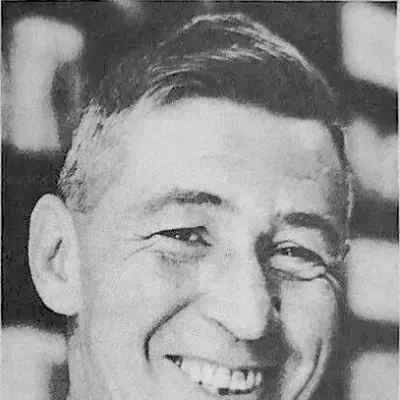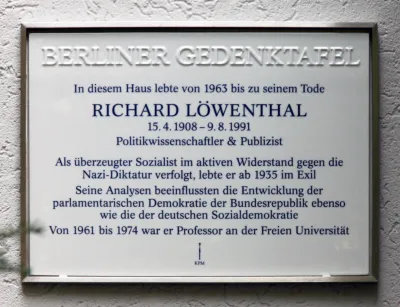
Richard Löwenthal
Human Design Chart
Biography
Löwenthal was a prominent Jewish member of the anti-Nazi group Neu Beginnen (New Beginnings / "[to] begin anew"). He fled to the United Kingdom in August 1935 then moved to Prague, Czechoslovakia, and Paris, France, then in 1939 returned to London, which was to be Löwenthal’s home until 1959.
Richard Löwenthal died on 9 August 1991, aged 83, in Berlin, Germany.
Richard Löwenthal — Projector with Profile 5/1
Projector 5/1 — Design at a Glance
Richard Löwenthal was someone who could immediately recognize systematic weaknesses in his environment. As a Projector, he had a dense, focused aura that worked like a bright light beam: it illuminated problems others might overlook or ignore. However, this ability to identify flaws in the system could be counterproductive if communicated directly and unfiltered. Such direct addressing often felt like being blinded by a spotlight to those around him, leading to defensiveness rather than openness.
His optimal strategy was therefore not to actively seek out or push for attention but to wait for an honest invitation from others. By living his own harmony and clarity, he became attractive to his environment; people would come to him on their own initiative to seek advice. His design lacked a defined Sacral Center, meaning he did not have constant intrinsic life energy available. Instead, he worked in phases of high intensity and efficiency followed by necessary rest periods for regeneration. Ignoring this rhythmic need or trying to push against the resistance of his environment led to burnout and feelings of bitterness. Living according to his strategy of waiting for invitations earned him recognition for his leadership role and rewarded him with success.
Splenic Authority
Richard Löwenthal demonstrated decision-making based on immediate physical perception. His inner authority lay in the defined Spleen Center, a system for health and survival intelligence. This configuration required both the Emotional and Sacral Centers to be open – a characteristic only Projectors or Manifestors exhibit.
His intuition functioned as a fine, spontaneous impulse signaling whether a situation or environment was beneficial at any given moment. This first impulse directly served his well-being by enabling him to rigorously distance himself from harmful influences. However, this Spleen voice was very subtle and occurred only once, posing the risk of being drowned out by external influences. This required high vigilance; occasionally, a short retreat helped in hearing the clear impulse.
Since knowledge about what is right became available only in the moment, long-term plans often remained unstable or changed at short notice. Richard Löwenthal therefore avoided firm commitments and instead sought flexibility and freedom. Spontaneous agreements suited his nature better than rigid structures. This lifestyle ensured him the necessary agility to move through life healthy and unburdened rather than getting entangled in situations that contradicted his inner alarm system.
The 5/1 Profile — Heretic / Investigator
Richard Löwenthal was someone who gathered deep knowledge to offer others for problem-solving. His Human Design Profile 5/1 combined Line 1 of the Investigator with Line 5 of the Hero, creating a nearly magnetic presence: others sought him out for solutions and answers.
This configuration corresponds to the archetype of an expert who dispels all doubts in lengthy conferences. However, this process carried a risk. Without clear boundaries, Richard Löwenthal quickly reached his limit. The Profile 5/1 tends to withdraw after such intense phases to conserve energy. Line 5 stands for practical solutions during crises and closing processes; it is often perceived as maturity but also leads to a need for withdrawal behind a mask.
At the same time, Gate 60 on Line 1 formed the foundation of his design. It emphasized the ability to maintain inner harmony despite external constraints. Dealing with limitations was given from birth. When Richard Löwenthal learned to say no sometimes, he could find a beneficial balance. This way, he preserved the tension between research for himself and problem-solving for others. This structure shaped how he not only possessed knowledge but also used it purposefully without losing himself.
Split Definition — Defined & Open Centers
Richard Lowenthal's Human Design profile indicated a tendency towards consequent, conceptual precision. His defined Ajna Center ensured a steady mental process; he processed data and creativity in a trustworthy manner, independent of external influences. This mental stability flowed directly into his defined Throat Center. The connection between mind and voice allowed him to articulate what he conceptualized clearly and reliably. His communication was not impulsive guessing but the articulation of well-thought-out theories.
This cognitive clarity was reinforced by his defined Spleen Center. It gave him a spontaneous, intuitive awareness of the 'now'. While the mind structured, the spleen filtered existential warning signals and promoted wellbeing and health. Additionally, his defined Root Center provided the necessary adrenalized pressure to move forward and master material or social challenges. This inner drive was set and helped him constructively deal with stress without slipping into obsessive patterns.
At the same time, Richard Lowenthal showed himself vulnerable in open areas. His open Head Center had no mental pressure of its own; he tended to take on questions and confusion from others or seek inspiration that wasn't his own. Without a fixed identity in his open G Center, he often adapted to the environment to find direction and love rather than asserting it himself. His open Heart Center lacked consistent willpower; ideally, he avoided making promises or proving his worth through competition as this could lead to frustration. Moreover, his open Sacral Center absorbed emotions from his surroundings, leaving him vulnerable to foreign moods while lacking constant generative energy, needing protection against overexertion through 'borrowed' vitality.
Channels for clarity, ambition and accepting logic.
Richard Lowenthal exhibited a fundamental disposition towards analytical order: his profile indicated a tendency to mentally structure complex information and translate it into clear language. This occurred via the Acceptance Channel 17-62, connecting Ajna Center with Throat Center. Here, Gate 17 visualized patterns while Gate 62 named and organized them; anything he couldn't fit into this logical system remained incomprehensible to him. He found satisfaction in explaining his opinions in detail when invited to do so.
Parallel to this was a driving force of improvement. The Judgment Channel 58-18 connected Root Center with Spleen Center, generating an insatiable urge to correct and perfect patterns. Gate 58 propelled life affirmation while Gate 18 checked what was healthy or faulty. This mechanism served as a sentry for the collective to ensure satisfaction through functioning structures. Richard Lowenthal used this ability most effectively when asked to find solutions; unsolicited criticism would have provoked resistance.
Another aspect was ambition towards social transformation. The Transformation Channel 54-32 also connected Root and Spleen, driven by the desire for recognition and advancement within the 'tribe'. Gate 54 brought in ambition while Gate 32 kept continuity and survival of the group in mind. His progress depended on support from others; he proved his worth through hard work and loyalty to solidify his position.
Additionally, his design included Gates that saw experience as a key to development (Gate 42) as well as acceptance of limitations (Gate 60). Mental processes were abstracted into figurative narratives via Gate 56 while Gate 52 required pauses for concentration. The ability to experiment (Gate 16) and act in the here-and-now (Gate 20) rounded out his profile. Resistance against harmful forces (Gate 38) and reflective retreats (Gate 33) served to preserve his integrity, while provocative impulses (Gate 39) and mutative creativity (Gate 12) shaped his emotional dynamics.
Collective Circuitry — Circuit Signature
Richard Lowenthal was marked by a design that combined rational clarity with instinctive adaptability. His split definition separated these areas energetically: he did not have an uninterrupted connection between all defined centers but worked with two parallel power blocks.
The Understanding Circuit formed one of these blocks. Here, the Acceptance Channel connected Ajna and Throat Centers. This allowed him to articulate visual strategies and logical concepts in words and share them. A second part of this circuit, the Judgment Channel, linked Spleen and Root Centers. This connection utilized his intuitive perception for situation evaluation to draw tangible, life-relevant conclusions - a form of emotionless ratio, free from conditioned reacting.
Parallel to this, the Ego Circuit also featured the Transformation Channel between Spleen and Root Centers. Although this circuit is often associated with cooperation, Richard Lowenthal lacked a connection to Sacral Center. Instead, his energy focused on the transformative potential of his intuition. The spleen recognized dangers or opportunities while the root transformed this recognition into immediate action impulses. As both circuits shared the same center combination (Spleen-Root), this impulse towards quick, instinctive reaction to changes was reinforced. Richard Lowenthal thus utilized his ability to understand and clearly communicate complex connections in parallel with a deep, physical intuition that enabled him to adapt to new circumstances efficiently and use resources effectively.
Left Angle Cross of Limitation 1
Richard Löwenthal's design indicated a tendency towards inner restraint and the protection of personal boundaries. This configuration, known as the left cross of limitation, described a life task characterized by preserving intimacy and refraining from excessive exposure.
In Human Design, this structure represents a process of withdrawing to gain clarity. Richard Löwenthal was someone who carefully dosed his energy rather than carrying it out uncontrollably. The mechanics of this cross imply a deep understanding of when it is necessary to set boundaries in order not to lose one's substance. This was not a passive stance but an active strategy for self-protection and focusing on the essential.
The energy of this configuration acted like an invisible barrier that protected against overextension. Richard Löwenthal lived with an inner compass that shielded him from situations that would have overstretched his personal resources. Instead of drawing attention through loud actions, his design was marked by a quiet but persistent presence. The search for authenticity happened in private, away from public pressure or expectations of others. This inner discipline allowed him to maintain his true values even when external circumstances pressed for adaptation. His path was characterized by the art of non-action and restraint, which gave him special stability.
Saturn Return · Uranus Opposition · Chiron Return · 2nd Saturn Return — Life Cycles
Richard Löwenthal demonstrated during his Saturn returns structural clarifications and positioning phases. The first Saturn return, appearing around age 27, marks the condensation of long-term groundwork into a viable result. This occurred for Richard Löwenthal in 1935 when he published his own theory on fascism at the age of 27 in the journal for socialism. This publication was not an isolated act but the concrete product of a maturation phase where intellectual foundations condensed into a coherent whole.
The second Saturn return, typically occurring around age 59, demands a reevaluation of established structures and often a distancing from earlier allies or concepts. Richard Löwenthal experienced this dynamic in 1967 at the age of 59 when he changed his position against SDS plans for introducing plebiscitary democracy. This step illustrated the mechanics of this cycle: it was not just criticism but a deep, structural correction of his stance given changing circumstances. Both events underscore how Richard Löwenthal during these specific age windows strengthened and refined his intellectual and political identity rather than passively developing them. The Saturn returns here acted as catalysts for defining actions that shaped his further path.
Projector · Splenic Authority — Synthesis
Richard Löwenthal was a projector who, through the ability to recognize patterns and highlight weaknesses (Channel Accepting), naturally tended to question what works in systems. This gift came with a challenge: his direct way of conveying information could be perceived as unpleasant because he shed light on darkness – often without regard for the immediate reaction of his counterpart. His profile as Leader/Researcher (5\/1) amplified this trait by positioning him where others actively sought his knowledge, bringing risks of overextension and inadequate boundary setting.
A central paradox in his design lay in the interplay between mental clarity and instinctive perception. The defined Ajna Center allowed for consistent conceptual thinking and the development of complex concepts while his authority in the Spleen rested on spontaneous, intuitive impulses. This led to a tension between the need to analyze things rationally and understand through logic (Understanding Circuit) and trusting immediate bodily feelings to protect one's health and well-being. The Saturn returns in his life appeared as moments of career and crisis where he reflected upon and adapted his positions.
3 Defined Channels
Incarnation Cross - Left Angle Cross of Limitation 1
Solar Return
The Solar Return shows the moment when the sun returns to its exact birth position - your personal solar year.
Life Cycles
Discover the life cycles with a detailed triple view (birth chart, cycle chart, composite).
Human Design Profile
- Type
- Projector
- Strategy
- Wait for the respectful invitation
- Authority
- Splenic Authority
- Profile
- 5/1 - Heretic / Investigator
- Definition
- Split Definition
- Incarnation Cross
- Left Angle Cross of Limitation 1
- Date of Birth
- 15.04.1908 08:30
- Place of Birth
- Berlin, Germany
Frequently Asked Questions
What was Richard Löwenthal's Human Design type?
What profile did Richard Löwenthal have?
What authority did Richard Löwenthal have?
What incarnation cross did Richard Löwenthal have?
When was Richard Löwenthal born?
Discover your own Human Design
Are you also a Projector? Find out in a personal reading how to unfold your leadership qualities and recognize the right invitations.
More Personalities
Back to overviewSissy Spacek

Alain-Fournier

Anémone

Ann-Margret

Bourvil
Hergé