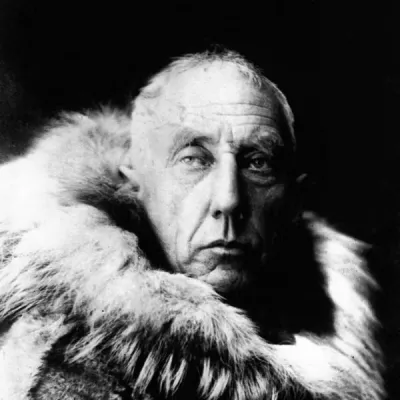
Roald Amundsen
Human Design Chart
Biography
Roald Amundsen as a Projector 4/6 in Human Design
Projector 4/6 — Design at a Glance
Roald Amundsen had a dense, focusing aura that allowed him to immediately identify system errors and weaknesses in his environment. As a projector, he did not have a constant intrinsic energy source but moved through rhythmic phases: periods of high intensity and rapid productivity alternated with necessary deep rest breaks. This structure required respect for his own pace to avoid exhaustion.
His strategy was not active correction of others but passive shining. Instead of presenting his observations directly – often uncomfortably like glaring light in the face – he let his competence shine through harmonious action. This created a natural attraction; his environment sought him out to benefit from his clarity. The key mechanism was waiting for an honest, appreciative invitation to lead. Only then could he exert influence effectively and without resistance.
If he did not live by this design and acted on self-initiative or ignored his need for recovery, bitterness appeared as a central non-self experience. However, if he followed the strategy of invitation and the rhythm of his energy, his actions were rewarded with success. His design thus tended towards precise diagnosis, whose effectiveness was fully dependent on passive attitude and recognition by others.
Splenic Authority
Roald Amundsen's design inclined him to immediate, instinctive orientation that showed as fine, spontaneous survival knowledge. His inner authority lay in the defined Spleen Center while Emotional and Sacral Centers remained open – a configuration only projectors or manifestors can have. The Spleen functioned here as health and alarm system: it delivered clear signals at any moment about whether a situation, environment, or society was beneficial or harmful.
The first spontaneous impulse served as the sole valid decision basis; it directly served physical integrity and enabled rigorous demarcation against negative influences. Since this spleen impulse was very fine and only occurred once in the moment, there was a risk that it could be drowned out by other thoughts or external voices. This required Roald Amundsen to maintain high vigilance not to miss the original signal; a temporary retreat could serve decision-making.
Due to this mechanism, long-term planning was difficult as what was right could change short-term. The design thus favored flexibility and free space over firm commitments. Roald Amundsen lived in dynamics that prioritized spontaneous adaptation to meet his own health and immediate well-being rather than orienting towards rigid future projections.
The 4/6 Profile — Opportunist / Role Model
Roald Amundsen's design was marked by the inner conflict between Heart (Line 4) and Head (Line 6). In his first thirty years, he intensely experimented in relationships and friendships as Line 6 still acted like a Line 3 at that time. This phase served to explore belonging.
After the Saturn Return, dynamics fundamentally shifted. The tension now showed itself between the desire for community connection (Line 4) and the need for distant reflection to think about life's meaning (Line 6). The Heart had to be careful not to get hurt by false connections. Simultaneously, an expectation developed towards him: to function as a wise role model through cooperation with others.
The sixth line allowed him to oversee processes and abstract insights from experiences. It was crucial that he let others participate in the growth process; denying this could lead to self-alienation. The fourth line also required time for inner processing before details were expressed outwardly. Roald Amundsen thus moved within the tension field between the tight network of relationships and the broad perspective of a teacher.
Split Definition — Defined & Open Centers
Roald Amundsen was marked by a constant, unbroken mental pressure. His design featured defined Head and Ajna Centers, indicating a continuous inspiration and the persistent questioning of connections. However, this mental energy was not directly linked to motors; acting on these thoughts directly led to frustration. Instead, it required waiting for the right moment and inspiring others to implement ideas.
In addition to this dominant mental activity, other defined centers provided stability: The G Center gave a reliable identity and direction, the Spleen Center intuitive safety in the present, the Root Center structural pressure to move forward, and the Throat Center clear communication channels. These elements were secondary to the primary mental energy but supported the ability to articulate concepts clearly.
The challenge lay in handling the mental pressure. The Non-Self tried to resolve this through hasty action or internal doubt. Roald Amundsen tended to confront his open Heart Center's need to prove his worth, often leading to a cycle of promises and disappointment. His open Sacral Center made him vulnerable to absorbing foreign energy, which led to exhaustion if he did not pause. Additionally, his open Solar Plexus absorbed the emotional moods of the environment, putting him at risk of identifying with non-own feelings and avoiding confrontations out of fear of rejection. The solution was to accept the mental process of confusion and clarity and trust in inner authority rather than fighting against the pressure or proving himself through overwork.
Channels for leadership, insight, clarity and transformation.
Roald Amundsen revealed himself as a leader whose authority was based on logical understanding of collective patterns. His design pointed towards leadership that did not rely solely on command but rather on offering tested and secure paths into the future. This was primarily expressed through Channel of the Alpha Animal 7-31: Gate 7 provided the logical role and the ability to recognize societal trends, while Gate 31 represented the voice of the collective leader. This configuration required that his leadership competence be recognized and actively invited by the community; without this approval from the "pack," his influence remained unused. He could show the way but did not have to go it alone – his success depended on being perceived as a reliable authority within existing patterns.
Parallel to this, Channel of Structuring 23-43 shaped how he communicated knowledge. Inspired insights from Gate 43 were processed through the assimilation and clear articulation of Gate 23. His innovative perspectives could only have transformative impact if they were communicated clearly and accepted by others; poor timing led to rejection of his ideas.
His thought process was characterized by Channel of Awareness 24-61: sudden inspirations (Gate 61) were rationalized (Gate 24), until knowledge became clear. This created a mutative spirit focused not on discovery but on the processing of inner truth.
Ambition and drive came from Channel of Transformation 32-54. The ambition of Gate 54 propelled him to improve his position, motivated by a desire for recognition. Gate 32 instinctively sought talents and support within the tribal context; his rise depended on confirmation by others who recognized and promoted his value. Additional facets like detail-oriented logic (Gate 62) or mystical innocence (Gate 25) rounded out this profile that relied on invitation, clear structuring, and tribe-based transformation.
Individual Circuitry — Circuit Signature
Roald Amundsen's Human Design shows two separate, parallel operating energy fields. One field connects the Head, Ajna, and Throat Centers: Here, the search for new, transformative knowledge drives forward, paired with the expression of a unique identity. This pulsating, acoustic energy fosters creative flashes of insight and emotional waves that bring change to the world. The Ajna Center stood at the focus of awareness.
Completely isolated from this was a second field: Spleen and Root Centers were connected by Channel 32-54. This part of the ego circuit did not concern itself with individual creativity but rather strategic resource management in the context of the trunk. It was about transformation, the balance between giving and taking, as well as the necessity of rest periods for energy regeneration. This conservative, probing nature stood in contrast to the impulsive energy of the knowledge circuit.
Furthermore, a channel from the Understanding Circuit connected the Throat with the Identity Center (Channel 31-7). This allowed for the expression of logical, rational insights – free from emotions and conditioned patterns – to lead society towards a better future.
Roald Amundsen thus lived with the tension between the generative power of new ideas and their emotional expression on one hand, and disciplined, resource-oriented transformation on the other. This split definition meant that these forces did not overlap but existed as independent systems alongside each other, each following its own logic.
Right Angle Cross of Maya 2
Roald Amundsen's design featured the structure of the 'Right Cross of the Maya 2'. This configuration defined a specific spiritual or existential architecture that remained content-wise undefined due to the lack of descriptive text in the raw data. Without mechanical details such as Gates, Channels, or Centers being provided, no concrete behavioral patterns could be derived from this position. The absence of interpretable mechanics within the given context significantly shaped the analysis. Without accessible information on how this Cross functioned, it remained unclear how this structure manifested in practical life or what internal dynamics it triggered. The design pointed to a deeper layer whose content was closed off. There were no indications as to whether this architecture led to specific actions or caused inner conflicts. Simply naming the 'Right Cross of the Maya 2' without further explanation left his character trait undefined. Roald Amundsen lived with this undefined structure in his chart, whose meaning could not be deduced from the available facts. The mechanics remained silent, and thus no connection could be made to external events or internal states. The lack of data was the defining characteristic of this aspect of his design.
Saturn Return · Uranus Opposition · Chiron Return — Life Cycles
Roald Amundsen's design indicated a tendency towards radical breaks that culminated in 1911 when he reached the geographic South Pole at age 39, marking the active Uranus Opposition Cycle. This astronomical passage often marks a moment of sudden success and liberation from the known. Amundsen's success was not gradual but disruptive, breaking old structures to establish a new reality. The energy of this opposition promoted the ability to break free from conventional paths and achieve groundbreaking goals.
This dynamic continued with his Chiron Return in 1920 when he reached Nome Harbor in Alaska at age 48 aboard the ship Maud before leaving it that May. The Chiron Return is not a process of healing wounds but rather an achievement cycle signaling the blossoming of one's incarnation purpose. Amundsen's arrival in Nome and his departure from the Maud were concrete manifestations of this professional transformation, marking the end of a long cycle and anchoring his life work into a new phase. The mechanics of this return confirmed that his previous steps had unfolded according to his strategy. This Return served not for repair but as affirmation of his lived path as an enlightening experience.
Projector · Splenic Authority — Synthesis
Roald Amundsen lived by a pattern of profound inner clarity, fueled by the combination of a mentally defined design – Head and Ajna Centers were firmly connected – with a Spleen Authority. This constellation allowed him to intuitively grasp situations and immediately assess what was right for him. The focus was on recognizing patterns (Gate 62) and the ability to translate these into clear, focused actions – a talent enhanced by the connection of Head with Throat Center. Concentration on details and logical processes was essential for his path, as well as the ability to distance himself from unnecessary influences and trust his own inner compass.
A central tension in his design lay between the need for independent thinking and an inherent capacity to lead others (Channel 31-7). He was not designed to be led by external expectations but rather to listen to his own inner truth. At the same time, he possessed the energy to serve as a role model and guide others into a specific direction – yet only when this aligned with his own internal guidance. This duality between autonomy and influence shaped his path and revealed itself in how he approached challenges and pursued goals.
4 Defined Channels
Incarnation Cross - Right Angle Cross of Maya 2
Solar Return
The Solar Return shows the moment when the sun returns to its exact birth position - your personal solar year.
Life Cycles
Discover the life cycles with a detailed triple view (birth chart, cycle chart, composite).
Human Design Profile
- Type
- Projector
- Strategy
- Wait for the respectful invitation
- Authority
- Splenic Authority
- Profile
- 4/6 - Opportunist / Role Model
- Definition
- Split Definition
- Incarnation Cross
- Right Angle Cross of Maya 2
- Date of Birth
- 16.07.1872 05:00
- Place of Birth
- Sarpsborg, Norge
Frequently Asked Questions
What was Roald Amundsen's Human Design type?
What Profiles did Roald Amundsen have?
What Authority did Roald Amundsen have?
What incarnation cross did Roald Amundsen have?
When was Roald Amundsen born?
Discover your own Human Design
Are you also a Projector? Find out in a personal reading how to unfold your leadership qualities and recognize the right invitations.
More Personalities
Back to overviewSissy Spacek

Alain-Fournier

Anémone

Ann-Margret

Bourvil
Hergé