
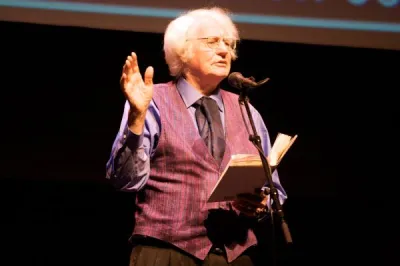
Robert Bly
Human Design Chart
Biography
Bly was born to parents of Norwegian descent. After serving in the U.S. Navy from 1944 to 1946, he received his bachelor of arts degree from Harvard University in 1950, and his master of arts degree from the University of Iowa in 1956. In 1958 he co-founded the magazine "The Fifties" (its name changed with the decades), which published important young poets. Bly's first collection of poems, "Silence in the Snowy Fields" (1962), was followed by "The Light Around the Body," which won a 1968 National Book Award. He published more poems and "prose poems" in volumes throughout the next decades. In 1966 he co-founded American Writers Against the Vietnam War and led much of the opposition to the war by writers.
In the 1980s his poems and work centered on men’s issues as explored in his best-selling "Iron John: A Book About Men" (1990). He made his living writing, editing, giving poetry readings around the nation and translating Scandinavian fiction. His second large prose book, "The Sibling Society," was the subject of nationwide discussion.
A tall and pleasant looking man, he frequently held workshops for men with James Hillman and others, and workshops for men and women with Marion Woodman. He and his wife Ruth, along with storyteller Gioia Timpanelli, frequently conducted seminars on European fairy tales. Bly avoided academia and the consumerist culture, preferring to live in the small town of Moose Lake, Minnesota on a farm with his wife and three children.
Bly died at his home in Minneapolis on 21 November 2021 at the age of 94.
Human Design Analysis: Robert Bly as Generator 3/6
Generator 3/6 — Design at a Glance
Robert Bly had a high, enduring sacral energy. His design characterized him as someone who used his strength most effectively when he responded to impulses from his environment rather than initiating independently. This configuration described the mechanics of the Generator type: The energy was primarily released when life sent a signal and Robert Bly responded with action.
This mechanism offered him enormous endurance, comparable to that of a workhorse, provided he had energy for his task. The central challenge lay in distinguishing between resonated and non-resonated activities. If he persistently carried out tasks he did not enjoy, wasted his energy, or was prevented from pursuing his heart's project when he still had plenty of power left, his system tended to burnout. Conversely, ignoring the inner urge to continue working also led to blockages.
The most successful strategy for him involved waiting for a signal from life and then acting when his sacral center clearly confirmed: "Yes! Let’s get started!" Living by this principle, he acted from the gut and found deep satisfaction as well as a sense of fulfillment. Deviations from it, especially constant initiating without an external impulse, eventually resulted in persistent frustration and a lack of energy. His design thus established that true effectiveness could only be achieved through reactive action and not by proactively forcing things.
Sacral Authority
Robert Bly oriented himself towards an inner, physical decision-making authority. As a Generator, his strategy was also his inner authority: Sacral Authority. This greatly simplified his orientation process. His leadership did not come from the Head Center but as a direct reaction to external stimuli. If his design showed an activation of the Spleen Center, which was also connected to the Sacral Center, he had quick and instinctive reaction capability. This allowed him immediate access to his physical well-being and reliable perception that he could trust.
The mechanics of this authority manifested in physical signals: a gut feeling or sudden surge of energy. Robert Bly learned to pay attention to these bodily noises – an approving "Mhm" or disapproving "Hmm". This resonance functioned as a reliable compass for his enthusiasm. When his sacral motor engaged with something, he felt vital and alive. Then he had an almost inexhaustible supply of energy that allowed him to tackle tasks with great zeal.
This design predisposed him to go through life with joy and contentment. He immersed himself in his activities without them needing to be strictly goal-oriented. The prerequisite for this clear sacral leadership was an open Emotional Center, meaning he could not make decisions based on emotional highs but acted from the stable level of his bodily resonance. So he lived out of the immediate confirmation of his body.
The 3/6 Profile — Martyr / Role Model
Robert Bly's Human Design profile features a two-phase development. In the first half of his life, up to around age 30, he was playful and experimental. This phase aligned with Line 3 of his Profile 3/6, which is oriented towards playful action and testing boundaries.
Only after his first Saturn Return, an astronomical event that recurs approximately every 29.5 years, did his inner dynamics fundamentally change. From this point on, Line 6 became active, bringing a need for withdrawal and reflection. The earlier carefree attitude now sought wise guidance to gain perspective. Robert Bly carried both the childlike desire to experiment and adult integrity within him. This duality often created a sense of being torn; while he may have appeared controlled outwardly, he felt internal pressure to find either more space to play or more time to reflect.
This tension did not resolve until around age 50. Through synthesizing both lines, he developed a charismatic role-model function. Over time, Line 6 bestows wisdom and the ability to teach. Robert Bly could then use his accumulated experiences to pave the way for others. His design thus described a process from playful uncertainty to integrated authority and clear projection of the future.
Triple Split Definition — Defined & Open Centers
Robert Bly's Human Design profile indicated a tendency towards constant, autonomous presence. His defined Ajna Center provided consistent, trustworthy thinking; he processed data and concepts in his own way, unaffected by external influences. This mental structure flowed into his defined Throat Center, allowing him to communicate his thoughts clearly and reliably. His defined G Center gave him a firm identity and inner direction; he knew who he was without becoming dependent on others. The energy source was provided by his defined Sacral Center: a vital force activated through reactions to life rather than intellectual initiatives. His defined Spleen Center offered spontaneous intuition for health and well-being in the present moment. The defined Root Center generated a steady pressure towards movement and stress management.
At the same time, Robert Bly was open and receptive in three areas. His open Head Center lacked consistent inspiration; it tended to absorb mental pressure and questions from others, leading to confusion if he interpreted these as his own tasks. His open Heart Center had no constant willpower; it was vulnerable to attempts to make promises or prove worth through performance, a cycle of self-doubt. His open Solar Plexus absorbed and amplified the emotions of his environment; he needed to learn not to personalize foreign moods as his own instability. The mechanics showed: Robert Bly possessed immense inner resources in thinking, voice, identity, and energy but faced the challenge of using external signals – doubts, will pressure, emotions – as mirrors rather than losing himself or owning them. His strength lay in applying his defined power while keeping open fields free to receive information without identifying with it.
Channels for rhythm, logic, structure and deep yes.
Robert Bly's Human Design profile indicated a tendency towards deep exploration of personal behavior. He lived his inner conviction to demonstrate self-love and independence, stemming from the Channel of Investigation 34-10 in his personality. Gate 34 provided the strength to hold onto personal beliefs while Gate 10 initiated self-behavior. By authentically reacting from his Sacral Center, he radiated a magnetic independence and exemplified the potential for complete self-love to others.
This focus on individuality was supported by the Channel of Rhythm 5-15. It connected his life energy with universal flow. Gate 5 held onto fixed habits while Gate 15 integrated societal diversity into this rhythm, giving him a unique sense of timing and vital connection to life that drew others into his energy flow.
Additionally, the Channel of Judgment 58-18 acted as a juxtapositional structure. It linked the drive for vitality (Gate 58) with the need for correction and perfection of patterns (Gate 18). This promoted an insatiable search for better solutions and the ability to question patterns to find satisfaction in the collective.
His design also included the Channel of Structuring 23-43. He processed spontaneous insights (Gate 43) through assimilation and clear expression (Gate 23), enabling him to formulate innovative perspectives that promoted efficiency and mutated others' thinking, provided he waited for the right moment to express them.
The Channel of Discovery 29-46 completed his profile. Through positive affirmation (Gate 29) and self-determination (Gate 46), he was poised to lose himself in experiences and gain deep insights through persistence that ultimately revealed their significance.
Collective Circuitry — Circuit Signature
Robert Bly's Human Design profile indicated a tendency towards firm inner anchoring, coupled with the ability to logically structure knowledge. His Triple Definition formed three separate energetic streams that existed parallel without directly flowing into each other.
The Centering Circuit connected his Sacral and Identity Centers through the Channel of Investigation. This created deep individual consistency and strong convictions, but often difficult to communicate externally due to a lack of connection to the Throat Center in this stream.
Parallel to this was the Knowledge Circuit. Here, the Channel of Structuring linked his Ajna with the Throat Center, allowing Robert Bly to clearly formulate and express intellectual insights and new knowledge, thereby initiating change through logical organization.
A third stream was the Understanding Circuit, which featured two isolated segments: The Spleen with the Root Center (Judgment) as well as the Sacral with the Identity Center (Rhythm). This added a strategic, future-oriented component that acted without emotional influence.
Finally, the Meaning-Finding Circuit through the Channel of Discovery reconnected his Sacral and Identity Centers. This stream referred to emotional reflection on past experiences, leading to wave-like dynamics. Robert Bly thus moved in the tension between his strong, not easily influenced inner anchoring and the need to carry this truth outward either through logical structuring or intuitive rhythms.
Right Angle Cross of the Vessel of Love 4
Robert Bly's Human Design configuration carried the signature of the right cross of the Love Vessel. This arrangement established a specific archetypal dynamic that was centered on the theme of 'Love Vessel.' It wasn't an individual trait in a narrower sense, but rather a deeper structural orientation within his Human Design. The cross acted as a framework that shaped certain emotional and interpersonal patterns. The emphasis lay on functioning as a container or space for love, implying that this energy was not primarily active outgoing but rather more receptive or holding. This structure created the foundation of how Robert Bly experienced relationships and emotional connection at an archetypal level. It was a constant component of his inner mechanics, working independently of external circumstances. The dynamics of this cross determined which themes were particularly relevant in his life without prescribing specific actions. Rather, it described the quality of energy flowing through his system. For Robert Bly, this was an integral aspect of his identity within the design, influencing how he loved and was loved. This archetypal imprint remained constant and formed a backdrop against which his personal life unfolded.
Saturn Return · Uranus Opposition · Chiron Return · 2nd Saturn Return — Life Cycles
In 1968, at age 42, Robert Bly experienced a significant turning point: He received the National Book Award for his poetry collection *The Light Around the Body*. This success coincided with the Uranus Opposition in his Human Design. This cyclical aspect marked a phase of breaking away from established structures. The energy was disruptive and called for a new orientation following previous stagnation. Instead of clinging to existing patterns, Robert Bly demonstrated the ability to suddenly break free from old molds. The award wasn't mere coincidence but rather the concrete expression of this unexpected breakthrough. The mechanics of the Uranus Opposition here created a rupture with the known in order to make room for something new. Robert Bly did not use this disruptive power for destruction, but as a catalyst for his artistic further development. His success confirmed that breaking free from old bonds was necessary to unleash his full potential. This phase left an enduring mark on him, showing how profound changes could become visible through external recognition. The stagnation preceding this event served as a necessary contrast, underscoring the value of subsequent liberation. Robert Bly demonstrated how cyclical turning points in Human Design structure concrete life stations and open up new paths.
Generator · Sacral Authority — Synthesis
Robert Bly lived a life deeply marked by his ability to receive internal impulses and translate them into creative expressions. His defined Sacral Center and sacral authority pointed to a strong energy source, which was only activated through external stimuli – constant reacting rather than initiating. This responsiveness combined with a firm G-Center, giving him clear direction and identity while also inclining him towards living his own inner truth and guiding others. The Channel of Rhythm (5/15) points to a life shaped by natural cycles, whereas the Channel of Exploration (34/10) emphasizes the need for continuous self-discovery and deepening experiences.
A central tension in Robert Bly's design lay between his capacity for profound self-discovery and the need to express these insights. While his defined Throat Center allowed clear communication, the connection to Ajna Center indicated a strong internal thought process that sometimes conflicted with spontaneous reactions. This dynamic between the desire for authentic expression and information processing created a paradox driving him continually to seek new paths of creativity and self-awareness – culminating in recognition through an award for his work in 1968.
5 Defined Channels
Incarnation Cross - Right Angle Cross of the Vessel of Love 4
Solar Return
The Solar Return shows the moment when the sun returns to its exact birth position - your personal solar year.
Life Cycles
Discover the life cycles with a detailed triple view (birth chart, cycle chart, composite).
Human Design Profile
- Type
- Generator
- Strategy
- To respond - wait for something to respond to
- Authority
- Sacral Authority
- Profile
- 3/6 - Martyr / Role Model
- Definition
- Triple Split
- Incarnation Cross
- Right Angle Cross of the Vessel of Love 4
- Date of Birth
- 23.12.1926 07:20
- Place of Birth
- Madison, MN, United States
Frequently Asked Questions
What was Robert Bly's Human Design type?
Which Profile did Robert Bly have?
What Authority guided Robert Bly?
What incarnation cross did Robert Bly have?
When was Robert Bly born?
Discover your own Human Design
Are you also a Generator? Find out in a personal reading how to use your sacral energy correctly and discover deep satisfaction.
More Personalities
Back to overviewAaliyah

Alain-Fournier

Alexia

Angèle

Angeli

Anne-Marie
