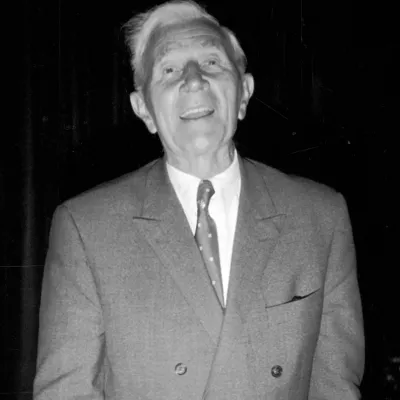
Rudolf Kinau
Human Design Chart
Biography
His brothers were Johann Kinau, who was also a writer known as Gorch Fock; and Jakob Kinau. He died on 19 November 1975, aged 88.
The Human Design of Rudolf Kinau: Generator 5/1
Generator 5/1 — Design at a Glance
Rudolf Kinau revealed himself as someone with remarkable inner endurance. His Human-Design type was the Generator, a configuration characterized by an active Sacral Center. This center functioned as a powerful energy reservoir, comparable to a workhorse that possessed immense physical and mental resources as long as it was motivated for its tasks. However, the functioning of this design did not lie in independent initiation of projects but rather in reacting to external impulses. Rudolf Kinau’s energy ignited most effectively when he responded to signals from his environment and received an inner “yes” as confirmation for the next step.
This strategy of responding was crucial for his well-being. When he acted in harmony with these sacral impulses, he experienced deep satisfaction and a sense of fulfillment. However, if he went against this natural pattern—such as by forcing himself to initiate things or completing tasks that did not resonate internally—his energy was at risk. The design warns of two specific dangers: burnout from wasting energy on inappropriate activities and frustration when hindered in his genuine heart projects despite having full power available. Rudolf Kinau’s life energy, therefore, was not a static reserve but a dynamic resource that gained its effectiveness through proper alignment with life itself.
Sacral Authority
Rudolf Kinaus Design set a tendency to make decisions not through intellectual analysis but through direct physical resonance. As a Generator, he had sacral authority – his inner guidance was identical with his strategy: to react to life. This configuration fundamentally simplified his decision-making process, as there was no separation between "how" and "if". A prerequisite for this clear signal transmission was his open Emotional Center; he did not need an emotional distance or long waiting periods to verify the validity of an impulse. Instead, his truth manifested in immediate physical reactions to external stimuli: as a gut feeling, a surge of energy, or audible expressions like grunts or affirmations. Such a positive signal gave him vitality and inexhaustible energy; he then approached matters with great enthusiasm, driven by joy in the act itself, not from purposefulness. Additionally, his activated Spleen Center acted as a supportive instance. It enabled quick, spontaneous reactions and a reliable instinctive access to physical well-being. Rudolf Kinau could thus be directly and intuitively guided without falling into hesitant deliberations. His authority resided in the defined Sacral Center; this sacral voice always took precedence over all other defined Centers, regardless of their content or urgency. It clearly and unequivocally determined the direction of his actions.
The 5/1 Profile — Heretic / Investigator
Rudolf Kinau revealed himself as someone who gathered deep knowledge to offer it to others for problem-solving. His design as a 5/1 – Hero/Researcher – established a specific dynamics: Line 1 drove him to recognize correcting patterns through experimenting and loving life. This inner research work formed the basis for his outer impact.
Line 5 functioned here as a projection line. Other people projected onto him the ability to heal or solve their problems. Kinau was magnetically drawn to, as his environment knew he offered valuable treasures. However, this led to a constant danger of overloading. Without clear boundaries, he risked becoming like a scientist who endlessly answered questions until he was drained. His design therefore demanded the learning process of withdrawal and self-awareness. Only through recognizing inner connections could he free himself from conditioned dependencies and heal.
The balance between his private research drive (Line 1) and public problem-solving (Line 5) was crucial. Kinau had to learn to say no in order to protect his energy. His zest for life and mindfulness were necessary to maintain the cyclical quality of his authority and avoid frustration. This way, he could optimally utilize his gifts without sacrificing himself.
Single Definition — Defined & Open Centers
Rudolf Kinau's Human Design profile indicated a tendency towards a stable, magnetic presence. His defined G Center provided him with a reliable sense of self-identity and a clear direction in life. This inner security allowed him to naturally attract others without being dependent on their validation. He had the ability to offer comfort and show new perspectives or love to people because he was deeply connected to his higher self. However, when he did not trust his inner authority, he tended to prescribe paths for others; the dilemma was that he could not control whether others would follow this path or wanted to.
His defined Sacral Center generated a tremendous vital energy daily, experienced as a constant hum or restlessness. For Rudolf Kinau, it was essential to activate this power by reacting to external questions – a clear 'yes' signaled available energy, while a 'no' protected against overloading. Initiating actions without prior invitation often led to frustration and exhaustion because the sacral connection was broken.
Additionally, his defined Spleen Center influenced his decisions through spontaneous intuition and present-moment body awareness. This instinctive authority helped him recognize health-promoting situations immediately and protect himself from danger. His defined Root Center provided the necessary adrenalized pressure to push forward in the material world and master existential challenges.
In contrast, Rudolf Kinau's open centers showed specific vulnerabilities. The open Head and Ajna Centers made him susceptible to mental confusion and the pressure of finding answers to questions that were not his own. He tended to get lost in intellectual monologues or accept false opinions as truth. His open Heart Center lacked consistent willpower; he easily fell into a cycle of making promises and failing to keep them, which damaged his self-esteem. The open Solar Plexus Center absorbed foreign emotions, causing him to fluctuate between happiness and depression without identifying these feelings as their own. Finally, his open Throat Center drew attention by intensifying the urge to speak; he had to learn to wait for invitations rather than seeking recognition on his own.
Channels for transformation, life purpose and persistent discovery.
Rudolf Kinau's Human Design profile indicated a tendency towards profound, often unexpected transformation. Channel of Mutation 60-3 connected his Root and Sacral Centers, generating pulsing energy that oscillated between melancholy and evolutionary breakthroughs. This configuration required patience: Kinau had to learn to accept limitations (Gate 60) and move beyond the confusion of a new beginning (Gate 3), without disrupting the process through rational analysis. The energy worked like music – sudden and in the pauses between pulses – making him an innovator who endured internal tension when change was delayed.
Parallel to this, he showed stubborn determination to follow his own path. Channel of Life Struggle 38-28 connected his Root and Spleen Centers, driving him to find meaning in daily struggles. Gate 38 exerted pressure to defend individual integrity against external distractions, while Gate 28 endowed intuitive ability to recognize which struggle was truly worthwhile. This combination made him an individualist willing to risk security for values he felt were genuine.
Another defining aspect was his dedication to long-term discovery processes. Channel of Discovery 29-46 connected his Sacral and G Centers, promoting deep persistence. Through Gate 29, he reacted positively to experiences in which he became fully immersed, while Gate 46 kept him at the right place at the right time. This mechanism required letting go of all expectations and having patience with processes that could take years before revealing their significance.
Additionally, individual Gates influenced his spiritual stance: Gate 25 promoted mystical innocence and centeredness, while Gate 58 in his Root Center encouraged experiments to perfect patterns. Gate 52 supported the ability for concentrated pauses and pattern correction. Further influences came from Gate 54 (connection of worldly success and spirituality), Gate 5 (fundamental rhythm and habits) as well as Gate 50 (protective reflex and tradition).
Individual Circuitry — Circuit Signature
Rudolf Kinau's Human Design profile indicated a tendency towards inner stability, coupled with the drive to forge his own path. His simple definition connected his Sacral, Root, Spleen, and Identity Centers into a cohesive energetic flow. In the Knowledge Circuit, Channels of Mutation (3-60) and Life Struggle (28-38) were active in him, linking his Sacral Center with his Root Center and Spleen. The energy of this connection promoted deviation from the known as well as the will to push through resistance to gain new insights. Parallel to this, he showed in the Meaning Circuit the connection between Identity and Sacral Centers via Channel of Discovery (46-29). This current channeled emotional waves from his Solar Plexus Center – here interpreted as part of the Identity Center – into the powerful expression capacity of the Sacrum. Rudolf Kinau used this configuration to reflect on past experiences and share derived meaningfulness with others. The combination of impulsive creativity of Spleen, urgent energy of Root, and rhythmic power of Sacral shaped his way of not only thinking about changes but bringing them into the world through persistent action. His identity was directly linked to his life force, enabling an authentic, inner-rhythm-based presence.
Left Angle Cross of Healing 1
Rudolf Kinau's Human Design indicated a profound tendency towards inner transformation and the desire for wholeness. As the holder of the left healing cross, he was someone whose life path was marked by a strong impulse not only to understand his own wounds but also to transform this experience into something useful for others. This configuration described a specific kind of development: it often began with an intense phase of inner work and self-reflection in which Rudolf Kinau had to learn to accept his patterns and injuries rather than suppress or fight them.
The mechanics of this cross emphasize that true healing does not lie in the absence of pain, but in the complete integration thereof. Rudolf Kinau's chart pointed towards his greatest strength being the ability to carry this personal journey of overcoming and understanding outwardly. He was called upon to show through his own example how personal weakness or injury could become a source of strength and empathy. This did not happen through theoretical knowledge alone, but through the lived practice of acceptance and letting go. His design challenged him to share this inner clarity and resulting empathy with others, thereby unconsciously or consciously acting as a catalyst for their healing processes.
Saturn Return · Uranus Opposition · Chiron Return · 2nd Saturn Return — Life Cycles
Rudolf Kinau's Human Design indicated a tendency towards internal structuring and the search for solid foundations. He was someone who did not immediately carry impulses outwardly but condensed them within himself until they took on a clear form. This attitude became particularly effective during his first Saturn return, marking typically the transition from an experimental phase to a serious engagement with one's life task and responsibility. At 29 years old in 1916, Kinau wrote his first story: an obituary for his older brother Gorch Fock. This event highlighted the mechanics of the Saturn return as a moment of condensation. Years of inner preparation and emotional experiences were here summarized into a concrete, tangible result – not through spontaneous impulsiveness but by consciously holding onto a moment in a stable structure – in this case, through writing. The obituary served as an expression of a deeper order that Kinau developed from personal losses and family bonds. His design thus promoted a kind of self-discovery where external events only gained their full meaning through inner reflection and structural integration. This process of solidification shaped his further development towards a clear positioning in his creative work.
Generator · Sacral Authority — Synthesis
Rudolf Kinau lived deeply rooted in his sacral center (Generator type), a source of inexhaustible energy that was, however, bound to the right task. His profile as Hero and Researcher (5/1) points to someone who collected knowledge and wanted to make it available to others – a process marked by a desire for depth and the magnetic attraction of his wisdom. This tendency towards learning and problem-solving was further strengthened by the channel of Mutation (3/60), which repeatedly led him to new paths and deviations from the norm. The ability to accept limitations and emerge from confusion was central to his development.
A central tension field in his design lay between the drive for deep exploration (Line 1) and the resulting burden through constant demand for his solutions (Line 5). The energy of the knowledge circuit, combined with a defined identity, created a pulsating expression of creativity and individuality. At the same time, the left healing cross indicated a tendency to heal himself and support others through his experiences, while an event at age 29 (first published work) marked the beginning of a life's work that was shaped by the transformation of knowledge.
3 Defined Channels
Incarnation Cross - Left Angle Cross of Healing 1
Solar Return
The Solar Return shows the moment when the sun returns to its exact birth position - your personal solar year.
Life Cycles
Discover the life cycles with a detailed triple view (birth chart, cycle chart, composite).
Human Design Profile
- Type
- Generator
- Strategy
- To respond - wait for something to respond to
- Authority
- Sacral Authority
- Profile
- 5/1 - Heretic / Investigator
- Definition
- Single Definition
- Incarnation Cross
- Left Angle Cross of Healing 1
- Date of Birth
- 23.03.1887 16:00
- Place of Birth
- Hamburg, Germany
Frequently Asked Questions
What was Rudolf Kinau's Human Design type?
What Profile did Rudolf Kinau have in Human Design?
Which Authority guided Rudolf Kinau?
What incarnation cross was assigned to Rudolf Kinau?
When was Rudolf Kinau born?
Discover your own Human Design
Are you also a Generator? Find out in a personal reading how to use your sacral energy correctly and discover deep satisfaction.
More Personalities
Back to overviewAaliyah

Alain-Fournier

Alexia

Angèle

Angeli

Anne-Marie