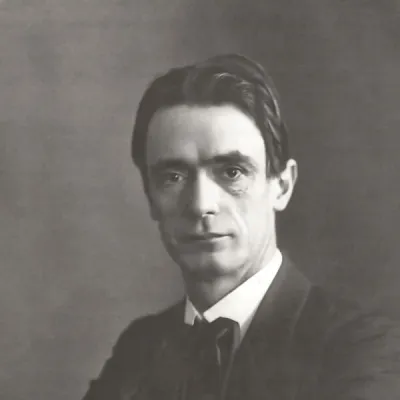
Rudolf Steiner
Human Design Chart
Biography
In the first, more philosophically oriented phase of this movement, Steiner attempted to find a synthesis between science and spirituality by developing what he termed "spiritual science", which he sought to apply the clarity of thinking characteristic of Western philosophy to spiritual questions, differentiating this approach from what he considered to be vaguer approaches to mysticism. In a second phase, beginning around 1907, he began working collaboratively in a variety of artistic media, including drama, dance and architecture, culminating in the building of the Goetheanum, a cultural centre to house all the arts. In the third phase of his work, beginning after World War I, Steiner worked on various ostensibly applied projects, including Waldorf education, biodynamic agriculture, and anthroposophical medicine.
What does Generator 2/4 mean for Rudolf Steiner?
Generator 2/4 — Design at a Glance
Rudolf Steiner revealed himself as someone who channeled his power not through initiated impulses but rather through reactive responses to external stimuli. As a Generator, he possessed immense sacral energy that endowed him with great endurance – comparable to a workhorse that only unleashes its full potential when motivated for the task at hand. His design dictated that this energy was primarily unleashed when he responded to signals from his environment and affirmed his inner center: “Yes! Let’s get started.”
This mechanism meant that Steiner did not act as an Initiator but rather reacted with action to existing requests or circumstances. If he lived in harmony with this reactive strategy from the gut, his system rewarded him with a deep sense of satisfaction and fulfillment. However, if he tried to work against this principle – for instance by initiating independently or doing things without inner desire – it inevitably led to frustration and a noticeable lack of energy. The danger always lay either in wasting energy on unwanted tasks, which could lead to burnout, or being held back from his heart project despite the internal power still being present. His effectiveness thus depended crucially on whether he maintained this reactive strategy and only deployed his enduring strength when the sacral center clearly consented.
Emotional Authority
Rudolf Steiner's inner authority was emotionally marked. His defined Solar Plexus Center determined his decision-making: He was constantly swept by waves of emotional ups and downs. The world appeared to him always colored by the current mood; enthusiasm could quickly turn into negative evaluation. However, this emotional snapshot was not automatically his truth. Quick, spontaneous decisions that directly emerged from such a feeling state often proved problematic for him.
The mechanics of his emotional authority required patience and time. Since the Solar Plexus Center carried the inner authority, it always took precedence over other defined centers in his design. To gain clarity, he had to let decisions mature, often through multiple nights' reflection. Only when intense feelings subsided and an emotional distance emerged did calmness set in. This process was essential for long-term shifts with significant influence on his life course. Rudolf Steiner thus showed himself as someone who reached deeper insight through a conscious handling of his emotional dynamics by postponing immediate impulsiveness in favor of a delayed, clear decision.
The 2/4 Profile — Hermit / Opportunist
Rudolf Steiner's design laid out a tendency towards tension between solitude and community. He revealed himself as someone constantly swinging between the need to be alone (Line 2) and the desire to spend time with his favorite people (Line 4). For him, it was therefore essential to create a safe environment where he could clearly communicate: when he sought company and when he wanted to remain undisturbed. During his “Me-Time,” he immersed himself in internal processes to gain clarity. Once this need was satisfied, he emerged from his “cave” to exchange with his network. This configuration allowed him to reflect on the knowledge of his network during alone time and develop brilliant ideas from it. The second line of Gate 37 projected an unawareness of his actual abilities outwardly and emphasized individual responsibility in an organic community. He often understood little about family values and had to feel a sense of belonging to access resources. At the same time, Gate 9, Line 4, acted as a transpersonal line for externalization and influence. Under stress, it demanded disciplined detail handling and concentration on one point. The focus was in skipping details and the urge to externalize things without all the specifics. This interplay shaped his way of processing and disseminating knowledge.
Triple Split Definition — Defined & Open Centers
Rudolf Steiner showed himself as someone who was under constant mental pressure to ask questions and understand connections. This tendency resulted from his definition between Head Center and Ajna Center: His mind was always active in creating concepts but lacked the personal energy for direct implementation. He was designed to inspire others to think, rather than taking the first step himself.
His willpower came from his defined Heart Center. This gave him a firm structure in dealing with resources and promises; he liked to determine his life himself and keep his word. This was complemented by his defined Sacral Center as a Generator: He possessed an enormous vital energy source, which was only available when he responded to external stimuli rather than initiating action. His inner authority lay in the Solar Plexus; he made decisions after waiting for the emotional wave to gain clarity. Additionally, he had a defined Spleen Center, which gave him spontaneous intuition for health and well-being in the present moment.
In contrast, his Throat Center was open. He tended to seek attention or feel pressure to speak when not listening to his inner guidance. His open G Center meant that he did not have a fixed identity but reflected it from the environment; he relied on others to initiate directions for him. Finally, his open Root Center absorbed external stress and adrenaline from the environment. Rather than using this pressure as personal drive, he had to learn to recognize it and not take it on through hyperactivity in order to avoid exhaustion.
Channels for clarity, care and communal connection.
Rudolf Steiner revealed himself as someone whose mind was geared towards processing sudden insights and pouring them into a rational structure. This resulted from Channel 61-24, which connected the Head Center with the Ajna Center. Here, the drive to know the unknown transformed through the inspiration of Gate 61 and the rationalization of Gate 24 into an individual way of thinking. His mind did not seek logical patterns for the future or abstract reflections on the past; instead, it waited for the moment of mutation – a Satori, in which knowledge simply arrived. Steiner did not control this thinking; he surrendered to the inner truth that emerged at its own pace while his mind was engaged with the "white noise" of inspiration.
Parallel to this, a deep energy for care and preservation worked through Channel 27-50. This channel connected the Sacral Center with the Spleen Center and urged him to tend to what had been created. Through Gate 27 (Care) and Gate 50 (Values), he showed selfless interest in preserving tribal values and laws that fostered order and enriched life. His aura automatically drew trust; people sought his support for nourishment and protection. He intuitively understood that true care begins with first properly caring for oneself – a form of "enlightened selfishness" – as only someone who is healthy can effectively support others.
Additionally, Channel 37-40 shaped his interpersonal actions. It connected the Solar Plexus Center with the Heart Center and emphasized the necessity of clear, fair agreements. Steiner sought his place in a larger whole (Gate 37) and was willing to work for those he loved but also needed breaks and recognition (Gate 40). He understood that genuine community bonds cannot be formed spontaneously but must be carefully considered and formulated over time so they are beneficial for all involved. His energy focused on the needs of the group, less through material goods but rather through working together side by side.
Individual Gates like 9 (Detail Work), 16 (Experimenting) and 34 (Power/Integration) underscored his ability to perfect through repeated experiments as well as his charisma that required guidance not to be used indiscriminately.
Tribal Circuitry — Circuit Signature
Rudolf Steiner's design featured a tendency towards pulsating, acoustic creativity. This energy source originated from the Knowledge Circuit, which connected his Head and Ajna Centers. Here it was about his innate path and gaining new knowledge. Through the Channel "Awareness" (Gates 24–61), innovative flashes of insight emerged, promoting deviations from the known.
Parallel to this, the Ego Circuit, connecting Heart and Solar Plexus Centers, played a role in core energy and involved cooperation as well as the joint creation of resources. The Channel "Community" (Gates 37–40) regulated a fair balance between giving and taking. Since there was no connection to the Sacral Center, rest periods were necessary to provide energy for these support tasks.
A third, separate stream formed with the Sharp-Shooter Circuit, which connected the Sacral and Spleen Centers. This primal configuration served to protect survival and preserve the family. The Channel "Conservation" (Gates 27–50) took care of nurturing, care, and sustenance.
As a Triple Defined individual, Rudolf Steiner had three such parallel, non-directly connected energy fields. Creative intelligence in his Head Center, social support in his Heart Center, and instinctive protective drive in his body existed alongside each other as separate yet simultaneous realities in his design.
Right Angle Cross of Planning 1
Rudolf Steiners design points to a tendency towards strategic and long-term thinking. He was someone who did not act impulsively but rather developed plans and pursued them with patience. This attitude stems from the right cross of Planning 1, a configuration often associated with a deep sense of structure and organization. In Human Design terms, this means that the energy of his system flows towards clear goals and well-thought-out processes. Rudolf Steiner lived out this trait by carefully preparing his ideas and implementing them step-by-step. His approach was methodical; he sought ways to make complex concepts understandable without losing the depth of content. The mechanics of this cross support a type of leadership based on preparation. It is not about reacting quickly but waiting for the right timing and then proceeding with care. Rudolf Steiner used this ability to transform his visions into concrete projects. His work was characterized by a certain consistency; he continuously built upon his concepts without being easily swayed by external circumstances. This created a foundation for sustainable developments that extended beyond the immediate moment. Thus, his design promoted an influence based on patience and strategic deliberation.
Saturn Return · Uranus Opposition · Chiron Return · 2nd Saturn Return — Life Cycles
Rudolf Steiners design points to a tendency towards intellectual condensation and later public recognition. In 1891, at age 30, he earned his doctorate in Rostock with the work 'The Fundamental Question of Epistemology'. This marked his first Saturn Return, a cycle where years of groundwork often culminate in a solid result that strengthens one's structure.
Ten years later, in 1901 at age 40, his book 'Mysticism on the Rise of Modern Spiritual Life' was published. This time coincided with the Uranus Opposition, a phase often marked by unexpected breaks or new perspectives and challenges to established patterns. Here, an opening to new intellectual currents was evident.
In 1911, at age 50, Anna Steiner-Eunike died in Berlin-Lankwitz. This coincided with his Chiron Return. In Human Design mechanics, this cycle is not a moment of wound healing but rather a phase of fulfillment and bloom where one's incarnation cross unfolds and meaning becomes experiential. The death of a close person during this period underscores the deep transformation and shift in life perspective that characterized this era.
Generator · Emotional Authority — Synthesis
Rudolf Steiner lived deeply rooted in his Generator nature (design), always driven by sacral energy marked by endurance and creative power. This energy found expression in the Knowledge Circuit – an ongoing search for new insights, transforming them, and sharing them with others. The defined Head and Ajna Centers (Channels/Gates) provided a constant mental pressure to question and understand the world through inspiration and rationalization, which was reflected in professional success (Saturn Return, 1891). However, emotional authority required time for decision-making, allowing impulses to mature into clarity.
A central paradox lay in the tension between the need for withdrawal and community (Profile 2/4). Steiner oscillated between internal processes that clarified his understanding and a desire to share his insights with others – a dynamic amplified by the right cross of Planning. This inner conflict was also evident in emotional waves (Authority) influencing him, but ultimately leading to knowledge mutation and transformation (Circuit).
3 Defined Channels
Incarnation Cross - Right Angle Cross of Planning 1
Solar Return
The Solar Return shows the moment when the sun returns to its exact birth position - your personal solar year.
Life Cycles
Discover the life cycles with a detailed triple view (birth chart, cycle chart, composite).
Human Design Profile
- Type
- Generator
- Strategy
- To respond - wait for something to respond to
- Authority
- Emotional Authority
- Profile
- 2/4 - Hermit / Opportunist
- Definition
- Triple Split
- Incarnation Cross
- Right Angle Cross of Planning 1
- Date of Birth
- 25.02.1861 23:15
- Place of Birth
- Donji Kraljevec, Croatia
Frequently Asked Questions
What was Rudolf Steiner's Human Design type?
What Profile did Rudolf Steiner have in Human Design?
What authority did Rudolf Steiner have?
What incarnation cross did Rudolf Steiner have?
When was Rudolf Steiner born?
Discover your own Human Design
Are you also a Generator? Find out in a personal reading how to use your sacral energy correctly and discover deep satisfaction.
More Personalities
Back to overviewAaliyah

Alexia

Angèle

Anne-Marie

Arcángel

Arno