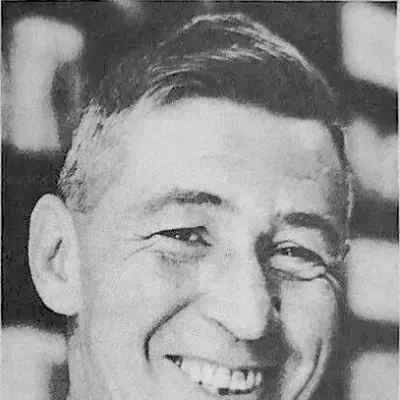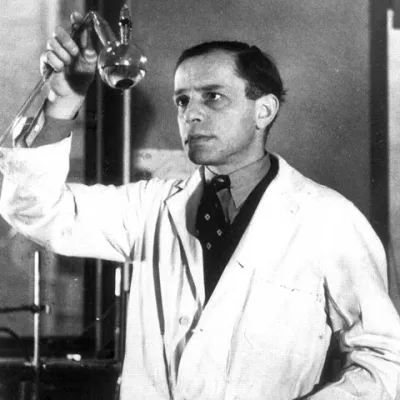
Rudolph Schoenheimer
Human Design Chart
Biography
After graduating in medicine from the Friedrich Wilhelm University in Berlin, he learned further organic chemistry at the University of Leipzig and then studied biochemistry at the University of Freiburg where he rose to be Head of Physiological Chemistry.
He spent the 1930-1931 academic year at the University of Chicago.
In 1933, following the rise of the Nazis to power he emigrated from Germany to the Columbia University to join the department of Biological Chemistry. Working with David Rittenberg, from the radiochemistry laboratory of Harold C. Urey and later together with Konrad Bloch, they used stable isotopes to tag foodstuffs and trace their metabolism within living things.
He suffered from manic depression all of his life, which led to him committing suicide using cyanide on 11 September 1941, aged 43.
Rudolph Schoenheimer as a Projector 2/4 in Human Design
Projector 2/4 — Design at a Glance
Rudolph Schoenheimer appeared as someone who interacted with his environment through a dense, focused aura. His Human Design type was Projektor (Projector), a configuration without an intrinsic constant life energy source in the sacral center. This meant that he had phases of available energy: times of high intensity and speed alternated with necessary rest periods for regeneration. Without these pauses, there was a risk of burnout because his system was not designed for continuous strain.
His specific role was to bring 'light into darkness' for others. He possessed the ability to immediately recognize flaws in systems or people – similar to a bright flashlight that is directed at dark spots. However, this direct confrontation with shortcomings could be perceived as unpleasant or aggressive when he actively addressed them. Therefore, his most effective strategy was not to seek out or push himself but rather to wait for an honest and appreciative invitation from others.
By waiting for such invitations and instead simply radiating his own harmony, he became attractive. Others came to him of their own accord to seek advice. If Rudolph Schoenheimer lived according to this principle of patience and waiting for recognition, he was rewarded with success. Ignoring this strategy and trying to impose his insights against the resistance of his environment led sooner or later to his non-self theme: bitterness. His design thus demanded respect for his boundaries and the art of gentle influence rather than direct correction.
Splenic Authority
Rudolph Schoenheimer showed a basic attitude based on immediate, intuitive perception: his inner system signaled in each moment whether a situation or environment was healthy for him. This ability stemmed from his authority in the spleen center, which functions as a health and alarm system. For this specific internal guidance to be effective, both his emotional and sacral centers were open; a configuration that only Projectors or Manifestors can have.
His survival intelligence manifested as spontaneous knowledge of what was right. Physical well-being and intuition served as reliable indicators for the fit of situations. Decisions therefore had to be made in the moment; the first impulse was the correct path for self-care and rigorously protected him from harmful influences. Since this spleen impulse was very subtle and only occurred once, it required high vigilance not to let it be drowned out by other voices. A brief retreat could be helpful during decision-making.
Since what was right became apparent only in the moment, plans often changed frequently. Long-term commitments were difficult for this design; instead, he needed a lot of space and flexibility to act spontaneously without unnecessarily restricting himself.
The 2/4 Profile — Hermit / Opportunist
Rudolph Schoenheimer lived in a constant interplay between the urge towards isolation and the need for community. His Profile 2/4 created an inner tension: on one hand, he withdrew into his 'cave' to gain clarity; on the other hand, he sought connection with his favorite people. This dynamic required him to clearly communicate his boundaries – when he needed company and when he needed solitude. In solitary time, he reflected on the knowledge of his network, which often led to brilliant ideas.
At the same time, a strong need for individual self-defense characterized him. His configuration signaled: where he was individually unique, no one else could interfere. This concerned less physical survival than protecting his uniqueness from external interference. As a child, he may have experienced that it could be dangerous to express a new truth or difference. The second line in his design projected outwards that he 'knew' what often met with resistance – for example through devaluing comments like 'shut up'.
The fourth line of his structure drove him to carry these principles outward and find support for revolutionary changes or human rights. He strove to reach the outside world and implement his program. However, this orientation also carried the risk of taking immature forms where promises were made without being fully kept. His life was thus marked by the struggle to maintain individuality against interference and the desire to make his insights effective in the community.
Single Definition — Defined & Open Centers
Rudolph Schoenheimer's design indicated a tendency towards continuous, structured thinking. His defined Ajna Center ensured constant mental activity; concepts and theories were his reliable compass. He was not easily distracted by others' opinions as his mind possessed a firm internal authority. These thoughts flowed directly into his communication: The also defined Throat Center allowed him to clearly and reliably express what he conceptualized. His voice was the expression of his mind, not impulsive moods.
At the same time, he had a defined Spleen Center. This gave him spontaneous, intuitive bodily intelligence. He tended to judge in the 'now' and trust subtle warning signals or intuitions that regulated his survival and well-being. However, this intuition was not rationalizable; it worked as an immediate existential truth that he had to follow to stay healthy.
This firm inner self contrasted with his open centers. His open Head Center made him vulnerable to mental pressure and the questions of others. He tended to dwell on doubts that were not his own and sought inspiration to resolve this confusion. His open G Center lacked a fixed identity; he adapted to people and places he encountered, finding direction only through correct environments. Additionally, his Heart Center was open, making him prone to threats to self-worth by proving worth through promises. His open Sacral and Solar Plexus Centers as well as the open Root Center made him sensitive to foreign energies: He absorbed stress, emotions, and vitality from the environment, which could lead to exhaustion if he did not recognize these as 'foreign'.
Channels for clear structure, deep intuition and mastery.
Rudolph Schoenheimer showed himself as someone who combined intuitive depth with technical precision. His design indicated a tendency to perfect skills through repeated experimentation and practice. This occurred via Channel 48-16: Gate 48 sought vital information from inner intelligence, while Gate 16 translated this into concrete dexterity. Through dedication, he transformed pure technique into talent, using recognition and resources as fuel for this perfection process.
Parallel to this, Rudolph Schoenheimer had the ability to formulate unique perspectives. The Channel of Structuring 43-23 connected his Ajna Center with his Throat Center. Here, Gate 43 received spontaneous insights and breakthroughs that were then assimilated and clearly expressed through Gate 23. This configuration required patience: His innovative thinking often felt light-years ahead. Only when the timing was right and explanations simple enough did his knowledge gain acceptance by the collective, leading to mutative changes in process efficiency.
Additionally, other gates influenced him. Gate 49 in the Solar Plexus Center steered his emotional wave during upheavals and principles, often tied to sacrifice for the tribe. Gate 4 allowed him to develop formulas to clarify suspicious patterns, creating future security. Gate 17 brought logical teaching and organization for the future, with true understanding taking precedence over blind adherence. Gate 56 contributed to abstracting mental processes by translating them into figurative narratives. Finally, Gate 35 promoted change through interaction, while Gate 45 gathered energy at tribal level and expressed willpower. This combination shaped a person who not only sought deep knowledge but also structured and perfected it.
Individual Circuitry — Circuit Signature
Rudolph Schoenheimer's design showed a clear, coherent energetic structure. As a simply defined individual, he had a continuous flow between the Ajna, Throat, and Spleen Centers. This connection marked his way of processing and conveying information: from analytical thinking in the Ajna Center to concrete articulation in the throat, supported by intuitive selection in the spleen.
The Knowledge Circuit worked through him via Channel 43-23 (Structuring). This connected the Ajna with the Throat Center directly. It was not about emotional waves or spontaneous inspiration from other parts of this circuit but rather the ability to structure and clearly formulate thoughts. Rudolph Schoenheimer could thus translate complex ideas into understandable language without focusing on individual mutation or creative chaos.
Parallel to this, the Understanding Circuit worked through Channel 16-48 (The Wavelength). This connected the Throat Center with the Spleen. Here, there was a tendency to share logical insights and strategic approaches – free from emotional coloring as the Solar Plexus Center was not involved. The Spleen ensured that only the most relevant knowledge was selected before articulation.
Both circuits converged in the Throat Center. This created an efficient line: Intuitive selection (Spleen) flowed into articulation, while structured thinking (Ajna) underpinned this. Rudolph Schoenheimer thus lived as someone who not only understood rational strategies and intuitive truths but also communicated them precisely and purposefully – a direct connection of analysis, selection, and expression.
Right Angle Cross of Explanation 2
Rudolph Schoenheimer carried the design of the right cross of revelation. This configuration shaped a fundamental attitude aimed at clarity and uncovering connections. In Human Design, this pattern represents the ability to penetrate complex issues and make them accessible to others in a way that they can be understood. It is not just about conveying information but achieving deeper insight that resolves misunderstandings and creates awareness.
Schoenheimer demonstrated himself as someone who utilized this energy to bring hidden truths to light. His focus was on presenting things so their essence becomes clear. This requires a specific kind of intelligence and communication that does more than analyze; it also explains. Through this process, he contributed to others gaining new perspectives and expanding their own understanding.
The mechanics of this design thus support the role of an explainer or enlightener. It helps bring order out of chaos and replaces uncertainty with clear insights. For Rudolph Schoenheimer, this was a central aspect of his expression and impact.
Saturn Return · Uranus Opposition — Life Cycles
Rudolph Schoenheimer's life path was marked by clearly structured phases. His design indicated a tendency towards set milestones often accompanied by external recognition or positioning. This became visible in 1926 at the age of 28 when he became an assistant at the University of Freiburg – a typical moment of his first Saturn return, where years of groundwork condensed into a solid professional result.
Later, another dynamic force came into play: the Uranus opposition. This configuration often brings sudden upheavals or the end of old structures when internal tensions can no longer be integrated. For Rudolph Schoenheimer, this phase began in 1941 at the age of 43. Instead of starting a new life stage, his life ended through suicide. This underscores the sharp edge of this astrological passage: it forces radical realignment or breakdown if the pressure overloads the system. His design thus contained both the potential for stable anchoring and the danger of an abrupt collapse under extreme internal stress.
Projector · Splenic Authority — Synthesis
Rudolph Schoenheimer lived deeply in observation and understanding of complex systems. As a projector with defined mental center (Ajna) and Channel Wave Length (Gate 48/16), he quickly identified errors and potentials, projected this knowledge onto his environment, and sought opportunities for refinement and correction. This ability, coupled with the Spleen authority, pointed to a strong instinctual understanding of how things work – an inner compass that gave him reliable impulses when something was right or wrong. The profile as a natural talent and networker reinforced this impulse by emphasizing both the need for introspective engagement and the desire for exchange with others.
A central paradox in his design lay in the interplay between projection and withdrawal. He was destined to shed light into darkness and inspire others, yet simultaneously needed phases of isolation (Line 2) to deepen his own processes and gain clarity. This tension between the need for connection and the desire for solitude created an inner dynamic that was further intensified by the emotional-sacral openness of the Spleen center – a constant balancing act between spontaneous impulses and the necessity to protect against overstimulation.
2 Defined Channels
Incarnation Cross - Right Angle Cross of Explanation 2
Solar Return
The Solar Return shows the moment when the sun returns to its exact birth position - your personal solar year.
Life Cycles
Discover the life cycles with a detailed triple view (birth chart, cycle chart, composite).
Human Design Profile
- Type
- Projector
- Strategy
- Wait for the respectful invitation
- Authority
- Splenic Authority
- Profile
- 2/4 - Hermit / Opportunist
- Definition
- Single Definition
- Incarnation Cross
- Right Angle Cross of Explanation 2
- Date of Birth
- 10.05.1898 18:30
- Place of Birth
- Berlin, GER
Frequently Asked Questions
What is Rudolph Schoenheimer's Human Design type?
What Profile did Rudolph Schoenheimer have?
What authority did Rudolph Schoenheimer have?
What incarnation cross did Rudolph Schoenheimer have?
When was Rudolph Schoenheimer born?
Discover your own Human Design
Are you also a Projector? Find out in a personal reading how to unfold your leadership qualities and recognize the right invitations.
More Personalities
Back to overviewSissy Spacek

Alain-Fournier
Anémone

Ann-Margret

Bourvil
Hergé