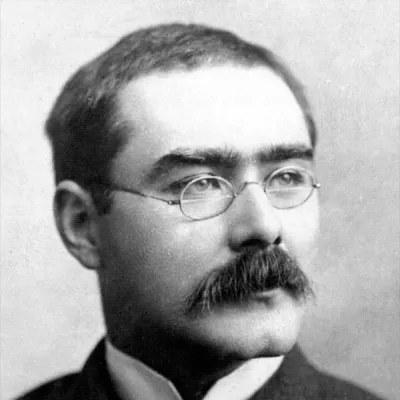
Rudyard Kipling
Human Design Chart
Biography
Kipling's works of fiction include the Jungle Book duology (The Jungle Book, 1894; The Second Jungle Book, 1895), Kim (1901), the Just So Stories (1902) and many short stories, including "The Man Who Would Be King" (1888). His poems include "Mandalay" (1890), "Gunga Din" (1890), "The Gods of the Copybook Headings" (1919), "The White Man's Burden" (1899) and "If—" (1910). He is seen as an innovator in the art of the short story. His children's books are classics; one critic noted "a versatile and luminous narrative gift".
Kipling in the late 19th and early 20th centuries was among the United Kingdom's most popular writers. Henry James said "Kipling strikes me personally as the most complete man of genius, as distinct from fine intelligence, that I have ever known." In 1907, he was awarded the Nobel Prize in Literature, as the first writer to receive the prize, and at 41, its youngest recipient to date. He was also sounded out for the British Poet Laureateship and several times for a knighthood, but declined both. Following his death in 1936, his ashes were interred at Poets' Corner in Westminster Abbey.
Kipling's subsequent reputation has changed with the political and social climate of the age. The contrasting views of him continued for much of the 20th century.
Rudyard Kipling as a Manifestor 6/2 in Human Design
Manifestor 6/2 — Design at a Glance
Rudyard Kipling's Human Design endowed him with the qualities of a trailblazer and visionary. He acted like an emperor in ancient Rome: With the vision of a great future, he did not fight battles himself but delegated tasks to others to expand his realm. This role, however, brought a specific conflict along with it. His often far-reaching thoughts led to misunderstandings and polarization; while some loved his big dreams and followed him, others rejected or even hated him.
To minimize this resistance and find the right followership, it was crucial for him to inform others timely and precisely about his plans. This strategy of informing served to reduce misunderstandings and clear the path. By following this approach, he was rewarded with a sense of inner peace. If he lived against his design and failed to communicate clearly, however, he felt instead a persistent, deep anger within himself. His internal state thus directly depended on whether or not he communicated his visions clearly.
Ego Authority
Rudyard Kipling revealed himself as someone whose inner truth lay in the will, not in the mind. His authority resided in the defined Ego Center – a configuration that only Projectors or Manifestors with open Emotional, Sacral, and Spleen Centers exhibit. This structure gave him great openness but also made him vulnerable to distractions from external influences. His task was to listen to himself while speaking, recognizing the difference between thought speech of the non-self and spontaneous, uncensored expression. What impulsively came out of him corresponded to his truth; the mind often served the interests of others in his open centers.
When Kipling did something that truly mattered to him, he had the necessary willpower to achieve goals and keep promises. This could appear egoistic from the outside, but for him it was crucial that his actions personally paid off. It wasn't just about material success or possession, but also about the urge to be first, break boundaries, and leave conventional paths behind. This attitude allowed him to lead others into new directions.
A central mechanism of his design was the need for a pause after each goal achievement. Continuous work in this configuration did not yield desired results but inevitably led to exhaustion and illness. Kipling therefore had to learn to follow his will without breaking himself through constant activity, so as to sustainably use his strength.
The 6/2 Profile — Role Model / Hermit
Rudyard Kipling's Human Design was characterized by a clear division in his life development. In the first three decades of his life, he primarily acted as an experimenter. His Profile 6/2 worked here like a 3-line: He learned through direct contact with reality, trial and error. This phase was marked by practical action and the accumulation of diverse experiences, often driven by a certain fascination for the process itself. Mistakes served not as failure but as necessary correction mechanisms to maintain identity.
After his thirtieth year, this dynamic fundamentally changed with the activation of the sixth line. Kipling metaphorically retreated into a 'cave' – a space of distance and deep introspection. In this phase, reflection on the previously gathered experiments came to the fore. It was a time of healing and self-discovery, in which he viewed his experiences from great heights. This retreat served integration and understanding of deeper connections of his path.
From this phase of intense inner life, Kipling later re-emerged into public view. He now appeared as a wise role model whose insights had matured through the filter of time. Other people sought his advice to benefit from his ability for deep introspection and resulting wisdom about life. His journey exemplarily showed how early experimental learning led to shared wisdom in later years.
Single Definition — Defined & Open Centers
Rudyard Kipling's design inclined towards inner constancy and clear expressiveness, supported by a defined triangle of Throat, G Center, and Heart. This configuration provided him with permanent energy sources for authentic communication, stable identity, and willpower. His voice spoke not from fleeting inspiration or emotion but from his firm self-understanding and will – he acted out of the 'I want' place, connected to a clear inner direction. The defined Heart Center gave him the strength for self-determination and resource control; he could make promises and keep them, which strengthened his self-esteem. Simultaneously, the G Center offered a reliable internal compass needle, independent of external confirmation.
This constant authority stood in tension with six open centers: Head, Ajna, Sacral, Solar Plexus, Spleen, and Root. These open areas functioned as windows to the environment, not as their own stable reality. Rudyard Kipling was receptive to mental inspirations and doubts (open Head/Ajna) without having to process them permanently; he could wonder without getting stuck in intellectual fixation. Emotionally, he absorbed his surroundings' climate (open Solar Plexus), but had to learn not to personalize others' moods as his own instability. Vitality and stress were also reflected: The open Sacral Center made him vulnerable to overexertion through 'borrowed' energy from others, while the open Root Center amplified external pressure he could not sustain long-term. Also, the Spleen was open, bringing a tendency towards intuitive perception of health and illness but no reliable basis for spontaneous decisions.
The challenge lay in using the open centers as informative mirrors – taking inspiration without mental fixation, reflecting emotions without identification, perceiving energy without exhaustion, and observing stress without internalizing it. His defined structure allowed him to transmute these fleeting influences through his stable inner authority: He spoke from his truth, acted according to his will, and remained rooted in his direction while consciously recognizing external currents as not his own field.
Channels for ambitious leadership, pioneering spirit and universal love.
Rudyard Kipling's design inclined towards material responsibility and competitive impulse for individualization. This combination shaped him as someone who sought control over resources while simultaneously being initiated through shock experiences.
The Money Line 21-45 connected his Heart to his Throat. Gate 21, the Hunter, drove the will to control to ensure peace; Gate 45, the Collector, demanded authoritative voice and loyalty for resources. This channel required mastering the material plane by taking on or rejecting responsibility. Kipling worked best as his own boss, controlling his rhythm and delegating reluctantly since dependency burdened his heart.
Parallelly, Initiation 25-51 in the Heart operated. Gate 51, Shock, sought first place and competition; Gate 25, Self Spirit, saw universal love and beauty. This channel made initiation an art: It recognized individualization potential and delivered necessary shock for growth upon invitation. Kipling was naturally competitive, encouraged others to cross boundaries, and experienced breakthroughs as mystical confirmation of his uniqueness. Initiation had to find him; he could not force it.
Additionally, Gates like 58 (Experiment, perfection under pressure) and 48 (pattern recognition, correction in the collective) contributed to inner dynamics. Gate 15 organized collective behavior through natural rhythms while Gate 46 demanded full commitment to the process. Gate 40 sought liberation and recovery after hard work, rewarded with acknowledgment. Gate 2 responded sensitively to evolutionary directions.
Kipling's structure showed a tension between the need for material security and the mystical search for individual transcendence. He lived this duality by controlling resources while enabling competitive initiations, always dependent on his inner authority and strategy.
Individual Circuitry — Circuit Signature
Rudyard Kipling appeared as a person with solid self-worth and strong internal convictions that were often not verbally articulated. This stance resulted from the Identity Circuit, which in him directly connected Identity and Heart Center. This connection promoted individualism and courage along with reinforcing others' uniqueness but lacked Throat Center linkage, so firm values were rarely expressed verbally. Parallelly, the Ego Circuit, connecting Kipling's Throat and Heart Centers, created a dynamic of giving and taking as well as cooperation in resource management. Since this circuit did not connect to the Sacral Center, constant life force was not directly available; instead, the design required regular rest pauses for energy regeneration for exchange. As a simply defined system, Heart, Throat, and Identity centers formed an interconnected energetic group. The connection from Heart to Identity strengthened inner stability while the connection from Heart to Throat focused on material or social resources. The absence of Sacral energy in both active circuits meant that energy was not inexhaustible but had to be regenerated through pauses. Rudyard Kipling's design thus linked individual constancy with a pragmatic, cooperative attitude towards resource and relationship management, always dependent on adequate recovery.
Left Angle Cross of Demands 2
Rudyard Kipling's Human Design profile established an existential stance that was heavily influenced by the demands of his environment. His internal orientation did not define itself through isolated self-determination but rather through continuous navigation within a field of external requirements. This configuration created a dynamic tension between what authorities or circumstances demanded and his personal inner compass.
The left cross of Requirements 2 describes precisely this mechanism: It is about the process of negotiating with external pressure situations. Rudyard Kipling showed himself to be someone whose integrity was proven in responding to these demands. The energy of this cross forces one not to passively endure but actively react and find their own position within these requirements. It was a constant balancing act between adaptation and asserting his will.
This structure meant that his life was not a calm flow of self-actualization, but rather a series of challenges he had to respond to. The mechanics do not describe a victim role but an active confrontation. Rudyard Kipling lived in a reality where external forces were always present and demanded action from him. His strength lay in seeing these demands not as obstacles but as the necessary context in which he defined and formulated his own stance. Thus, the tension between outer and inner worlds was the driving force of his development.
Saturn Return · Uranus Opposition · Chiron Return · 2nd Saturn Return — Life Cycles
Rudyard Kipling's Human Design unfolded in two distinct phases structured by astrological cycles. In 1907, at forty-four years old, he received the Nobel Prize for Literature. This peak of public recognition fell on his Uranus opposition. During this cycle, a radical change occurs, often associated with breaking old structures and reaching external milestones. For Kipling, this moment marked the pinnacle of visible success before dynamics shifted.
The subsequent Chiron return around age fifty signaled a profound shift towards internal confrontation. This cycle is not a process of traditional wound healing but an achievement cycle in which one's life purpose and its meaning increasingly unfold – provided that one lives according to their strategy. For Kipling, this phase was marked by a severe personal tragedy: In 1915, his eldest son John died in World War I. This event interrupted the previous trajectory of success and plunged him into deep crisis. The contrast between the external triumph of the Uranus phase and the painful, soul-searching test of the Chiron return shaped his later development. His design suggested that true fulfillment did not lie in fame but in navigating these existential turning points, which led him from public acclaim to private pain and thus into a new dimension of his incarnation.
Manifestor · Ego Authority — Synthesis
Rudyard Kipling lived a life marked by a deep inner tension between the drive for leadership and the necessity of reflection. As a Manifestor with defined Throat (and thereby connected access to energy from multiple centers), he possessed the ability to develop visions and convey them through his voice into the world. This expressive power was amplified by Channel 21-45 – the 'Money Line' – positioning him as a kind of tribal leader who took responsibility for the survival and well-being of his community. Simultaneously, his Profile (6/2) points to a process where early experimental phases were followed by a long period of intense self-observation and wisdom-seeking – a withdrawal to digest gained insights and later pass them on as an example.
This interplay generated a central paradox: Kipling was both the active initiator (Manifestor), who wanted to influence others' fate, and a figure who repeatedly withdrew to learn from experiences and gather wisdom. The recognition of his work through the Nobel Prize (1907) contrasted with the personal crisis of losing his son (1915), underscoring his ability to experience both success and profound suffering and let them inform his expression. Thus, his life was a continuous movement between external action and internal transformation.
2 Defined Channels
Incarnation Cross - Left Angle Cross of Demands 2
Solar Return
The Solar Return shows the moment when the sun returns to its exact birth position - your personal solar year.
Life Cycles
Discover the life cycles with a detailed triple view (birth chart, cycle chart, composite).
Human Design Profile
- Type
- Manifestor
- Strategy
- To inform others before acting
- Authority
- Ego Authority
- Profile
- 6/2 - Role Model / Hermit
- Definition
- Single Definition
- Incarnation Cross
- Left Angle Cross of Demands 2
- Date of Birth
- 30.12.1865 22:00
- Place of Birth
- Mumbai, India
Frequently Asked Questions
What is Rudyard Kipling's Human Design type?
Which Profile did Rudyard Kipling have?
What kind of Authority did Rudyard Kipling have?
What was Rudyard Kipling's incarnation cross?
When was Rudyard Kipling born?
Discover your own Human Design
Are you also a Manifestor? Find out in a personal reading how to use your initiation power peacefully and dissolve resistance.
More Personalities
Back to overviewAlain-Fournier

Angeli

Christian-Jaque
Juninho

Kesha

Lucebert