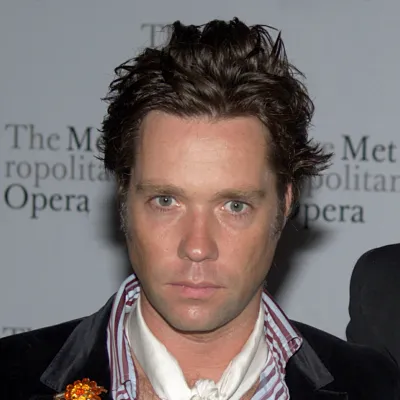
Photo: Wikimedia Commons
Rufus Wainwright
Human Design Chart
Biography
With several albums and DVDs to his credit, Wainwright is a talented songwriter and vocalist. A versatile young man, he has also been seen in films and has written film scores. His first opera, aptly entitled "Prima Donna," debuted in summer 2009. Among his films are a role in "The Aviator" (2004) starring Leonardo di Caprio.
In late 2010 Wainwright became engaged to his partner Jörn Weisbrodt.
In 2011, Wainwright announced that he and friend Lorca Cohen, daughter of Leonard Cohen, had had a child in a parenting partnership. Their daughter Viva Katherine Wainwright Cohen was born on 2 February 2011 in Los Angeles.
On 23 August 2012, Wainwright and Weisbrodt married in Montauk, New York.
Human Design Analysis: Rufus Wainwright as Generator 4/6
Generator 4/6 — Design at a Glance
Rufus Wainwright's design points to a tendency towards great endurance, comparable to a workhorse that exerts immense effort as long as it has the energy for its task. As a Generator, he had a lot of sacral energy, which was released not through self-initiation but by responding to signals from life. The motto was clear: don't start, but answer. When his sacral core signaled an inner 'yes', he could act through following this affirmation.
This system contained two specific pitfalls. One was persistently doing things that didn't resonate internally; here, wasteful energy could lead to exhaustion, given his high productivity. The other danger lay in being held back from his heart project, even though he still wanted to continue working with full power.
If Rufus Wainwright lived in harmony with this mechanism – that is, by responding to impulses and acting from the gut – he was unstoppable. The reward for this was a feeling of deep fulfillment. If he couldn't apply this strategy and instead continuously initiated, he would sooner or later encounter persistent frustration or a lack of energy. His success thus directly depended on whether he waited for inner confirmation before becoming active.
Sacral Authority
Rufus Wainwright's design points to an immediate, physical resonance with external stimuli. As a Generator, he had sacral authority, which also represented his strategy. This configuration fundamentally simplified the decision-making process: instead of analytical deliberation, he acted through direct feeling. A prerequisite for this was an open emotional center, meaning he didn't react to short-term emotional waves but to the stable energy in the lower abdomen.
This inner voice manifested as a physical reaction – a grunt, a hum, or a noticeable surge of power. When his sacral motor engaged with something, he felt vital and alive. He had access to seemingly inexhaustible energy and tackled tasks with great enthusiasm. His path was to immerse himself fully in his activities without rigid purposefulness. He was born to go through life with joy and contentment.
Additionally, an activated spleen center acted as a supporting authority. This gave him the ability to react particularly quickly and spontaneously. He had immediate access to his physical well-being and instinctive perception. These instincts were reliable and could be used as complementary guidance that strengthened and refined the sacral response.
The 4/6 Profile — Opportunist / Role Model
Rufus Wainwright's design points to a tendency towards much experimental exploration in the first three decades of life, before a deeper, reflective stance sets in. This pattern corresponds to Profile 4/6: In youth, Line 6 still acts like a 3, which favors curiosity and testing various roles, especially in relationships and friendships.
With the activation of Line 6, often in connection with the first Saturn return, an inner conflict emerged: the contradiction between the desire for belonging (Line 4, the heart) and the need for distance and wise contemplation (Line 6, the head). Life revolved around this tension between emotional connection and intellectual solitude.
Gate 56 on the fourth line shaped the nature of communication. It wasn't just about talking, but about strategically conveying messages, often in the form of stories or 'fables'. Clever calculation and a certain degree of self-interest played a role in seizing the right opportunity and effectively delivering the message.
At the same time, Gate 3 on the sixth line showed the ability to surrender to processes that cannot be controlled. It was important to recognize when resistance was futile and to entrust oneself to change – to mutation. This step from surrendering to confusion to self-care and concrete action for oneself was crucial to prevent depression that can arise when life is felt as meaningless. Later, Rufus Wainwright was expected to integrate these experiences into the role of a wise role model that shines through cooperation with others, while carefully protecting the big heart.
Split Definition — Defined & Open Centers
Rufus Wainwright's Human Design shows a tendency towards constant, independent thinking, paired with a clear inner identity. His defined Ajna Center ensures consistent mental processes; he thinks all the time and is hard to influence from the outside. This mental stability flows into his defined Throat Center, allowing him to express his concepts reliably and directly.
Fundamentally, his energy source was the defined Sacral Center, generating enormous vitality daily. His strategy was not to initiate but to wait for external stimuli, responding with a spontaneous yes or no. Only this way could the full energy be available to pursue tasks to mastery without falling into frustration or exhaustion.
This mechanical responsiveness was supported by his defined Spleen Center, which gave him spontaneous, intuitive bodily intelligence. He could judge in the moment what was healthy and correct without having to rationalize. Additionally, the defined Root Center provided a steady pressure, propelling him forward and nourishing existential awareness.
In contrast, his vulnerability was shown in the open centers. The open Head Center had no mental pressure of its own but tended to take on inspirations and questions from others, leading to confusion if he identified with them. His open Heart Center lacked a consistent willpower; it was vulnerable to the attempt to prove its worth through promises or competition, which could lead to a cycle of self-doubt if he did not listen to his inner authority. Moreover, his open Solar Plexus absorbed the emotions of the environment. He acted like a barometer, intensifying foreign moods, leading to emotional decisions or avoiding confrontations out of fear of rejection, rather than separating his feelings from those of others.
Channels for change, focus, care and intuitive power.
Rufus Wainwright's Human Design shows a tendency towards evolutionary change, paired with the ability to logically structure complex patterns. This configuration reveals someone who holds internal tensions to bring forth innovations while simultaneously translating detailed information into understandable language.
The Channel of Mutation 60-3 connects the Root Center with the Sacral Center. It brings unpredictable, mutative change, dependent on the ability to accept limitation (Gate 60) and go beyond the confusion of a new beginning (Gate 3). This energy is melancholic and pulsing, forcing adaptation and generating sudden innovations, often in the pauses between impulses.
Parallel to this, the Channel of Concentration 52-9, also between Root and Sacral, forms through the Gate of Non-Action (52) and the Gate of Focusing (9), creating potential for precise attention. It requires stillness to evaluate details and perfect patterns, generating a calm, sustained tension that keeps distractions at bay.
In the cognitive realm, the Channel of Acceptance 17-62 shapes the way understanding is gained. It connects the Ajna Center with the Throat Center, translating visual patterns (Gate 17) into linguistic details (Gate 62). This allows for mental organization of information and logical communication of opinions, making complex connections accessible to others.
Additionally, the Channel of Rhythm 5-15, which connects biological life processes with magnetic attraction, and the Channel of Discovery 29-46, which through persistence and timely positive affirmation places one at the right place at the right time, form the energetic foundation. The Channel of Preservation 27-50 provides care and values, while the Channel of Power 34-57 supplies intuitive survival intelligence. Prioritized Gates like Gate 56 (Inspiration through Storytelling) and Gate 58 (Experimentation and Perfection) emphasize the ability to depict mental processes visually and correct patterns.
Collective Circuitry — Circuit Signature
Rufus Wainwright's Human Design shows a tendency towards pulsating, acoustic creativity, arising from the Knowledge Circuit. Here, the Channel of Mutation connects the Sacral Center with the Root Center. This connection generated an energetic basis for innovations that appeared as deviations from the known, supported by the life force of the Sacral with the urgency of the Root Center. The energy worked in the present and promoted the expression of a unique individuality.
Parallel to this, the Understanding Circuit showed a divided structure. One group connected the Ajna Center with the Throat Center, allowing logical, rational insights to be communicated free from emotional coloring. A second, independent group connected the Identity Center with the Sacral and Root Centers. These parts were not directly connected in Rufus Wainwright but existed as separate energetic streams. The focus was on the transmission of strategic visions and the improvement of future structures through clear thinking.
In the Meaning Circuit, the Channel of Discovery connected the Identity Center with the Sacral Center. This promoted a cyclical confrontation with past experiences. Emotional waves from the past were reflected to draw meaning from them and share these insights with others. The energy was visual and served collective learning from history.
The Protector Circuit connected the Sacral Center with the Spleen Center through the Channel of Preservation. This created a primal energy for protection and the preservation of one's genetics. Themes like care, nutrition, and defending the family were active here. The Spleen provided instinctive knowledge implemented through the life force of the Sacral to ensure survival.
Finally, the Integration Circuit also connected the Sacral with the Spleen Center through the Channel of Power. This supported self-reinforcement through intuitive reactions to life. Strength was gained from immediate reactions and directed in the present to maintain the highest individuality. Both circuits (Protector and Integration) used the same connection between Sacral and Spleen, making this energetic axis particularly marked for protection and intuitive adaptation.
Right Angle Cross of Laws 2
Rufus Wainwright's design points to a tendency towards a deep, often unconscious connection to spiritual or universal laws. This configuration, known as the right cross of laws 2, does not describe an active search for truth but rather a passive, almost fated orientation towards what is understood as higher order or cosmic law. It is an energetic imprint that guides the individual to intuitively move through currents that transcend the purely personal.
In Human Design, this means that the person does not primarily find solutions through logical analysis or conscious decision-making, but rather through an inner compass that reacts to resonance with these 'laws'. It is an energy of surrender to something greater, often not clearly defined but manifesting as a deep need for meaning and belonging to a higher whole. Those who carry this cross often experience moments where external circumstances align as if guided by an invisible hand. This is not an act of will but a consequence of one's own inner alignment. The challenge lies in recognizing and not ignoring these subtle signals, as they often point in the direction where life encounters the least resistance. It is less about understanding the laws intellectually and more about trusting one's own resonance with them.
Saturn Return · Uranus Opposition · Chiron Return — Life Cycles
Rufus Wainwright's design points to a tendency towards cyclical phases of structural condensation and radical realignment. This dynamic was evident in 2001 when, at the age of 28, he toured as an opening act for Tori Amos. This marked the first Saturn return, a mechanism that often condenses years of groundwork into a viable, public result and solidifies one's professional identity.
Ten years later, in 2012, Wainwright married Jörn Weisbrodt in Montauk. At 39, he was in the Uranus opposition, a phase that triggers deep changes in personal freedom and binding structures. Here, the inner necessity for autonomy is often answered through a new, equal partnership or a break from old patterns.
The Chiron return, a fulfillment cycle that unfolds around the 49th year of life, shapes the experience of meaning and purpose. In 2020, at 47 years old, the album 'Unfollow the Rules' was released. This reflects the flowering of the incarnation cross: if one's own strategy is followed, the individual contribution becomes clearly perceptible. The album does not stand as a healing but as an expression of the mature, self-following life task that unfolds its full effect in this phase.
Generator · Sacral Authority — Synthesis
A central red thread in this design is the dynamic connection between energy and inner search. The sacral authority and defined sacral center point to a deep, physical energy source that is activated by external stimuli – a force that invites action and creation. However, this energy is not aimless; it is channeled through a defined Ajna center and the knowledge circuit, leading to a constant process of thinking, conceptualizing, and searching for new paths. The channel of mutation strengthens this tendency towards change and deviation from conventions, while the profile as a networker/role model emphasizes the desire to share insights and inspire others.
The central paradox lies in the interplay of deep engagement and melancholic distance. The strong sacral energy drives full commitment to the heart project, yet the line 6 in the profile creates an inner conflict between the desire for community and the need for introspective reflection. The right cross of laws 2 points to an inner tension between the desire for freedom and the necessity to adhere to certain rules. Verifiable events like touring as an opening act and marriage seem to arise within this tension field, as well as the publication of new works.
7 Defined Channels
Incarnation Cross - Right Angle Cross of Laws 2
Solar Return
The Solar Return shows the moment when the sun returns to its exact birth position - your personal solar year.
Life Cycles
Discover the life cycles with a detailed triple view (birth chart, cycle chart, composite).
Human Design Profile
- Type
- Generator
- Strategy
- To respond - wait for something to respond to
- Authority
- Sacral Authority
- Profile
- 4/6 - Opportunist / Role Model
- Definition
- Split Definition
- Incarnation Cross
- Right Angle Cross of Laws 2
- Date of Birth
- 22.07.1973 01:31
- Place of Birth
- Rhinebeck, NY, United States
Frequently Asked Questions
What is Rufus Wainwright's Human Design type?
What Profile does Rufus Wainwright have in Human Design?
What authority does Rufus Wainwright have?
Which incarnation cross is active for Rufus Wainwright?
When was Rufus Wainwright born?
Discover your own Human Design
Are you also a Generator? Find out in a personal reading how to use your sacral energy correctly and discover deep satisfaction.
More Personalities
Back to overviewSissy Spacek
Aaliyah

Alexia

Anémone
Angèle

Ann-Margret