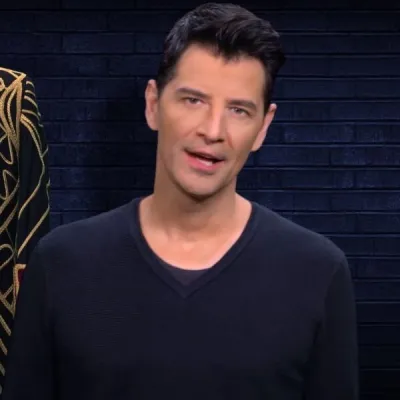
Sakis Rouvas
Human Design Chart
Biography
Born in Corfu, Rouvas won medals with Greece's U18 and U20 national athletics team during the 1980s before pursuing a music career. He rose to fame in 1991 with his debut album and became one of Greece's most prominent musical artists, with numerous number-one albums and singles—most of which have been certified platinum or higher—as well as widely attended tours and live shows. Over the course of his career, he has released fourteen studio albums, including five under PolyGram Records and nine under Minos EMI. His entry for the Eurovision Song Contest 2004, "Shake It" became one of the best-selling CD singles in Greece. In addition to maintaining a successful recording career, Rouvas has also expanded into acting, television presenting, and business.
Rouvas has received numerous accolades, including six Arion Music Awards, 15 Pop Corn Music Awards, 26 MAD Video Music Awards, four Status Man of the Year Awards, a Karolos Koun Award from the Union of Greek Theatre and Music Critics, an MTV Europe Music Award and two World Music Awards. A major figure in modern Greek pop culture for over three decades—recognized for his artistic versatility, stage presence, and influence—Rouvas is often cited as one of the country's most recognizable and marketable public figures.
Sakis Rouvas as a Manifesting Generator 6/2 in Human Design
Manifesting Generator 6/2 — Design at a Glance
Sakis Rouvas reveals himself as someone with the ability to quickly draw things into his life. His design as an Manifesting Generator grants him a hybrid nature: He possesses the constant energy of a Generator through the defined sacral center, combined with the direct connections of a Manifestor. This allows him to skip steps and push projects forward at great speed.
This quickness harbors two specific challenges. First, Sakis Rouvas can overlook important stages, leading to having to go back to catch up on missing foundations – a process that often leads to frustration. Second, he tends to pursue multiple things simultaneously by reacting to various impulses and starting diverse projects in parallel.
To use this dynamic constructively, it is crucial not to initiate himself but to respond to inner signals. Only when the sacral center gives a clear 'yes' should he act. Regular checks if current endeavors still bring joy are essential. With this orientation, Sakis Rouvas finds deep satisfaction in creation. The pressure to complete one thing before starting another works counterproductively for him. Instead, he thrives in a play mode that uses variety and parallel work as sources of his strength, provided strategy and inner authority remain aligned.
Sacral Authority
Sakis Rouvas showed a decision-making stance based on immediate physical resonance. His design laid the groundwork for him not to act through intellectual analysis but to respond to inner signals. As a Generator, Sakis Rouvas possessed sacral authority – his strategy was also his inner compass, simplifying and making direct his decision process.
This authority only works clearly if the emotional center is open; this was the case with Sakis Rouvas. His responses to external stimuli showed as gut feeling or surge of power: a grunt for yes, an exhalation for no. When his sacral motor kicked in, he felt vital and energized, with enthusiasm helping him lose himself in activities – without these needing to fulfill any outer purpose.
Additionally, the activated spleen center supported this reaction. It gave Sakis Rouvas quick, spontaneous decision-making and direct access to instinctive perception of well-being. This combination allowed him to reliably be guided by his body: The sacral authority provided energy and direction, the spleen center ensured intuitive security in choice. Thus a flow emerged where joy and satisfaction did not appear as goals but as natural accompaniments to action.
The 6/2 Profile — Role Model / Hermit
Sakis Rouvas revealed himself through his design as someone who was strongly shaped by the principle of trial and error in youth. Before the age of 30, the six-line of his configuration acted similarly to a three-line: It drove him to collect diverse personal experiences and actively experiment. Mistakes were not failures but necessary steps in a learning process, followed by strategic retreats for reflection.
With entering the phase around 30 years old, this dynamic fundamentally changed. The full power of line six became effective, prompting Sakis Rouvas to gain distance and withdraw temporarily. In this 'cave' on the mountain, he looked at his past experiments with great clarity. This time served intense self-knowledge and healing. From this phase of inner cleansing and rethinking values – supported by the intuitive strength of line two – deep wisdom emerged.
Sakis Rouvas eventually came forward as a role model. The earlier misunderstandings and struggles transformed into an unyielding stance that helped others clarify their own values. His ability for deep introspection became visible to his environment; others sought his advice to partake in his life wisdom. Thus, the path from experimental natural talent to wise mentor was completed, showing through personal transformation and inner cleansing a way to others.
Single Definition — Defined & Open Centers
Sakis Rouvas is characterized by a design that emphasizes inner stability and direct reaction. His defined centers – Sacral, G Center, Spleen, and Throat – create a reliable energy source. The defined Sacral Center generates continuous vital force, which only activates upon external invitation; his strategy involves waiting to react rather than initiating action. This gives him endurance in matters where he feels inner approval.
The defined G Center provides him with clear self-identity and direction as well as love. He knows who he is without needing to prove it. The connection to the defined Throat Center allows him to express his identity and sacral energy clearly and honestly, provided he listens to his inner authority; his voice carries the truth of his internal conviction and will.
The also defined Spleen Center offers spontaneous intuition and body awareness in the present moment. It provides immediate feedback on health and well-being, helping him recognize what is right at any given time without having to rationalize it.
In contrast, Head, Ajna, Heart, Solar Plexus, and Root are open centers. These open centers make him susceptible to conditioning. The open Head and Ajna Centers tend to absorb external mental pressure or confusion, leading to doubt if he does not trust his inner authority. The open Heart Center lacks consistent willpower; it is tempted to give promises to prove value, often ending in frustration. The open Solar Plexus Center absorbs foreign emotions, making him emotionally vulnerable and prone to identifying with others' moods or avoiding confrontation out of fear of rejection. The open Root Center takes on external stress as uncontrollable pressure if not recognized. Sakis Rouvas’ challenge lies in not accepting these open areas as his truth but orienting himself towards his defined energy and intuition.
Channels for intuition, charisma and powerful self-expression.
Sakis Rouvas connects his intuition with physical endurance through the Power Channel 34-57, linking the Sacral Center to the Spleen Center; this connection allows him to react immediately to dangers or opportunities, supported by a deep survival intelligence. This spontaneous responsiveness finds its voice in the Charisma Channel 34-20, which links the Sacral Center with the Throat Center. Here his generative energy directly manifests into the present moment, allowing him to carry activities with impressive vitality and self-assurance without being guided by external expectations.
Parallel to this, Sakis Rouvas seeks hidden truth through the Lost Son Channel 13-33, connecting the G Center with the Throat Center. He listens (Gate 13), gathers secrets and experiences, then withdraws (Gate 33) to reflect on these insights. This process of patience and integration helps him understand deeper connections before communicating them.
His technical mastery is marked by the Wavelength Channel 48-16, which connects the Spleen Center with the Throat Center. Combining intuitive depth (Gate 48) and a drive for skill perfection (Gate 16), he transforms raw talent into precise ability through repeated practice and engagement until his proficiency becomes natural expression.
Additionally, the Lightning Flash Channel 57-20 enhances his capacity to articulate intuitive insights (Gate 57) directly in the present moment (Gate 20). This connection gives a clear voice to his spontaneous perception and enables him to communicate existential truths immediately.
Individual Gates like Gate 38 (Pressure/Limits), Gate 39 (Provocation/Mutation), Gate 51 (Willpower/Shock Response), Gate 31 (Leadership/Transmission), Gate 50 (Protective Reflex/Tradition) and Gate 46 (Devotion/Bodily Love) round out his profile by adding aspects of resistance, adaptability, and full presence in physical life.
Individual Circuitry — Circuit Signature
Sakis Rouvas is characterized by an expression and survival energy flowing in a single, continuous stream. His simple definition connects the G Center with Throat, Spleen, and Sacral centers into one unit. This creates a direct line from identity through intuitive instinct to physical endurance and verbal articulation.
This flow is shaped by four specific circuits. The Knowledge Circuit activates Channels 20-57 (Lightning Flash) in him, linking the Throat Center with Spleen. This promotes innovative, creative impulses that are immediately put into action. Parallel to this, the Understanding Circuit works through Channel 16-48 (The Wavelength). It also connects Throat and Spleen, focusing on logical strategies and rational insights – an “emotionless ratio” aimed at future solutions.
In contrast, the Meaning-Finding Circuit operates via Channel 33-13 (The Lost Son), connecting the Throat Center with Identity. Here it concerns emotional waves from the past, their reflection, and a collective learning process. Finally, the Integration Circuit integrates Channels 20-34 (Charisma) as well as 34-57 (Power). These link the Throat Center directly to Sacral center and Spleen. They enable drawing strength from reacting to life through intuitive knowledge and expressing it in the present moment.
All these energies are not isolated but flow seamlessly into each other at Sakis Rouvas. His identity, intuition, endurance, and expression form a coherent whole that unites creative innovation with strategic clarity and emotional depth with physical vitality.
Left Angle Cross of Individualism 2
Sakis Rouvas revealed a deep desire for autonomy and the formulation of a unique personal path. His design indicated a tendency not to simply conform to existing structures but to establish his identity as an independent value. This attitude stemmed from the energetic pattern of the left cross of individualism 2. In Human Design mechanics, this configuration represents the process of separating the individual from the masses and giving them a clear, unmistakable voice. Sakis Rouvas was less about rebellion for its own sake than about the necessity to define his truth as precisely as possible in order to appear authentic. This impulse shaped his way of interacting with the outside world: through consistent persistence on his own path. The energy of this cross promoted the ability to translate complex inner experiences into a clear outer form without compromising integrity. Sakis Rouvas used this structure not only to shape his individuality as a private matter but also as an active contribution to the diversity of his environment. The challenge was always to reconcile this strong personal expression with the reality of social surroundings, without diluting his essence.
Saturn Return · Uranus Opposition · Chiron Return — Life Cycles
Sakis Rouvas has been marked by profound inner clarification and the unfolding of his personal purpose since his 49th year of life. This period marks the Chiron Return, a cycle of fulfillment and bloom. During this phase, Sakis Rouvas’ incarnation cross – assuming he followed his strategy and authority up to that point – becomes increasingly tangible. The meaning of his design does not appear as an abstract idea but as lived reality. It is a time of maturation in which earlier experiences merge into a coherent whole, making the inner purpose clearer.
Previous phases had different tasks. The first Saturn Return around age 29 often demanded from Sakis Rouvas a confrontation with structure, responsibility, and the condensation of years of groundwork into sustainable results. It was a time of building and consolidation. Later came the Uranus Opposition, typically between ages 69 and 71. This configuration often brings a phase of breaking free from old ties or expectations to give space for new freedom. It demands adaptation to changed circumstances and can lead to unexpected turns that serve greater autonomy. Together these cycles show Sakis Rouvas’ path from early structuring through the midlife crisis to later release, and finally deep personal fulfillment in the Chiron Return.
Manifesting Generator · Sacral Authority — Synthesis
A central red thread runs through the design: the dynamic connection between initiation and reaction. The configuration as a Manifesting Generator (with sacral center) implies a constant readiness to react to external stimuli and thereby release energy. This reactivity is complemented by the ability to skip steps and attract things quickly – an aspect that stems from the manifestor component in his type. The channel of the Lost Son (13/33) strengthens this cycle of experience, reflection, and ultimately passing on wisdom, while the defined communication center emphasizes the ability to express transformed insights. The profile as a role model/natural talent indicates that this process is not only personal but also influences others.
The design reveals a central paradox between the urge for quick implementation and the need for deep reflection. Sacral authority demands reacting in the moment, while line 6 in the profile highlights a phase of intense withdrawal and self-awareness following initial experimentation. This shift between action and contemplation, between skipping steps and slowly digesting experiences, creates tension that defines this design – a constant oscillation between the outer world and inner wisdom.
5 Defined Channels
Incarnation Cross - Left Angle Cross of Individualism 2
Solar Return
The Solar Return shows the moment when the sun returns to its exact birth position - your personal solar year.
Life Cycles
Discover the life cycles with a detailed triple view (birth chart, cycle chart, composite).
Human Design Profile
- Strategy
- To respond - wait for something to respond to
- Authority
- Sacral Authority
- Profile
- 6/2 - Role Model / Hermit
- Definition
- Single Definition
- Incarnation Cross
- Left Angle Cross of Individualism 2
- Date of Birth
- 05.01.1972 15:20
- Place of Birth
- Corfu, Greece
Frequently Asked Questions
What is Sakis Rouvas' Human Design type?
What profile does Sakis Rouvas have in Human Design?
What authority does Sakis Rouvas have?
What is Sakis Rouvas' incarnation cross?
When was Sakis Rouvas born?
Discover your own Human Design
Are you also a Manifesting Generator? Find out in a personal reading how to unfold your multi-talents and direct your energy wisely.
More Personalities
Back to overviewAldair

Alizée

Angeli

Arletty
Artus
Balthus