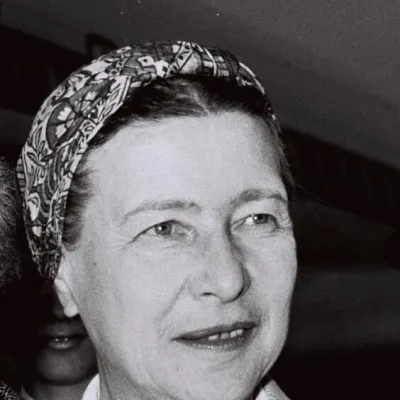
Simone de Beauvoir
Human Design Chart
Biography
Beauvoir was the eldest daughter of a middle-class lawyer, raised Catholic with a convent education. She sided with her dad as an atheist at 15. While at the Sorbonne, she gained the nickname "Beaver" for being industrious, a name by which she was known for the rest of her life.
In 1947 she made a trip to New York for a lecture tour where she met Nelson Algren, author of "The Man With the Golden Arm." They began a passionate affair that continued intermittently for some 15 years. When they finally parted, it was with some bitterness, however, in her last letter to him in 1963, she wrote that she would love him forever.
She obtained math and philosophy degrees from the Sorbonne when she was 21, and taught there from 1931-1943, when she wrote her first novel. She regarded herself more as a Marxist than a feminist. With a stern, though unconventional morality, she devoted her full time to grappling with the taboos of her time in her writing. Her work, "The Second Sex," 1949, was hailed as a landmark examination of the position of women in a male-dominated word and sold over a million copies in paperback in the U.S. alone.
The Human Design of Simone de Beauvoir: Manifestor 3/5
Manifestor 3/5 — Design at a Glance
Simone de Beauvoir's design marked her as a pioneer and visionary whose task was to lead the world into a new future. Her archetype resembled that of a Roman emperor: she had the great vision but did not wage the necessary wars herself; instead, she sent others out to achieve her goals. These far-reaching plans naturally encountered resistance; Simone de Beauvoir polarized strongly and was misunderstood because she often thought ahead of her environment. While some people loved her dreams and followed her, they outraged others precisely due to their magnitude, leading to rejection or even hatred. This tension between love and rejection was a central pain point in her design. To find the right following and minimize friction, her configuration required the strategy of informing: she had to enlighten others about her intentions early and accurately. If Simone de Beauvoir followed this strategy, she was rewarded with an inner sense of peace. Living against her design by neglecting to inform led to persistent, deep-seated anger. Her path was thus defined by the necessity to communicate her visions clearly to attract the right circle of supporters and find internal balance.
Emotional Authority
Simone de Beauvoirs decision-making followed a rhythmic pattern of emotional waves that required patience and time delay. Her design carried emotional authority rooted in the defined Emotional Center. This meant that her inner truth did not lie in spontaneous moment judgments but revealed itself only after intense emotional fluctuations had subsided.
The mechanics of this configuration show: The Emotional Center undergoes constant up-and-down movements. Simone de Beauvoir saw the world always colored by her current mood; a topic could be inspiring at one moment and negative the next. These immediate reactions were mere snapshots, not the deeper truth. Quick decisions made in emotional heat risked negative consequences as they were based on transient states.
Clarity emerged for Simone de Beauvoir only through delay. She had to take time to let decisions mature – often by sleeping on them multiple times and consciously distancing herself from initial reactions. Over time, intense feelings subsided, emotional distance gained strength, and calmness set in. This process was essential for long-term course setting that shaped her life trajectory. Emotional authority always took precedence over other defined centers; it dictated the pace of insight. Simone de Beauvoir thus had to go through cycles of emotion and subsiding to reach true inner clarity.
The 3/5 Profile — Martyr / Heretic
Simone de Beauvoir showed herself as someone who gained knowledge not from books but through personal, often risky experimentation. Her design shaped an attitude of skeptical experimenting: she initially trusted no one and had to test everything herself to learn. This Line 3 of the Explorer drove her to encounter obstacles and even be allowed to fail – a process supported by secret interactions and the use of hidden means when paths were blocked.
From these practical experiences, including failures, Simone de Beauvoir developed a rich treasure trove of life wisdom. This experiential wealth made her attractive to others; people sought her proximity to benefit from her insights. Here Line 5 of the Hero came into play: she used self-acquired knowledge to solve other people's problems and establish new forms of viability in crisis times. This role as rescuer or hero flattered her design but also carried the pain point of public failure. When she experimented and failed in front of others, it was particularly painful because her attractiveness was directly tied to shared experience. Her intuition was challenged to provide individual mutations for the collective to protect against new threats. The tension between the need for personal experimentation and the expectation to be a problem solver defined her work enduringly.
Single Definition — Defined & Open Centers
Simone de Beauvoir revealed herself through a stable internal foundation of defined identity, will, and emotional depth. Her defined G Center gave her a reliable self-identity and the feeling of being lovable without relying on others. She had a clear sense of direction in life. This was complemented by her defined Heart Center, which gave her the ability to set intentions; she could make promises and keep them, strengthening her self-esteem. As an inner authority, her defined Solar Plexus allowed Simone de Beauvoir to wait for the up-and-down rhythm of her emotional wave before making decisions. Emotional clarity came to her over time, not in impulsive moments.
These internal states flowed into her defined Throat Center, the energy source for communication and action. Her voice thus spoke from her identity, will, and emotional truth, leading to an honest and clear expression style. She could transport her inner reality outward without being impulsive as long as she trusted in her authority.
In contrast, Head, Ajna, Sacral, Spleen, and Root were open. This meant situational openness for inspiration and concepts without mental fixation. Simone de Beauvoir tended to question whether she needed to find an answer or if a concept was her own truth rather than getting entangled in it. Her open Sacral Center made her sensitive to external energy; she was not designed to respond constantly to generative impulses but had to learn when enough was enough to avoid exhaustion. Similarly, her open Root Center absorbed stress from the environment, which could make her feel driven by external pressure instead of acting from within. Her open Spleen Center meant that intuition was not a constant decision-making source; she had to learn to distinguish between her own needs and absorbed fears or well-being to avoid unhealthy dependencies. This openness allowed flexibility but required discipline to prevent being overwhelmed by foreign energies.
Channels for emotional depth, reflection and spiritual pioneering.
Simone de Beauvoir's design shaped a complex dynamic between emotional openness, patient reflection, and competitive drive. She showed herself as someone whose social interactions were strongly dependent on her inner mood. This resulted from the Openness Channel 22-12, connecting the Solar Plexus Center with the Throat Center. Here, the emotional wave of Gate 22 determined the timing for articulation; Gate 12 provided necessary restraint, limiting communication to people with high mutative potential. When Simone de Beauvoir was in the right mood, she could deeply touch and inspire others through her voice and words. However, if forced into social situations against her rhythm, she tended to appear sharp or misunderstood, which could foster isolation.
Parallel to this, Simone de Beauvoir gathered experiences with the patience of an observer. The Lost Son Channel 13-33 connected listening and storing information (Gate 13) in the G Center with withdrawal for reflection (Gate 33). She withdrew to sort through collected memories and secrets before sharing her insights. This process of maturation allowed her to recognize deeper truths behind surface events and later share this wisdom as a lesson. Her strength did not lie in predicting the future but rather in organizing past experiences so they made sense.
A third aspect was her competitive drive toward individuation. The Initiation Channel 51-25 connected the competing ego energy of Gate 51 in the Heart Center with universal love and higher self (Gate 25). Simone de Beauvoir aspired to be first and break boundaries. This initiation shock served to activate potential for individuation. She also awakened this competitive spirit in others to spur their growth, provided that initiation was accepted as an invitation rather than forced. This combination of emotional timing, reflective wisdom, and bold self-assertion shaped her unique expression.
Individual Circuitry — Circuit Signature
Simone de Beauvoir revealed herself through a synthesis of individual identity strengthening, the drive for new knowledge, and emotional reflection. Her design was simply defined, allowing coherent energy flows between Throat, Solar Plexus, G, and Heart Centers. The Knowledge Circuit connected her Throat with her Solar Plexus Center via the Openness Channel. This shaped an original path: New knowledge emerged through emotional wave dynamics and was acoustically expressed to initiate transformation. Parallel to this, the Centering Circuit linked Identity with Heart Center via the Initiation Channel. This created inner stability, courage, and strong convictions. However, since this circuit did not lead to Throat Center, there was no direct external expression possibility; the power remained internally centered. The Meaning-Finding Circuit connected her Throat with her Identity Center via the Lost Son Channel. It processed past emotions and experiences cyclically to gain collectively shareable insights. These three circuits worked together: The inner stability of Centering supported the emotionally driven expression in the Knowledge circuit, while the Meaning-Finding circuit translated past experiences into shared knowledge. Simone de Beauvoir's design leaned towards transforming her identity through expression, bolstered by emotional depth and reflective past, without losing sight of internal conviction. Energy flowed coherently between these defined areas, basing her actions and expressive forms on this specific inner structure.
Right Angle Cross of Penetration 4
Simone de Beauvoir's design carried the structure of the right cross of penetration 4. This configuration established a fundamental attitude characterized by deep analysis and a need for clear, unvarnished perception. In Human Design, this cross describes a specific energetic alignment: it is not about superficial adaptation but rather penetrating structures to understand their core. Simone de Beauvoir was someone who did not just observe complex connections but intellectually and emotionally delved into them until she reached the bottom.
The mechanics of this design promote a way of seeing that overcomes barriers. It tends towards questioning things until absolute clarity is achieved. For Simone de Beauvoir, this meant her perception of the world was always marked by a strong urge to look behind facades and societal norms. She lived in an attitude that required engaging with reality as it truly was, not how it should be. This penetrating power allowed her to recognize patterns hidden from others and created an inner discipline to hold these insights. It was not passive reception but an active process of understanding that shaped her entire life path.
Saturn Return · Uranus Opposition · Chiron Return · 2nd Saturn Return — Life Cycles
Simone de Beauvoir's design featured a clear cyclical structure driven by four marked phases. The first Saturn return around the age of 28 established her career: in 1936, she returned to Paris and took up positions at Lycée Molière as well as later at Lycée Camille Sée. This phase condensed years of preparatory work into a solid professional foundation.
The Uranus opposition at the age of 40 promoted creative expansion and movement. In concrete terms, this was seen in 1948 when she traveled to Berlin to attend the premiere of her drama 'Die Fliegen' – a moment of artistic extension beyond her usual structures.
The Chiron return, a fulfillment cycle between ages 49 and 51, brought political intensity and pressure for meaning-making. In 1956, at age 48, she engaged in activities against the Algerian War. Here, her incarnation purpose became evident through confrontation with societal crises; it was not about healing old wounds but about unfolding her life goal by actively advocating for justice.
The second Saturn return around the age of 58 led to later critical reflection. In 1966, her novel 'The World of Beautiful Pictures' was published, which dealt with consumerism and the gap between rich and poor in Paris during the 1960s. This phase marked the maturation of her intellectual position by examining societal structures and integrating her previous experiences into a comprehensive critique of contemporary life.
Manifestor · Emotional Authority — Synthesis
A central red thread running through the chart is the dynamic connection of inner authenticity and the drive to carry this outward (Channel 22-12, Channel 51-25). The defined emotional authority (Solar Plexus) anchors deep experience while the defined G Center establishes a clear self-identity. This inner foundation is channeled through an open Throat – not as unfiltered expression but as transformative message once emotional clarity is achieved. Recurring Gates 53, 54 and 57 in the cross underscore a lifestyle marked by the search for authentic experiences, striving for individual growth, and the ability to intuitive insight.
The central paradox lies in the tension between inner depth and the need to share this with the world (Channel 22-12). The defined Heart Center and G Center provide strong inner direction and willpower while open centers – particularly Head, Ajna, Sacral, and Spleen – mean constant intake of environmental influences. This openness leads to heightened sensitivity to external stimuli and conditioning, which must be filtered through emotional authority to make authentic decisions. It is a dance between receiving information from the world and finding one's inner compass.
3 Defined Channels
Incarnation Cross - Right Angle Cross of Penetration 4
Solar Return
The Solar Return shows the moment when the sun returns to its exact birth position - your personal solar year.
Life Cycles
Discover the life cycles with a detailed triple view (birth chart, cycle chart, composite).
Human Design Profile
- Type
- Manifestor
- Strategy
- To inform others before acting
- Authority
- Emotional Authority
- Profile
- 3/5 - Martyr / Heretic
- Definition
- Single Definition
- Incarnation Cross
- Right Angle Cross of Penetration 4
- Date of Birth
- 09.01.1908 04:30
- Place of Birth
- Paris Arrondissement 6, France
Frequently Asked Questions
What was Simone de Beauvoir's Human Design type?
What Profile did Simone de Beauvoir have in Human Design?
What Authority did Simone de Beauvoir have?
What incarnation cross did Simone de Beauvoir have?
When was Simone de Beauvoir born?
Discover your own Human Design
Are you also a Manifestor? Find out in a personal reading how to use your initiation power peacefully and dissolve resistance.
More Personalities
Back to overviewChristian-Jaque

Kesha

Laurent-Eynac
Lucebert
Masaccio
Papus