
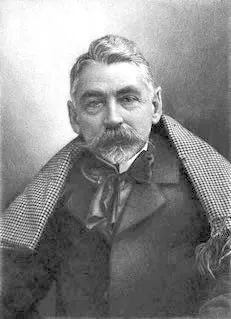
Stéphane Mallarmé
Human Design Chart
Biography
His life was simple and without event. His small income as professor of English in a French college was sufficient for his needs. His Tuesday evening receptions, which did so much to form the thought of the more interesting of the younger French men of letters, were almost as important a part of his career as the few carefully elaborated books which he produced at long intervals.
Mallarme's poetry has been the inspiration for several musical pieces and film.
He died 9 September 1898, Vulaines-sur-Seine, France.
Stéphane Mallarmé — Generator with Profile 5/2
Generator 5/2 — Design at a Glance
Stephane Mallarmé's design sets a tendency for high endurance and a specific kind of energy generation. As a Generator, he had plenty of sacral energy, which made him extremely strong and resilient – provided this power was used for tasks where it actually existed. His central dynamic lay in not pushing forward through his own initiatives but responding to impulses from life. The strategy of his design required him to wait until a signal came and then respond with action as soon as he had a clear "yes" internally.
This mechanism carried two essential risks: If he did things that he didn't want to do, he wasted his energy and was prone to burnout. Conversely, if he was prevented from working on his heart project even though he wanted to continue full of power, he also ran into difficulties. When Stephane Mallarmé lived in harmony with this response rather than initiation, he was rewarded with a sense of deep fulfillment. Ignoring this principle and instead trying to initiate things or suppress his inner signal led him sooner or later to persistent frustration and a lack of energy. His strength thus showed itself most effectively when he responded from the gut to what was offered to him.
Sacral Authority
Stephane Mallarmé lived as a Generator, whose decision-making was shaped by sacral authority. This inner instance replaced complex mental deliberations with direct physical resonance. His design required the strategy of reaction: Instead of proactively planning or anticipating goals, he waited for external stimuli to respond to.
The sacral authority manifested in him through physical signals from his lower abdomen – as grunts, hums, or silent affirmations like "Mhm." These sounds marked the moment when his sacral motor responded to an impulse from the environment. When this resonance occurred, a sudden surge of energy followed. Stephane Mallarmé then felt vital and alive, with an almost inexhaustible source of energy that allowed him to immerse himself fully in activities. This work was done without compulsive purposefulness; it was driven by pure enthusiasm and inner satisfaction.
A prerequisite for this clear guidance was an open emotional center, ensuring that short-term gut feelings were not confused with long-lasting emotional waves. Through this interplay, Stephane Mallarmé could walk through life joyfully and invest his energy where he was externally addressed appropriately. His path involved using these physical cues as a reliable compass needle rather than fighting against the natural flow of his vitality or taking preemptive initiatives that often went nowhere without external confirmation.
The 5/2 Profile — Heretic / Hermit
Stephane Mallarmé's design creates a tension between the urge to offer practical solutions as a hero in crises (Line 5) and the deep need for isolation and independence in his own "cave" (Line 2). He was someone who initially hid his gifts; Line 2 encouraged a hermit-like attitude to avoid influences and make spiritual activity fruitful through withdrawal. This contrasted with Line 5, which enabled him to act as an accompanier under difficult conditions and provide concrete answers in times of need.
Passively waiting to be "discovered" by the world would have led to bitterness and frustration for this configuration, as heroism does not function in the mode of a lone wolf. The mechanics of his design required that he actively step out of isolation. Once his presence and clearly articulated insights were shared, admiration was reaped. This happened only under the condition that he set clear boundaries for necessary alone time. Line 2 warns against conditioning by external demands; therefore, it was essential to maintain independence in action. Mallarmé worked hard during his isolation phase to prepare himself for the hero role. Success depended on him checking his expectations of others and not waiting passively for discovery but stepping onto the stage himself, with the balance between public action and private retreat determining his inner peace.
Single Definition — Defined & Open Centers
Stéphane Mallarmé revealed himself as someone with a stable internal structure characterized by defined energy and clear identity. His defined Sacral Center provided a constant vital source; he had the ability to respond to life through reaction, not initiation. This mechanical “Yes/No” response ensured satisfaction and prevented exhaustion, so long as he used his energy only for things that inspired him. Simultaneously, his defined Heart Center gave him willpower and self-esteem; he preferred to determine his own resources and keep promises, which strengthened his trust in himself. His defined G Center provided a firm life direction and the feeling of being lovable without relying on others.
This inner stability contrasted with his five open centers, which marked him as a sensitive antenna for external influences. His open Head Center made him vulnerable to mental confusion and the pressure to find answers to other people’s questions; he tended to get stuck in doubts that were not his own. His open Ajna Center allowed flexible thinking but risked adopting foreign concepts as his own truth or appearing uncertain. The open Throat Center led him to seek attention or feel compelled to speak under pressure, rather than waiting for an invitation. His open Solar Plexus absorbed and amplified emotions from the environment; he could identify with others’ moods and avoid confrontations to maintain peace. Additionally, his open Spleen Center took on fears and health conditions of others, which might lead him to cling to unhealthy relationships to simulate a sense of security. Finally, his open Root Center absorbed stress from the environment; he could find himself under adrenalized pressure that was not self-generated and often tried to escape this through hyperactivity rather than observing it as an external phenomenon. His challenge lay in not personalizing these situational pressures but maintaining his defined authority.
Channel 15-5: The Rhythm — Channels & Gates
Stéphane Mallarmé revealed himself as someone whose inner life flow was determined by a firm, biological rhythm that also possessed a magnetic aura. His design tended to draw others into his own energy flow through this natural pulse without him having to act actively. This mechanism was shaped by the Rhythm Channel 5-15: Gate 5 held onto fixed habits and rituals while Gate 15 integrated the diversity of society into this flow with its universal love for humanity. The result was a timing that felt effortless and logical as long as it followed his inner Sacral rhythm; outside of this, his life appeared chaotic to those around him.
Parallel to this, Stéphane Mallarmé carried competitive energy within himself designed to initiate individualization through “shocks.” The Initiation Channel 51-25 connected the competing ego-energy of Gate 51 (always wanting to be first) with the spiritual potential of Gate 25, seeing beauty in both the living and non-living. This configuration described a natural ability to push others into their own uniqueness through challenges or sudden insights (shocks), provided this process was lived authentically and not forced.
Additionally, other gates influenced him: Gate 36 brought the experience of crises as cyclical movements preparing ground for new developments. Gate 6 functioned as an elemental building block for friction and further development regulated by emotional waves. Gate 10, the most complex gate in the G Center, supported his convictions and genetically determined behaviors at the right time. Gate 42 emphasized the importance of experience and completing processes for new commitments while Gate 13 through gathering experiences and stories established continuity in collective memory. Together these elements formed a fabric of firm rhythm, initiatory power, and profound experience.
Individual Circuitry — Circuit Signature
Stéphane Mallarmé showed a paradoxical dynamic: strong inner certainties that were hard to put into words paired with a rational impulse for strategic future planning. His design was marked by the Centering Circuit, which in him only connected Identity and Heart Centers. This connection fostered a reinforced individuality and strong self-worth — he knew who he was and what he believed in. Since this circuit did not connect to the Throat Center, these deep convictions often remained unspoken or hard to verbalize; inner strength found no direct linguistic channel outward.
Parallel to this, the Understanding Circuit worked. Here Stéphane Mallarmé connected Identity with Sacral Centers through the “Rhythm” Channel. This brought a logical, strategic perspective — an “emotionless ratio,” aimed at structuring insights and steering towards a better future. This impulse demanded sharing rational insights even if they were free of emotional coloring.
As someone with simple definition, these two circuits together formed a coherent flow: the deep individual conviction (Heart-Identity) stood in tension to clear strategic reason (Sacral-Identity). While inner substance often remained silent, the rational mind drove the pursuit of clear structure and future-oriented understanding forward. Stéphane Mallarmé thus lived in the field of tension between unspeakable inner truth and the desire to make logical connections understandable.
Left Angle Cross of the Plane 1
Stéphane Mallarmé's Human Design chart indicated a tendency towards a deep, often unspoken orientation to inner principles. His charts showed the presence of the left cross on Level 1. This configuration is not merely symbolic but describes a specific energetic structure within the system. It characterizes individuals whose life path has been strongly shaped by a search for fundamental truth and inner integrity.
The mechanics of this cross imply that Stéphane Mallarmé was not primarily driven by external recognition or social adaptation. Instead, there was a force that compelled him to engage with the deepest layers of his own existence. It was an attitude of silent observation and internal weighing. Decisions were often made after a long process of inner clarity rather than impulsively.
This structure created a protective space against superficial influences. Stéphane Mallarmé lived in a world that was often inaccessible to outsiders. His energy directed inward, making him more noticeable by his absence or reticence than by loud presence. The left cross on Level 1 thus described a life task of deepening: exploring spaces beyond the visible and finding grounding in personal, unshakable conviction.
Saturn Return · Uranus Opposition · Chiron Return — Life Cycles
Stéphane Mallarmé's Human Design chart indicated structural consolidations that intensified with the birth of his son Anatole in 1871. The first Saturn Return marked this transition: A period of intensive groundwork culminated in a stable outcome, here concretized through family establishment and the associated responsibility.
At age 41 in 1883, he was hit by the Uranus Opposition. This cycle often brings unexpected turns or breaking out of old structures. For Stéphane Mallarmé, this manifested when Paul Verlaine's *Les Poètes maudits* brought his work closer to a larger public audience. The mechanics of this point describe a moment of sudden visibility and breaking free from previous constraints, which here was effective through the public recognition of his creation.
The Chiron Return around 1893 at age 51 is an fulfillment cycle where one's incarnation cross unfolds if the person has followed their strategy and authority. For Stéphane Mallarmé, this point coincided with a physical crisis: Due to poor health, he was prematurely retired. This transition was not seen as healing old wounds but rather as a turning point where the internal structure of his design reorganized in external life, shifting focus from active production to another phase.
Generator · Sacral Authority — Synthesis
Stéphane Mallarmé lived deeply rooted in his sacral energy (Generator type, defined G Center) and the resulting rhythm of life (Channel Rhythm). This inner power source fueled a steady creative force that was always bound to authentic stimuli (sacral authority). The connection between Sacral Center and Identity Center in the F1 circuit pointed towards a strong internal foundation and firm convictions. He tended to immerse himself in his work as long as it brought him joy – a tendency reinforced by the Profile Hero/Natural Talent (Line 5/2), as he carried both the desire for recognition and the necessity of isolation.
A central paradox shaped his life: While Mallarmé had a defined G Center and thus clear self-identity, the profile showed ambivalence between the need to present his gifts and the wish for withdrawal. This led to internal tension that could manifest in phases of intense productivity (documented by success in 1883) followed by exhaustion (health crisis in 1893). The birth of his son (1871) might also have triggered such a cycle of energy and retreat, adding new responsibility.
2 Defined Channels
Incarnation Cross - Left Angle Cross of the Plane 1
Solar Return
The Solar Return shows the moment when the sun returns to its exact birth position - your personal solar year.
Life Cycles
Discover the life cycles with a detailed triple view (birth chart, cycle chart, composite).
Human Design Profile
- Type
- Generator
- Strategy
- To respond - wait for something to respond to
- Authority
- Sacral Authority
- Profile
- 5/2 - Heretic / Hermit
- Definition
- Single Definition
- Incarnation Cross
- Left Angle Cross of the Plane 1
- Date of Birth
- 18.03.1842 07:00
- Place of Birth
- Paris, France
Frequently Asked Questions
What was Stéphane Mallarmé's Human Design type?
What profile did Stéphane Mallarmé have?
What authority did Stéphane Mallarmé have?
What incarnation cross did Stéphane Mallarmé have?
When was Stéphane Mallarmé born?
Discover your own Human Design
Are you also a Generator? Find out in a personal reading how to use your sacral energy correctly and discover deep satisfaction.
More Personalities
Back to overviewAaliyah

Alain-Fournier

Alexia

Angèle

Angeli

Anne-Marie
