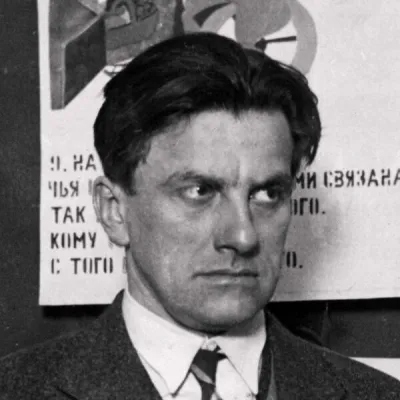
Vladimir Mayakovsky
Human Design Chart
Biography
Though Mayakovsky's work regularly demonstrated ideological and patriotic support for the ideology of the Bolsheviks and a strong admiration of Vladimir Lenin, his relationship with the Soviet state was always complex and often tumultuous. Mayakovsky often found himself engaged in confrontation with the increasing involvement of the Soviet state in cultural censorship and the development of the State doctrine of Socialist realism. Works that criticized or satirized aspects of the Soviet system, such as the poem "Talking With the Taxman About Poetry" (1926), and the plays The Bedbug (1929) and The Bathhouse (1929), met with scorn from the Soviet state and literary establishment.
In 1930, Mayakovsky committed suicide.
The Human Design of Vladimir Mayakovsky: Manifesting Generator 1/3
Manifesting Generator 1/3 — Design at a Glance
Vladimir Mayakovsky revealed himself as someone who acted with an unparalleled speed. As a Manifesting Generator, he had a constant energy source in his sacral center, which also gave him the ability to skip steps during action through additional connections to motor centers. This allowed him to quickly draw things into his life and push projects forward where others were still planning.
This hybrid nature brought specific challenges with it. His inclination towards speed led him to pursue multiple things simultaneously as he reacted to numerous different impulses. If these parallel activities were not steered by a clear inner consent, his creative enthusiasm would quickly turn into frustration – his Non-Self theme. Often, he had to go back and make up for skipped steps, which was felt as arduous.
The key to his satisfaction lay in not initiating himself but reacting to life. Only when his sacral center responded with a clear “yes” could he effectively use his energy. Under this condition, his multitasking ability transformed from a source of overstimulation into a productive play mode. He found deep satisfaction in his work as long as he found variety and continuously affirmed the inner authority of each project. His strength was not to proceed linearly but dynamically respond to impulses while maintaining the rhythm of his own energy.
Sacral Authority
Vladimir Mayakovsky revealed himself as a Generator whose decision-making was characterized by sacral authority. This internal leadership is unique to this type and decisively simplified his process of action. A prerequisite for this was an open emotional center; thus, he did not react to fleeting moods but rather to a deeper, physical resonance.
His authority manifested in the form of a “gut feeling” or sudden bursts of power as a direct response to external stimuli. He learned to pay attention to these bodily signals – audible as grunts, hums, or affirming mm-hmms. When his sacral motor engaged with a topic, he felt vital and alive. An almost inexhaustible energy was available to him, enabling him to tackle tasks with great enthusiasm.
This design predisposed him to go through life with joy and satisfaction. He immersed himself in his activities without having to pursue a rigid goal-oriented purpose. The activity itself was the reward. Additionally, his activated spleen center acted as supportive authority, giving him the ability to react particularly quickly and spontaneously. He possessed an immediate access to his physical well-being and instinctive perception, which he could rely on for guidance. This combination of sacral energy and spleen-supported intuition formed the foundation of his actions.
The 1/3 Profile — Investigator / Martyr
Vladimir Mayakovsky revealed himself as someone who combined theoretical knowledge with practical experience inseparably. His design as a Researcher and Experimenter (Profile 1/3) established a fundamental attitude: He learned intensively first, then tested what really worked through direct experimentation. This combination of scientist and adventurer meant that his judgment always rested on double verification – he knew not only how something should work but had also personally tested it in the crucible of experience.
His Line 1 emphasized the quality of stimulation and the value of ideas; he sought substance, not superficiality. At the same time, the energy of his Line 3 drove him to expose himself to extremes and develop through mistakes. For Mayakovsky, learning was not a static process but a dynamic survival instrument. If he deemed an idea or object valuable, he had previously tested it both intellectually and practically on its merits. His judgment was therefore trustworthy because it emerged from this synthesis of study and trial and error. He avoided triviality by ensuring that his expressions possessed genuine, vetted quality.
Single Definition — Defined & Open Centers
Vladimir Mayakovsky revealed himself as someone with an immense, constant energy source. His defined Sacral Center generated a specific amount of vitality daily that he used to find satisfaction by reacting to life rather than initiating actions; false initiations led to resistance and exhaustion.
His communication was equally structured: The defined Throat Center provided a consistent, reliable way of expression. Whether speaking or acting, it came from a clear source, allowing him to convey his truth with honesty and clarity. Supported by his defined Spleen Center, he could make spontaneous, intuitive decisions in the moment. This body intelligence served as a trustworthy authority for survival and well-being decisions independent of rational thought. Additionally, he had a defined Root Center that provided steady pressure to move forward in the world and maintain existential awareness.
At the same time, Mayakovsky was vulnerable to mental confusion due to his open Head Center. He lacked a consistent way to process mental information; he tended to engage with others' questions or be overwhelmed by doubts that were not his own. His open Ajna Center amplified this: He could take on concepts and opinions but risked interpreting them as personal truths or feeling uncertain without clear answers.
His open G Center meant he did not have a fixed identity. He relied on the environment to initiate direction and love for him; attempts to seek these himself led astray; only at the right place would a beneficial identity crystallize. His open Heart Center made him vulnerable to proving his worth through promises or competitive behavior – a cycle that ended in self-criticism without inner authority. Finally, his open Solar Plexus absorbed emotions from his surroundings. He had to learn not to personalize these feelings to remain emotionally stable and free from conditioning.
Channels for transformation, intuitive mastery and caring values.
Vladimir Mayakovsky's internal rhythm was marked by sudden, almost fateful impulses originating from the Channel of Mutation 60-3, connecting the Root Center with the Sacral. This channel endowed him with the ability to initiate evolutionary change but required him to accept limitations (Gate 60) and associated melancholy until a new order (Gate 3) emerged through him. This channel generated pulsating on-and-off energy that not only deeply influenced and conditioned himself but also his environment.
Parallel to this, Vladimir Mayakovsky had a deep need for perfection and expression. The Channel of Wavelength 48-16 connected his intuitive depth (Gate 48) with the skillful expression (Gate 16). Here lay his talent: through repeated practice and dedication, he could lead a skill to mastery so that it became not only technically correct but unique. However, this design required recognition and resources to continue working on the pattern.
A third strand was the Channel of Preservation 27-50, linking care (Gate 27) with traditional values (Gate 50). Vladimir Mayakovsky naturally took on caretaking responsibilities for his clan and attracted others' trust. His aura signaled safety and sustenance, making him vulnerable to overloading if he did not trust his own sacral reaction.
Additionally, individual Gates shaped his profile: Gate 56 allowed abstracting mental processes into figurative narratives; Gate 32 ensured continuity and assessed the clan's material success; Gate 33 called for withdrawal for reflection. Gate 28 stood for risk in the here and now, while Gate 44 promoted vigilance and transformation through interaction. Gates like 42 (Experience), 8 (Contribution), 18 (Correction) and 35 (Change) rounded out his complex profile oscillating between radical change and value preservation.
Individual Circuitry — Circuit Signature
Vladimir Mayakovskys design was characterized by a simple, coherent energy connection. His defined centers – Sacral, Root, Spleen, and Throat – formed one continuous flow, indicating an integrated capacity for action.
In the Knowledge Circuit, he linked his Sacral with his Root Center through the Channel of Mutation (Gates 3–60). This gave him the power to find new expression and initiate change by deviating from the existing. His identity manifested in pulsating, acoustic creativity.
The Understanding Circuit connected his Throat with his Spleen Center via the Channel 'Wavelength' (Gates 16–48). Here lay the ability to share logical insights focused and visually clear, free of emotional distortion. It was about strategic understanding for the future.
In the Protector Circuit, he again linked his Sacral with his Spleen Center through the Channel of Preservation (Gates 27–50). This primordial energy served protection and preservation of genetic heritage, coupled with instinctive care.
Together, these circuits formed a profile based on introducing new, mutating ideas that were clearly communicated and simultaneously protected.
Right Angle Cross of Laws 2
Vladimir Mayakovskys design suggests a tendency towards a specific internal tension arising from the interplay of two opposing forces. This configuration, known as the right cross of Laws 2, combines a strong desire for structure and control with an equally compelling drive for freedom and spontaneity. It is not merely a contradiction but a dynamic balance that requires constant adaptation.
This mechanism describes a life task where creating order was necessary without losing one's unpredictability. Vladimir Mayakovsky showed himself as someone who had to learn to view these two poles not as enemies, but as essential partners. The challenge lay in respecting established rules and laws while simultaneously keeping space open for improvised solutions.
This tension shaped his approach to authority and independence. He sought ways for personal freedom to unfold within existing systems without entirely rejecting or blindly following them. The right cross of Laws 2 challenged him to find a unique definition of lawfulness that allowed both discipline and creativity. This was not a static state but an ongoing process of balancing the desire for security with the impulse towards innovation.
Saturn Return — Life Cycles
Vladimir Mayakovsky published 'How Does a Democratic Republic Work?' in 1922, at age 29 – a significant point in his development. For his design, this was the first Saturn Return, marking a period where years of internal preparation and maturation often coalesce into a tangible external result. This cycle signals not mere randomness but the structural condensation of previous experiences into a graspable achievement.
The mechanics of the first Saturn Return act like a litmus test: what previously existed as potential or search now gains contour and weight. Vladimir Mayakovsky here did not improvise, but his inner pressure pushed towards a concrete form. The publication was the visible tip of a longer process of self-discovery and positioning. Instead of getting lost in unclear areas, his design focused energy on a defined work. This underscores his chart's tendency to anchor internal developments through external milestones. The Saturn Return functioned as a catalyst that transformed latent forces into tangible reality, thereby clarifying his role and contribution.
Manifesting Generator · Sacral Authority — Synthesis
He lived as a Generator whose connection between sacral energy and manifesting impulses (Design) provided an unstoppable drive. This combination allowed him to swiftly realize ideas but also required constant re-evaluation of the path taken (Authority). His profile as a Researcher and Experimenter (Profile Role) reinforced this cycle of quick action followed by retrospective validation. He incessantly sought new insights, tested them in practice, and distilled his own well-founded judgment from these – a process marked by pulsating energy (Switch Circuit: Knowledge Switch Circuit) manifesting through the Channel of Mutation (Channel 3-60).
A central tension field lay in the interplay between his drive for rapid implementation and the necessity to critically question results. He could send and transform messages through his defined Throat Center, yet underlying energy was marked by melancholy and a constant search for new paths. This led to a dynamic tension relationship between wanting to create something new and accepting limitations – a cycle evident in documented events like publications (Cycles).
3 Defined Channels
Incarnation Cross - Right Angle Cross of Laws 2
Solar Return
The Solar Return shows the moment when the sun returns to its exact birth position - your personal solar year.
Life Cycles
Discover the life cycles with a detailed triple view (birth chart, cycle chart, composite).
Human Design Profile
- Strategy
- To respond - wait for something to respond to
- Authority
- Sacral Authority
- Profile
- 1/3 - Investigator / Martyr
- Definition
- Single Definition
- Incarnation Cross
- Right Angle Cross of Laws 2
- Date of Birth
- 19.07.1893 14:36
- Place of Birth
- Kutaisi, Georgia
Frequently Asked Questions
What was Vladimir Mayakovsky's Human Design type?
Which Profile did Vladimir Mayakovsky have?
What Authority guided Vladimir Mayakovsky?
What incarnation cross did Vladimir Mayakovsky have?
When was Vladimir Mayakovsky born?
Discover your own Human Design
Are you also a Manifesting Generator? Find out in a personal reading how to unfold your multi-talents and direct your energy wisely.
More Personalities
Back to overviewAlain-Fournier

Aldair

Alizée

Angeli

Arletty

Artus