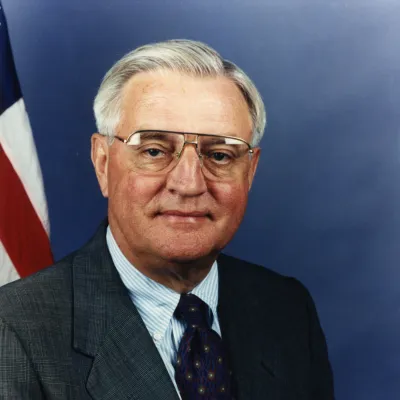
Walter Mondale
Human Design Chart
Biography
Mondale was born second of four children in Ceylon, Minnesota, to a Methodist minister and his wife, a part-time music teacher. Mondale’s father was 49 years old by the time he married Mondale’s mother, having lost his first wife from encephalitis. Nicknamed Fritz at birth, his real boyhood home was Elmore, which was where the family moved in 1937. Following his exploits on the football field, he became known as "Crazylegs" in high school. He attended Macalister College in St. Paul, Minn., considering a career of social work or teaching. But shortly after he heard Hubert Humphrey, mayor of Minneapolis at the time, his interests turned to politics. Humphrey would become a major mentor in his life.
After his father died in 1948, Mondale headed for Washington as executive secretary of the college branch of Americans for Democratic Action (ADA), a liberal anticommunist group that Hubert Humphrey helped found. He returned to Minnesota in 1950 and finished his undergraduate studies at the University of Minnesota.
He enlisted in the Army from 1951-1953, and spent the Korean War years guarding Fort Knox. He received his Law degree from the University of Minnesota in 1956. After law school, he took a job in a Minneapolis law firm. After a year, he started his own practice.
In May 1960, Mondale was named Minnesota state attorney general, serving until 1964. After John Kennedy’s assassination, Mondale volunteered to head up Lyndon Johnson’s 1964 re-election campaign in Minnesota. With Hubert Humphrey as Johnson’s running mate, Mondale was appointed to Humphrey’s vacant Minnesota Senate seat in 1964, where he served until 1977, focusing on civil rights and child welfare. In 1975, he wrote "Accountability of Power.
What does Generator 5/2 mean for Walter Mondale?
Generator 5/2 — Design at a Glance
Walter Mondale revealed himself as someone with tremendous inner endurance, but he unleashed his strength not through independent initiative, but rather through reactive action. As a Generator, he possessed an abundance of sacral energy that made him an extremely powerful "workhorse" – provided he followed the right impulse. His design dictated that this energy only became free when he reacted to a signal from the outside world and answered with a clear “yes” from within. The motto was not to initiate but to wait until life posed a question that he could respond to instinctively.
This mechanism created two clear pitfalls for him: Either he wasted his strength on tasks that did not resonate internally, leading to exhaustion, or he was prevented from continuing work on his true heart’s project even though he still had plenty of power. If Walter Mondale lived in harmony with this strategy of reaction, his system rewarded him with a deep sense of fulfillment and satisfaction. On the other hand, if he initiated too much out of his own will without waiting for the inner signal, sooner or later he encountered persistent frustration and a noticeable lack of energy. His strength lay in recognizing the right impulses and responding to them with full endurance rather than fighting against the current of his own nature.
Sacral Authority
Walter Mondale revealed himself as a person whose decision-making was guided by direct physical resonance. As a Generator, he possessed sacral authority, meaning his strategy and inner guidance were identical: He responded to external stimuli. This mechanism greatly simplified his process, as no cognitive analysis preceded action.
His responses did not manifest in the Head Center but rather as physical signals – a kind of "gut feeling." This could be expressed verbally through grunts or affirming mms, but also as a palpable surge of energy. When his sacral motor engaged with a topic, he felt vital and energized. This state allowed him to approach tasks with great enthusiasm without them needing to fulfill a compulsive purpose. The joy in the work itself was the central feature of this configuration.
Furthermore, his activated Spleen Center served as a supportive instance for his sacral authority. This connection granted him quick, spontaneous access to instinctive perception and physical well-being. He could reliably guide himself by these immediate impulses, which enhanced his responsiveness. Walter Mondale did not live according to abstract plans but followed the rhythmic pulse of his own energy, leading him toward things that organically resonated with him.
The 5/2 Profile — Heretic / Hermit
Walter Mondale's design was shaped by the tensions of the 5/2 profile "Hero/Natural Talent." He carried within him the inner conflict of wanting to help others and earn admiration (Line 5) while his deepest need was to live in seclusion and spend time alone with himself (Line 2). Unlike obvious hero archetypes, Mondale preferred to hide his gifts in his "cave." As long as the world had not yet discovered him, he worked hard on himself and used this isolation to prepare for his later role.
This pattern of Line 5, often described as alienation or being a lone fighter, meant that he acted intuitively and got through crisis times by fighting alone. The challenge was not so much separating from others but preventing himself from sinking too deeply into this solitude. At the same time, Line 2, in conjunction with Gate 57, promoted intuitive clarity regarding appropriate values and ideals. These values served his survival and required resolute determination to acknowledge inner insights. Thus, Mondale showed himself as someone who only made his presence and insights effective when he was ready to step out of his reclusive stance – always with the necessary balance through sufficient alone time and clear boundaries.
Single Definition — Defined & Open Centers
Walter Mondale revealed himself as someone with a fixed, reliable self-identity and a clear sense of direction in life. His defined G Center gave him the ability to love others without becoming dependent on them, along with an innate compass for the evolution of the species. This inner security was reinforced by his defined Heart Center, which endowed him with permanent willpower and the drive to keep promises. He enjoyed working independently to follow his internal mechanisms and focused his energy on providing for family and community while seeking recognition for his contribution.
As a Generator, Walter Mondale had a defined Sacral Center that provided an enormous source of vital energy. His strategy was not to initiate but to wait until he was asked before responding from the gut with a yes or no answer. This ensured him the necessary endurance and satisfaction in his activities. Complementing this was his defined Spleen Center, which gave him spontaneous intuition and a strong immune system. He could make intuitive judgments in the moment, protecting him from danger and allowing deep well-being as long as he trusted his instincts.
In contrast, Walter Mondale was vulnerable to external influences in other areas. His open Head Center had no consistent way of processing mental information; he tended to engage with others' questions and doubts or seek inspiration to relieve mental pressure. Similarly, his open Ajna Center made him susceptible to foreign concepts and opinions that he must not misinterpret as his own truth. His open Solar Plexus absorbed the emotions of the environment, leading him to personalize other people's moods or recoil from emotional confrontations. Furthermore, his open Root Center took on external stress and adrenaline surges, driving him into a cycle of avoidable pressure and exhaustion if he did not learn to recognize and let go of this foreign impulse.
Channels for pioneering spirit, instinctive devotion and individual power.
Walter Mondale demonstrated the ability to compete effectively and encourage others' individualization through a targeted impulse. This attitude stemmed from Channel Initiation 51-25, connecting the Heart Center with Shock Gate (51) and Spirit Self Gate (25). Here, ego energy, always wanting to be first, merged with universal love for beauty, enabling him to recognize potential in others and advance them through a 'shock' if invited.
Parallel to this, he had an instinctive sense of the tribe's needs coupled with the willpower to fulfill them. Channel Devotion 44-26 linked Spleen Center (Gate Alertness 44) with Heart Center (Egotist Gate 26). This configuration endowed him with intuitive insight into what people needed and conveyed it convincingly. He acted as an entrepreneur or promoter, generating resources and expecting recognition and rest in return. His strength lay in waiting for the market or tribe to recognize his gifts and invite him to contribute.
Additionally, he was marked by a high intuitive alertness based on survival instincts. Channel Power 34-57 connected Sacral Center (Power Gate 34) with Spleen Center (Intuitive Insight Gate 57). This allowed him to react spontaneously and quickly to dangers or opportunities without mental delay. His energy was geared towards navigating daily life safely through auditory attention and physical vitality.
Furthermore, additional gates shaped his profile: Gate 38 set boundaries for defending identity under pressure, while Gate 39 drove mutation through provocation and analysis. Gate 5 ensured rhythmic energy buildup through habits, Gate 40 expected reward in the form of rest after hard work, and Gate 29 demanded a persistent yes to challenges to receive the inevitable reward.
Individual Circuitry — Circuit Signature
Walter Mondale's design inclined towards solidified individuality, marked by the Projector Circuit. Here, Channel 25-51 connected Heart Center with Identity Center. This connection fostered strong convictions and self-worth while the lack of connection to Throat Center often resulted in these internal beliefs not being verbally expressed.
Parallel to this, the Ego Circuit worked through Channel 26-44 between Heart and Spleen Centers. This channel emphasized cooperation and the ability to mediate within group structures. Since Sacral Center was not involved here, this dynamic collaboration required necessary pauses for resource regeneration.
A third aspect appeared in the Integration Circuit via Channel 34-57 between Sacral and Spleen Centers. This connected powerful reactions to life (Gate 34) with intuitive knowledge (Gate 57). It was about drawing strength from interaction and making it effective in the present moment.
As a person with Simple Definition, these centers – Heart, Spleen, Sacral, and G Center – formed a cohesive energetic group. Walter Mondale thus lived an integrated experience of these forces: inner constancy, group-oriented cooperation, and intuitive action ability influenced his actions as a unified flow without external energies disturbing this structure.
Left Angle Cross of Individualism 2
Walter Mondale's design indicated a tendency towards independent and often solitary searches for inner truth. He was someone who questioned societal structures and chose an individual path away from collective expectations or predefined roles. This attitude stemmed from the so-called 'Left Cross of Individualism 2'. In Human Design mechanics, this configuration describes a specific life task: exploring new horizons and developing a personal philosophy that does not rely on external authorities but rather emerges from deep inner intuition.
Mondale lived with an internal drive to break free from conventional thought patterns. Instead of losing himself in groups or established systems, he sought an authentic expression of his own identity. This did not necessarily mean isolation, but a conscious distancing from norms that limited his individual integrity. His energy was directed towards uncovering new perspectives and integrating these insights into his actions. Through this process of self-discovery, he developed a robust inner stability that allowed him to follow his personal compass even under pressure. The mechanics of this cross thus fostered an attitude of critical reflection and bold breaking free from known patterns toward a self-determined way of existence.
Saturn Return · Uranus Opposition · Chiron Return · 2nd Saturn Return — Life Cycles
Walter Mondale's design indicated a tendency towards structured, long-term commitments that crystallized into clear professional milestones. This life line followed a pattern of step-by-step consolidation and later review. In 1956, at the age of 28, Mondale earned his law degree from the University of Minnesota. This first Saturn Return often marked the moment when years of hard work matured into a viable result; here, the foundation for a stable professional identity was laid based on discipline and clear definition.
Several decades later in 1977, the Chiron Return occurred as Mondale, at age 49, took office as Vice President under Jimmy Carter. This cycle did not describe healing old wounds but rather a phase of bloom and fulfillment: his incarnation cross unfolded increasingly, making sense and purpose tangible. Taking on this high office was an expression of inner maturity and alignment with the greater life purpose.
However, in 1984, at age 56, during the second Saturn Return, this development faced a test. Mondale ran for President and lost to Ronald Reagan. This time marked a classic crisis where previously established structures were confronted with harsh reality. The design indicated that such turning points should not be seen as failure but rather as necessary confrontation with the limits of one's strategy – a moment of deep reflection and realignment after years of intense political engagement.
Generator · Sacral Authority — Synthesis
Walter Mondale was a Generator whose life was characterized by a deeply rooted drive to set energy in motion – so long as this energy was directed towards tasks that truly resonated with him. The sacral authority (and thus the defined G Center) provided an inner compass guiding him to activities where he felt alive and fulfilled, while simultaneously through the Initiation Channel (51/25), he naturally showed a capacity to inspire and motivate others. This interplay of inner vitality and external influence formed a red thread manifesting in his engagement for areas close to his heart where he could fully deploy his energy.
A central paradox in Walter Mondale's design lay in the tension between the desire for connection and the need for autonomy. As Hero/Natural Talent (Line 5/2), he strove to help others and find recognition, yet also withdrew to recharge his energy and work quietly on his goals. This interplay between public role and inner restraint led to a dynamic where successes (such as taking office) were accompanied by phases of retreat and self-discovery, which was evident even during crisis times.
3 Defined Channels
Incarnation Cross - Left Angle Cross of Individualism 2
Solar Return
The Solar Return shows the moment when the sun returns to its exact birth position - your personal solar year.
Life Cycles
Discover the life cycles with a detailed triple view (birth chart, cycle chart, composite).
Human Design Profile
- Type
- Generator
- Strategy
- To respond - wait for something to respond to
- Authority
- Sacral Authority
- Profile
- 5/2 - Heretic / Hermit
- Definition
- Single Definition
- Incarnation Cross
- Left Angle Cross of Individualism 2
- Date of Birth
- 05.01.1928 10:30
- Place of Birth
- Ceylon, MN, United States
Frequently Asked Questions
What was Walter Mondale's Human Design type?
What profile did Walter Mondale have in Human Design?
Which authority guided Walter Mondale?
Which incarnation cross was active for Walter Mondale?
When was Walter Mondale born?
Discover your own Human Design
Are you also a Generator? Find out in a personal reading how to use your sacral energy correctly and discover deep satisfaction.
More Personalities
Back to overviewAaliyah

Alexia
Angèle

Anne-Marie

Arcángel

Arno