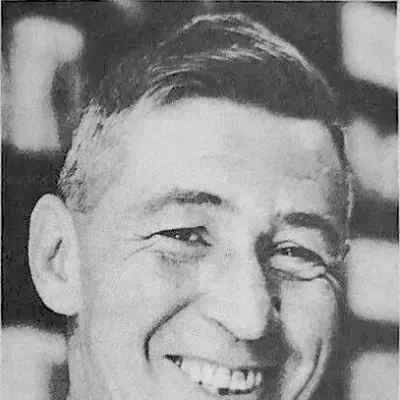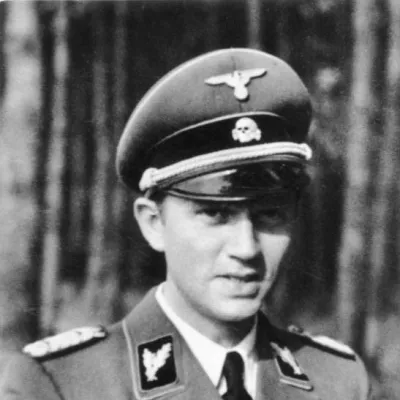
Walter Schellenberg
Human Design Chart
Biography
Human Design Analysis: Walter Schellenberg as Projector 6/2
Projector 6/2 — Design at a Glance
Walter Schellenberg was someone who immediately recognized weaknesses in systems and other people. His Human Design type was Projector, which shaped his perception and interaction style uniquely. Projectors act like bright flashlights: They shine directly on areas that are still dark or not functioning properly in others. Walter Schellenberg had the ability to identify flaws in a system instantly.
However, since he did not have a defined Sacral Center, he lacked a constant intrinsic source of life energy. Instead, he experienced phases of high activity and rapid workability, followed by necessary rest periods to prevent burnout. The conventional societal structure with its rigid working models often failed to accommodate this need for rhythm.
His most effective strategy was to wait for an appreciative and sincerely meant invitation from his environment. Rather than presenting his observations directly and possibly in a confrontational manner – which could quickly trigger resistance in others – it was more elegant for him to shine harmoniously himself. If he maintained this inner radiance, people would automatically seek him out for advice. When Walter Schellenberg lived by this design, he was rewarded with success; deviating from it sooner or later led to a feeling of bitterness.
Splenic Authority
Walter Schellenberg showed a basic orientation towards spontaneous and instinctive guidance. His internal authority lay in the defined Spleen Center, which presupposed that both the Emotional and Sacral Centers were open – a configuration only Projectors or Manifestors can exhibit. The Spleen served as an alarm system and source of survival intelligence for him. It provided an immediate physical signal indicating whether a situation, environment, or person was healthy or harmful. This impulse was subtle and occurred only once at the moment of occurrence. Walter Schellenberg had to recognize and follow this initial spontaneous impulse to effectively distance himself and protect himself. Since knowledge about what is right became available only in the moment, long-term commitments were difficult; his design required flexibility and freedom as plans could be adjusted short-term. The Spleen voice demanded high vigilance as it could easily be drowned out by external influences. A retreat for decision-making could be helpful to not miss this subtle impulse. Walter Schellenberg lived in a dynamic of momentary adaptation: He only knew what was right for him in the concrete moment and acted accordingly, based on this immediate inner truth, rather than orienting himself towards rigid future plans.
The 6/2 Profile — Role Model / Hermit
Walter Schellenbergs design showed a tendency towards experimental learning in early years, followed by a phase of deep introspection. As a 6/2-Profile, his line before the return of Saturn was similar to that of a 3-line: Trial and error characterized his youth, where he retreated after mistakes to gather experience. Around thirty years later, the sixth line from Gate 61 activated. Walter Schellenberg metaphorically withdrew into a 'cave' to look back at earlier experiments with distance. This period served for healing and self-awareness. The mutative energy of this line transferred important insights into collective consciousness if they were of great significance. It checked the practicability of solutions and decided whether these were confirmed or denied. Walter Schellenberg knew clichés of the collective, but it did not always listen to them. Simultaneously, his second line from Gate 50 projected determination outward. He presented ideas intelligently, yet encountered resistance when his value system had not yet established a deep foundation. In face of strong opposition, he withdrew resolutely or used friends to circumvent this resistance. Later, Walter Schellenberg emerged as a wise person from his reflective phase. Others sought him out to partake in his life wisdom and learn the ability for deep introspection. His path revealed itself as a process of verification, withdrawal upon resistance, and later dissemination of collective knowledge.
Single Definition — Defined & Open Centers
Walter Schellenberg was characterized by a consistent, trustworthy mental function. His defined Ajna Center ensured that he created concepts and theories in the same way; his mind was an ongoing process of data processing, acting as an external authority. This mental energy flowed directly into his defined Throat Center, allowing him to articulate what he thought. Thus, his communication was a reliable manifestation of his conceptual thinking, not impulsive or emotionally colored but conceptually structured.
At the same time, Walter Schellenberg had a defined Spleen Center. This gave him spontaneous body awareness and intuitive judgments in the here and now. He could perceive what was healthy for his survival based on moment-to-moment consciousness that did not need to be rationalized but simply followed instinct.
In contrast, several centers were open, making him vulnerable to external conditioning. His open Head Center had no consistent way of processing inspiration; he tended to take mental pressure from the environment and engage with others' questions rather than generating his own inspirational impulses. The open G Center meant that he did not have a fixed identity or direction but found it through interaction with his environment and the right places. His open Heart Center led him to be designed to use willpower consistently; he could easily fall into the cycle of making promises to prove his worth, often leading to failure and self-doubt.
Furthermore, his Sacral Center was open. Walter Schellenberg did not have a constant energy flow but absorbed generative energy from others. This could lead him to overextend himself as he did not know when it was enough, risking running on borrowed energy, which led to exhaustion. His open Solar Plexus absorbed emotions from the environment that he amplified rather than owning them, making him emotionally vulnerable. Finally, his open Root Center took stress and adrenalized pressure from the environment, reflecting and amplifying it without generating it himself, potentially resulting in an endless cycle of avoidance.
Channels for logical acceptance, deep perception and skill.
Walter Schellenberg was characterized by a combination of intuitive depth and the ability to logically structure complex information. His design suggested that he could translate inner perceptions into precise language, helping him recognize patterns and explain them to others.
This attitude was significantly influenced by Channel 48-16. This channel connected his Spleen Center with his Throat Center through Gate of Depth (48) and Gate of Dexterity (16). Gate 48 constantly sought life-critical information, while Gate 16 considered new possibilities for experimentation and perfected skills. Walter Schellenberg used this connection to refine intuitive insights through repeated trials. It was a process where technical mastery merged with inner intelligence to develop talents. He needed recognition and resources to continue this perfection process as his talent depended on confirmation from others.
Parallel to this, Channel of Acceptance 17-62 worked, connecting his Ajna Center with his Throat Center. Through Gate of Opinions (17) and Gate of Details (62), his mind permanently organized information in his mental system. He visualized patterns with Gate 17 and translated them into words with Gate 62 to give meaning. Everything he could not integrate into his inner vision, he did not understand. This created pressure in the Throat Center to communicate logically organized opinions in detail. Successful communication depended on listeners' openness as unchecked speaking could lead to resistance.
Additionally, individual gates contributed: Gate 50 fostered awareness and protective reflexes in terms of traditional values. Gate 61 urged inner truth and self-recognition through mental stillness. Gate 3 promoted mutations to create new orders from confusion while Gate 12 emphasized restraint and the influence of emotional mood on action.
Collective Circuitry — Circuit Signature
Walter Schellenberg's design inclined towards structured, rational analysis driven by a desire to logically improve things. This manifested as an ability to grasp complex relationships visually and strategically without emotional influence. The Understanding Circuit shaped this attitude: It connected Walter Schellenberg's Ajna Center (mind, focus), Throat Center (communication), and Spleen Center (intuition, choice). Through the channels 'Acceptance' (Gates 17/62) and 'The Wavelength' (Gates 16/48), this energy flowed as a cohesive stream. Walter Schellenberg used this flow to share rational insights in formats aiming for a better future or structure. As all three centers lay within one group, this logical processing worked as an integrated force, not separate impulses. The strategy involved filtering information (Spleen), structuring it in the mind (Ajna), and then precisely expressing or implementing it (Throat). This allowed him to focus on essentials and develop solutions strategically without being distracted by disruptive emotions. The energy of this circuit served to bring order out of chaos and clearly communicate rational concepts. Walter Schellenberg lived this ability for focused, logical improvement as a central expression of his defined nature.
Left Angle Cross of Obscuration 2
Walter Schellenberg's Human Design profile was marked by the left cross of veiling. This configuration established a fundamental tendency towards an inner distancing, where his true nature did not always manifest openly and directly to the outside world. Instead of open self-revelation, Walter Schellenberg exhibited a stance that favored protective mechanisms and strategic reserve. The left cross of veiling in Human Design describes an energetic state in which the direct connection between inner truth and external expression is clouded or consciously modified. For Walter Schellenberg, this did not necessarily mean deception in a negative sense but rather a natural inclination to safeguard his intentions and true self from unprotected observation. His way of interacting with his environment was characterized by this subtle filtering; he often appeared as someone who kept his cards close and did not reveal everything at once. This mechanism created an aura of mystery or unpredictability, serving to maintain personal boundaries and control over his sphere of influence. Walter Schellenberg lived this dynamic by engaging in situations where discretion and tactical behavior were advantageous. The veiling served here as a shield against unauthorized intrusion into his private realm while simultaneously being a tool to confuse others or keep them at a distance if it suited his strategy. His actions thus followed a pattern of selective disclosure, with control over information and perception always remaining with him.
Saturn Return · Uranus Opposition — Life Cycles
Walter Schellenberg was a person whose life course was marked by sudden turning points that came from the outside. This dynamic corresponded to the Uranus opposition in his design: an aspect often associated with unexpected breaks or rapid changes in social surroundings, which do not solely result from personal planning but rather as reactions to external circumstances. Such configurations can lead to important life phases abruptly ending or new paths unexpectedly opening up, frequently independent of one's own will.
A concrete example of this occurred in 1950 when Walter Schellenberg, at the age of 40, was prematurely released from the war criminal prison Landsberg due to liver disease. This event illustrates the mechanics of the Uranus opposition: A health crisis led to a drastic and rapid change in his life circumstances – release from prison – which abruptly interrupted his previous state (incarceration). It was a moment when external factors (his health condition and the resulting decision by authorities) decisively determined the course of his life rather than him actively and deliberately bringing about this step. This experience underscores the tendency of his design to be influenced by uncontrollable, external events that could have profound impacts on his daily life.
Projector · Splenic Authority — Synthesis
Walter Schellenberg was a projector whose design endowed him with a deep ability to recognize patterns and expose weaknesses (Gate 16/48). This gift combined with an inner authority in the Spleen Center, which provided him spontaneous knowledge about well-being and the correctness of situations. He lived a life path characterized by a constant interaction between observing and analyzing his environment followed by trusting his instinctive perception – a process that was particularly reinforced during his early years through experimentation (Line 6/2).
A central paradox defined his essence: the tendency to identify and address flaws in systems clashed with the awareness of potentially repelling reactions from others. His defined Mind Circuit (Ajna, Throat, Spleen) created a strong ability for conception and sharing insights, yet the subtle impulse of his Spleen authority demanded a sensitive handling of this power. The Uranus opposition in life cycles manifested in an event that required a sudden change in circumstances – a hint at the necessity to adapt to unexpected turns while always listening to his inner voice.
2 Defined Channels
Incarnation Cross - Left Angle Cross of Obscuration 2
Solar Return
The Solar Return shows the moment when the sun returns to its exact birth position - your personal solar year.
Life Cycles
Discover the life cycles with a detailed triple view (birth chart, cycle chart, composite).
Human Design Profile
- Type
- Projector
- Strategy
- Wait for the respectful invitation
- Authority
- Splenic Authority
- Profile
- 6/2 - Role Model / Hermit
- Definition
- Single Definition
- Incarnation Cross
- Left Angle Cross of Obscuration 2
- Date of Birth
- 16.01.1910 22:00
- Place of Birth
- Saarbrücken (Saarland), GER
Frequently Asked Questions
What was Walter Schellenberg's Human Design type?
What Profile did Walter Schellenberg have in Human Design?
What Authority did Walter Schellenberg have?
What incarnation cross did Walter Schellenberg have?
When was Walter Schellenberg born?
Discover your own Human Design
Are you also a Projector? Find out in a personal reading how to unfold your leadership qualities and recognize the right invitations.
More Personalities
Back to overviewSissy Spacek

Alain-Fournier

Anémone

Ann-Margret

Bourvil
Hergé