
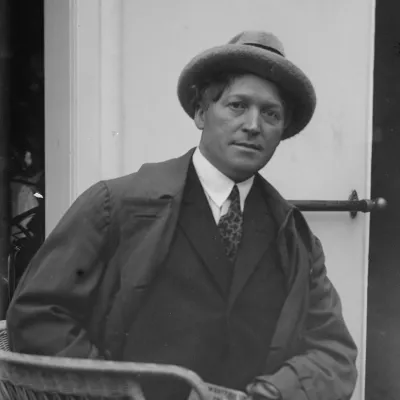
Werner Krauss
Human Design Chart
Biography
In 1903 Krauss debuted at the Guben municipal theatre and later played in Magdeburg, Bromberg (Bydgoszcz), at the Theater Aachen, in Nuremberg and Munich.
By the agency of Alexander Moissi, in 1913 he met the noted theatre director Max Reinhardt, who took Krauss to his Deutsches Theater in Berlin. However, Krauss initially only got minor and secondary roles like King Claudius in Shakespeare's Hamlet or Mephistopheles in Goethe's Faust, wherefore after his military discharge as a midshipman of the German Navy in 1916 he also pursued a career as a film actor.
Committed to playing sinister characters, Krauss became a worldwide sensation for his demonic portrayal of the titular character in Robert Wiene's 1920 film The Cabinet of Dr. Caligari. He also played the title role ofWilliam Shakespeare's Othello in a 1920 adaption, and played Iago in a 1922 adaptation.
Krauss' consummate skills in characterization earned him the title of "the man with a thousand faces".
Krauss was an unabashed anti-Semite who supported the Nazi party and its ideology. In 1933 Krauss joined the Vienna Burgtheater ensemble to perform in Campo di Maggio (German: Hundert Tage), a drama written by Giovacchino Forzano together with Benito Mussolini, whereafter he was received by the Italian dictator and also made the acquaintance of German Propaganda Minister Joseph Goebbels. Krauss was appointed by Goebbels to be vice president of the Reichskulturkammer theatre department and served in that capacity from 1933 to 1935. In 1934, Krauss was designated as a Staatsschauspieler (i.e. an actor of national importance).Adolf Hitler rated him as a cultural ambassador of Nazi Germany.
Werner Krauss was banned from performing on stage and in films in Germany. He was required to undergo a de-Nazification process from 1947 to 1948. Ultimately, he was rehabilitated to the extent of being invited to German film festivals.
The Human Design of Werner Krauss: Manifestor 5/1
Manifestor 5/1 — Design at a Glance
Werner Krauss revealed himself as a pioneer and visionary whose design predisposed him to lead the world in new directions. His Human Design type was that of a Manifestor – a configuration often compared to an emperor in ancient Rome: someone with great plans but who does not execute them personally, instead instructing others to carry them out. This role inevitably led him into conflicts as his far-reaching ideas were not understood or accepted by everyone. He polarized strongly; some followed him enthusiastically while others rejected or even hated him because of his ambitious visions.
The core challenge of his design was that he was often misunderstood. To find his „followers“ and minimize resistance, it was essential for Werner Krauss to inform others precisely about his intentions at the right time. This was the specific strategy of a Manifestor. If he followed this guidance and trusted in his inner authority, he was rewarded with a deep sense of inner peace. Living against his design – such as acting without information or giving in to others – instead left him feeling a persistent, deep anger. His life thus became an ongoing struggle to maintain the balance between independent impulse and clear communication to preserve peace within himself.
Emotional Authority
Werner Krauss demonstrated decision-making that did not occur at the moment of first excitement or rejection. His design carried Emotional Authority, meaning his defined emotional center always took precedence over all other internal signals – regardless of which additional centers were active in his chart. This configuration marked him by a natural emotional wave: His perception of the world swung between intense devotion and deep skepticism depending on his current mood level.
An initial impression was for him merely a snapshot, not yet the final truth. Quick, spontaneous judgments based on temporary feelings often proved misleading and could have negative consequences. Instead, his inner mechanics required patience and time. He had to let decisions rest, think them over multiple times, and sleep on them. Only when the initial emotional heat subsided and distance was gained did clarity set in for him. This process of emotional condensation was essential for all long-term turning points in his life. Through this conscious delay alone could he recognize his deeper, more comprehensive truth and act calmly rather than being driven by fleeting moods.
The 5/1 Profile — Heretic / Investigator
Werner Krauss revealed himself as a person carrying deep, specialized knowledge that became relevant to solving others' problems. His Human Design Profile 5/1 shaped him into a „Hero“ who used the depth of his own research (Line 1) to make it accessible to others (Line 5). This configuration gave him almost magnetic appeal: Others actively sought out his answers and advice.
This process was based on fundamental openness towards various opinions and theories (Gate 17), allowing him to grasp reality from many perspectives. At the same time, he possessed the ability to adapt extremely in crisis situations and take drastic stances if necessary (Gate 15). This served growth through intense experiences.
The challenge lay in balance: If Werner Krauss did not set clear boundaries, there was a risk of him burning out like an overburdened expert oracle – drained by the abundance of inquiries and criticism directed at his knowledge. Only learning to say „No“ allowed him to maintain the beneficial tension between private research for himself and public problem-solving for others. This way, he could optimally utilize his gifts without being overwhelmed by the expectations of his environment.
Split Definition — Defined & Open Centers
Werner Krauss revealed himself as someone with a consistent, trustworthy mental structure and a clear sense of identity. His defined Ajna Center ensured that he created concepts in the same way every time; his mind was constantly active and served as an external authority that conditioned the mental field around him. Simultaneously, his defined G Center provided a firm self-identity and direction in life without being dependent on others.
This inner stability was complemented by his defined Heart Center, which gave him willpower. He preferred to control his own resources and keep promises, strengthening his self-esteem. His communication was reliable: the defined Throat Center transformed information from his mind or heart into clear messages that he could express. Additionally, he possessed deep emotional intelligence through his defined Solar Plexus Center. He used his feelings as an inner authority and waited patiently for the emotional wave to gain clarity before acting. His defined Spleen Center protected him with spontaneous intuition in the present moment, while his defined Root Center allowed a set approach to stress that promoted his survival and material well-being.
In contrast, Werner Krauss was vulnerable to conditioning in certain areas. His open Head Center had no consistent way of processing mental inspiration. He tended to be overwhelmed by doubts or questions from others and might seek external answers to resolve this confusion rather than trusting his inner authority. Similarly, his Sacral Center was open, making him sensitive to the energy around him. He could absorb borrowed energy and overextend himself without a steady internal flow of energy. This led him to learn how to set boundaries and listen to his personal authority to prevent exhaustion, instead of being driven by the generative power of others.
Channels for intuitive elegance, clarity, logic, pioneering spirit & emotion.
Werner Krauss exerted a profound impact on his surroundings simply by being present and speaking in the moment. This attitude was rooted in Channel of Awakening 10-20, which connected his G Center with his Throat Center. Through Gate 10 (Presence) and Gate 20 (Now), he lived the principles of survival through self-love and acceptance. His behavior was not planned but an expression of inner clarity: “I am.” This inspired others unconsciously to be themselves without him actively leading.
This authentic presence was supported by Channel of Perfect Form 10-57, which linked Gate 57 (intuitive insight) from the Spleen Center with Gate 10 in the G Center. Krauss acted spontaneously based on deep, acoustic intuition, far from thoughts or future anxieties. He perfected his survival through a natural adaptability that moved him existentially unburdened through the world. His creativity was not a reflective process but an instinctive flow that left his environment healthier and more beautiful, often without this being his goal.
At the same time, he had a sharp, logical side. Channel of Acceptance 17-62 connected the Ajna Center (Gate 17, opinions) with the Throat Center (Gate 62, details). His mind constantly organized visual patterns and translated them into precise language. He sought logical consistency; what did not fit his mental system he could not understand. This gave him the ability to structure complex information and present it in detail – a gift for teaching or presenting if invited to speak.
His intuitive knowledge also found expression through Channel of Brainwave 57-20. Gate 57 (Spleen) flowed directly into Gate 20 (Throat). Here he spoke the truth of the moment, supported by ancient primal instincts. His verbal outbursts were quick and hit the core of a matter before others could rationalize it. This encouraged others to use their own inner survival intelligence.
Emotionally, Krauss was marked by Channel of Emotion Release 39-55. Gate 39 (provocation) in the Root Center acted on Gate 55 (spirit) in the Solar Plexus. He was subject to a pulsing wave of passion and melancholy. His mood determined whether he experienced joy or sadness and how he influenced others. He learned to find the right people by provoking their spirit to recognize the appropriate spirit. Authenticity at this emotional depth was crucial for his spiritual creativity.
Finally, Channel of Initiation 51-25 carried competitive energy. Gate 51 (shock) in the Heart Center connected with Gate 25 (spirit of self). Krauss had the potential to trigger individual growth processes in others through challenges and “shocks.” This happened correctly only when invited; otherwise, it led to resistance. His path was to live these mutative forces as a byproduct of his authentic life, not as targeted intervention.
Individual Circuitry — Circuit Signature
Werner Krauss revealed himself as someone who combined inner convictions with a strong individual identity. His design tended towards a fortified self-worth supported by the Centering Circuit. This connected his Identity and Heart Centers directly (Channel 25-51), fostering courage and firm principles, though often without direct verbal expression in the Throat Center. Simultaneously, separate energetic poles were at work: The “Split Definition” separated this inner stability from other areas.
Another aspect was the connection of logic and expression. The Understanding Circuit linked Werner Krauss’s Ajna with his Throat Center (Channel 17-62). This allowed him to articulate rational insights and strategic structures clearly, free from emotional coloring. At the same time, he had in the Knowledge Circuit two independent segments: On one hand, he connected the Throat Center with the Spleen (Channel 20-57), translating intuitive flashes of insight and creative inspiration into language. On the other hand, his Solar Plexus Center was linked to the Root Center (Channel 55-39), providing emotional waves and pulsing energy, though not directly connected to intuition or expression.
Finally, he integrated power through the Integration Circuit. Here he connected his Throat Center over the Identity Center with the Spleen (Channels 20-10 and 10-57). This created a flow of intuitive knowledge that was directed by proper behavior and manifested verbally in the present moment. Werner Krauss lived in a tension between deep inner centering, clear rational communication, and impulsive creative intuition, where these areas did not always energetically flow directly into one another but worked as parallel forces.
Left Angle Cross of Prevention 1
Werner Krauss revealed through his design as someone whose inner orientation was strongly focused on prevention and protection against future dangers. This attitude resulted from the configuration of the left cross of Prevention 1, a specific energetic structure in the Human-Design system. This cross connects themes of safety, preparation, and conscious action to avoid potential risks. For Werner Krauss, this did not necessarily mean fear or paranoia but rather a deep, structural inclination to think situations through ahead of time and take measures to prevent negative developments before they occurred. His energy flowed into areas where preparation and strategic planning were crucial. He lived with a focus on maintaining stability and buffering chaos through targeted precautions. This mechanism shaped his way of interacting with the world: less impulsively, but rather calculated and mindful of long-term security. The energy of this cross supported him in acting as a guardian or stabilizer in his environment by identifying and closing gaps in the system early on. It was a constructive force of defense that helped him set boundaries and conserve resources instead of unnecessarily risking them. Werner Krauss used this inner logic of prevention to instill order and reliability in his life, based on his ability to detect danger signals early and respond accordingly.
Saturn Return · Uranus Opposition · Chiron Return · 2nd Saturn Return — Life Cycles
Werner Krauss revealed himself as someone whose professional career was closely intertwined with the cyclical phases of his Human Design. In 1913, at age 29, he was engaged by Max Reinhardt at the Deutsches Theater Berlin. This fell during his first Saturn Return, a phase in which years of groundwork often condenses into a solid result and structural confirmation.
In 1924, at age 40, he appeared in Max Reinhardt's production of "Das Mirakel." This marked the Uranus Opposition, a period of detachment and transformation that often requires new forms of expression or roles.
His engagement at the Burgtheater Vienna in 1933, at age 49, fell during his Chiron Return. During this fulfillment cycle, one's incarnation cross unfolds increasingly; if followed by strategy, purpose becomes experiential. For Krauss, this was evident as a professional peak and anchoring on a prestigious stage.
In 1940, at age 56, he portrayed in Veit Harlan’s antisemitic propaganda film "Jud Süß" in five roles anti-Semitic stereotypes. This occurred during his second Saturn Return, a time of maturation and confrontation with the limits of one's structure. Here, a severe crisis emerged, where external circumstances challenged his inner integrity and led to actions later deemed as a moral breach. Thus, the cycles not only shaped his ascent but also his deepest conflicts.
Manifestor · Emotional Authority — Synthesis
Werner Krauss lived as a Manifestor (Design) with emotional authority and the Profile Hero/Researcher. This combination shaped a person who was destined to lead while also needing time to find his inner truth. The defined Mental Center (Ajna) points to a consistent way of thinking that created concepts and inspired others – a process reinforced by the Awakening Channel (Gate 10/20), leading him to recognize principles in the present moment and put them into action. Repeated significant events in the career area, coinciding with his Saturn Return and Uranus Opposition, underscored a life marked by profound changes and an ongoing search for expression.
A central paradox lay in the tension between his manifesting nature – the drive to initiate and shape things – and the emotional wave (authority) that compelled him to let decisions mature. He could act as a visionary, yet his authenticity depended on taking time to experience and understand his feelings. This inner dynamic led him to both polarize and have a profound impact, especially in moments of crisis (Chiron Return, Saturn Return 2).
6 Defined Channels
Incarnation Cross - Left Angle Cross of Prevention 1
Solar Return
The Solar Return shows the moment when the sun returns to its exact birth position - your personal solar year.
Life Cycles
Discover the life cycles with a detailed triple view (birth chart, cycle chart, composite).
Human Design Profile
- Type
- Manifestor
- Strategy
- To inform others before acting
- Authority
- Emotional Authority
- Profile
- 5/1 - Heretic / Investigator
- Definition
- Split Definition
- Incarnation Cross
- Left Angle Cross of Prevention 1
- Date of Birth
- 23.06.1884 20:45
- Place of Birth
- Sonnefeld, Germany
Frequently Asked Questions
What was Werner Krauss' Human Design type?
What profile did Werner Krauss have?
What authority did Werner Krauss have?
What incarnation cross did Werner Krauss have?
When was Werner Krauss born?
Discover your own Human Design
Are you also a Manifestor? Find out in a personal reading how to use your initiation power peacefully and dissolve resistance.
More Personalities
Back to overviewSissy Spacek

Anémone

Ann-Margret

Arletty

Arno

Artus
