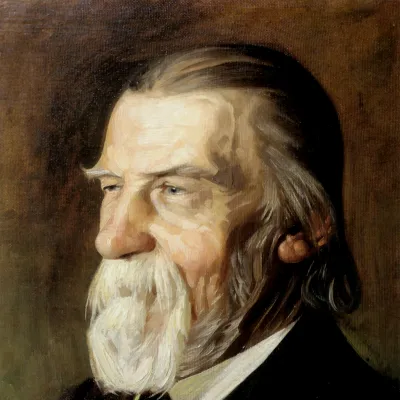
Wilhelm Raabe
Human Design Chart
Biography
After leaving school in Wolfenbüttel in 1849, Raabe was apprenticed for four years to a Magdeburg book dealer, during which time he read widely. Although he attended lectures at Berlin University, the important product of his time in Berlin was his popular first novel, published under his pseudonym, Jakob Corvinus Die Chronik der Sperlingsgasse (1857; “The Chronicle of Sperling Street”), which depicts episodes in the lives lived out on one small street. In 1856 Raabe returned to Wolfenbüttel, determined to make a living as a writer. He published a number of novels and story collections, none of which attracted much attention, and then set out to travel through Austria and Germany.
In 1862 he married and settled in Stuttgart, where he lived until 1870. During the Stuttgart years he wrote his then most successful novels, Der Hungerpastor, 3 vol. (1864; The Hunger-Pastor),Abu Telfan, oder Die Heimkehr vom Mondgebirge, 3 vol. (1868; Abu Telfan, Return from the Mountains of the Moon), and Der Schüdderump, 3 vol. (1870; “The Rickety Cart”). These three novels are often viewed as a trilogy that is central to Raabe’s generally pessimistic outlook, which views the difficulties of the individual in a world over which he has little control. Discouraged by a lack of public acclaim in Stuttgart, Raabe returned to Braunschweig, where he spent the last 40 years of his life. He specialized in short stories and involved shorter novels, which are now considered his most original, revealing a mature acceptance of compromise between the old order and the bewildering changes brought about by industrialization and urbanization.
He died 15 November 1910, Braunschweig.
The Human Design of Wilhelm Raabe: Manifestor 5/1
Manifestor 5/1 — Design at a Glance
Wilhelm Raabe's design leans towards pioneering leadership and visionary thinking. As a Manifestor, he was predestined to steer the world in new directions, similar to an emperor in ancient Rome who designed grand plans and inspired others with these visions. However, this role also brought specific challenges: His ideas were often misunderstood or polarized his environment. While some people loved his big dreams and followed him, others rejected him precisely because of these overwhelming visions, which could lead to conflicts. To minimize these tensions and find the right following, it was crucial for Wilhelm Raabe to inform others about his intentions in a timely and precise manner. This strategy of informing was key to his inner balance. If he adhered to this path, his design rewarded him with a deep sense of peace. Conversely, if he lived against this nature, he felt an enduring, deep anger within himself. His life task therefore consisted in clearly communicating his visions before acting, thereby gaining both his own internal calm and the support of those willing to follow him.
Emotional Authority
Wilhelm Raabe exhibited a fundamental disposition characterized by emotional wave movements. His design carried Emotional Authority, meaning that his defined Emotional Center was always his inner decision-making authority – regardless of which other centers were also defined. This priority rule is a central mechanism: The emotional truth always took precedence over other internal voices.
He experienced constant ups and downs in emotions. His perception of the world was always colored by the current mood; at one moment he could be enthusiastic about something, only to see it negatively in the next. For Wilhelm Raabe, however, such a first impression was merely a snapshot, not necessarily his deeper truth. Quick, spontaneous decisions directly from an emotion would often have negative consequences.
Instead, his design worked towards taking time. The longer he let a decision mature, the deeper and more comprehensive could he see it. This required patience and repeatedly reconsidering important questions. Through this hesitation, intense feelings gradually subsided. He gained emotional distance, leading to clarity and calmness. Only then was the inner process complete. This mechanism particularly shaped long-term decisions that had a significant impact on his life course. Wilhelm Raabe learned to take proper time for himself and ask himself multiple times before acting.
The 5/1 Profile — Heretic / Investigator
Wilhelm Raabe emerged as someone who gathered deep knowledge to offer others for problem-solving. His design as Hero/Researcher (Profile 5/1) leans towards using the depth of his knowledge base (Line 1) to make it available to others (Line 5). This configuration gave him almost magnetic qualities; people sought solutions from him, sensing his treasures. However, this could lead to exhaustion if clear boundaries were not set – similar to an expert who is drained at the end of a day because their inbox overflows. Raabe learned, however, to also say no in order to maintain balance between research for himself and help for others.
His Line 5 in Gate 64 emphasized hope and promises of clarity during crises. He sought practical solutions to fulfill this promise and promoted harmonious interactions to justify his efforts. Simultaneously, Line 1 in Gate 45 enabled him through natural attraction of like forces by advocacy and instruction. This ability for education and community promotion served the entire tribe and led to financial success when all actions were beneficial. Through good training, Raabe effectively applied his skills, connected with hope for harmony in relationships despite possible confusion over values. His path was marked by the task of uncovering hidden connections and conveying them so that others could adopt them without losing themselves.
Triple Split Definition — Defined & Open Centers
Wilhelm Raabe was someone who constantly faced mental pressure to question and understand connections. This tendency stemmed from his defined connection between the Head Center and Ajna Center. He had a firm way of conceptual thinking, but it did not provide direct energy for implementation; struggling against this limitation often led to frustration or inner concern when he tried to immediately turn unsolved inspirations into actions. Instead, his mental activity served as an inspiration source for others, particularly those with open Head Centers.
Parallel to that, Wilhelm Raabe had defined centers in the Heart (Willpower), Solar Plexus (emotional authority), and Root (stress management). This shaped him as a strong-willed person but also emotionally impulsive. His decisions were dependent on waves of his feelings; he needed time to achieve emotional clarity before acting. The defined Root Center gave him the necessary pressure to move forward in the world, while the Heart Center strengthened his need for control and recognition.
In contrast, his design revealed a high vulnerability to conditioning through open centers: G (Identity/Direction), Sacral (vital energy), and Spleen (health/intuition). Wilhelm Raabe tended to feel uncertain about his identity and search for a firm direction instead of owning it from within. He was sensitive to the energy of his environment, which could easily exhaust him since he did not have his own constant generative power. Additionally, he suffered from the fundamental fear of not surviving or feeling well, leading him to cling to people with defined Spleen centers for a sense of security and wellbeing. Spontaneous decisions were risky for him as his open Spleen Center did not offer reliable intuition.
Channels for abstraction, logic, synthesis and material values.
Wilhelm Raabe was someone whose mind swam in a constant, almost agonizing process of pattern recognition and meaning-making. His design set a fundamental attitude that oscillated between skeptical analysis and the urge for emotional belonging. The Logic Channel 63-4 connected the Head Center with the Ajna Center through the Gate of Doubt (63) and the Gate of Formulating (4). This created a mind that permanently filtered patterns to check if they were consistent. Here, doubt was not an obstacle but an essential part of logic that only accepted what practically worked. Parallel to this, the Abstraction Channel 64-47 connected the Head Center with the Ajna Center through the Gate of Confusion (64) and the Gate of Understanding (47). This channel drove him to sift every experience through a kaleidoscope of mental images to find a story that made sense – often accompanied by significant inner restlessness until clarity suddenly emerged.
Besides this intellectual intensity, deeper emotional and material streams shaped his work. The Synthesis Channel 19-49 connected the Root Center with the Solar Plexus Center through the Gate of Claims (19) and the Gate of Principles (49). This gave him a fine sensitivity to his position in the whole; he sought something to believe in, what held the trunk together. Loyalty and emotional frequency of acceptance or rejection determined who belonged here. Additionally, the Money Line Channel 21-45 connected the Heart Center with the Throat Center through the Gate of the Hunter (21) and the Gate of the Gatherer (45). This created a strong will to master the material plane and control his own rhythm so as not to be controlled.
This picture was complemented by individual Gates: The Gate 26 in the Heart Center promoted innovation within conservative structures, while the Gate 40 connected work only with the expectation of rest and recognition. In the design, the Gate 8 of Contribution, the Gate 56 of narrative abstraction, the Gate 62 for precise logic, and the Gate 61 of inner truth all together formed a person who not only thought complex connections but translated them into stories.
Collective Circuitry — Circuit Signature
Wilhelm Raabe was shown through a tripartite structure that created three independent energetic blocks. This separation created parallel forces that did not directly interweave but worked as separate focal points.
The Understanding Circuit connected his Head and Ajna Centers via the Logic Channel. This promoted a rational, future-oriented thinking approach aimed at improving things through focus and strategy – free from emotional influence. Parallel to this, in the same central area, the Meaning-Making Circuit also connected Head and Ajna, but via the Abstraction Channel. Here it was about reflecting past events to grasp their deeper meaning and share these emotionally colored insights with others. Both circuits thus used the same centers for different purposes: cool ratio versus emotional processing of the past.
A third, isolated block consisted of the Ego Circuit. It connected Throat and Heart Centers as well as Solar Plexus and Root Centers without these two parts communicating with each other. Through the 'Money Line' (Channel 45-21), it was about jointly creating material resources, while the Synthesis Channel (49-19) offered the ability to integrate various information. Since there was no connection to the Sacral Center, this configuration required necessary pauses for regeneration as energy did not flow continuously but in waves or jerks.
Left Angle Cross of Dominion 2
Wilhelm Raabes Design legt eine Neigung zu einem tiefen, fast schon schicksalhaften Verständnis von Macht und Autorität fest. Sein innerer Kompass zielt darauf ab, die unsichtbaren Strukturen zu erkennen, die das menschliche Zusammenleben regeln – nicht im Sinne politischer Herrschaft, sondern als fundamentale Ordnungsmuster, die jeden Einzelnen berühren.
Diese Ausrichtung entspringt dem sogenannten „linken Kreuz des Herrschaftsgebietes 2“. In der Human-Design-Mechanik markiert diese Konfiguration eine spezifische energetische Signatur: Sie verbindet die intuitive Wahrnehmung mit einer klaren, fast schon unerbittlichen Logik. Wer dieses Kreuz trägt, neigt dazu, Situationen nicht nur emotional zu erleben, sondern sie gleichzeitig durch ein strenges inneres Raster zu filtern – ein Raster, das zwischen dem, was wirklich ist, und dem, was nur Schein oder Illusion darstellt, unterscheidet.
Für Wilhelm Raabe bedeutete dies, dass er Autorität nicht als äußere Befehlsgewalt sah, sondern als eine innere Disziplin, die aus Klarheit erwächst. Seine Energie wirkte dabei oft ruhig, aber durchdringend; sie forderte keine lauten Forderungen, sondern strahlte eine stille Gewissheit aus, die andere entweder anzog oder abstoßend wirken konnte – je nachdem, ob sie bereit waren, sich dieser inneren Ordnung zu stellen. Es war kein Streben nach Kontrolle über Andere, sondern ein tiefes Bedürfnis, die eigenen Grenzen und die der Welt präzise zu definieren.
Saturn Return · Uranus Opposition · Chiron Return · 2nd Saturn Return — Life Cycles
Wilhelm Raabes Design legt eine Neigung zu langfristiger, strukturierter Arbeit fest, die erst mit zunehmendem Alter ihre volle Tragfähigkeit erlangte. Diese Konfiguration zeigte sich deutlich während seines ersten Saturn-Returns: 1857, im Alter von 26 Jahren, veröffentlichte er seinen ersten Roman „Die Chronik der Sperlingsgasse“ unter dem Pseudonym Jakob Corvinus. Dieser Zeitpunkt markierte den Übergang von der Vorbereitung zur konkreten Umsetzung seiner kreativen Visionen in der Öffentlichkeit.
Später präsentierte sich seine Struktur durch eine Phase der Überprüfung und Neuorientierung. 1870, im Alter von 39 Jahren, während einer Uranus-Opposition, kehrte er entmutigt vom fehlenden Publikumserfolg nach Braunschweig zurück. Diese Krise verdeutlichte den Druck, der auf sein System wirkte, als äußere Anerkennung ausblieb und innere Stabilität gefragt war.
Die endgültige Verfestigung seines Lebenswerks trat mit dem zweiten Saturn-Return ein. 1886, im Alter von 55 Jahren, erhielt er die Ehrengabe und später den lebenslangen Ehrensold der Schillerstiftung. Dieser Erfolg bestätigte die nachhaltige Wirkung seiner bisherigen Arbeit und sicherte ihm eine stabile Grundlage in seinen letzten Lebensjahren. Sein Weg folgte somit einem Muster, das anfängliche Hingabe, mittlere Prüfung und späte Anerkennung als zusammenhängende Entwicklungslinie verstand.
Manifestor · Emotional Authority — Synthesis
Wilhelm Raabe lebte einen Lebensweg, der von einem tiefgreifenden Drang nach Erkenntnis und dem Wunsch geprägt war, dieses Wissen weiterzugeben. Die Kombination aus Manifestor-Typ (mit dem Bedürfnis, anzuregen und zu initiieren) und emotionaler Autorität deutet auf eine Persönlichkeit hin, die zwar visionär und vorreiterisch agierte, Entscheidungen jedoch stets nach reiflicher innerer Auseinandersetzung traf. Das definierte Kopf- und Ajna-Zentrum (Kanal der Logik) erzeugt einen beständigen mentalen Druck, Muster zu hinterfragen und zu formulieren – ein Prozess, der ihn als Held/Forscher (5/1 Profil) dazu antrieb, Lösungen für andere bereitzustellen. Die wiederkehrenden Zyklen, insbesondere die Veröffentlichung eines ersten Werkes (Saturn Return 1) und die spätere Anerkennung durch die Schillerstiftung (Saturn Return 2), unterstreichen diesen fortwährenden Kreislauf aus kreativer Arbeit und dem Streben nach Bestätigung.
Raabe schien jedoch in einem inneren Spannungsfeld zwischen der Notwendigkeit, seine Visionen zu kommunizieren, und einer gewissen Entmutigung angesichts fehlender Resonanz zu leben (Uranus-Opposition). Die emotionale Welle führte ihn zwar zu tiefgreifenden Einsichten, doch die daraus resultierenden Zweifel (Gate 63) und das Bedürfnis nach logischer Validierung (Kanal der Logik) bargen auch die Gefahr des Stillstands. Er war ein Denker, der sich in der Formulierung seiner Erkenntnisse verlor, während er gleichzeitig den Drang verspürte, diese mit anderen zu teilen – ein Paradox zwischen innerer Tiefe und äußerem Ausdruck.
4 Defined Channels
Incarnation Cross - Left Angle Cross of Dominion 2
Solar Return
The Solar Return shows the moment when the sun returns to its exact birth position - your personal solar year.
Life Cycles
Discover the life cycles with a detailed triple view (birth chart, cycle chart, composite).
Human Design Profile
- Type
- Manifestor
- Strategy
- To inform others before acting
- Authority
- Emotional Authority
- Profile
- 5/1 - Heretic / Investigator
- Definition
- Triple Split
- Incarnation Cross
- Left Angle Cross of Dominion 2
- Date of Birth
- 08.09.1831 18:00
- Place of Birth
- Eschershausen, GER
Frequently Asked Questions
What was Wilhelm Raabe's Human Design type?
What profile did Wilhelm Raabe have in Human Design?
What authority did Wilhelm Raabe have?
What incarnation cross did Wilhelm Raabe have?
When was Wilhelm Raabe born?
Discover your own Human Design
Are you also a Manifestor? Find out in a personal reading how to use your initiation power peacefully and dissolve resistance.
More Personalities
Back to overviewAlain-Fournier

Angeli

Christian-Jaque
Juninho

Kesha

Lucebert