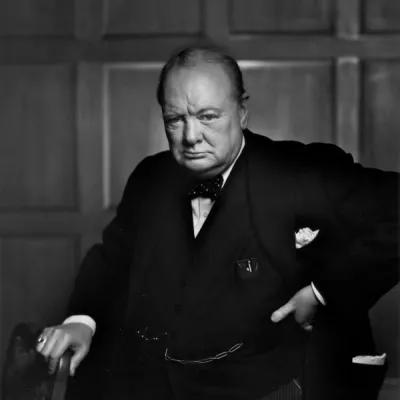
Winston Churchill
Human Design Chart
Biography
Of mixed English and American parentage, Churchill was born in Oxfordshire into the wealthy, aristocratic Spencer family. He joined the British Army in 1895 and saw action in British India, the Mahdist War and the Second Boer War, gaining fame as a war correspondent and writing books about his campaigns. Elected a Conservative MP in 1900, he defected to the Liberals in 1904. In H. H. Asquith's Liberal government, Churchill was president of the Board of Trade and later Home Secretary, championing prison reform and workers' social security. As First Lord of the Admiralty before and during the First World War he oversaw the disastrous naval attack on the Dardanelles (a prelude to the Gallipoli campaign) and was demoted to Chancellor of the Duchy of Lancaster. He resigned in November 1915 and joined the Royal Scots Fusiliers on the Western Front for six months.
Winston Churchill as a Projector 3/5 in Human Design
Projector 3/5 — Design at a Glance
Winston Churchill had a dense and focused aura as his Projector, allowing him to instantly recognize systemic errors and guide others. His design acted like a bright flashlight that targeted problematic areas in his environment, bringing light into the dark. With an undefined Sacral Center, he did not have constant intrinsic life energy. Instead, he went through cycles of high activity followed by necessary rest periods to prevent burnout.
The mechanics of his design required a specific strategy: Directly addressing errors often provoked resistance, as if shining a bright light directly into someone's face. More effective for him was attracting others with his own harmonious example. People would then automatically come to him seeking advice because of his appealing aura. The key to success lay in waiting for a genuine invitation that valued and respected him. Living by this design rewarded him with success; deviating from it led to the experience of bitterness as a non-self theme. This dynamic shaped his interaction with the environment and defined his path to effectiveness.
Emotional Authority
Winston Churchill's inner authority was emotionally influenced, significantly impacting his decision-making process. His design showed a tendency for spontaneous reactions often being unreliable, requiring time to gain emotional clarity. The emotional wave in his Solar Plexus Center caused his feelings to fluctuate constantly. At one moment he might be enthusiastic about something, while it could seem negative the next instant. These mood swings did not mean that his immediate impressions reflected truth; rather, they were initial moments yet to be fully processed.
The mechanics of his emotional authority required patience and waiting for calm before making final decisions. Winston Churchill learned that the more time he took, the deeper and broader he could understand situations. This meant reconsidering decisions multiple times to ensure intense emotions had subsided and an emotional distance was gained. Only then did clarity set in, crucial for long-term decisions. Through this process, he ensured his actions were based on a solid foundation rather than reflecting momentary impressions.
The 3/5 Profile — Martyr / Heretic
Winston Churchill's design was characterized by fundamental skepticism towards pre-established truths; he initially believed nothing and had to test everything himself. This experimental attitude (Line 3) was essential because for him, errors were not endpoints but indispensable teachers. A tiny detail could cause a process to fail entirely, keeping his logical error tolerance extremely low to ensure future security.
This learning-oriented process stood in stark contrast to the expectations of his environment. As an Hero (Line 5), he appeared attractive to others due to his wealth of practical life experiences; they sought his guidance and wanted to learn from his insights. This role flattered his ego but became painful when experiments failed in public. His inflexibility towards the hopes of the outside world required actively warding off negative forces to find necessary rest periods and free himself from the pressure of always appearing competent. Winston Churchill lived this dynamic of learning through mistakes while simultaneously bearing the burden of the Hero role, which both propelled him forward and exposed him to the risk of public disappointment.
Split Definition — Defined & Open Centers
Winston Churchill's design laid the foundation of persistent willpower and clear identity through defined Heart Center, G Center, and Throat Center. He had a reliable voice that spoke directly from his inner value sense and personal direction. His communication emanated not from fleeting thoughts but from a deep 'I want to' and steadfast self-love. Simultaneously, he possessed a defined Solar Plexus, bringing emotional depth with it. His inner authority lay in the ability to wait out his own emotional wave to reach clarity rather than reacting impulsively to moods.
In contrast, Head Center, Ajna Center, Sacral Center, Spleen Center, and Root Center were open. These areas made him receptive to external influences. The open Head Center tended to interpret mental pressure or environmental questions as personal urgency, leading to confusion if he did not trust his emotional clarity. An open Ajna Center meant that concepts and opinions were situational; he had to learn not to fix answers as absolute personal truth.
The open Sacral Center was particularly vulnerable to conditioning by the generative energy of the environment. There was a risk of overloading himself with 'borrowed' vitality or ignoring exhaustion, since he lacked a constant internal source for persistent work. Instead, he had to learn to listen to his authority to set boundaries and respect downtime. The open Spleen Center carried a fundamental fear of survival that could lead him to cling to uncertain situations because they emitted a false sense of well-being or security from others. Spontaneous decisions were risky here as they often rested on absorbed fears.
Finally, the open Root Center took in stress and adrenaline from the environment. The pressure he felt was often not his own but an amplification of the surroundings. The challenge lay in not mistaking this adrenalized pressure for personal drive or compensating with hyperactivity but observing it and using it only when it aligned with his inner strategy. His design thus required the discipline to distinguish external mental and energetic stillness from the internal, defined truth of Heart Center, G Center, and emotional clarity.
Channels for inspiring presence and genuine connection.
Winston Churchill's design inclined towards intensive detail work driven by the dominant personality-sun energy in Gate 9. This configuration promoted taming details and perfecting through repeated experiments; without adequate energy input, there was a risk of depression as the power could not be effectively channeled.
This focus on the concrete stood in tension with his public presence. The Inspiration Channel 1-8 connected his G Center to Throat Center and gave him a constant presence for individual creative expression. He was designed to act as an example without social adaptability. His impact arose not through explanation but by living his unique identity, thereby drawing public attention. This inspired others to unfold their own uniqueness, yet required patience in timing since this leadership had to stem from inner authenticity.
Parallel to this, emotional bonds with group structures shaped him. The Community Channel 37-40 connected his Solar Plexus Center to Heart Center and demanded careful, emotional agreements. Here it was about belonging and building bridges between individuals. A good deal or connection could not be made spontaneously; they needed time for formulation to benefit both sides. He sought recognition within the whole and was willing to serve the community but required clear agreements and pauses. This combination of detail-oriented perfectionism, inspirational example character without adaptation pressure, and need for emotionally secure group bonds formed his specific way of interacting with his environment.
Individual Circuitry — Circuit Signature
Winston Churchill's design inclined towards two parallel, not directly connected energetic fields. As someone with split definition, these forces worked alongside each other without a continuous flow between all defined areas.
Part of his design included the Knowledge Circuit. Here Channel 1-8 directly linked Throat Center to Identity Center. This connection fostered inspiration and the expression of unique individuality. The energy in this area was pulsing and creative, driven by the urge to forge new paths and initiate change. Winston Churchill showed himself as someone propelled by this inspiring force to express his own identity through words and actions.
Simultaneously, there existed a separate field in the Ego Circuit. This circuit connected his Heart Center to Solar Plexus Center via Channel 37-40. This created a dynamic of giving and taking based on mutual support and cooperation. As no connection to Sacral Center existed, this field was timeless and required pauses for resource regeneration. Winston Churchill moved here in a conservative, traditional stance that relied on the balance between investment and return.
The tension lay in the interplay of these two separate systems: the pulsing, creative impulse towards individual transformation on one hand and the calm, community-oriented necessity of resource management on the other. Both aspects shaped his essence as complementary yet energetically isolated poles.
Right Angle Cross of Planning 4
Winston Churchill revealed himself as someone who penetrated complex situations and developed long-term strategies. His design indicated a tendency towards strategic planning, allowing him to see the bigger picture and recognize patterns that extended beyond the immediate horizon. This ability stemmed from the right cross of Planning 4.
This element in Human-Design describes the capacity not only to perceive the obvious but also to identify hidden connections. It involves a deeper level of understanding where one learns to plan steps that have lasting impact. For Winston Churchill, this meant he was able to free himself from short-term reactions and instead take a broader view of the overall situation.
The emphasis lay in developing strategies that were not just for the moment but also included a future perspective. Through this way of thinking, he could make decisions based on a well-founded understanding of the situation. It was less about quick intuition and more about careful weighing and planning.
In this context, his ability to strategic vision became effective. He used this trait to show clear directions in difficult moments and guide others towards a common goal. The right cross of Planning 4 thus shaped a significant aspect of his approach to challenges: a thoughtful, far-reaching perspective that allowed him to look beyond the immediate horizon and design long-term solutions. This characteristic enabled him to solve complex problems while always keeping the big picture in mind.
Saturn Return · Uranus Opposition · Chiron Return · 2nd Saturn Return — Life Cycles
Winston Churchill's Human Design profile shaped a career marked by recurring astrological cycles that indicated structural turning points and identity shifts. These phases served as architectural milestones where his inner strategy condensed into external form. In 1902, at the age of 28, he experienced his first Saturn Return – a cycle often summarizing years of groundwork into a solid outcome. That year, he was elevated to Master in the "Rosemary Lodge No. 2851," underscoring this condensation on a career level.
The Uranus opposition around the age of 41 typically brings disruptive changes and new freedoms. In 1915, Churchill became Chancellor of the Duchy of Lancaster, an appointment reflecting this sudden shift in power structures.
The Chiron Return, beginning around the age of 49, is not a healing process in a medical sense but rather a fulfillment cycle where one's incarnation cross unfolds and meaning becomes tangible. In 1923, at 49 years old, the publication of "The World Crisis," a multi-volume history of World War I, began. This marked the point where his life purpose became concrete through writing.
The second Saturn Return around age 57 demands a re-evaluation of one's structures and boundaries. In 1931, Churchill stepped out of Baldwin's shadow cabinet. This move proved necessary to redefine his position rather than becoming entrenched in old roles. Each of these cycles served to make his inner architecture visible externally.
Projector · Emotional Authority — Synthesis
He was a Projector destined by his design to bring light into darkness for others and reveal flaws in the system (Design Perspective). This ability to recognize patterns and communicate them was amplified by a defined Throat Channel that transformed impulses from various centers into expressive power (Centers & Channels). His profile as an Experimenter/Hero and Saviour suggests he gathered experiences himself before serving others with his knowledge – a role that clearly suited him (Profile Role). Repeatedly documented events in career cycles indicate a life marked by constant transformation and adaptation to new circumstances.
A central paradox lay in the combination of his emotional authority with the need for expression from the Knowledge Circuit (Authority & Circuit). He needed time to let feelings mature while his design simultaneously urged him to publicly express creative impulses and insights. This likely led to an internal tension between the desire for introspective clarity and the wish to act as an inspiring role model, which manifested in different career phases.
2 Defined Channels
Incarnation Cross - Right Angle Cross of Planning 4
Solar Return
The Solar Return shows the moment when the sun returns to its exact birth position - your personal solar year.
Life Cycles
Discover the life cycles with a detailed triple view (birth chart, cycle chart, composite).
Human Design Profile
- Type
- Projector
- Strategy
- Wait for the respectful invitation
- Authority
- Emotional Authority
- Profile
- 3/5 - Martyr / Heretic
- Definition
- Split Definition
- Incarnation Cross
- Right Angle Cross of Planning 4
- Date of Birth
- 30.11.1874 01:30
- Place of Birth
- Woodstock, England, United Kingdom
Frequently Asked Questions
What was Winston Churchill's Human Design type?
Which Profile did Winston Churchill have?
What Authority guided Winston Churchill?
What incarnation cross did Winston Churchill have?
When was Winston Churchill born?
Discover your own Human Design
Are you also a Projector? Find out in a personal reading how to unfold your leadership qualities and recognize the right invitations.
More Personalities
Back to overviewSissy Spacek

Alain-Fournier

Anémone

Ann-Margret

Bourvil
Hergé