
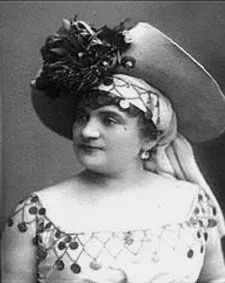
Zulma Bouffar
Human Design Chart
Biography
Aged only six, Bouffar appeared in "La fille bien gardée" in Marseille, and followed this with successful performances in Lyon. Her father then toured with her around western Europe and Scandinavia. After her father’s death in 1854 she continued travelling, bringing into her repertoire some of the contemporary songs of Offenbach, who heard her sing in Hamburg in 1864. The same year Bouffar appeared at Bad Ems in Offenbach's "Lischen et Fritzchen," and repeated her success in Paris.
From this time for about 12 years Bouffar was probably Offenbach's mistress – his longest extra-marital liaison. She created Nani in "Les géorgiennes," Jeannet in "Les bergers," Gabrielle in "La vie Parisienne," Drogan in "Geneviève de Brabant," Toto in "Le château à Toto," Fragoletto in "Les Brigands," Robin Luron in "Le Roi Carotte," Ginetta in "Les braconniers," Moschetta in "Il signor Fagotto" and Prince Caprice in "Le voyage dans la lune" – a range of men's and women's roles.
From 1891-93 Bouffar became the manager of the Théâtre de l'Ambigu-Comique. In the latter part of her stage career, Bouffar appeared in operettas by Lecocq and Strauss, and sang around Europe. She announced her retirement from the stage in 1902, and she died on 20 January 1909.
Zulma Bouffar as a Manifesting Generator 2/4 in Human Design
Manifesting Generator 2/4 — Design at a Glance
Zulma Bouffar's design featured a tendency towards hybrid energy: She had the constant power source of a Generator paired with the speed of a Manifestor. As a Manifesting Generator, she could skip steps when taking action and achieve results quickly. However, this mechanism carries risks: Acting too fast often led to important intermediate steps being skipped, resulting in backtracking and frustration – her specific theme of non-self. Additionally, she tended to pursue multiple projects simultaneously by reacting to various impulses. Without inner consent, this creative drive quickly turned into exhaustion.
The solution lay in her strategy: Reacting rather than taking initiatives. Zulma Bouffar acted effectively when she waited for external impulses and only started once her sacral center gave a clear "yes". Regularly checking this internal confirmation was crucial. When applying this reaction correctly, there was no pressure to linearly complete tasks. Instead, she found deep satisfaction in a playful mode that did not perceive variation and parallel work as disruption but rather as a source of energy. This state of fulfillment occurred when her speed was channeled through conscious reactions instead of blindly rushing forward.
Emotional Authority
Zulma Bouffar's design shows a tendency towards strategic hesitation: She made decisions only after achieving emotional clarity and consciously waited until the waves had subsided. This happened through her defined Solar Plexus Center as an internal authority. In Human Design mechanics, this center carries emotional authority – independent of which other centers may also be defined. It is subject to a constant wave of ups and downs in feelings. The world appeared to her always colored by her current mood; one moment totally excited, the next negatively surprised. However, her feeling in the moment was merely a snapshot, a first impression, not necessarily her truth yet. Quick, spontaneous decisions based on emotion could therefore have negative consequences. The more time she took to let a decision mature, the deeper and more comprehensive she could understand something. This required patience and repeatedly sleeping on decisions. She properly deliberated and asked herself multiple times. Over time, intense feelings subsided, she gained emotional distance. Then clarity and calmness set in – the process was complete. This mechanism was particularly important for long-term decisions that could have a significant impact on her life course. By waiting for the moment of peace, she avoided impulsive actions and acted from a position of inner security.
The 2/4 Profile — Hermit / Opportunist
Zulma Bouffar lived in the polar tension between a deep need for withdrawal and the urge towards community. Her design as Profile 2/4, which combines natural talent with networking skills, shaped a rhythm that constantly required oscillating between isolation and social integration. Line 2 conveyed the necessity of solitude: here it was essential to withdraw to create clarity and selectively focus on what is essential in the present moment. This phase of ascetic preparation was crucial; disrupting it could lead to an explosive reaction due to the stark contrast with her later social state.
Only once this inner need for peace had been satisfied did the energy of Line 4 open up. She then actively sought contact with her network, driven by a desire to align herself with stronger forces and a transpersonal understanding of the dynamics of happiness and relationships. For Zulma Bouffar, her success depended on how clearly she communicated these cycles: signals for "me-time" had to be just as clear as the desire for company. Only in this way could she reflect upon the knowledge of her network during times of solitude and develop brilliant ideas from it. This conscious control over the interplay between isolated reflection and social integration formed the basis of her inner balance.
Single Definition — Defined & Open Centers
Zulma Bouffar's Human Design profile indicated a tendency towards constant, willful expression supported by deep emotional authority. She emerged as someone who spoke from her identity and direction, with her voice marked by the defined G Center – the seat of higher self and love. This gave her a reliable inner compass. Her communication was not just intellectual but manifested through the also defined Throat Center as a direct translation of her internal states into the world.
Her actions were driven by an enormous vital energy originating from the defined Sacral Center. As custodian of this power source, she had a steady stream for work and activity provided that she responded to requests rather than initiating them. This sacral energy worked closely with her emotional depth: The defined Solar Plexus Center served as her inner authority. Zulma Bouffar was designed to wait for the emotional wave before making decisions; truth revealed itself to her over time, not in impulsive moments. Additionally, she possessed a firm will through the defined Heart Center and a steady life pressure via Root Center, which helped her advance in the material world and keep promises.
In contrast, her vulnerability was evident in mental and intuitive areas. The open Head Center meant that she did not have a consistent source for inspiration or mental clarity. She tended to absorb doubts and questions from others rather than generating her own answers. Similarly, the Ajna Center being open made her conceptual thinking flexible but not self-referential; she could take on ideas without identifying them as personal truth. The open Spleen Center was drawn to external security and comfort. Here lay the trap of clinging to people or situations that gave a false sense of safety, driven by deep survival fear rather than trusting her own authority supported by the Sacral and G Centers. This configuration required a constant balance between her strong inner energy and openness to external influences in mental and intuitive fields.
Channels for authentic presence, emotional depth and inner rhythms.
Zulma Bouffar's Human Design profile indicated a tendency towards deeply rooted, authentic presence. She emerged as someone who acted through pure being and trust in her own internal timing mechanism. This stance came from the Awakening Channel 10-20, an aware expression of self-love and anchoring in the present moment. Gate 20 conveyed the survival strategy of accepting one's essence, while Gate 10 ensured authentic presence. Parallel to this, the Rhythm Channel 5-15 flowed as a background structure. It connected firm habits (Gate 5) with a magnetic attraction for diversity (Gate 15), giving her an unshakable inner rhythm that brought others into her own flow without controlling them.
Additionally, other channels were at work: The Exploration Channel 34-10 promoted reinforcement through individual convictions and sacral reactions. The Charisma Channel 34-20 endowed a charismatic presence based on direct manifestation from the moment. The Openness Channel 22-12 brought emotional moodiness and cautious articulation. The Synthesis Channel 19-49 fostered tribal connection through emotional principles. The Initiation Channel 51-25 promoted competitiveness and initiation. The Emotion Release Channel 39-55 produced provocative emotional waves.
Individual gates complemented this picture: Gate 59 pursued a genetic binding strategy. Gate 3 stood for mutation and order creation from confusion. Gate 26 enabled innovation through weak ego. Gate 30 recognized feelings and longing. Gate 42 focused on experience and process completion. Gate 38 set boundaries to preserve integrity. Gate 13 collected collective experiences. Gate 54 connected worldly success with spirituality. Gate 36 used crises as developmental impulses. This configuration marked Zulma Bouffar as a person who influenced her environment through authentic presence and rhythmic constancy.
Individual Circuitry — Circuit Signature
Zulma Bouffar revealed herself through pulsating, acoustic energy rooted in the present moment seeking her own unique path. Her design connected Throat, Solar Plexus, and Root Centers in the Knowledge Circuit. This allowed her to emotionally process new insights and carry them outward as individual expression. The Channels 'Openness' and 'Emotion Release' promoted creativity along with the ability to initiate transformation through authentic voice.
Parallel to this, the Centering Circuit connected her Identity, Heart, and Sacral Centers. This inner configuration created solid convictions and strong self-worth. Through the Channels 'Exploration' and 'Initiation', she acted courageously and individualistically, strengthened others with her presence but had difficulty verbally articulating these internal certainties as Throat was not directly involved here.
The Understanding Circuit contributed through the Channel 'Rhythm' between Identity and Sacral Centers. This supported her in intuitively grasping logical structures and finding rhythms in daily life free from emotional overload. In the Ego Circuit, the Channel 'Synthesis' between Solar Plexus and Root was at work. Here it was about finding connections in chaotic situations, with pauses for regeneration necessary as there was no direct connection to Sacral.
Finally, the Integration connected her Throat, Sacral, and Identity Centers. The Channels 'Awakening' and 'Charisma' helped her draw power from reacting to life and manifest this in the present through action and expression. As a person with simple definition, all these centers worked as a cohesive flow, focusing and directing her energy.
Right Angle Cross of the Sleeping Phoenix 2
Zulma Bouffar's Human Design indicated a tendency towards profound inner transformation, often marked by periods of rest or withdrawal. This configuration pointed to a process where old structures were not simply discarded but rested until they could be reformed from within. It required patience and trust in one's own rhythm since the change occurred through internal maturation rather than external pressure.
The right cross of the sleeping Phoenix 2 described this mechanism exactly: a cyclical process of dying and rebirth on a subtle level. It was not about dramatic breaks but a quiet, continuous renewal that became apparent only later. Zulma Bouffar used these phases of silence to collect energy and develop new perspectives without having to immediately share them externally.
This structure shaped her way of dealing with change: not through confrontational action but through an internal condensation of experiences. She learned to accept the moment of 'sleeping' as a necessary part of growth rather than misinterpreting it as passivity. In this way, from stillness emerged a new quality that was sustainable and authentic because it was not forced but naturally matured.
Saturn Return · Uranus Opposition · Chiron Return · 2nd Saturn Return — Life Cycles
In 1902, at the age of 59, Zulma Bouffar withdrew from her active professional life. This step marked the conclusion of her first major life cycle, triggered by her second Saturn return. During this phase of internal inventory, she learned to integrate or let go of burdens and responsibilities that had weighed on her for decades. The second Saturn return symbolizes the consolidation of identity after a period of external achievements. It is a moment when an individual assesses which structures are sustainable and which can be shed to enable a more authentic life path. Zulma Bouffar's withdrawal was thus not a defeat but a strategic realignment of her energy towards inner stability and understanding of personal limits. This process allowed her to appreciate the fruits of her previous work while simultaneously creating space for new, more personal focal points, free from public expectations or professional obligations.
Manifesting Generator · Emotional Authority — Synthesis
Zulma Bouffar lived a life marked by the dynamic interplay between internal power and external expression. Her definition as an Manifesting Generator with emotional authority indicates someone who both had the ability to set things in motion and needed time for emotional clarity. This combination led to a life characterized equally by swift action and deep reflection – a constant balancing act between the impulse for immediate manifestation and the emotional wave that required careful decision-making. The connection of her defined G Center with the Throat Center amplified this tendency, enabling a strong expression of individuality and direction that was always filtered through emotional authority.
A central paradox in Zulma Bouffar's design lies in the tension between her manifesting aspect and her emotional nature. While her body was geared towards quick reaction and initiation, her inner authority required a phase of maturation and waiting. This discrepancy likely led to an internal struggle – the need for immediate action versus the necessity to fully explore the emotional landscape before committing. The 2/4 Profile underscored this by creating a dynamic between the desire for alone time for reflection and the need for connection and exchange with others.
8 Defined Channels
Incarnation Cross - Right Angle Cross of the Sleeping Phoenix 2
Solar Return
The Solar Return shows the moment when the sun returns to its exact birth position - your personal solar year.
Life Cycles
Discover the life cycles with a detailed triple view (birth chart, cycle chart, composite).
Human Design Profile
- Strategy
- To respond - wait for something to respond to
- Authority
- Emotional Authority
- Profile
- 2/4 - Hermit / Opportunist
- Definition
- Single Definition
- Incarnation Cross
- Right Angle Cross of the Sleeping Phoenix 2
- Date of Birth
- 23.05.1843 02:00
- Place of Birth
- Nérac, France
Frequently Asked Questions
What was Zulma Bouffar's Human Design type?
Which Profile did Zulma Bouffar have?
What Authority did Zulma Bouffar have?
What incarnation cross did Zulma Bouffar have?
When was Zulma Bouffar born?
Discover your own Human Design
Are you also a Manifesting Generator? Find out in a personal reading how to unfold your multi-talents and direct your energy wisely.
More Personalities
Back to overviewSissy Spacek

Aldair

Alizée

Anémone

Angeli

Ann-Margret
