
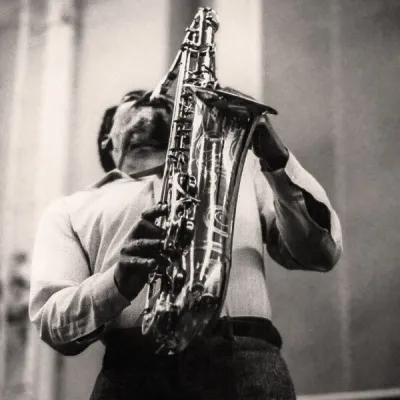
Albert Ayler
Human Design Chart
Biography
He served in the Army, 1958-1961.
Raised in a family of music; his brother played trumpet and his dad sang and played the sax and violin. Original in all his works, Ayler was driven, sincere and deeply religious. He died mysteriously, November 1970, missing for 20 days, found floating drowned in the East River.
Albert Ayler as a Generator 6/2 in Human Design
Generator 6/2 — Design at a Glance
Albert Ayler had a massive, enduring sacral energy source. His design characterized him as a Generator, a type with enormous inner power potential, comparable to a strong workhorse that only functions effectively when it feels the necessary resonance for its task. This configuration established a specific way of functioning: Energy did not arise from arbitrary initiative but exclusively through reaction to internal impulses.
The central mechanics of his design required Albert Ayler to wait for signals from his environment and then act once his sacral center signaled a clear "yes" – what is known as gut feeling. Acting in harmony with this inner compass resulted in deep satisfaction and a sense of fulfillment. Conversely, ignoring this signal or forcing actions without internal motivation led to frustration and energy loss.
Two main risks shaped his energetic profile: First, the waste of his strength on tasks where he did not feel intrinsic motivation, which over time tended towards burnout. Second, the risk of being prevented from continuing work on his heart project even though he was still full of power and wanted to keep going. His strength thus lay in his ability to channel his immense endurance through reactive action from the gut rather than fulfilling external expectations or stopping prematurely.
Sacral Authority
Albert Ayler was a Generator whose decision-making was shaped by Sacral Authority. This internal instance served as his primary source for actions and reactions. His design required him to wait on external stimuli rather than immediately intellectually analyze or plan. The response came physically: a gut feeling, an energy surge, or a loud grunt signaled resonance.
This mechanism meant that Albert Ayler had to learn to distinguish between vital energy and neutrality. When his sacral motor engaged with something, he felt alive and had inexhaustible energy. He then tackled his tasks with great enthusiasm and immersed himself in them without the need for external purposefulness. This was the source of his satisfaction and joy in life.
Since his Emotional Center was open in his design, this Sacral Authority could fully function. It simplified his process significantly as strategy and inner authority were identical: wait on the stimulus, then react. He did not act out of headbound considerations but let himself be guided by these immediate physical signals. This allowed him direct access to his life force energy and ensured that he only did what truly motivated and sustained him internally.
The 6/2 Profile — Role Model / Hermit
Albert Ayler revealed himself in his early phase as someone who learned through intensive experimentation. His design as Profile 6/2 established that before the age of thirty, the energy of Line 3 dominated. This meant a path of trial and error: he gathered diverse, often chaotic experiences to figure out what worked. Mistakes were not failures but necessary steps towards adapting under pressure.
After turning thirty, this dynamic fundamentally changed. Line 6 became active and demanded a withdrawal. Albert Ayler metaphorically retreated into a "cave on the mountain" to gain distance. This period served for intense reflection upon the previously gathered experiences. It was a phase of healing and deeper self-awareness, in which he integrated patterns from his past. Line 2 supported this process through selectivity; it created a dilemma between the desire for change and the necessity to complete deep inner processes.
The result of this two-phase development was acquired wisdom. Albert Ayler eventually emerged from his retreat as an example for others. His self-awareness became visible to those who wanted to partake in his ability for introspection. The mechanics here do not describe mere maturity but a structural transformation from an experimenting natural talent to a reflective teacher, who through pressure and repetition established successful patterns.
Split Definition — Defined & Open Centers
Albert Ayler revealed himself as someone with a high level of inner consistency and independence from external influences. His design was characterized by six defined centers forming a closed system: Mental Awareness (Ajna), Communication (Throat), Identity (G Center), Vital Energy (Sacral), Intuitive Protection (Spleen) and Stress Management (Root). This configuration created a constant mechanical presence.
The defined Ajna Center ensured continuous, specific mental function; he thought constantly and was not easily influenced by others. This flowed directly into the also defined Throat Center, allowing him to consistently express his thoughts. His firm identity and direction came from the defined G Center, giving him reliable self-love. The energy for this was provided by the defined Sacral Center, which responded with clear yes or no reactions to stimuli rather than initiating them. Intuitively, the defined Spleen Center protected him in the present moment while the defined Root Center supplied the necessary pressure for forward movement.
In contrast, his Head Center was open. This meant that he did not have a constant source of inspiration but served as a sensor for external impulses. He tended to be swayed by doubts or questions from others when he did not trust his inner authority. His Heart Center was also open, making him vulnerable to the pressure of proving his worth through willpower – a trap he had to avoid by not giving promises he could not keep out of inner conviction. Additionally, his Solar Plexus Center was open; he absorbed and amplified the emotions of his environment without owning them as his own. This required using emotional waves as information rather than identifying with them or avoiding confrontations due to fear of rejection. His design thus balanced a strong internal structure with the ability to reflectively take in external mental and emotional fields without being submerged.
Channels for rhythm, curiosity, ambition and maturation.
Albert Ayler was marked by a deep, inner rhythm that determined his timing and presence. This trait came from Channel 5-15 in his personality, a strong activation between Sacral and G Centers. Gate 5 held onto fixed habits while Gate 15 integrated the diversity of society into the life flow. This created an energetic magnetism that drew others into his continuous energy flow and influenced the course of a group. His timing worked independently, determined by this natural flow.
Additionally, he carried Channel 11-56 as a Juxta-Channel. This connected Ajna Center with Throat Center through Gate 11 (Ideas) and Gate 56 (Inspiration). It was an exploratory stance that aimed not at finding but at sharing stories. Albert Ayler used this ability to connect ideas and stimulate others through narrative presentations, less interested in pure facts than in the illustrative power of his storytelling.
Channel 54-32 (Root-Spleen) drove him forward with ambition and a desire for recognition. Gate 54 aimed at advancement supported by Gate 32, which sought talents to secure the existence of the tribe. This led to constant effort and the desire to be seen.
Channel 53-42 (Root-Sacral) promoted a cyclical experience process. Gate 53 initiated new cycles while Gate 42 reflected growth. Albert Ayler had to go through experiences fully to gain wisdom he could then share.
Additional Gates in his personality like Gate 10 (Integration), Gate 39 (Mutation/Provocation) as well as Design Gates such as Gate 58 (Pressure/Experimentation), Gate 25 (Innocence/Mysticism) and Gate 27 (Care) rounded out his profile. Gate 24 (Return), Gate 52 (Concentration) and Gate 62 (Logic) worked in the background, with the latter emphasizing pattern recognition and detail work.
Collective Circuitry — Circuit Signature
Albert Ayler moved within a split definition, meaning two parallel existing, not directly connected energetic systems. This created an inner tension between the focused shaping of a rational future and the wave-like reflecting on past experiences.
The Understanding Circuit in him linked Identity Center with Sacral Center through the Rhythm Channel. This connection promoted visual, structured logic for societal improvement – an 'emotionless ratio' that wanted to share insights free from conditioning. Simultaneously, the Sense-making Circuit worked as a separate system. It included two distinct parts: Ajna with Throat Center (Curiosity Channel) and Sacral with Root Center (Maturation Channel). Here it was about cyclical emotional waves from the past that needed to be processed and shared with the collective.
Furthermore, the Ego Circuit was defined through the Transformation Channel between Spleen and Root Centers. This stood for cooperation in creating resources within the tribe based on mutual support. Since this circuit did not connect to Sacral Center, pauses for regeneration of life force were necessary.
Albert Ayler thus lived with the challenge of integrating these different formats – the cool future logic on one hand and the inexplicable emotional reflection on the other – without them forming a common energetic flow. The mechanics showed as an ongoing balance between sharing visual strategies and going through emotional learning cycles.
Left Angle Cross of Cycles 1
Albert Ayler's design carried the potential to serve as a fundamental source for cyclical processes. His chart contained the structure of the left cross of cycles 1, which established a connection to the origin of all recurring patterns. This configuration did not describe active engagement in terms of planning or control but rather the presence of an initial energy. It was the point from which new cycles could develop before they took visible form.
In Human Design mechanics, this cross represents the starting point from which processes unfold. It stood for pure potential, the silent power behind all repetitions and patterns. For Albert Ayler, it meant a deep anchoring in this original state. He was the place where cyclical energies had their root before they unfolded outwardly. This position did not provide control over the process but rather the possibility to serve as a source. The energy flowed from him without his having to direct it. It was a passive yet essential function within the overall system of cycles. His design allowed patterns to emerge by being the point where everything began. This shaped his way of responding to changes: not through intervention, but by providing the fundamental potential out of which new things could develop.
Saturn Return — Life Cycles
Albert Ayler's design inclined him towards serious self-commitment, especially when it came to structuring his identity. This was evident in 1964: at age 28, he recorded his first studio album in New York and released the essential work 'Spiritual Unity'. For his Human Design, this marked his first Saturn Return. Typically, this cycle signals a transition from experimental exploration to taking concrete responsibility for one's life path. The energy of this return urges to pour previous impulses into sustainable structures and commit firmly. Ayler's step to now professionally and permanently fixate his musical statement aligned precisely with the mechanical demand for structuring and maturity. It was no mere coincidence that this publication occurred in this specific phase of his life; the Saturn Return acted as a catalyst for crystallizing his artistic stance. Through this event, it became visible how his design propelled him to not only live out his inner truth but also carry it outwardly through binding works, thereby taking a clear position in his environment.
Generator · Sacral Authority — Synthesis
Albert Ayler lived deeply rooted in the present moment, guided by a powerful sacral center (Design View) and direct, instinctive authority (Authority). This connection manifested in a lifestyle based on reaction and immediate experience – constantly responding to what was presented rather than initiating (Design View). His defined G Center (Centers) anchored him further in deep self-worth and inner direction, yet this openness did not force itself into rigid plans. Instead, he seemed to adopt a cyclical nature, fully experiencing each experience before moving on (Channels-Gates: 53/42), gathering wisdom for future steps.
A central tension lay in the combination of this grounding, reactive power and open Head Center (Centers). While deeply rooted in his body and trusting his inner voice, his mind remained open to external influences and inspirations. This led to a dynamic interaction between inner certainty and the absorption of new ideas, driving him continuously to experiment (Profile-Role) and lose himself in creative processes – a process further intensified by his connection through the Rhythm Channel (Channels-Gates: 5/15).
4 Defined Channels
Incarnation Cross - Left Angle Cross of Cycles 1
Solar Return
The Solar Return shows the moment when the sun returns to its exact birth position - your personal solar year.
Life Cycles
Discover the life cycles with a detailed triple view (birth chart, cycle chart, composite).
Human Design Profile
- Type
- Generator
- Strategy
- To respond - wait for something to respond to
- Authority
- Sacral Authority
- Profile
- 6/2 - Role Model / Hermit
- Definition
- Split Definition
- Incarnation Cross
- Left Angle Cross of Cycles 1
- Date of Birth
- 13.07.1936 01:27
- Place of Birth
- Cleveland, OH, United States
Frequently Asked Questions
What was Albert Ayler's Human Design type?
Which Profile did Albert Ayler have?
What Authority did Albert Ayler possess?
What incarnation cross did Albert Ayler have?
When was Albert Ayler born?
Discover your own Human Design
Are you also a Generator? Find out in a personal reading how to use your sacral energy correctly and discover deep satisfaction.
More Personalities
Back to overviewAaliyah

Alexia

Alizée

Angèle

Anne-Marie

Arcángel
