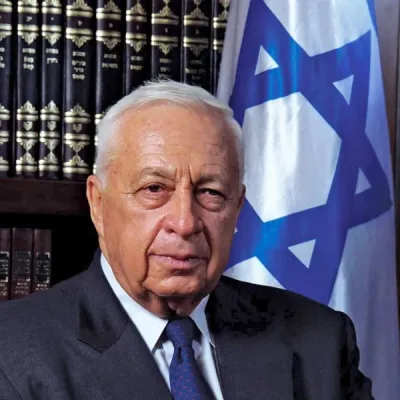
Ariel Sharon
Human Design Chart
Biography
Born in Kfar Malal in Palestine to Russian Jewish immigrants, he rose in the ranks of the Israeli Army from its creation in 1948, participating in the 1948 Palestine war as platoon commander of the Alexandroni Brigade and taking part in several battles. Sharon became an instrumental figure in the creation of Unit 101 and the reprisal operations, including the 1953 Qibya massacre, as well as in the 1956 Suez Crisis, the Six-Day War of 1967, the War of Attrition, and the Yom-Kippur War of 1973. Yitzhak Rabin called Sharon "the greatest field commander in our history". Upon leaving the military, Sharon entered politics, joining the Likud party, and served in a number of ministerial posts in Likud-led governments in 1977–92 and 1996–99. As Minister of Defense, he directed the 1982 Lebanon War. An official enquiry found that he bore "personal responsibility" for the Sabra and Shatila massacre of Palestinian refugees, for which he became known as the "Butcher of Beirut" among Arabs. He was subsequently removed as defense minister.
From the 1970s through to the 1990s, Sharon championed construction of Israeli settlements in the Israeli-occupied West Bank and Gaza Strip.
The Human Design of Ariel Sharon: Manifestor 2/4
Manifestor 2/4 — Design at a Glance
Ariel Sharon appeared as a pioneer and visionary whose nature was geared towards steering the world into new directions. His design presented him similarly to an emperor in ancient Rome: He possessed the grand vision of an encompassing empire, yet he did not lead the necessary wars and battles himself on the field but delegated these tasks to others to take foreign territories for his goals. This structure often led to misunderstandings as his thinking surpassed many people's comprehension. He polarized strongly; while some loved his immense visions and followed him, others hated or liked him precisely because of this magnitude not. This formed one of his greatest pain points. To find the right followership, it was crucial for him to inform others timely and accurately about his plans – his ideal strategy. If he lived according to this strategy and followed his authority, he was rewarded with a feeling of inner peace. Acting against his design, however, he felt instead persistent deep anger within himself. This dynamic between vision, information need, and the environment's reaction shaped how he worked and formed the world around him.
Emotional Authority
Ariel Sharon was subject to an emotional wave that made his judgment strongly dependent on the current mood state. His design featured an Emotional Authority as the emotional center was defined and thus took precedence over all other centers – a mechanism independent of further definitions. This configuration caused him to always see the world through the filter of his momentary feelings; enthusiasm could quickly turn into negative assessment.
The problem lay in the fact that these emotional impulses often only represented snapshots and did not necessarily reflect deeper truths. Quick, spontaneous decisions made directly from this emotional excitement frequently turned out problematic or negatively impacting. The mechanics of his inner authority therefore required time for decision maturation. Only through patience and consciously sleeping on important questions could clarity set in.
Intense feelings needed space to dissipate before an emotional distance could be gained. Then calmness entered, and true readiness for decisions was reached. This process of 'taking one's time' and multiple reflections served to separate superficial impulses from lasting insight. For long-term course settings that significantly shaped his life trajectory, this waiting period was essential to avoid the mistake of valuing transient moods as final directional decisions.
The 2/4 Profile — Hermit / Opportunist
Ariel Sharon showed himself as someone who oscillated between two seemingly contradictory needs: a deep longing for retreat and silence alongside a strong urge to engage in close exchange with a chosen group of trusted individuals. His design carried the Profile 2/4, structurally anchoring this tension. Line 2, often referred to as 'Hermit', demanded times of isolation to gain inner clarity and reflect undisturbed. In this phase, he immersed himself inwardly, far from external stimuli.
Simultaneously, Line 4, the 'Community' line, drew him towards connection with his inner group. For him, it was crucial to create a safe environment where he could clearly communicate these needs: when he sought company and when he withdrew. Only when his need for alone time was fulfilled did he emerge from this 'cave' to spend time with his favorite people.
In these moments of exchange, he utilized the knowledge of his network. The transpersonal energy of Line 4 helped him carry ideas outwardly and exert influence, often through focused detail work or a drive to externalize things quickly. Thus, his design combined the ability to develop brilliant concepts in solitude with the power to share and realize them later within the protected framework of his community. This rhythmic interplay between retreat and connection shaped how he interacted with others and made decisions.
Single Definition — Defined & Open Centers
Ariel Sharon presented a design characterized by constant mental activity and strong willpower. His defined Ajna Center provided reliable independent conceptual power; he processed data and creativity on his own terms and was hardly influenced by external opinions. This mental stability directly flowed into his defined Throat Center, allowing him to consistently express what he thought. His voice served as a transmission organ for his inner concepts and actions.
Parallel to this, Sharon had a defined Heart Center that gave him constant access to willpower and ego strength. He tended to control his life himself, make promises, and fulfill them to strengthen his self-esteem. The combination of defined mentality, communication, and willpower created a profile that often made decisions from the mind or ego, with a tendency to cling to unfinished actions if they did not meet his own expectations.
In contrast, his design revealed several vulnerable areas. His open Head Center made him susceptible to external mental pressure and others' questions, which led him to deal with problems that were not his own. The open G Center meant a lack of firm identity; Sharon often adapted to the environment and sought direction through external initiation rather than asserting it himself. Furthermore, his Sacral Center was open, making him vulnerable to 'borrowed' energy. He tended to absorb others' vitality and amplify it without knowing his own consistent boundaries, leading to overexertion if he did not pause. His open Spleen Center carried a fundamental survival fear, which made spontaneous decisions risky as they were often driven by conditioned fears rather than clear intuition. Finally, his open Root Center absorbed environmental stress, pushing him to process adrenalized pressure that was not his own and making him vulnerable to burnout if he followed this external rhythm.
Channels for insight, emotional transformation and community.
Ariel Sharon showed a basic attitude based on the search for new experiences, often provoking crises to generate movement. This dynamic was driven by the Channel of Transience 36-35: Gate of Crisis (36) in the Solar Plexus Center felt inexperience as a lack and drove him to seek validation through emotional fluctuations, while Gate of Change (35) in the Throat Center sought expression. He lived his wisdom not through logical planning but by experiencing emotions and learning from direct experiences.
Parallel to this, he had the ability to translate complex connections into efficient concepts. The Channel of Structuring 43-23 connected his Ajna Center with the Throat Center. Here, Gate 43 (Insight) picked up spontaneous mental breakthroughs and filtered them through Gate 23 (Assimilation) before formulating them linguistically. His challenge lay in giving this internal processing time; only when he clearly expressed his innovative thinking at the right moment did it gain acceptance from the environment and lead to evolutionary changes in organizations or communities.
In interpersonal relationships, he sought clear agreements and mutual support. The Channel of Community 37-40 connected his Solar Plexus Center with the Heart Center. Gate 37 (Friendship) strove for recognition and belonging, while Gate 40 (Solitude) emphasized the need for breaks and rewards for work done. Sharon built bridges between individuals by waiting for emotional clarity to negotiate fair contracts that strengthened both ego and community.
Additionally, specific gates in his design were active: Gate 9 (Detail Work) at the Sacral Center promoted a goal-oriented focus on perfection through repetition, while Gate 16 (Experimentation) drove him towards continuous improvement of new skills. In the personality field, Gate 55 (Emotional Awareness) highlighted extreme mood swings and the necessity to eat only when truly hungry, as well as Gate 17 (Succession), which linked logical teaching for the future with a healthy dose of doubt. Within the design itself, Gate 45 (Tribe Level) expressed willpower and hierarchical order in the Throat Center, supported by Gate 26 (Manipulation/Innovation) in the Heart Center, which moved the conservative tribe to new paths.
Individual Circuitry — Circuit Signature
Ariel Sharon's design was marked by a simple, coherent energetic structure that connected Ajna, Throat, Solar Plexus, and Heart Centers. This unity created a clear, undivided focus on his own creation. In the Knowledge Circuit, Channel 43-23 (Structuring), which linked Ajna with Throat Center, promoted the ability to translate complex thoughts into concrete, understandable structures and express them powerfully through language. Parallel to this, in the Meaning Circuit, Channel 35-36 (Transience) flowed between Throat and Solar Plexus Centers. This was about emotional processing of experiences and sharing felt insights with others, often driven by a desire to learn from the past. The third active area was the Ego Circuit, represented by Channel 40-37 (Community) between Heart and Solar Plexus Centers. This channel emphasized the dynamics of giving and taking as well as mutual support within a group. Since there was no direct connection to the Sacral Center, this configuration required necessary pauses for resource regeneration. Together, these three circuits formed a system that united structured communication, emotional reflection, and cooperative resource generation in one flowing energetic network.
Right Angle Cross of Planning 1
Ariel Sharon's design carried the imprint of the 'right cross of planning 1'. This configuration pointed to a deep, often unconscious loyalty to higher structures or authorities. It was not blind obedience but rather an inner commitment to follow a path that seemed dictated by external circumstances or higher powers.
In Human Design, this cross describes a specific energy connection between the Solar Plexus and the G Center. The Solar Plexus reacts to emotional waves and impulses, while the G Center steers identity and life direction. In this configuration, there is a tension: the person feels emotionally drawn towards or repelled by a goal but must simultaneously learn that their true path often emerges through external guidance or structural mandates. There was constant interaction between personal emotional rhythms and the necessity to integrate into larger systems.
This mechanism created a life dynamic in which Ariel Sharon navigated between his own will and the role within a greater order. The energy of this cross fostered loyalty towards institutions or ideologies perceived as stable. It was less an act of free choice in the classical sense but rather following a destiny key activated through emotional resonance. This shaped his way of acting: always conscious of a higher order to which he submitted or represented.
Saturn Return · Uranus Opposition · Chiron Return · 2nd Saturn Return — Life Cycles
Ariel Sharon's design showed a tendency towards structural anchoring, evident in clear power transitions. In 1953, at the age of 25, he became commander of Unit 101. This marked his first Saturn return, a cycle where years of groundwork condenses into sustainable results and new responsibilities are taken on.
His path then led through phases of internal tension resolution. The Uranus opposition around 1966, when he was 38, concluded his evening law course. This cycle often demands the loosening of old bonds to integrate new perspectives – visible here in expanding qualifications alongside his military career.
The Chiron return around 1977, at age 49, ushered in a phase of bloom. Sharon joined Begin's government as Minister of Agriculture. In this fulfillment cycle, one increasingly unfolds their incarnation cross; meaning and purpose become experiential when living according to strategy and authority. Here his political influence on an institutional level was realized.
The second Saturn return around 1983, at age 55, brought a severe crisis: Sharon had to resign as Defense Minister due to indirect responsibility for the Sabra and Shatila massacre. The second Saturn return tests the durability of structures established in the first cycle. If these are not flexible enough or based on false foundations, collapse can occur. Sharon's design showed here the harsh test of his established position and the need to confront the consequences of his actions, which significantly shaped his further life path.
Manifestor · Emotional Authority — Synthesis
Ariel Sharon was a Manifestor whose life seemed marked by a strong drive towards leadership and vision. The combination of emotional authority and the profile of a natural talent with networker points to someone deeply rooted in their emotions yet possessing the ability to form connections and win others over for their ideas (Line 4). His defined Mental Center (Ajna) enabled consistent conceptual thinking, channeled through the Channel of Structuring (Gate 43/23) into concrete expressions – a skill evident at career turning points (documented events at ages 25, 38, 49 and 55). Thus, he lived a process of inner maturation followed by building a supportive community.
A central paradox in Sharon's nature lay in the Manifestor energy driving him to quick action and implementation seeming to stand in tension with his emotional authority. He needed time for emotions to mature while his design simultaneously urged him to take initiatives and push changes forward. This might have led to internal conflicts and polarizing decisions, as rapid implementation of visions (Knowledge Circuit) did not always align with the emotional depth necessary for authentic connection.
3 Defined Channels
Incarnation Cross - Right Angle Cross of Planning 1
Solar Return
The Solar Return shows the moment when the sun returns to its exact birth position - your personal solar year.
Life Cycles
Discover the life cycles with a detailed triple view (birth chart, cycle chart, composite).
Human Design Profile
- Type
- Manifestor
- Strategy
- To inform others before acting
- Authority
- Emotional Authority
- Profile
- 2/4 - Hermit / Opportunist
- Definition
- Single Definition
- Incarnation Cross
- Right Angle Cross of Planning 1
- Date of Birth
- 26.02.1928 22:18
- Place of Birth
- Tel Aviv, Israel
Frequently Asked Questions
What is Ariel Sharon's Human Design type?
What Profile did Ariel Sharon have in Human Design?
Which authority guided Ariel Sharon?
What incarnation cross did Ariel Sharon have?
When was Ariel Sharon born?
Discover your own Human Design
Are you also a Manifestor? Find out in a personal reading how to use your initiation power peacefully and dissolve resistance.
More Personalities
Back to overviewChristian-Jaque
Kesha

Laurent-Eynac
Lucebert
Masaccio

Papus