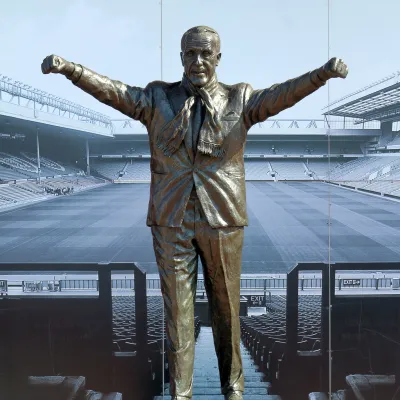
Bill Shankly
Human Design Chart
Biography
Shankly declared in his autobiography that he "specialised in the art of tackling", emphasising that it is an art. He claimed that he was "never sent off the field or had (his) name in a referee's book". In his view, the art of tackling is in the timing and the sole object is to win the ball. Even if the opponent is injured in the tackle, "it's not a foul because you have timed everything right and you've won it". His philosophy, therefore, was to play "hard but fair" with no cheating. During his playing career, Shankly said he would not argue with referees. He realised after taking the advice of his brothers that it is a waste of time. The referee, he wrote, "always wins in the end".
Shankly wrote in his autobiography that he had long prepared himself "for the day when I would become a football manager". He pointed out that he had absorbed all the coaching systems with any useful qualifications and had full confidence in his ability and in himself to be a leader. For him, he had done the hard work and "it was simply a question of an opportunity presenting itself". Shankly summed up the essential criteria for success in football management when he said: "I could speak common sense about the game and I could spot a player". In terms of the latter criterion, he always applied "the same basic formula" in that, first and foremost, the player must have both ability and courage. Other attributes were physical fitness and willingness to work, especially to struggle against the odds.
"Right from the start as a manager, I tried to show that the fans are the people that matter. You've got to know how to treat them (and) have them on your side".
Bill Shankly as a Generator 4/6 in Human Design
Generator 4/6 — Design at a Glance
Bill Shankly was someone who exhibited immense, enduring strength, comparable to a strong workhorse. His Generator design indicated a tendency towards great energy, but this energy required specific conditions to be effective. This strength was most available to him when he responded to impulses from his environment rather than initiating independently. The motto of his system was clear: don't start, but respond.
This mechanism explained his work style decisively. Shankly could only optimally utilize his energy when his sacral center – the motor of his endurance – gave a clear “yes” to an external signal. Reacting to such internal affirmations allowed him to push projects forward with great persistence. Conversely, he faced two specific pitfalls: either he spent his energy on tasks that did not internally engage him, leading to exhaustion, or he was hindered from continuing to work on his heart project, even though he was still full of drive.
Living in harmony with this strategy of responding, Shankly’s design rewarded him with a deep sense of fulfillment. Initiating independently, without waiting for an internal signal, sooner or later led to persistent frustration and a noticeable lack of energy. His success thus depended less on constant activity than on whether he could synchronize his actions with the right, internally coming signals.
Emotional Authority
Bill Shankly’s design indicated a tendency towards emotional depth and temporal distancing in decision-making. His inner authority was Emotional Authority, carried by the defined Emotional Center. This mechanism means that he was subject to a constant wave of emotional ups and downs. His perception of the world was always colored by his current mood: the same situation could appear as enthusiastically positive in one moment and negative in the next.
For Bill Shankly, however, the immediate feeling was only a snapshot, not a final judgment. Spontaneous decisions made directly from such an emotional peak carried a high risk of proving wrong later on. The mechanics of his authority required patience. He needed time to let decisions mature. Often, this meant leaving a choice overnight or considering it multiple times.
Only when the intense feelings subsided and emotional distance was gained, true clarity and calmness set in for him. This process was particularly crucial for long-term, life-defining decisions. Through waiting and “sleeping on options,” he could distinguish the superficial emotion from the deeper truth. His strength did not lie in the quick reaction, but in the ability to let the emotional wave subside before acting. This protected him from impulsive misjudgments and allowed him to make decisions that aligned with the complex reality of his inner truth, rather than just the temporary mood.
The 4/6 Profile — Opportunist / Role Model
Bill Shankly’s design indicated a tendency towards a deep inner conflict: the tension between the need for belonging and the drive for detached wisdom. In the first thirty years of his life, his Line 6 still acted like a Line 3. Therefore, he experimented a lot in his youth, especially in relationships and friendships, driven by the Network Energy of Line 4. This phase required a balance between willpower and necessary rest phases to maintain a harmonious state and avoid burnout from overloading.
Once Line 6 became active, Shankly frequently experienced the contradiction between the desire to belong to a community and the desire to be high on a mountain, contemplating the meaning of life. The whole life of a 4/6 revolves around this conflict of heart versus head. In later years, it was expected of him to meet the high standards of a wise role model. His skill was in assessing the expressive power of others and rendering judgments. However, he was prone to depression when the ideal could not be reached or executed. His large heart remained cautious to avoid opening up to the wrong people and getting hurt. The development from gullibility to the ability to recognize propaganda vulnerability shaped his way of correctly seizing opportunities in the network.
Single Definition — Defined & Open Centers
Bill Shankly's Human Design profile pointed towards a tendency towards a fixed, reliable self-identity and a clear sense of direction. With a defined G-Center, he had an inner compass that helped him be loved and show others new paths without being dependent on them. This stable identity was complemented by a defined Heart Center, which gave him willpower and the ability to keep promises and determine his own resources. He enjoyed working and preferred to follow his own inner mechanisms, which promoted his ego strength and competitive orientation.
At the same time, as a Generator, he had a defined Sacral Center, which gave him an enormous source of vital energy. This energy was only available to him when he responded to questions and gave an affirmative answer, rather than initiating. His defined Solar Plexus Center functioned as an emotional authority; he had to wait for the emotional wave to gain clarity before making decisions. This combination of a stable identity, willpower, reactive energy, and emotional depth shaped his ability to act.
In contrast, his open Head Center revealed a vulnerability to mental pressure and confusion that did not originate from him. He tended to engage with questions that actually belonged to others and could easily get caught in a whirlwind of doubts if he did not trust his inner authority. His open Ajna Center amplified this, as he absorbed concepts and opinions from the environment without identifying them as his own truth. This made him vulnerable to identifying with ideas that were not correct for him.
Similarly, his open Throat Center showed a tendency to seek attention rather than waiting for invitations. He could be under pressure to speak or act to be noticed, leading to unpredictable communication situations. His open Spleen Center carried a fundamental fear of not being equipped for survival, which led him to cling to things that were not good for him to gain a sense of security. Finally, his open Root Center absorbed stress from the environment, leading to a cycle of adrenalized pressure and trying to release it through hyperactivity rather than accepting it. These open centers challenged him to disengage from external conditioning and trust his defined energies.
Channels for community, spiritual breakthrough and inner determination.
Bill Shankly was someone who not only practiced competitiveness but actively awakened and channeled it in others. His design pointed towards a tendency to act through the Initiation Channel 51-25: Here, the aggressive ego energy of Gate 51, which always wants to be first, combined with the universal love of Gate 25. This constellation made initiation an art – Shankly recognized the potential for individuation in others and, when invited, provided the necessary 'shock' that initiated and reinforced them. This was not a controllable process but a mystical impulse towards mutation, which propelled him and his environment forward.
Parallel to this, the Discovery Channel 29-46 shaped his approach to work. Through the Gate of Saying Yes (29) in the Sacral Center and the Gate of Determination (46) in the G-Center, he immersed himself in the experience without hasty expectations. This persistence allowed him to be in the right place at the right time and make discoveries that changed collective understanding. Success came to him not through control but through letting go of expectations and trusting his own cycle.
In interpersonal relationships, the Community Channel 37-40 was at play. It connected the emotional search for recognition (Gate 37) with the need for reward and pause (Gate 40). Shankly built bridges between individuals to form a community where everyone had an honorable place. He understood that true connection was not a spontaneous transaction but needed to be carefully negotiated to create a fair, long-term agreement.
Additionally, prioritized gates like Gate 16 (Experimenting towards Mastery), Gate 9 (Detail Work and Perfectionism), and Gate 36 (Crisis as a Development Motor) contributed to his ability to bring order out of confusion and master skills through repeated experimentation.
Tribal Circuitry — Circuit Signature
Bill Shankly's design pointed towards a tendency towards solid, courageous personality structures that rested strongly on inner conviction. The Centering Circuit in him connected the Identity Center with the Heart Center. This configuration promoted a strong self-worth and confirmation of individuality, where the firm conviction was often not necessarily verbally expressed, as the Throat Center was missing. Parallel to this, a cyclical, emotional wave was shown through the Meaning Circuit. Here, the Discovery Channel connected the Identity Center with the Sacral Center. This directed attention to the past to gain insights from earlier experiences and emotions and share them with the collective. A third aspect was the Ego Circuit, which connected the Heart and Solar Plexus Centers. The Community Channel emphasized here the giving and taking as well as mutual support. Since the Sacral Center was not involved in this circuit, rest pauses were necessary to generate resources for the tribe. Overall, these separate but defined streams shaped a profile that combined individual strength, emotional reflection of the past, and cooperative resource creation without these energies directly overlapping.
Right Angle Cross of Planning 3
Bill Shankly demonstrated himself as someone who utilized inner clarity and structured planning as the central foundation of his actions. His design indicated a tendency to master complex situations through an orderly, logical approach, rather than being distracted by external circumstances. This attitude stemmed from the configuration of the right planning cross 3, which describes a specific ability for strategic organization. Here, it was not about spontaneous impulses, but about the careful building of systems that guaranteed stability and long-term perspective. Shankly lived the necessity of having a clear plan before taking action, as his energy flow depended on this internal structuring. Without this preparatory order, his strength would have dissipated; with it, he could act purposefully and sustainably. The mechanics of this cross emphasized the connection between the will to lead and the ability to translate this will into concrete, actionable steps. Shankly used this energy to replace uncertainties with clear directives and thus create an environment in which others could rely on his direction. His strength lay in taming chaos through disciplined planning and forging a solid foundation for collective action from it. This was no coincidence, but the direct result of his energetic blueprint, which defined planning and order as keys to success.
Saturn Return · Uranus Opposition · Chiron Return · 2nd Saturn Return — Life Cycles
Bill Shankly's design showed him as someone whose life's work gained weight and stability in later years. His energy did not focus on quick, fleeting successes, but on building structures that stood the test of time. This was particularly evident during his second Saturn return phase, which begins around the age of 59. During this cycle, years of work often condense into a solid, institutional result. In 1972, this phase culminated in the UEFA Cup victory for Liverpool. This success was no coincidence, but the visible result of a long-term strategy that prioritized stability and perseverance.
Previously, at the age of 49, his Chiron return occurred. This period marks in Human Design the full flowering of the incarnation purpose, provided one has followed their own strategy. It is not a phase of healing, but of the full realization of personal potential. In 1962, this led to his rise to the First Division. This milestone confirmed that Shankly's path now found its deepest meaning and was concretized in his external life. Both events underscore that his design was geared towards bringing about sustainable changes over long periods through consistent action.
Generator · Emotional Authority — Synthesis
He was a Generator who, through his emotional authority and defined G Center, possessed a deep, inner direction and identity. This combination created a person who, while possessing enormous work capacity and endurance – ready to generate energy for what truly drove him – also felt the necessity to not rush into decisions. Instead, he allowed his emotions time to unfold and mature to grasp the true essence of a situation. The profile as a networker and role model indicates that he experienced an inner conflict throughout his life between the desire for community and the need for independent reflection.
This design harbored a central paradox: He lived the intense energy of a Generator (Sacral Center), coupled with the inner, often slow decision-making of emotional authority. The channel of Initiation (51/25) pointed to a competitive spirit, which was balanced by the ability to recognize beauty and potential in the lives of others. The documented successes in later life cycles (Saturn return, Chiron return) showed how he could release energy through patience and connection to his inner truth to achieve goals and inspire others.
3 Defined Channels
Incarnation Cross - Right Angle Cross of Planning 3
Solar Return
The Solar Return shows the moment when the sun returns to its exact birth position - your personal solar year.
Life Cycles
Discover the life cycles with a detailed triple view (birth chart, cycle chart, composite).
Human Design Profile
- Type
- Generator
- Strategy
- To respond - wait for something to respond to
- Authority
- Emotional Authority
- Profile
- 4/6 - Opportunist / Role Model
- Definition
- Single Definition
- Incarnation Cross
- Right Angle Cross of Planning 3
- Date of Birth
- 02.09.1913 02:00
- Place of Birth
- Glenbuck, UK
Frequently Asked Questions
What was Bill Shankly's Human Design type?
What profile did Bill Shankly have in Human Design?
Which authority guided Bill Shankly?
What incarnation cross did Bill Shankly have?
When was Bill Shankly born?
Discover your own Human Design
Are you also a Generator? Find out in a personal reading how to use your sacral energy correctly and discover deep satisfaction.
More Personalities
Back to overviewAaliyah

Aldair

Alexia

Angèle

Anne-Marie

Arcángel