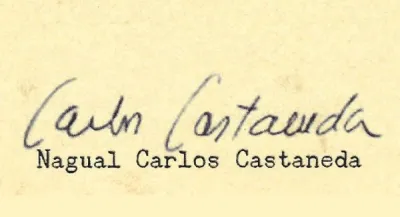
Carlos Castaneda
Human Design Chart
Biography
Carlos Castaneda as a Generator 6/2 in Human Design
Generator 6/2 — Design at a Glance
Carlos Castaneda showed himself as someone who did not unleash his power through personal initiatives but waited for life to provide impulses. As a Generator, he had much sacral energy and was extremely enduring, comparable to a strong workhorse – provided that he had the right motivation. His design suggested that he only generated energy effectively when responding to signals rather than initiating himself. The motto 'do not initiate, but react' defined his functioning: Only when his sacral center clearly signaled a 'Yes!', did he respond with action.
This mechanism protected him from two specific pitfalls. On the one hand, it prevented him from wasting energy on things that internally repelled him; otherwise, such high productivity potential could lead to burnout. On the other hand, he suffered when held back from his heart project, even though his inner self still wanted to continue working with full power. If Carlos Castaneda lived in harmony with this strategy of waiting and reacting, his design rewarded him with deep satisfaction and a sense of fulfillment. If he continuously initiated independently or ignored internal signals, sooner or later he encountered persistent frustration and a noticeable lack of energy. His strength lay therefore in responding from the gut to what spoke to him.
Sacral Authority
Carlos Castaneda lived as a Generator whose decision-making was shaped by sacral authority. This inner leadership was also his strategy: He reacted to external stimuli with a physical response from the abdominal area. If a positive impulse appeared – felt as an energy surge or vocal signal like a grunt – he felt vital and acted with great enthusiasm. His tasks were carried out without aimlessness, fully immersed in the work itself.
This mechanism only worked because his Emotional Center was open. Without this emotional distance, the sacral reaction could be clearly perceived. Additionally, the Spleen Center functioned as a supporting authority. Since it was activated and connected with the Sacral Center, it allowed him to make quick, spontaneous decisions. He had an immediate access to his instinctive perception and physical well-being. This connection enabled him to reliably guide himself from inner impulses rather than planning from the head. The combination of sacral energy and spleen-based intuition created an efficient way of acting based on direct bodily resonance.
The 6/2 Profile — Role Model / Hermit
Carlos Castaneda showed himself as someone who, in his youth, learned through intense experimentation and the principle of trial and error. His configuration as a 6/2-line worked like a 3-line before the age of thirty: He gathered numerous personal experiences, withdrew after failures, and started anew. This phase served the practical acquisition of knowledge through direct action and the resulting setbacks.
Around thirty years old, the sixth line activated itself. Castaneda metaphorically retreated into a 'cave' to look back at his earlier experiments with great distance. This period of intense reflection was also a time of healing and deep self-awareness. The 6/2-line goes through three phases: Martyrdom, the roof phase, and finally authenticity from age fifty. In this later life span, he no longer saw perfect behavior as rigid rules but as individual survival tactics. Hypocrisy, a specific phenomenon in the middle phase, then became unbearable to him.
Furthermore, Gate 18 in Line 2 shaped his character through the need for correction and the painful realization of the uncorrectability of certain situations. Where change was not possible, he sought acceptance and spiritual renewal instead of fighting against the wind. Emerging as a wise person from his reflective phase, he became an example to others. People sought him out to partake in his life wisdoms and learn the ability for deep introspection from him. His design always encompassed the entire circuit and the integration of the whole plan.
Split Definition — Defined & Open Centers
Carlos Castaneda revealed himself as someone whose design carried a persistent mental pressure to ask questions and find answers. His defined Head and Ajna Centers created an uninterrupted mental activity; he thought constantly, which made meditation difficult but also provided a reliable source for concepts. This inner drive demanded clarity, yet since these centers did not have their own energy for implementation, fighting against the pressure often led to frustration or hasty decisions. Instead, he served as an inspiration: His aura pressured others to think, especially those with undefined Head Centers.
His defined Throat connected this thought process directly to communication. Carlos Castaneda consistently spoke out what his mind conceptualized. This connection allowed him to express his mental processes transparently and continuously without the words being diverted by other engines like emotions or willpower. His voice was thus a direct reflection of his conceptual thinking.
At the same time, he possessed a fixed sense of self through his defined G Center. This gave him a clear sense of direction and the ability to show others new paths without relying on their approval. He knew who he was and where he was going, which protected him from confusion that arises when trying to follow others' directions.
In contrast, his vulnerability showed in the open centers. His open Heart Center lacked consistent willpower; he tended to want to prove his worth through promises or performance, which could lead into a cycle of self-doubt if these were not kept. Additionally, his open Solar Plexus absorbed the emotions of his surroundings. Carlos Castaneda was prone to personalizing other people's feelings and feeling emotionally unstable, although he merely amplified their climate. His open Spleen Center made him sensitive to fears and well-being; he unconsciously sought security from others, risking unhealthy dependencies or spontaneous, conditional decisions that did not align with his true nature.
Channels for rhythm, clarity, acceptance and determination.
Carlos Castaneda revealed himself as someone deeply connected to the natural flow of life. The Rhythm Channel 5-15 linked his Sacral Center with the G Center; Gate 5 held fast to established habits, while Gate 15 integrated the diversity of society into his life flow. This gave him an inner sense of timing and a non-personal magnetism that drew others into his energy field.
His mind was designed to know the unknown. The Awareness Channel 61-24 connected Head Center with Ajna Center: Gate 61 received inspiration as white noise, which Gate 24 transformed into rational answers and spontaneous insights (Satori). His thinking did not follow logical patterns but rather mutative leaps.
At the same time, he mentally organized details precisely. The Acceptance Channel 17-62 linked Ajna with Throat Center; Gate 17 visualized patterns that Gate 62 translated into language and named. This allowed him to logically structure complex visual impressions and communicate them clearly, provided he paid attention to the timing of his listeners.
Moreover, he possessed a persistent endurance in exploring new paths. The Discovery Channel 29-46 linked Sacral with G Center; Gate 29 offered the depth and persistence of saying "yes," while Gate 46 kept him at the right place at the right time. He had to let go of expectations to lose himself in experiences, thereby making discoveries that changed collective understanding.
Influential Gates like Gate 10 (Integration through genetically fixed behavior), Gate 18 (Discrimination between important corrections) as well as Creativity Gates (Gate 1) and Communication Gate (Gate 43) rounded out his Profile by supporting his ability to create meaningful collaboration and breakthroughs of individual insights.
Collective Circuitry — Circuit Signature
Carlos Castaneda showed himself as a person whose energetic structure consisted of separate, parallel energy fields. The Split Definition created two independent streams: one mental-communicative and one identity-based. These fields worked alongside each other without directly overlapping.
In the Knowledge Circuit, Channel 24-61 connected the Head Center with the Ajna Center. This generated innovative flashes of insight and a specific awareness. The energy was pulsing and acoustic, driven by the need to forge new paths and initiate changes.
The Understanding Circuit maintained two separate connections. Channel 17-62 linked Ajna to the Throat Center, enabling the sharing of logical insights. Parallel to this, Channel 15-5 connected the Identity Center with the Sacral Center. This provided a focused, rhythmic endurance for strategic action and structural improvement, free from emotional influence.
In the Meaning Circuit, Channel 46-29 worked between Identity and Sacral. Here it was about discovering meaning in past experiences. This cyclical energy reflected emotions to learn from them and share them with others. Together, these separate circuits shaped his work: mental innovation, rational communication, as well as a deep, experience-based identity that each acted independently.
Left Angle Cross of Prevention 2
Carlos Castaneda was marked by the left cross of prevention. This configuration determined his fundamental attitude: He did not seek new paths but rather aimed to preserve and protect existing structures and truths from decay. His design inclined him towards bringing order out of chaos by stabilizing established systems instead of revolutionizing them.
In Human Design, this cross describes a specific energy alignment. A person with this signature feels most at home in the role of a guardian. Their task was to secure the foundation upon which others could build. They were shown as someone who valued continuity and stability. Rather than rushing ahead, they analyzed the stability of what already existed.
This mechanism influenced his approach to processing knowledge. Carlos Castaneda filtered information through the demand for durability. He did not primarily ask 'What is new?', but rather 'What stands the test of time?'. This shaped his method of presenting complex connections in a way that ensured longevity. His focus was on preventing misinterpretations and preserving the integrity of inherited content. Through this stance, he created a space where traditional knowledge would not be lost but re-established anew. His energy served to stabilize the bridge between ancient understanding and current application without altering the original structure.
Saturn Return · Uranus Opposition · Chiron Return · 2nd Saturn Return — Life Cycles
Carlos Castaneda presented himself as someone whose life's work was structured in phases of intense transformation followed by later completion. His design inclined towards deep transformative processes, often coinciding with public milestones. In 1968, at age 43, his book 'The Teachings of Don Juan' appeared. This fell within the period of a Uranus opposition. In Human Design mechanics, this aspect frequently marks a point where internal tensions or long-prepared changes manifest outwardly and personal orientation shifts fundamentally. For Carlos Castaneda, it acted as a decisive career impulse, casting his previous knowledge into a new public form.
Later, in 1974 at age 49, he published 'The Power of Silence' along with his trilogy. This corresponded to his Chiron return. This cycle does not describe the healing of old wounds but rather a phase of fulfillment and bloom. If one follows their inner strategy, here the individual's incarnation cross unfolds increasingly; meaning and purpose become experiential. For Carlos Castaneda, this period marked the maturation of his work: The previously accumulated insights condensed into a coherent whole. It was a moment of confirmation where his specific life task – conveying these teachings – unfolded its full impact and affirmed itself as a central part of his existence.
Generator · Sacral Authority — Synthesis
Carlos Castaneda was a Generator with sacral authority, whose life was marked by a profound commitment to personal experience. His profile as role model/natural talent indicates he initially went through an intense phase of experimentation before retreating into reflection and wisdom – a process amplified by the line 6 in his profile. The defined connection between Head Center and Ajna Center created a persistent mental pressure to question and expand consciousness, manifesting in an unceasing quest for understanding. This internal dynamic corresponded with the sacral center's ability to generate energy for activities as long as they were perceived as stimulating (Channel Rhythm).
A central paradox lay in the tension between the need for continuous activity and the necessity of isolation. Castaneda lived his sacral authority by reacting from his gut and being guided by external stimuli, yet simultaneously the left cross of prevention 2 suggests that avoiding problems played a role – a retreat into inner worlds. The documented events around 1968 and 1974 (Uranus opposition, Chiron return) underscore this inclination towards transformation and expression of individuality in the realm of knowledge circuits while maintaining a certain distance to established structures.
4 Defined Channels
Incarnation Cross - Left Angle Cross of Prevention 2
Solar Return
The Solar Return shows the moment when the sun returns to its exact birth position - your personal solar year.
Life Cycles
Discover the life cycles with a detailed triple view (birth chart, cycle chart, composite).
Human Design Profile
- Type
- Generator
- Strategy
- To respond - wait for something to respond to
- Authority
- Sacral Authority
- Profile
- 6/2 - Role Model / Hermit
- Definition
- Split Definition
- Incarnation Cross
- Left Angle Cross of Prevention 2
- Date of Birth
- 25.12.1925 09:00
- Place of Birth
- Cajamarca, Peru
Frequently Asked Questions
What was Carlos Castaneda's Human Design type?
Which Profile did Carlos Castaneda have?
What Authority did Carlos Castaneda have?
What incarnation cross did Carlos Castaneda have?
When was Carlos Castaneda born?
Discover your own Human Design
Are you also a Generator? Find out in a personal reading how to use your sacral energy correctly and discover deep satisfaction.
More Personalities
Back to overviewAaliyah

Alain-Fournier

Alexia

Angèle

Angeli

Anne-Marie