
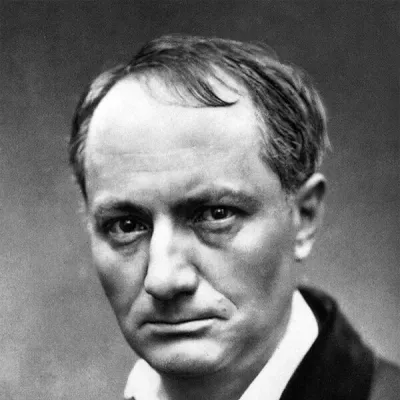
Charles Baudelaire
Human Design Chart
Biography
In his extraordinarily complicated life, he had a suffocatingly intimate relationship with his bewildered mother, who lovingly nurtured and then callously ignored his lifelong dependence on her which reached classically Oedipal proportions. He was the son of a lapsed Catholic priest, a roué and cultured epicurean who passed on to his son his love of art. After his dad died in 1827, his mom married Col. Jacques Aupicki, a dour career diplomat who, disgusted by his high-strung stepson's eccentricities, tried to impose military standards of discipline and conduct, values that Baudelaire disavowed in a rebellion that lasted the rest of his life.
By the time he came into his inheritance from his birth father in 1842, he was already exorbitantly precocious and foppish, squandering over a half of his considerable fortune in 18 months. His taste ran to elegant fashion, and he would have gone through the entire amount had not his stepfather brought the spending spree to a halt with legal intervention. Much to his humiliation, Baudelaire was then forced to petition an attorney for his funds, cap in hand, living on a meager monthly allowance.
His spending spree was the only time in his short and miserable life that he was ever without financial stress. His writings were not only scandalous, but paid poorly, and he once remarked that his income for years was the equivalent of the price of two cigars a day.
He lived in dilapidated fleabag hotels, eking out a precarious existence as a poet, art critic and translator of Edgar Allan Poe.
Charles Baudelaire — Projector with Profile 5/1
Projector 5/1 — Design at a Glance
Charles Baudelaire appeared as a Projector with a dense, focusing aura that acted like a bright flashlight to uncover system flaws in his environment immediately. This mechanism allowed him to quickly identify weaknesses in others; however, addressing these issues directly often led to rejection and conflict. Instead, his strategy was based on attracting through personal harmony and waiting for an honest invitation to exert influence effectively. Without a defined Sacral Center, Charles Baudelaire lacked a constant source of intrinsic life energy. His rhythm consisted of phases of high activity followed by necessary rest periods to prevent burnout. Living in accordance with this design rewarded him with success; deviating from it led to the experience of the Non-Self theme of Bitterness. Therefore, his energy work required conscious control between engagement and withdrawal rather than continuous readiness.
Splenic Authority
Charles Baudelaire exhibited a decision-making approach based on immediate physical intuition. His design instructed him to trust the first spontaneous impulse at every choice since it originated directly from his defined Spleen Center. This center functioned as his internal health and alarm system, equipped with fine survival intelligence that signaled instantly whether a situation, environment, or person was beneficial or harmful for his well-being. With both the Emotional and Sacral Centers open, this Spleen Authority could be effective; it allowed him no delayed deliberations but demanded immediate reaction to the present moment.
This impulse was subtle and appeared only once in the now. It could easily be overlooked or overshadowed by external influences, which required Charles Baudelaire to maintain high inner vigilance. Long-term planning stood against his nature since what was right became apparent only at the moment of confrontation. His design compelled him to remain flexible and take on few firm commitments to preserve necessary space for spontaneous adaptation. This mechanism served as protection from harmful influences through rigorous demarcation in the here and now.
The 5/1 Profile — Heretic / Investigator
Charles Baudelaire's design established a tendency towards magnetic attraction coupled with a deep need for isolated research work. As a Hero/Researcher (Profile 5/1), he appeared to others as someone offering solutions while internally nurturing the esoteric knowledge of Line 1. This configuration created a tension: The public projection of Line 5 attracted people seeking answers, whereas Line 1 demanded withdrawal and secrecy.
The mechanics of his profile precisely describe this dynamic. Line 5 brings symmetry and high expectations; others projected onto him the role of a hero or problem solver. Simultaneously, Line 1 generated pressure to deeply conceal knowledge and pulse it forth intermittently. Without clear boundaries, overexertion threatened through constant external expectation that drained energy from his necessary inner work.
His challenge lay in separating these two poles. He had to learn to say no to avoid being exhausted as an all-knowing figure. Only by setting limits could he maintain balance: Publicly acting as a problem solver (Line 5), but privately taking the necessary withdrawal for his own knowledge work and mutation (Line 1). This allowed him to make his mutating knowledge public only when it was ripe, rather than being drained by endless demands from others.
Split Definition — Defined & Open Centers
Charles Baudelaire had a stable, constant inner architecture defined by five centers: Ajna, Throat, G Center, Heart, and Spleen. This gave him reliable mental function, a firm identity, strong willpower, and spontaneous intuition. His concepts (Ajna) were communicated directly (Throat), supported by clear direction (G), determination (Heart), and intuitive knowledge in the present moment (Spleen). He radiated a steady presence that was hard to influence from outside.
In contrast, Head, Sacral, Solar Plexus, and Root centers were open. These open centers made him situationally dependent on his environment for inspiration, energy levels, emotional mood, and stress. Instead of personalizing these states, they served as barometers for the environment. The open Head Center tended to pick up mental pressure or confusion from the surroundings; he might wonder if he needed to find answers that weren't his own. The open Sacral Center received foreign vital energy, leading to fluctuations – sometimes there was energy, other times not – forcing him to learn how to set boundaries and avoid following borrowed effort. The open Solar Plexus Center absorbed and amplified emotions of others; he risked interpreting the moods of others as his own instability or avoiding confrontation out of fear of rejection. The open Root Center took on adrenalized stress; attempts to relieve this pressure through hyperactivity often led into a cycle of exhaustion, as he was not designed to sustain external drive for long.
His defined structure provided an anchor: He trusted his inner authority to use the open centers as informative windows without identifying with foreign pressure, emotion or energy. This allowed him to maintain a clear, self-determined stance despite being sensitive to the outer field.
Channels for pioneering spirit, intuitive elegance and logical clarity.
Charles Baudelaire exhibited a fundamental disposition of competitive individualization driven by intense internal dynamics. This tension between the urge for initiation and intuitive form completion shaped his essence significantly.
The Initiation Channel 51-25 connected the competing ego energy of Gate 51 with the universal love of Gate 25, creating natural competitiveness aimed at being first and initiating through 'shocks'. It was a mystical process of individualization that awakened potential for personal expansion and testing creative limits. This channel was a mutative force exerting pressure on developing deeper body consciousness.
Simultaneously, the Perfect Form Channel 57-10 acted as an opposite pole. It connected Spleen Center with G Center and projected behavior guided by intuitive awareness. Based on self-respect and love for oneself, this channel supported survival through spontaneous, appropriate actions in the present moment. The acoustic sensitivity of Gate 57 allowed more attention to tone than words, creating rare clarity for intuitive action.
To structure these forces, the Accepting Channel 17-62 connected Ajna Center with Throat Center and organized mental information logically. Gate 17 visualized patterns while Gate 62 translated them into language and details, allowing continuous internal organization of opinions and facts, understanding only what logically integrated into his worldview.
Additionally, Gates 61 with its focus on inner truth and acoustic silence as well as Gate 21 with its control over material things contributed to complexity. Gate 26 in Heart Center further promoted the ability to establish innovations within a conservative lineage. This constellation resulted in a design based on individual distinction and intuitive adaptability.
Individual Circuitry — Circuit Signature
Charles Baudelaire appeared as someone with an unshakable inner identity and firm self-worth, yet his deepest convictions were often hard to put into words. This configuration arose from his split definition: Two energetically isolated groups shaped his design parallel to each other.
The dominant force came from the Centering Circuit. Here, Channel 25-51 (Initiation) directly connected Identity Center with Heart Center. This connection created pulsating, acoustic energy in the present moment, appearing strongly individualistic and courageous. It not only strengthened his own 'I', but also affirmed the individuality of others. Since this circuit lacked a direct expression channel to Throat Center, intense inner certainties were expressed through compensatory forms like creativity and melancholy.
Alongside this central identity structure existed a second, separate group: The Understanding Circuit connected Ajna Center with Throat Center via Channel 17-62 (Accepting). This allowed focused visual thinking and the ability to articulate rational insights – yet independent of the emotional depth of Heart Identity Core.
Additionally, Integration Channel 10-57 (Perfect Form) linked Identity Center with Spleen Center. This supported securing survival through intuitive wisdom and powerful reactions to life, again as a separate piece within the first group.
Overall, Charles Baudelaire lived with a strong, inward-focused identity that offered clear strategies for communication (Ajna-Throat), but did not energetically connect these with his deepest emotional and identity-forming power (Heart Identity).
Left Angle Cross of the Clarion 1
Charles Baudelaires Human Design carried the archetypal structure of the left cross of Fanfare 1. This configuration shaped a life dynamic oriented towards producing sound and resonance. It was a profound impulse to carry inner states or perceptions outward, not merely as information but as something that resonates within others. The energy of this cross worked like a fanfare: a signal demanding attention while setting a specific frequency in the space. For Charles Baudelaire, this meant his expression often had the quality of an announcement or call to action aimed at putting others into a certain state or pointing them towards something that would otherwise be overlooked. The mechanics of this left cross accelerated this process; it was not about prolonged hesitation but rather the direct emission of a specific vibration. This created tension between inner experience and the necessity to make this audible or symbolically perceptible. Fanfare 1 marked the beginning of a cycle in which it was necessary to set the first note clearly and distinctly. Charles Baudelaire lived within this dynamic of announcing, where the intensity of his emission depended on the clarity of his own internal position. It was a force aimed at breaking silence through his expression, creating a wave of resonance that reached and moved other people.
Saturn Return · Uranus Opposition — Life Cycles
Charles Baudelaires Human Design featured two decisive turning points shaping his development: a phase of professional consolidation and a later impulse towards radical social realignment. This structure manifested in his life concretely. In 1847, at the age of 26, he published the novella *La Fanfarlo* in magazines. This marked his first Saturn Return cycle, a period where years of groundwork often condenses into a solid result and professional consolidation occurs. For his chart, this was a moment of confirmation and structuring of his previous efforts.
Later, the Uranus Opposition triggered a fundamental change. In 1859, at age 38, Charles Baudelaire met Édouard Manet; their friendship lasted until his death. The Uranus Opposition acts in Human Design as an instigator for abrupt changes in social bonds and attitudes. It forces the reevaluation of old patterns and opens paths to new, often unexpected connections that profoundly alter one's environment. In Baudelaires case, this cycle manifested not as a break but as a deep, lifelong bond with a new person who reordered his social reality. Both cycles – Saturn Return as consolidation and Uranus Opposition as realignment – thus significantly shaped the external circumstances of his creation and relationships by translating inner developments into concrete life events.
Projector · Splenic Authority — Synthesis
Charles Baudelaire lived a life marked deeply by an internal tension between recognizing errors and patterns (Gate 61) and the necessity to express these insights (defined Throat Center). His design as a Projector with Spleen Authority points towards a natural ability to recognize others' potential and intuitively understand what is right for them – yet only if he reacts spontaneously without being influenced by expectations or external pressure. The profile of Hero/Researcher (5/1) amplifies this tendency: He was destined to accumulate profound knowledge and make it available to others, which also made him vulnerable to overextension when clear boundaries were lacking. The connection between G Center, Heart, and Spleen underscores a strong self-identity and the ability to instinctively attend to one's own well-being.
A central paradox in Baudelaires design lies in the interplay between his capacity for deep insight (Ajna) and his undefined Sacral Center. He could clearly recognize patterns and errors in the world but was not equipped with a constant life energy to sustainably realize these insights or protect himself from others' stress. This likely led to phases of intense creativity followed by exhaustion and bitterness – a cycle further intensified by the conditioning of an undefined Root Center. His design points towards someone who could both shine brightly and wander in shadows, always searching for truth and beauty in a world often riddled with errors.
3 Defined Channels
Incarnation Cross - Left Angle Cross of the Clarion 1
Solar Return
The Solar Return shows the moment when the sun returns to its exact birth position - your personal solar year.
Life Cycles
Discover the life cycles with a detailed triple view (birth chart, cycle chart, composite).
Human Design Profile
- Type
- Projector
- Strategy
- Wait for the respectful invitation
- Authority
- Splenic Authority
- Profile
- 5/1 - Heretic / Investigator
- Definition
- Split Definition
- Incarnation Cross
- Left Angle Cross of the Clarion 1
- Date of Birth
- 09.04.1821 15:00
- Place of Birth
- Paris, France
Frequently Asked Questions
What is Charles Baudelaire's Human Design type?
What profile did Charles Baudelaire have in Human Design?
Which authority determined Charles Baudelaire?
What incarnation cross was active for Charles Baudelaire?
When was Charles Baudelaire born?
Discover your own Human Design
Are you also a Projector? Find out in a personal reading how to unfold your leadership qualities and recognize the right invitations.
More Personalities
Back to overviewSissy Spacek

Alain-Fournier

Anémone

Angeli

Ann-Margret

Bourvil
