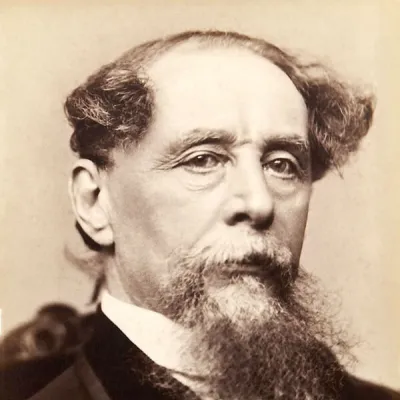
Charles Dickens
Human Design Chart
Biography
Born in Portsmouth, Dickens left school at age 12 to work in a boot-blacking factory when his father John was incarcerated in a debtors' prison. After three years, he returned to school before beginning his literary career as a journalist. Dickens edited a weekly journal for 20 years; wrote 15 novels, 5 novellas, hundreds of short stories and nonfiction articles; lectured and performed readings extensively; was a tireless letter writer; and campaigned vigorously for children's rights, education and other social reforms.
Dickens's literary success began with the 1836 serial publication of The Pickwick Papers, a publishing phenomenon—thanks largely to the introduction of the character Sam Weller in the fourth episode—that sparked Pickwick merchandise and spin-offs. Within a few years, Dickens had become an international literary celebrity, famous for his humour, satire and keen observation of character and society.
Human Design Analysis: Charles Dickens as Manifesting Generator 6/2
Manifesting Generator 6/2 — Design at a Glance
Charles Dickens revealed himself as a person with a unique hybrid energy: He possessed the constant, sacral power of a Generator and was also capable of lightning-fast, step-skipping action like a Manifestor. This mechanism allowed him to quickly draw things into his life but carried specific risks. Often he acted too quickly and skipped important intermediate steps, which inevitably led him to return later and make up for what was missing. This process could cause frustration and leave him in states of non-self.
Furthermore, due to his speed, Dickens tended to pursue multiple projects simultaneously. He reacted to numerous different impulses at once and started various undertakings side by side. Without strict adherence to the strategy – namely waiting and reacting to life rather than initiating himself – as well as without approval from his inner authority, his initial creative enthusiasm quickly turned into disappointment.
Deep satisfaction and fulfillment arose for him only when he consistently applied this strategy. He had to check if his sacral center confirmed the impulse with a clear “yes.” If that was the case, he succeeded in entering a powerful play-mode. In this state, it was not a problem but even necessary for Dickens to seek variety and work on different tasks simultaneously. The advice to finish one thing before starting another would have blocked his energy; instead, he flourished when he could move playfully through the diversity of his reactions.
Emotional Authority
Charles Dickens showed an attitude of emotional detachment in decision-making: He avoided spontaneous reactions and sought clarity through temporal delay instead. This arose from his inner authority located in the defined Emotional Center. In Human-Design mechanics, this center always carries authority regardless of other defined areas. It is subject to a permanent emotional wave, an up-and-down of feelings that momentarily colors perception of the world. What appeared inspiring at one moment could seem negative the next. This current feeling was merely a snapshot and not necessarily the truth. Quick decisions made from this mood risked negative consequences.
The strategy consisted in taking time and letting decisions mature. Charles Dickens hesitated, slept on important questions, and sought multiple confirmations. Only when intense feelings subsided and emotional distance had been gained did calmness set in. This process of detachment allowed deeper insights, especially regarding long-term life decisions. The patience to wait out the wave pattern rather than follow the first impulse shaped his way of orienting himself in complex situations and making grounded judgments not distorted by passing mood swings.
The 6/2 Profile — Role Model / Hermit
Charles Dickens developed from an experimenting young adult into a reflective instance. Before the age of 30, he was characterized by learning through trial and error, marked by the dynamics of Profile Line 2. He actively sought insights and showed a deep readiness for engagement, with his unique thought processes often perceived as unusual. This phase was marked by intense immersion in life experiences to acquire knowledge.
After turning 30, this attitude fundamentally changed with the activation of Line 6. Dickens metaphorically withdrew to gain distance and reflect on his earlier experiments from a higher perspective. This period served for healing and deep self-knowledge. From this introspection emerged new wisdom that led him to hope for union. He accepted interactions as necessary steps toward a better world, transforming his earlier pessimism into unwavering optimism.
As he emerged from this reflective phase, Dickens functioned as an example role model. Other people sought him out to partake in his life wisdom and learn the ability of deep introspection. His development from seeking breakthroughs in youth to conveying wisdom later in life shaped his entire work as someone who not only endured but ultimately made comprehensible complex human connections.
Split Definition — Defined & Open Centers
Charles Dickens was characterized by a design marked by constant mental production and strong expressive ability. His defined Ajna Center provided uninterrupted conceptual thinking that directly flowed into his defined Throat Center; he reliably spoke what his mind conceptualized. This connection gave him a consistent voice, but it also brought the urge to speak or act impulsively if not guided by strategy.
His actions were driven by his defined Heart Center, which supplied willpower and ego strength. He sought control over resources and recognition for his contribution, making him appear competitive. Simultaneously, his defined Sacral Center generated a massive vital energy source. However, this reactive power required that he wait on questions or circumstances to respond with a clear yes or no; initiating actions without such invitations often led to frustration and exhaustion as the sacral energy was then unavailable.
Emotional decisions followed the rhythm of his defined Solar Plexus Center. Truth revealed itself to him only over time; he had to wait out the emotional wave to gain clarity. Impulsive reactions to emotional highs or lows would otherwise lead to chaos and later regret. This process was accompanied by the constant existential pressure of his defined Root Center, which propelled him forward and acted as a driving force in life.
In contrast, he lacked a firm identity or direction due to his open G Center (status: open). He tended to adapt to his environment and reflect others' energy, making him prone to 'borrowed' identities. The right environment was crucial; at the wrong place, he felt lost. His open Head (status: open) meant that he did not have a constant stream of inspiration but was open to external ideas, yet also risked being overwhelmed by doubts and questions from others. Additionally, he lacked spontaneous intuition or health wisdom due to his open Spleen Center (status: open). He was prone to fears and conditioning from the environment, tended to hold onto things that were not good for him to gain a sense of security rather than trusting on his own intuitive impulses.
Channels for emotional depth, community, focus and clear structure.
Charles Dickens appeared as someone who preserved collective memory and reflected experiences in the context of time. His Sun in Gate 13 functioned as a mirror of past events, promoted cooperation through awareness of progress, and established continuity. This stance was reinforced by specific design channels: The Concentration Channel 52-9 connected the Root Center with the Sacral Center. It endowed the ability for calm, detailed analysis and perfection of patterns through logical focus, supported by an inclination towards non-action (Gate 52) and precise focusing on facts (Gate 9). Parallel to this, the Structuring Channel 43-23 between Ajna and Throat Centers worked. It translated spontaneous insights (Gate 43) into innovative, efficiency-enhancing expression forms through assimilation (Gate 23), thereby clearly explaining new perspectives.
The Personality Channels modified this base: The Openness Channel 22-12 connected Solar Plexus and Throat Centers. It brought emotional depth to communication, where expression depended on the emotional wave; Gate 22 sought openness while Gate 12 cautiously regulated. Additionally, the Community Channel 37-40 between Solar Plexus and Heart Center worked. It sought the right place in the whole through fair contracts (Gate 37) and mutual provision, with the need for reward and pauses (Gate 40) playing a role. This mechanism described someone who recognized complex patterns through logical analysis and put these into emotional expression forms to serve the community.
Individual Circuitry — Circuit Signature
Charles Dickens lived with a split definition, meaning he needed exchange with others to fully activate his inner energies. His design showed tension between individual transformation and collective rationality. The Knowledge Circuit connected Ajna, Throat, and Solar Plexus Centers directly in him. This created a flow of creative ideas over emotional resonance to expression. Simultaneously, the Understanding Circuit existed as a separate piece connecting Sacral and Root Centers. Here lay a focused, logical strategy for the future, emotionally unburdened. The Ego Circuit formed a third independent segment through the connection of Heart and Solar Plexus Centers. This stood for cooperation and give-and-take in the family, yet without direct life force from the sacral center, which required rest pauses. Since these circuits were not connected to each other, they acted as parallel forces: emotional individuality, rational structure, and social resource management. Dickens had to integrate these separate areas through interaction since no direct energetic bridge existed between them. His experience was marked by the necessity of uniting these different energies – the pulsating creativity of knowledge, the visual logic of understanding, and the tangible cooperation of ego – in dialogue with his environment to achieve wholeness.
Left Angle Cross of Masks 1
Charles Dickens carried an identity primarily defined by social adaptation and the assumption of roles. His design suggested that acceptance in his environment could only be achieved through adopting fitting masks; he often identified more strongly with this outer shell than with his true essence. This dynamic arose from the configuration of the left cross of Masks 1. In this pattern, the need for belonging takes precedence, leading to a flexible adaptation of one's personality to fit the context. The mask became an instrument of integration, less as deception and more as a necessary protective mechanism and means of social navigation. Thus, Charles Dickens appeared as someone who consistently aligned his expression and behavior with the expectations of his environment in order to feel secure. This constant adaptability shaped his experience of identity: it was not a static core but a fluid construct that was reshaped according to circumstances. The boundary between who he truly was and the role he played often blurred. His design challenged him to empathize with others and reflect their mirror, enabling social embedding but also bringing a continual dependence on external validation. Identifying with the mask rather than his essence was not a choice in the traditional sense, but the mechanical logic of his system to survive and be recognized in the world.
Saturn Return · Uranus Opposition · Chiron Return · 2nd Saturn Return — Life Cycles
Charles Dickens’ life followed a clear rhythmic pattern shaped by four central astrophysical cycles. These phases marked structural turning points: maturation, public presence, creative fulfillment, and the final conclusion.
The first Saturn return around age 27 signaled the consolidation of earlier efforts into stable structures. This was evident in 1839 with the publication of the German translation of "The Pickwick Papers," a milestone in his career that solidified his international reach.
With the Uranus return at about age 40, a phase of public visibility and transformation began. In 1852, Dickens used this energy to promote the Great Ormond Street Hospital widely and held his first reading in England. Here, his influence on society became tangible.
The Chiron return between ages 49 and 51 is a cycle of fulfillment during which one’s inner purpose unfolds. Although the event from 1859 (writing "A Tale of Two Cities") occurred at age 47, it falls within the preparatory phase of this bloom period when his deepest creative substance came to fruition.
The second Saturn return around age 58 brings the cycle to rest and concludes it. For Charles Dickens, this period ended in 1870 with his death from a second stroke. This conclusion marked the end of his structural impact after the previous cycles had completed their respective tasks of stabilization, opening, and fulfillment.
Manifesting Generator · Emotional Authority — Synthesis
Charles Dickens lived a life marked by a profound inner dynamism: the interplay of sacral energy and mental concentration. His defined Sacral Center provided a constant readiness to react, while Channel 16-27 offered a strong focus on details and the ability to format information – a pattern that manifested in repeated professional successes (Cycles). This combination enabled him to seize opportunities quickly but also led to a tendency to skip important steps. The energy of the Knowledge Circuit supported the development and dissemination of new ideas, filtered through emotional depth (Authority).
A central paradox in Charles Dickens’ design lay in the tension between his manifesting Generator nature and his emotional authority. He was capable of swiftly initiating things (Design), yet his inner decision-making required mature emotional processing (Authority). This led to an internal rhythm where impulsive actions were followed by phases of intense reflection and healing – a pattern that repeated throughout his life, from early experiments to the later wisdom he embodied as a role model (Profile).
4 Defined Channels
Incarnation Cross - Left Angle Cross of Masks 1
Solar Return
The Solar Return shows the moment when the sun returns to its exact birth position - your personal solar year.
Life Cycles
Discover the life cycles with a detailed triple view (birth chart, cycle chart, composite).
Human Design Profile
- Strategy
- To respond - wait for something to respond to
- Authority
- Emotional Authority
- Profile
- 6/2 - Role Model / Hermit
- Definition
- Split Definition
- Incarnation Cross
- Left Angle Cross of Masks 1
- Date of Birth
- 07.02.1812 19:50
- Place of Birth
- Portsmouth, England, United Kingdom
Frequently Asked Questions
What was Charles Dickens' Human Design type?
What Profile did Charles Dickens have in Human Design?
What Authority did Charles Dickens have?
What incarnation cross did Charles Dickens have?
When was Charles Dickens born?
Discover your own Human Design
Are you also a Manifesting Generator? Find out in a personal reading how to unfold your multi-talents and direct your energy wisely.
More Personalities
Back to overviewAlain-Fournier

Aldair

Alizée

Angeli

Arletty
Artus