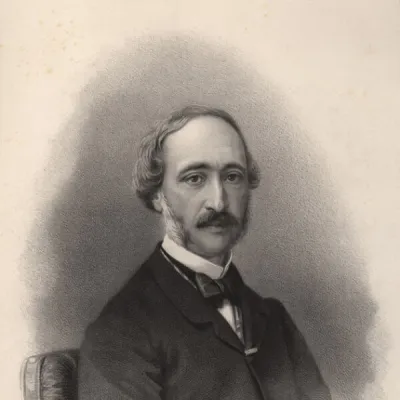
Edmond Becquerel
Human Design Chart
Biography
He was the son of Antoine César Becquerel and the father of Henri Becquerel, one of the discoverers of radioactivity.
Edmond Becquerel died on 11 May 1891 at age 71 in Paris.
Edmond Becquerel — Projector with Profile 6/3
Projector 6/3 — Design at a Glance
Edmond Becquerel's design inclined towards focused perception, quickly identifying systemic errors. His aura acted like a bright flashlight, illuminating areas where others still had uncertainties or processes not functioning optimally. This ability to pinpoint system flaws directly was characteristic of his Projector type.
The challenge lay in the nature of intervention. Addressing these issues head-on often provoked resistance from others, akin to shining a blinding light into their eyes. Instead, his most effective approach involved attracting through his own harmonious glow. By embodying functional patterns himself, he became attractive to others; they came to him seeking advice on their own accord. Therefore, his strategy was to wait for an appreciative invitation before sharing his knowledge.
This approach was essential due to his undefined Sacral Center. Edmond Becquerel did not have a constant, intrinsic source of life energy. Instead, he experienced phases of high activity that had to be followed by rest periods to prevent burnout. Ignoring this rhythm led to exhaustion and bitterness. However, living according to this design – through restraint until invited and respectful pauses – rewarded him with success. His path was marked by the balance between sharp insight and patient expectation.
Splenic Authority
Edmond Becquerel exhibited a fundamental stance of strict demarcation against harmful influences, guided by a fine, momentary survival instinct. His inner authority lay in his defined Spleen Center, while his Emotional and Sacral Centers were open – a configuration only Projectors or Manifestors exhibit. The Spleen served as his health and alarm system, providing spontaneous internal knowledge about whether the environment, situation, or society was right for him. This impulse was based on intuition and physical well-being; the first, spontaneous thought was always correct and immediately served his health.
However, this spleen voice was a very fine impulse that only appeared once in the moment, posing the risk of being drowned out by other influences. This required Edmond Becquerel to maintain high vigilance; occasionally, he needed withdrawal for decision-making. Since he could only know what was right at the moment, plans often changed last-minute. Long-term commitments were therefore difficult; he needed much space and flexibility to make spontaneous decisions rather than being bound by them. This mechanism shaped his lifestyle through the necessity of maximum adaptability and protection of his own resources from external stress.
The 6/3 Profile — Role Model / Martyr
Edmond Becquerel lived a continuous series of self-experiments, driven by a deep desire for an extraordinary existence beyond ordinary standards. His design showed clear development: In the first three decades, he primarily acted through the energy of Line 3 – the Adventurer and Experimenter. This phase was marked by intense, often self-driven activity and some ignorance about the long-term consequences of his actions. The third line gave him strong independence; he could stimulate himself without external confirmation to satisfy his curiosity.
Around age thirty, with Saturn's return, this dynamic fundamentally changed. The energy of Line 6 – Wisdom and Role Model – became active. Edmond Becquerel began integrating the previously gathered, somewhat chaotic experiences into far-sighted insights. What had earlier appeared as inappropriate or transformative action now served the development of a spiritual attitude and dry humor. He became a wise observer who not only judged others' mistakes but understood their value. The constant search for the 'Perfect' never fully ended since experimental Line 3 remained present, yet it now culminated in mature authority. Edmond Becquerel used his unusual life paths to serve as an example to others and make complex connections tangible through personal experience.
Split Definition — Defined & Open Centers
Edmond Becquerel was marked by a constant mental pressure resulting from his defined Head and Ajna configuration. This perpetual stream of inspiration drove him to ask questions and understand connections, yet he lacked the direct energy to implement these thoughts. His communication was clear and reliable, shaped by his defined Throat Center which articulated his conceptual ideas into words. Supported by his defined Spleen Center, giving him a firm survival instinct and spontaneous intuition, as well as his defined Root Center regulating his specific approach to stress and forward momentum.
On the other hand, Edmond Becquerel lacked a fixed inner identity or direction due to his open G Center. He tended to reflect in his environment and sought external initiations to find his path rather than asserting it himself. Similarly, he did not have consistent willpower; his open Heart Center made him vulnerable to pressure to make promises or prove his worth, often leading to frustration as he lacked the necessary constant energy for this. His vital energy was fluctuating, caused by his open Sacral Center which tended to absorb and amplify energies from the environment rather than generating them itself. Additionally, his open Solar Plexus absorbed the emotions of his surroundings, making him emotionally vulnerable and causing him to experience foreign feelings as his own until he learned to let these waves go.
Channels for logical clarity, critical scrutiny and inner truth.
Edmond Becquerel was someone who organized details into a coherent worldview while utilizing sudden insights that broke old patterns. This synthesis of logical order and mutative knowledge fundamentally shaped his approach.
The Accepting Channel 17-62 connected his Ajna Center with the Throat Center. Gate 17 visualized patterns, while Gate 62 translated them into language. This allowed him to mentally structure information and present his opinions in detail. Anything he could not integrate into this logical system was incomprehensible; this internal process of organization was continuous.
Simultaneously, the Judgment Channel 58-18 operated between Root and Spleen Centers. Here Gate 58 drove an insatiable urge for perfection, while Gate 18 corrected it. This created a constant impulse to improve and review patterns. Edmond Becquerel always sought what was out of balance to correct it – a driving force for correction that required solutions only be shared upon invitation to avoid resistance.
Additionally, the Awareness Channel 61-24 connected Head and Ajna Centers. Gate 61 brought inspiration from the unconscious, while Gate 24 rationalized this as sudden knowledge. This led to individual insights that were uncontrollable but spontaneous. Such moments broke logical cycles and offered new perspectives.
Moreover, prioritized gates contributed: Gate 25 promoted mystical innocence and individuation, Gate 46 emphasized physical presence and dedication in the process. Gate 52 required concentrated silence for pattern correction, while Gate 8 supported group contribution through identity expression. Gate 11 helped with visual assessment before action, and Gate 31 stood for the transmission of leadership to the collective. These configurations formed a person who logically structured, perfectionistically corrected, and inspired new paths.
Collective Circuitry — Circuit Signature
Edmond Becquerel's design presented two parallel, separate energy fields. The Knowledge Circuit connected Head and Ajna Centers via the Awareness Channel (Gates 24-61). This generated pulsating energy in the here and now: innovative flashes of insight met the search for individual identity. This configuration promoted creative mutations – deviations from the known – but were emotionally colored as the circuit used emotional waves to express new knowledge.
Simultaneously, the Understanding Circuit operated as a separate system. It consisted of two unconnected parts: Ajna and Throat Centers (Channels Accepting 17-62 and Judgment 18-58) provided focused logical structure for improving the future. Parallel to this, another part connected Spleen and Root Centers, combining strategic intuition with physical endurance. As Solar Plexus Center was missing here, this ratio remained emotionless.
The tension lay in this duality: on one side, the pulsating emotional creativity of the Knowledge Circuit; on the other, the cool future-oriented logic of the Understanding Circuit. Both systems worked alongside each other without directly merging. Edmond Becquerel navigated between impulsive innovation and strategic planning, where each energy followed its own path – sometimes driven by creative impulses, sometimes guided by rational analysis. This separation prevented a unified experience but created space for both spontaneous ideas as well as thought-out structures.
Left Angle Cross of Healing 1
Edmond Becquerel's Human Design profile revealed a profound, intuitive orientation towards the question of how things can be healed or repaired. His character was marked by a natural approach to identifying the root causes of problems and understanding processes for restoration. This attitude stemmed from the configuration of his left Healing 1 cross.
This specific alignment in Human Design describes not just a casual inclination but a structural life task: seeking the core of what has gone wrong and intuitively recognizing paths towards improvement. It was less about superficial relief than understanding the underlying dynamics that enable healing. Edmond Becquerel carried this inner compass needle – an ongoing, often unconscious focus on repair and renewal.
The mechanics of this cross endowed him with a sense for what 'is not right' and simultaneously pointed to where balance could be restored. It was no external instruction but an internal architecture filtering his perception: he saw more than just the symptom; instinctively seeking out the root cause and potential for healing. This energy shaped how he engaged with challenges – always with an eye on the healing process itself, as a central element of his experiential world.
Saturn Return · Uranus Opposition · Chiron Return · 2nd Saturn Return — Life Cycles
Edmond Becquerel's design pointed to a phase where inner development and years of groundwork would become visible as recognized authority externally. This dynamic characterized the second Saturn Return cycle: a period fostering societal affirmation and institutional anchoring. During this life stage, all previous work condensed into a stable position implying respect and leadership rights.
In 1880 at age 60, Edmond Becquerel became President of the Académie des sciences. This event marked the peak of this cyclical development. It did not appear as sudden good fortune but rather as the logical consequence of long-term alignment with competence and structure. The second Saturn Return here functioned as a mechanism translating private expertise into public responsibility. Taking up this office confirmed that his life's work now provided a solid foundation for leading others. It was the moment when his inner authority was validated through external institutions, typical for this configuration: anchoring one’s path in societal structures after laying down the groundwork.
Projector · Splenic Authority — Synthesis
Edmond Becquerel lived a life marked by a deep drive towards understanding and correction (Gate 58-18). The ability to recognize patterns and uncover errors within systems (Projector Design, Gate 25) seemed to propel him constantly. This manifested in meticulous analysis and striving for precision underlying his work – a logical process amplified by the connection between Head Center and Ajna Center. He was not someone who blindly followed but always sought new ways to improve existing structures (undefined Root Center).
A central paradox in his design lay in the interplay of mental clarity and emotional openness. While he possessed an acute ability to logically organize and communicate information (Channel 17-62), his Solar Plexus Center was open, making him susceptible to environmental energies. This tension between analytical distance and emotional resonance shaped his approach – able both to objectively assess and deeply feel, giving him a unique perspective (Gate 46).
3 Defined Channels
Incarnation Cross - Left Angle Cross of Healing 1
Solar Return
The Solar Return shows the moment when the sun returns to its exact birth position - your personal solar year.
Life Cycles
Discover the life cycles with a detailed triple view (birth chart, cycle chart, composite).
Human Design Profile
- Type
- Projector
- Strategy
- Wait for the respectful invitation
- Authority
- Splenic Authority
- Profile
- 6/3 - Role Model / Martyr
- Definition
- Split Definition
- Incarnation Cross
- Left Angle Cross of Healing 1
- Date of Birth
- 24.03.1820 13:00
- Place of Birth
- Paris, France
Frequently Asked Questions
What Human Design type was Edmond Becquerel?
Which Profile did Edmond Becquererl have?
What Authority was defined for Edmond Becquerel?
What incarnation cross did Edmond Becquerel have?
When was Edmond Becquerel born?
Discover your own Human Design
Are you also a Projector? Find out in a personal reading how to unfold your leadership qualities and recognize the right invitations.
More Personalities
Back to overviewSissy Spacek

Alain-Fournier

Anémone

Ann-Margret

Bourvil
Hergé