
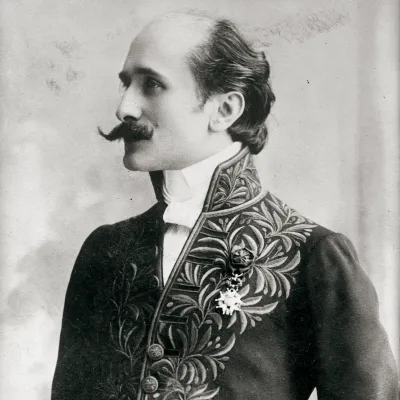
Edmond Rostand
Human Design Chart
Biography
Rostand received considerable fame and honors; was made commander of the Legion of Honor, 1900, and a member of the Academie Françoise in 1901.
He married the poet, Rosemonde Gerard, in 1890. She later collaborated with their adult son, Maurice, for two plays, produced in 1912 and 1914. With Rostand's health failing, he built a villa in southern France, where he spent most of his remaining years. He died on 2 December 1918, Paris.
Edmond Rostand — Generator with Profile 3/6
Generator 3/6 — Design at a Glance
Edmond Rostand had an enormous, enduring source of energy that made him a powerful creative force. As a Generator, he had a lot of sacral energy, comparable to a workhorse that is strong and steady as long as it burns for its task. His design determined that this power was released not through self-initiated action but through reacting to impulses from the environment. The motto was clear: do not initiate, but react.
His most successful strategy was to wait for signals from life and then act when his inner self gave a clear "yes." When he acted in harmony with this, his system rewarded him with a deep sense of fulfillment. If, however, he tried to go against this natural flow by initiating things he did not have an inner desire for, or if he was held back from his heart project despite being full of power, he was in danger. This deviation from his strategy led him to the typical pitfalls of his type: either a creeping burnout through energy waste or persistent frustration and a lack of power. Edmond Rostand's path to materializing his ideas thus depended crucially on whether he managed to respond from the gut to what truly spoke to him, rather than swimming against the current of his own nature.
Emotional Authority
Edmond Rostand showed himself to be someone who never made decisions based on the first emotional wave. His design revealed a tendency towards profound, delayed clarity that only set in after intense emotional movements subsided. This approach stemmed from his emotional authority, carried by his defined Solar Plexus Center. In Human Design mechanics, this center always carries inner authority once it is defined—regardless of which other centers are also active. This priority rule was central to his decision-making process.
The Solar Plexus Center was subject to a constant wave motion of emotions that heavily colored his perception of the world depending on his current mood. What appeared inspiring in one moment could be perceived as negative in the next. Edmond Rostand recognized that this first impression was merely a snapshot and not necessarily the truth. Quick, spontaneous decisions made from this emotional state could have had negative consequences. Instead, he took his time, let decisions mature, and slept on them multiple times. Only when the intense emotions had subsided and emotional distance had been gained did the necessary calmness and clarity set in. This process was particularly crucial for long-term life decisions that significantly influenced his life course. Through this patience and conscious delay, he arrived at a more comprehensive understanding that went beyond the initial emotional coloring.
The 3/6 Profile — Martyr / Role Model
Edmond Rostands Design laid a tendency that clearly divided into two life phases. Until the age of about 29, before the return of Saturn, he acted primarily from Line 3. This meant that his early life was characterized by experimenting, trial and error. He confronted superior forces and had to learn to avoid dependencies to prevent falling into experiences of fainting. This phase was marked by a playful but also uncertain energy, as he had not yet found an inner contrast.
With the onset of Line 6, that is after the age of 30, his attitude fundamentally changed. He withdrew to reflect on his previous experiences. The experimental energy of Line 3 now received the wise guidance of Line 6, which sought an overview of the whole. Edmond Rostand carried within him both the perspective of the young, learning self and that of the mature observer. This process of distancing and maintaining an unyielding stance was necessary to overcome misunderstandings and undergo an inner mutation. In his later years, around age 50, he became a role model for others through the combination of charm and wisdom, teaching from his own history.
Split Definition — Defined & Open Centers
Edmond Rostand revealed himself as someone with a fixed, reliable self-identity and a clear sense of direction. His defined G Center gave him the ability to love others without becoming dependent on them, and he naturally showed others new paths. This inner security was strengthened by his defined Heart Center, which gave him willpower and control over his resources; he enjoyed working but preferred to follow his own inner rhythm. His energy source came from his defined Sacral Center, a motor that generated constant vitality. Rostand had to respond to questions to use this energy correctly, rather than initiating it himself. His emotional depth and authority lay in his defined Solar Plexus Center, which required waiting for the emotional wave to gain clarity before making decisions. The defined Root Pressure supported him in nurturing existential awareness and moving forward.
In contrast, Rostand was open in mental and physical aspects. His open Head Center had no consistent way of processing mental information; he tended to get stuck in doubts or questions that were not his own, and sought inspiration to relieve this pressure. Similarly, his open Ajna Center allowed a flexible mind that was open to intellectual stimulation but tended to adopt other people's concepts without identifying them as his own truth. His open Throat Center meant that he could not communicate consistently; he drew attention to himself by waiting for invitations rather than trying to be the center of attention. Finally, his open Spleen Center brought a fundamental fear of survival and sensitivity to well-being. He was prone to clinging to people or situations that pretended to offer security and had to learn to avoid spontaneous decisions to not be guided by conditioned fears.
Channels for self-acceptance, community and emotional release.
Edmond Rostand revealed himself as someone who lived his own uniqueness without encountering resistance, while deeply engaged in the dynamics of communities. His design tended to love and honor himself while building bridges between individuals.
This attitude was shaped by the Exploration Channel 34-10. It connected the Sacral Center with the G Center: Gate 34 provided the inner strength to hold onto personal convictions, while Gate 10 initiated behavior from the deepest inner self. This allowed him to respond authentically and give others the example of self-acceptance without imposing his energy.
Parallel to this, the Community Channel 37-40 connected the Solar Plexus Center with the Heart Center. Here, Gate 37 sought recognition and his place in the whole, while Gate 40 was ready to provide but needed pauses and rewards. This combination created an emotional pressure wave that required carefully balanced agreements to find an honorable place in groups or relationships.
Additionally, the Channel of Emotional Release 39-55 shaped his emotional landscape. It connected the Root Center with the Solar Plexus Center: Gate 39 provoked to strengthen the mind, while Gate 55 carried the pulsating wave between joy and sadness. This led to a moody but creative energy that allowed him to feel and influence the mood of others, as long as he accepted his own emotional waves.
Individual Gates complemented this picture: Gate 48 promoted pattern recognition and depth, Gate 38 set boundaries to preserve integrity, and Gate 21 directed material resources. Gate 59 pursued a genetic strategy of attachment, Gate 22 brought calm openness, Gate 36 used crises for development, Gate 52 demanded concentrated pauses, Gate 19 sought secure resources, and Gate 2 enabled new directions through receptivity.
Individual Circuitry — Circuit Signature
Edmond Rostand's design tended towards pulsating, acoustic creativity that showed in separate energetic blocks. As a person with split definition, his energy did not consist of a single flow but of two parallel systems: a block from G and Sacral Centers, and another from Solar Plexus, Heart, and Root Centers. This separation meant that his inner identity was not directly connected to his emotional or willful power.
The Knowledge Circuit connected his Solar Plexus with the Root Center. This generated emotional waves that served as an impulse to transform and express new knowledge. The Centering Circuit, on the other hand, connected the Identity with the Sacral Center. Here, a powerful, individual life energy strengthened firm convictions and self-worth, but without a direct expression channel to the Throat Center. Finally, the Ego Circuit connected the Heart with the Solar Plexus Center. This promoted a give-and-take relationship within a community, but required pauses, as there was no direct connection to the constant life force of the Sacral Center. Overall, these separate but strong units shaped a profile that swung between individual firmness and communal cooperation.
Right Angle Cross of Tension 1
Edmond Rostand's Human Design profile indicated a tendency towards inner conflict, manifesting as a constant oscillation between two opposing poles. He felt a deep tension that arose not from external actions but from the way he perceived the world. This configuration described a life task of carrying and integrating seemingly irreconcilable forces.
The mechanics of this tension cross acted like an internal compass, pushing him to swing between the desire for peace and the need for action, between the urge for solitude and the desire for connection. There was no simple solution to dissolve this tension; instead, he learned to live with this dynamic. The energy of this configuration shaped his inner stance, leading him to accept the contradictions of life not as obstacles but as driving forces.
This inner conflict was not a sign of weakness but a specific way of perceiving that allowed him to recognize nuances hidden from others. He was someone capable of grasping the complexity of human relationships and situations without needing to simplify them. The tension he carried became the engine of his personal development, driving him to seek a deeper truth beyond obvious opposites.
Saturn Return · Uranus Opposition · Chiron Return — Life Cycles
Edmond Rostand's Human Design profile showed a sudden, unexpected conclusion at the age of 50. In 1918, he died of the Spanish flu. This moment precisely coincided with his Chiron Return, a cycle in Human Design mechanics that marks a phase of fulfillment and bloom. Those who had lived according to their strategy and authority experienced the concrete manifestation of their Inkarnation Cross during this period. The meaning and purpose of their design became tangible and condensed into a final, clear statement.
His death in this specific life stage did not interrupt this bloom as a tragic failure but marked the end of a complete incarnation task. The mechanics of the Chiron Return describe not a process of wound healing or pain but the ripening of one's essence. That Edmond Rostand died exactly at this window suggests that his life task had reached its peak and completion. The external circumstances of the pandemic acted here as a catalyst for the end of a cycle that had already internally reached its conclusion. His design was completed at this moment, without the need for further external developments to prove the meaning of his existence.
Generator · Emotional Authority — Synthesis
Edmond Rostand primarily lived through his sacral energy (Generator type) and the resulting endurance. This power drew from a deep, inner direction and the need to be loved (defined G Center), leading him to a constant exploration of his self and behavior (Channel 34-10). His emotional authority required time to mature decisions, yet the energy flowing from the Sacral Center allowed him to immerse in projects as long as they truly mattered to him. The oscillation between enthusiasm and doubt, marked by the emotional wave, seemed to constantly propel him to explore new paths and shape his unique identity (Knowledge Circuit).
Rostand was marked by a paradox between the need for self-confirmation and the inner search for authenticity. The exploration channel points to a permanent confrontation with his behavior to succeed in the world, while the tension cross 1 indicates an inner conflict. He drew strength from the confirmation of others (Gate 34), but also needed the space to define himself and walk his own path. This tension culminated in a life marked by creative energy but also inner melancholy.
3 Defined Channels
Incarnation Cross - Right Angle Cross of Tension 1
Solar Return
The Solar Return shows the moment when the sun returns to its exact birth position - your personal solar year.
Life Cycles
Discover the life cycles with a detailed triple view (birth chart, cycle chart, composite).
Human Design Profile
- Type
- Generator
- Strategy
- To respond - wait for something to respond to
- Authority
- Emotional Authority
- Profile
- 3/6 - Martyr / Role Model
- Definition
- Split Definition
- Incarnation Cross
- Right Angle Cross of Tension 1
- Date of Birth
- 01.04.1868 17:00
- Place of Birth
- Marseille, France
Frequently Asked Questions
What is Edmond Rostand's Human Design type?
What Profile did Edmond Rostand have in Human Design?
Which Authority guided Edmond Rostand's decisions?
What incarnation cross did Edmond Rostand have?
When was Edmond Rostand born?
Discover your own Human Design
Are you also a Generator? Find out in a personal reading how to use your sacral energy correctly and discover deep satisfaction.
More Personalities
Back to overviewAaliyah

Alain-Fournier

Alexia

Angèle

Angeli

Anne-Marie
