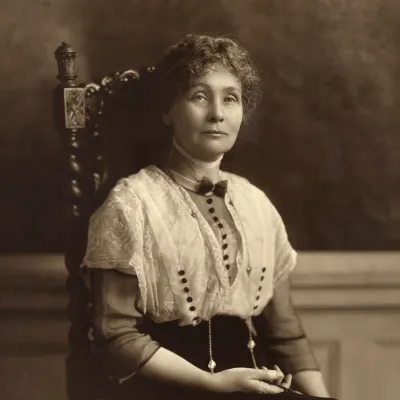
Emmeline Pankhurst
Human Design Chart
Biography
Educated in Paris, she married Richard Marsden Pankhurst in 1879, a barrister and advocate of suffrage. After helping to found the League in 1889, she became a member of the Independent Labour Party. She was widowed in 1898, leaving her with three daughters; her one son died in 1910.
Pankhurst took the post of Registrar of Births and Deaths but later had to resign due to her propaganda activities. She established headquarters in London. As she became more deeply passionate and involved with her cause, she was imprisoned several times for Breach of the Peace.
She and her daughter Christabel became more militant by 1903 and by the end of 1911 they directed a window-breaking campaign for which she was sentenced to nine months jail. Their suffrage efforts led to arson and destruction of property 1913-14. Pankhurst was sentenced to three years prison but fled to Paris, then to the U.S.
During WWI, she became involved in public service, which took some of the pressure off her reputation as a trouble-maker. An able and ardent public speaker, she ran as candidate for various political posts. In 1918, due in large part to her conviction, the Suffrage Act was passed.
Pankhurst died on 14 June 1928 in London at age 69.
Emmeline Pankhurst — Manifesting Generator with Profile 3/5
Manifesting Generator 3/5 — Design at a Glance
Emmeline Pankhurst revealed herself as someone who quickly drew things into her life and could skip steps. As a Manifesting Generator, she combined the constant sacral energy of a Generator with the active traits of a Manifestor, allowing her to tackle multiple projects simultaneously and act swiftly.
Her strategy was to not initiate herself but to react to impulses. Only when her sacral center gave a clear 'yes' did she start to act. This reaction to inner confirmation was crucial to avoid frustration that often arose when she was too quick or skipped important steps. In such cases, she had to go back and make up for the missed stages.
Due to her speed, she tended to pursue many different impulses at once. As long as her inner authority was 'on board', this complexity led to deep satisfaction. She fell into a play mode where variety enhanced her creativity. The advice to finish one thing before starting another did not suit her nature. Instead, she found satisfaction in parallel work on various projects, as long as she listened to the confirmation of her center and regularly checked if the projects still fed her energy.
Emotional Authority
Emmeline Pankhurst showed herself as someone who never made decisions in the heat of the moment but took conscious time to let the first emotional wave subside. Her design carried emotional authority, meaning the defined Solar Plexus Center took over her inner guidance. This configuration was subject to constant ups and downs of feelings; the world appeared colored by the current mood. A sudden burst of enthusiasm could turn into deep skepticism in the next moment. Since this first impression was only a snapshot and not necessarily the truth, spontaneous actions based purely on emotion often had negative consequences. Instead, her mechanics required patience and the repeated consideration of important questions. Only when the strong feelings subsided and emotional distance was gained, did the necessary clarity and calmness set in. This process was particularly crucial for long-term, life-defining decisions. Emmeline Pankhurst therefore took her time, asked herself repeatedly, and waited until the inner turbulence subsided before choosing a path. This ensured that her choice was based on deeper insight, not on fleeting mood.
The 3/5 Profile — Martyr / Heretic
Emmeline Pankhurst revealed herself as someone who learned through personal experimentation and later offered these experiences as solutions for others. Her design as a 3/5 Profile, the 'Explorer and Hero', set a basic attitude: she believed nothing initially but had to test everything herself. The third line of her profile drove her to proceed through trial and error. Failures were not a failure but a necessary part of the learning process. Through this detailed work, she discovered unusual paths and was ready to enter into commitments and break them when necessary to start anew.
This self-acquired knowledge from practical experience worked attractively on others. People wanted to learn from her created solutions, pushing Emmeline Pankhurst into the role of helper. The fifth line of her profile, that of the 'Savior', came into play during crises. Here she showed practical solutions and concluded processes. This competence led to maturity and self-realization. Yet, this heroic role also had a shadow side: when she experimented in front of others and failed, it was painful. Moreover, she tended to withdraw after overcoming crises, even though her skills were highly valued. She wore a mask of invincibility while carrying the burden of expectations internally. Her path was marked by the alternation between active experimentation for herself and later sharing this knowledge as rescue for the community.
Single Definition — Defined & Open Centers
Emmeline Pankhurst's design revealed a tendency towards tireless mental work and clear focus. She was someone who constantly questioned and formulated answers, driven by her defined Head and Ajna Centers. This mental process was not a choice for her but a permanent reality that enabled her to inspire others to think. Her defined Throat Center allowed her to bring these concepts and theories directly into the world, giving her communication a transformative power.
At the same time, she possessed a firm identity and willpower. Her defined G Center gave her a clear sense of direction and the feeling of being lovable, while her defined Heart Center endowed her with the energy to fulfill promises and control her own resources. This combination of mental clarity, communicative power, and egoic strength shaped her presence.
As a Generator with a defined Sacral Center, she had an immense source of vitality. Her strategy was to wait and react to life rather than initiate. Once she received an affirmative response from her Sacral, she could persistently use her energy to pursue her goals. Her defined Solar Plexus served as an inner authority; she had to wait for her emotional wave to gain clarity before taking decisive steps.
In contrast, her Spleen and Root Centers were open. The open Spleen Center made her vulnerable to conditioned fears and the temptation to make spontaneous decisions to gain a sense of security that did not come from her own intuition. She tended to question whether she could survive without external validation. The open Root Center absorbed stress from her environment, leading to a cycle of adrenalized pressure that she did not generate herself but absorbed from others. This openness required her to distinguish between her own and others' pressure to avoid burnout or hyperactivity.
Channels for determination, community, charisma, structure, awareness and change.
Emmeline Pankhurst revealed herself as someone whose actions were marked by an insatiable urgency that could only be channelled through direct reactions to external stimuli. This dynamic stemmed from the Channel of Charisma 34-20, which connected raw physiological energy from the Sacral Center (Gate 34) with immediate expression in the Throat Center (Gate 20). She could not sit still; her sphere of influence emerged when she followed her inner guidance and was not led by the "shoulds" of the mind. At the same time, she possessed the ability to translate complex relationships into efficient structures. The Channel of Structuring 43-23 linked her spontaneous insight (Gate 43) with the assimilated expression (Gate 23), enabling her to communicate innovative perspectives clearly as soon as the timing was right. Her mental clarity arose through the Channel of Awareness 61-24, which transformed sudden inspirations (Gate 61) into rational responses (Gate 24) – a process that required patience until the knowledge ripened. In her life's journey, she sought deep meaning through the Channel of Discovery 29-46, which led her through persistent saying "yes" (Gate 29) to the right place at the right time (Gate 46), provided she trusted the process. Emotional motivations played a role through the Channel of Transience 36-35, which drove her towards new experiences and changes (Gate 35), often triggered by the feeling of inadequacy (Gate 36). Finally, she understood community as a mutual obligation, steered by the Channel of Community 37-40, which connected friendship (Gate 37) with the necessity of solitude and the reward (Gate 40). Additional gates like 42 (Completion), 32 (Continuity), and 62 (Logic) underscored her ability to see processes through and structure details, while gates like 27 (Care) and 8 (Contribution) marked her role as a caregiver and enabler in the collective.
Individual Circuitry — Circuit Signature
Emmeline Pankhurst's design established a tendency towards pulsating creativity and structured awareness. As a simply defined person, she had a continuous energetic flow through all her centers, creating an integrated yet complex experiential world.
The Knowledge Circuit connected her Head, Ajna, and Throat Centers. This generated innovative flashes of insight that were translated into clear structures and expressed verbally. The energy was pulsating and focused on her own individuality. Parallel to this, the Meaning Circuit worked, forming two separate segments: on one hand, the Throat with the Solar Plexus Center, and on the other hand, the Identity with the Sacral Center. Here, it was about sharing emotional waves from the past and discovering new meaning patterns that cycled through.
The Ego Circuit connected her Heart and Solar Plexus Centers. This fostered a relationship of giving and receiving within a community based on mutual support and traditional cooperation. Finally, the Integration Circuit connected her Throat with her Sacral Center. This gave her charisma through the ability to express intuitive power directly in the present moment. Together, these circuits shaped a personality that structured new knowledge, shared emotional experiences, cooperated in communities, and radiated her inner power charismatically outward.
Right Angle Cross of Maya 2
Emmeline Pankhurst's Design was characterized by the presence of the right Maya Cross. This configuration established a specific inner dynamics that significantly shaped her actions and perception of the world.
The right Maya Cross is a rare but powerful combination of several defined Channels in the Human Design System. It unites the energy of the instinct, the intuition of the Solar Plexus, and the transformative power of the Root. For Emmeline Pankhurst, this meant that she did not simply react but was guided by a deep, often unconscious certainty. She possessed the ability to find a clear, instinctive path in chaotic or uncertain situations.
Her decisions did not arise from mere logic or external pressure but from an inner resonance that felt "right." This structure fostered a kind of leadership based on trust in her inner compass. When others were uncertain, Emmeline Pankhurst could radiate a calming, guiding presence due to this designed energy. She often acted in alignment with a larger, almost fateful flow that ran through her life. The mechanics of this Cross supported her in tackling complex challenges with a mix of patience, intuition, and persistent endurance without losing her inner alignment.
Saturn Return · Uranus Opposition · Chiron Return · 2nd Saturn Return — Life Cycles
Emmeline Pankhurst's design showed a tendency towards intense turning points triggered by external crises. Her Uranus was in opposition, indicating sudden upheavals that break old structures. In 1898, at the age of 40, her husband Richard Pankhurst died. This loss marked a deep crisis that interrupted her previous life paths and forced her to take new, more radical routes.
Later, her Chiron Return cycle began, marking fulfillment and the blossoming of her purpose. In 1910, at age 52, she organized the WSPU demonstration on Black Friday. This was not a moment of healing but the powerful unfolding of her incarnation cross in public, despite massive resistance.
The second Saturn Return brought further structuring and testing. In 1914, at age 56, Emmeline Pankhurst was arrested again when she tried to present a petition to King George V. This act underscores the mechanical necessity of upholding inner convictions even against established authorities. The sequence of these events—death of her husband, public confrontation, political imprisonment—illustrates how her design used crises not as endings but as catalysts for the realization of her specific life purpose. Each crisis sharpened her position and made her message unmistakable.
Manifesting Generator · Emotional Authority — Synthesis
Emmeline Pankhurst's life was marked by a constant interplay between deep emotional depth and the drive to effect change through action. Her defined emotional solar plexus (Authority) required time to let decisions mature, while the connection between sacral and throat center (Manifesting Generator) released an immediate, almost impulsive energy to respond to external stimuli. This combination led to a personality that was both profound and contemplative, as well as resolute and action-oriented – a pattern that was evident in the recurring crises of the Uranus opposition, the Chiron return, and the Saturn return.
A central paradox in her design lay in the tension between the need to experience things firsthand (Line 3, Explorer) and the responsibility to help others through these experiences (Line 5, Hero and Helper). The fast energy flowing through the channel of charisma could quickly spark changes, but it also carried the risk of skipping important steps, thereby shortening the process of thoroughly engaging with the issues brought forth by the defined mental center.
6 Defined Channels
Incarnation Cross - Right Angle Cross of Maya 2
Solar Return
The Solar Return shows the moment when the sun returns to its exact birth position - your personal solar year.
Life Cycles
Discover the life cycles with a detailed triple view (birth chart, cycle chart, composite).
Human Design Profile
- Strategy
- To respond - wait for something to respond to
- Authority
- Emotional Authority
- Profile
- 3/5 - Martyr / Heretic
- Definition
- Single Definition
- Incarnation Cross
- Right Angle Cross of Maya 2
- Date of Birth
- 15.07.1858 21:30
- Place of Birth
- Manchester, UK
Frequently Asked Questions
What was Emmeline Pankhurst's Human Design type?
What profile did Emmeline Pankhurst have?
Which authority guided Emmeline Pankhurst?
What incarnation cross did Emmeline Pankhurst have?
When was Emmeline Pankhurst born?
Discover your own Human Design
Are you also a Manifesting Generator? Find out in a personal reading how to unfold your multi-talents and direct your energy wisely.
More Personalities
Back to overviewAldair

Alizée

Angeli

Arletty

Artus

Balthus