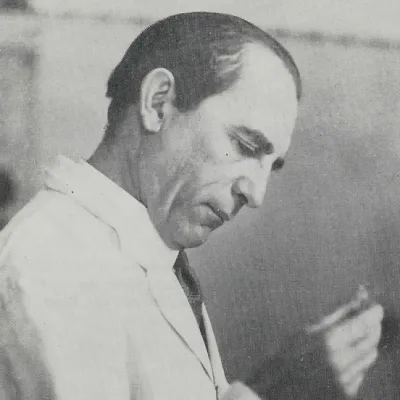
Ernst Josef Lesser
Human Design Chart
Biography
Lesser maintained close friendships with leading figures of his time, such as Martin Buber, Chaim Weizmann, Július Šimon and Max Weber. In 1914, he travelled to Palestine for the first time to help found a university in the Holy Land.
At the end of 1927 Lesser fell ill with a pancreatic carcinoma and died on 1 March 1928.
Human Design Analysis: Ernst Josef Lesser as Generator 4/1
Generator 4/1 — Design at a Glance
Ernst Josef Lesser was a Generator, a type characterized by immense inner endurance and the ability to generate energy. His design marked him as someone who functioned like a strong workhorse: extremely resilient and capable, provided he had energy for his tasks. This power, however, was conditional. It did not ignite through spontaneous initiatives but exclusively through reactions to signals from life. His motto was not 'initiate' but 'react'.
His most successful path involved waiting for impulses and then acting when his sacral center – often described as gut feeling – gave a clear 'yes'. In this state of resonance, no one could stop him, and he was rewarded with a deep sense of fulfillment. If he lived against this design, for instance by constantly initiating himself or doing things that lacked inner approval, he would eventually encounter frustration and energy loss. Two stumbling blocks defined this dynamic: first, wasting energy on tasks without inner joy, leading to exhaustion. Second, holding back from his heart project despite still being full of power. His design thus demanded a clear distinction: only what was felt as right from the gut should be pursued with his great endurance.
Emotional Authority
Ernst Josef Lesser was someone who did not make decisions immediately but let them mature. His design carried emotional authority, meaning his defined Emotional Center served as the inner guiding force. This configuration was subject to a wave motion of feelings, constantly oscillating between highs and lows. The world appeared to him colored by his current mood; enthusiasm could shift into negative assessment within the same moment.
This mechanism made quick, spontaneous judgments dangerous, as they only reflected momentary snapshots and did not necessarily mirror the truth. For Ernst Josef Lesser, patience was essential. He needed time to reconsider a decision multiple times and, if necessary, to endure it before clarity emerged. The longer he waited, the more intense feelings subsided, and emotional distance allowed for calmness.
A central aspect of this mechanism was the absolute priority of emotional authority. Regardless of which other centers were defined in his chart, the Emotional Center always took precedence in decision-making. This rule was strict and overrode other internal impulses. Ernst Josef Lesser therefore had to consciously let himself be guided and ask himself repeatedly to navigate through the emotional process. Only when the wave had ebbed could he take long-term, life-defining steps with the necessary assurance. This shaped his approach to significant turning points: not through quick reactions but through patient waiting until inner peace was achieved.
The 4/1 Profile — Opportunist / Investigator
Ernst Josef Lesser, with his 4/1 Profile, revealed himself as someone whose essence was deeply rooted and hardly swayed from the individual path. As the only fixed profile, it marked the transition from 'I' to 'You'. His nature was marked by a great heart that needed protection from injuries. This led him to quickly exclude people offering well-meaning impulses for change. Since he neither could nor wanted to change his essence, such advice was often perceived as a rejection of his true identity. Externally, this sometimes appeared stubborn or incapable of criticism, which could undermine his self-confidence.
The fourth line emphasized survival and success through maintaining his own rhythm. It transformed passive experience into active performance but required patience and waiting for opportunities. The risk was to reject this rhythm and thus endanger survival. The first line sought meaning in the past during hard times and tried to eliminate negative factors. It tended to find culprits and see distress as an exclusive phenomenon. However, when Ernst Josef Lesser acknowledged his character and rested stably within it, he became a rock in the storm. In this security, he could teach others magnificently and convey his insights without being distracted by external expectations. His strength lay in the constancy of his essence, not in adaptation.
Split Definition — Defined & Open Centers
Ernst Josef Lesser appeared as someone who was constantly under an internal mental pressure to ask questions and understand connections. His defined Head and Ajna Centers generated a continuous inspiration, but did not provide direct energy for implementation; he had to learn to use this pressure not as a trigger for hasty actions, but as a source of thought impulses that inspired others. This mental constellation was linked to a clear, defined identity in the G Center, which gave him a reliable self-esteem and a firm direction. He knew who he was and could convey this security to others without being dependent on their expectations.
His actions and promises were carried by his defined Heart Center, which gave him willpower and the ability to take responsibility for his resources. He worked independently and kept his promises, which strengthened his self-esteem. At the same time, he possessed enormous vital energy through his defined Sacral Center. As a Generator, his strategy was not to initiate, but to wait until life asked him, then to react with full energy. This ensured him satisfaction and prevented frustration.
This energy was filtered through his defined Solar Plexus Center, which acted as an emotional authority. Ernst Josef Lesser needed time to wait out the waves of his feelings before making decisions; spontaneous impulses often led to chaos, while patience brought emotional clarity.
In contrast, his open Spleen Center revealed a vulnerability to survival fears and the pressure to act spontaneously to feel secure. He tended to hold onto things that were not good for him out of fear of losing security. Additionally, his open Root Center absorbed external stress and adrenaline from the environment, often leading to a feeling of chaos and the attempt to get rid of this foreign pressure through overactivity, which put him at risk of burnout if he did not recognize that this stress did not come from him.
Channels for rhythm, intimacy, logic, clarity and community.
Ernst Josef Lesser was shown through a deep-rooted connection to the natural life flow, which made him vital and propelled him forward with his own inner timing. This basic attitude stemmed from the Rhythm Channel 5-15, connecting the Sacral Center with the G Center. Through Gate 5, he held onto firm habits, while Gate 15 integrated the diversity of society into this flow, making him magnetically draw others into his energy flow and set the course for a group.
His drive for merging and intimacy was shaped by the Pairing Channel 59-6. This channel connected sacral sexuality (Gate 59) with the emotional wave of pleasure and pain (Gate 6). Ernst Josef Lesser needed patience to nourish this intensity; only by waiting out his emotional cycle wave could he gain clarity about relationships and enable true fertility in creative endeavors.
Mentally, he consistently organized details into his inner system, driven by the Accepting Channel 17-62. Gate 17 visualized patterns that Gate 62 translated into language. This gave him the ability to logically structure complex information and convey it to others, provided he was invited to speak. His thinking itself was mutative and inspired by the Awareness Channel 61-24. Here, he processed acoustic inspiration (Gate 61) to sudden insight (Gate 24), a Satori moment that he could not control but only allow.
Social connections he sought through the Community Channel 37-40. Gate 37 sought recognition in the whole, while Gate 40 provided the necessary pause and reward. Ernst Josef Lesser built bridges between individuals to create harmonious agreements based on mutual benefit and loyalty.
Additionally, Gates like 35 (Change through Interaction) and 47 (Purpose from the Past) enhanced his ability to gain clarity from experiences. Gate 26 supported him in anchoring innovations in a conservative environment, while Gate 2 prepared him for new evolutionary directions. His persistence (Gate 29) and contribution to the group (Gate 8) rounded out a design based on natural flow, emotional depth, and logical structuring.
Collective Circuitry — Circuit Signature
Ernst Josef Lesser appeared through his design as someone who oscillated between two separate, not directly connected energetic poles. This arose from his split definition: One group connected the Sacral, G, Solar Plexus, and Heart Centers; the other the Ajna, Throat, and Head Centers. Between these blocks, there was no direct flow, which could lead to internal dissonance or the need for balance through partnership.
Within the defined groups, specific circuits were at work. The Knowledge Circuit in Lesser connected the Head with the Ajna Center through the Awareness Channel (24-61). This promoted innovative flashes of insight and the ability to transform new knowledge. The Understanding Circuit consisted of two separate parts: Ajna and Throat Center (Channel 17-62, Accepting) allowed the sharing of rational insights, while Identity and Sacral Center (Channel 15-5, Rhythm) combined logical structure with life force, free from emotional influence.
The Ego Circuit connected Heart and Solar Plexus Centers (Channel 37-40, Community). Here, it was about cooperation, mutual support, and creating resources in the tribe, with pauses for regeneration being necessary. Finally, the Protector Circuit connected Sacral and Solar Plexus Centers (Channel 59-6, Pairing). This connection emphasized instinctive protection, care, and the preservation of one's genetics and family. Thus, Lesser lived in a tension between individual insight and tribe-oriented responsibility, with the split definitions requiring constant integration.
Juxtaposition Cross of Habits
Ernst Josef Lesser revealed himself through a deep-rooted need for stability and familiar structures. His design was marked by the Habit Cross, a configuration that aims at stability and the repetition of proven patterns. This mechanical alignment created an inner order that provided him with a sense of security and allowed him to navigate safely within known paths.
For him, habit was not just a mere automatism, but an essential source of security and efficiency. The Habit Cross connects various aspects of his character into a coherent whole that relies on reliability. Ernst Josef Lesser found his strength in establishing routines and consistently adhering to them. This created a stable framework in which he could unfold without being overwhelmed by the unpredictability of daily life.
This configuration promoted a lifestyle based on continuity. Changes were not seen as enrichment, but often as disruptions that threatened his inner balance. Instead, he sought ways to deepen and refine the familiar. Through this dedication to habit, he developed a specific form of mastery in his daily routines. His design suggested that his greatest satisfaction came from the harmony between inner expectation and outer repetition. He lived in a rhythm that provided him with the necessary energy and clarity to fulfill his tasks without constantly reinventing himself. This stability was the foundation of his personal architecture.
Saturn Return · Uranus Opposition — Life Cycles
Ernst Josef Lesser's design shaped an attitude of structural anchoring and gradual consolidation. He was someone who sought inner stability through external form and clear responsibilities. This tendency towards consolidation was particularly effective during the first Saturn Return, the cycle of maturity and responsibility. In this phase, years of groundwork often crystallized into solid results that laid the foundation for further life development.
In 1910, at the age of 31, Ernst Josef Lesser was appointed to the board of the city's municipal hospital laboratories. This career development was a typical moment of his first Saturn Return. The appointment not only marked a professional advancement but also institutional recognition of his ability to carry and organize complex structures. Through this position, he received the necessary platform to live out his analytical skills and sense of responsibility in a stable framework. The Saturn Return acted here as a catalyst, linking his inner readiness for leadership roles with an external, socially recognized role. This established a basis on which he could bring his specific way of perception and analysis long-term and sustainably.
Generator · Emotional Authority — Synthesis
Ernst Josef Lesser lived a life marked by a deep, sacral energy (Generator Type), which expressed itself in a constant rhythm (Channel Rhythm). This energy was, however, always bound to emotional waves (Emotional Authority), requiring careful consideration before decisions could be made. His Profile as a 4/1 Networker/Researcher indicates a deeply rooted nature that did not change easily and cultivated relationships based on complete acceptance. The defined Head Center brought a steady mental pressure to question and understand things, making him an inspiration to others.
A central paradox in his design lay in the tension between the deep, fixed nature of his profile and the emotional wave that shaped his decisions. He was a person who, on the one hand, clung to his habits and rituals (Gate 5), while on the other hand, his emotions prompted him to constantly reassess things. This dynamic led to an inner complexity that drove him to acquire and transform knowledge (Knowledge Circuit), and kept him in a constant flow of change that also manifested in professional turns (Saturn Return Event).
5 Defined Channels
Incarnation Cross - Juxtaposition Cross of Habits
Solar Return
The Solar Return shows the moment when the sun returns to its exact birth position - your personal solar year.
Life Cycles
Discover the life cycles with a detailed triple view (birth chart, cycle chart, composite).
Human Design Profile
- Type
- Generator
- Strategy
- To respond - wait for something to respond to
- Authority
- Emotional Authority
- Profile
- 4/1 - Opportunist / Investigator
- Definition
- Split Definition
- Incarnation Cross
- Juxtaposition Cross of Habits
- Date of Birth
- 07.12.1879 12:00
- Place of Birth
- Stettin, Germany
Frequently Asked Questions
What was Ernst Josef Lesser's Human Design type?
What Profile did Ernst Josef Lesser have in Human Design?
What Authority did Ernst Josef Lesser have?
What incarnation cross was assigned to Ernst Josef Lesser?
When was Ernst Josef Lesser born?
Discover your own Human Design
Are you also a Generator? Find out in a personal reading how to use your sacral energy correctly and discover deep satisfaction.
More Personalities
Back to overviewAaliyah

Alexia

Angèle

Anne-Marie

Arcángel

Arno