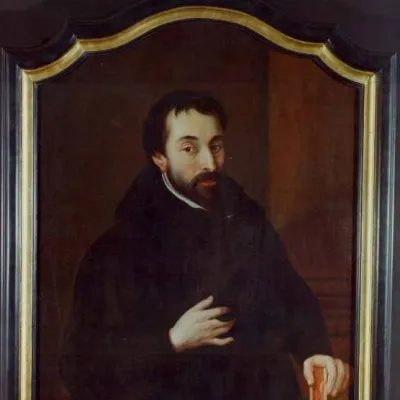
Friedrich Spee
Human Design Chart
Biography
He died 7 August 1635.
The Human Design of Friedrich Spee: Manifesting Generator 1/3
Manifesting Generator 1/3 — Design at a Glance
Friedrich Spee was characterized by a hybrid energy configuration. As an Manifesting Generator, he combined the constant power of a Generator with the direct impact of a Manifestor. This setup gave him the ability to skip steps and quickly draw results into his life.
His defined sacral authority provided him with steady energy, but his strategy involved not initiating himself but reacting to inner impulses. Only when this reaction radiated a clear 'yes' did he act effectively. However, this speed came with risks: Often, he would overlook necessary intermediate steps, leading him later to backtrack and fill in the gaps. Such setbacks could cause frustration as they undermined his efficiency.
Moreover, Friedrich Spee tended to pursue multiple projects simultaneously, driven by different impulses. Without strict adherence to his inner authority, this complexity threatened to overwhelm him. When the strategy was followed—reacting purely to what truly spoke to him—he found deep satisfaction in creation. For him, a linear focus on a single task was limiting; instead, his creativity flourished through shifts and playful modes that sought and utilized variety.
Emotional Authority
Friedrich Spee exhibited a decision-making structure that did not reveal itself immediately but only after an emotional condensation phase. His inner authority lay in the defined Solar Plexus Center—the seat of emotional authority. This mechanism was subject to constant ups and downs of emotions; his perception was always colored by the current mood. What appeared inspiring at one moment could turn negative the next. His immediate feeling was just a snapshot, not necessarily the truth.
Quick, spontaneous decisions based on such emotion would often have negative consequences for him. Instead, his design required patience: he had to take time to let decisions mature. This meant taking his time and sleeping on it multiple times. Over time, intense feelings subsided, he gained emotional distance, clarity set in, and calmness followed. Only then was he through the process. This rule was absolute: As the Solar Plexus Center was defined, it always carried inner authority regardless of other defined centers in his chart. Friedrich Spee lived this necessity of delay; his deepest insights emerged not from rushing ahead but in the internal peace after the emotional waves subsided.
The 1/3 Profile — Investigator / Martyr
Friedrich Spee's design inclined towards deep knowledge shaped by experience. As a Researcher and Experimenter (Profile 1/3), he was programmed to first engage theoretically with topics before practically implementing them. This configuration described a life path of learning through trial and error. Line 1 conveyed a sensitive approach to guideline formation, while line 3 established the necessity of learning from mistakes as a process. For Friedrich Spee, this meant that his judgment only became trustworthy when he had both thought something through in theory and tested it on practical grounds. There was no quick path to truth; instead, insights had to be earned through personal effort. The mechanics showed that often a tiny detail could bring an entire process to failure—a learning moment central to his development. His authority did not rest solely on theory but on the hard lessons of practical application. When Friedrich Spee made a statement, it was backed by the certainty that he had already experienced and understood its consequences. This combination of theoretical foundation and practical testing shaped how he dealt with information: skeptical towards untested claims but absolutely reliable when evidence was confirmed through personal experience.
Split Definition — Defined & Open Centers
Friedrich Spee was someone whose expression and actions were characterized by a reliable internal structure. His defined Throat Center ensured that his communication wasn't arbitrary but flowed from a clear source; he spoke what was truly in him rather than just expressing thoughts. This ability to transform inner impulses into words and deeds aligned with his defined Willpower in the Heart Center. Spee had a natural energy to fulfill promises and take responsibility for his environment. He preferred working independently and sought confirmation of his own worth by keeping his word. Thus, his actions were not merely rhetorical but driven from a deeper level of commitment and ego.
At the same time, Spee possessed immense vital force drawn from his defined Sacral Center. However, this energy wasn't an impulse for immediate action but rather a reservoir waiting to respond to stimuli. His strategy was not to initiate but to wait until life called upon him before responding with full strength and satisfaction. This required patience, deepened by his defined Solar Plexus Center. Spee needed to wait out emotional waves before making decisions. Truth revealed itself to him not in moments of excitement or anger but after going through the emotional cycle.
These internal definitions starkly contrasted with his open areas. His open Head Center made him vulnerable to mental pressure and others' questions; he tended to get entangled in thoughts that weren't his own, often seeking inspiration to resolve this confusion. Similarly, his open Ajna Center meant he could take on concepts but they were never his firm truth. His open G Center indicated that he lacked a fixed identity or direction, reflecting himself in relationships and environments. This led him to be easily absorbed by the energy of his surroundings, especially through his open Root Center, which took in external stress and adrenaline. Therefore, Spee was dependent on observing these external influences without interpreting them as personal necessities to avoid falling into cycles of exhaustion and false identification.
Channels for community, expression, resources and intuitive power.
Friedrich Spee's social interactions were strongly determined by emotional waves. The Openness Channel 22-12 connected his Solar Plexus Center with the Throat Center, regulating his articulation through mood: he spoke or acted openly only when he felt like it, which helped him create a receptive environment for transformative insights. Simultaneously, he carried the internal tension of the Money Line Channel 21-45 within himself, linking his Heart Center to the Throat Center. This channel brought forth the struggle between the will to control (Gate 21) and the need for authority as well as resources (Gate 45); he had to learn to take responsibility without sacrificing his own independence or the calm of his heart.
Another defining feature came from the Power Channel 34-57, connecting his Sacral Center with the Spleen Center. This connection endowed him with an intuitive survival intelligence: he reacted spontaneously to dangers and vibrations in his environment, independent of logical considerations. This helped him assert himself as a distinct individual and maintain his vitality through acoustic attention.
In interpersonal relations, the Community Channel 37-40, connecting Solar Plexus and Heart, guided him to seek his place within a group but needed time for emotional clarity before committing fully. His design promoted fair agreements based on mutual benefit rather than hierarchy.
Additionally, individual Gates shaped his approach: Gate 9 at the Sacral Center drove him towards detailed work and perfection through repetition. Gate 16 in the collective context fostered an experimental spirit and mastery. On a personal level, Gate 36 with its cyclical crisis experience prepared new developments. Gate 55 brought extreme mood swings on an emotional level. Gate 31 stood for the transmission of leadership qualities while Gate 28 in his design highlighted risk-taking in the here and now. Gate 33 promoted reflection and withdrawal to process experiences. Finally, Gate 62 supported logical pattern recognition and patient fact-finding.
Tribal Circuitry — Circuit Signature
Friedrich Spee's design set a tendency towards separate, parallel operating energy focal points. Through Split Definition, two independent power fields existed: an upper region comprising Throat, Solar Plexus, and Heart Centers as well as a lower one including Sacral and Spleen Centers. These groups were not directly connected, so experiences appeared as coexisting streams that did not interpenetrate.
In the Knowledge Circuit, the Openness Channel linked the Throat Center with the Solar Plexus. This promoted a pulsating, acoustic expression style translating emotional waves directly into words. The Ego Circuit was shown through two separate channels: 'The Money Line' (Channel 21-45) and 'Community' (Channel 37-40). These connected Spee's Throat Center, Heart, and Solar Plexus to form a single group. Here it revolved around traditional cooperation, mutual support, and the accumulation of material resources through mediation and exchange. Since no Sacral Channel was involved, this dynamic required quiet pauses for regeneration.
The Integration Circuit operated isolated in the lower region. The Power Channel linked the Sacral Center with the Spleen. This allowed drawing strength from reacting to life and guiding it through intuitive knowledge to make it effective in the present moment. This configuration supported securing one's survival through highest individuality and spontaneous adaptability, entirely independent of communicative processes above.
Right Angle Cross of Planning 1
Friedrich Spee's Human Design indicated a specific tendency towards strategic preparation. The right cross of Planning 1 described an internal mechanism that required him to carefully examine his own resources and possibilities before taking action or speaking. This was not hesitation in the negative sense, but rather a necessary process of orientation: Friedrich Spee had to ensure first that his own system – his energy, clarity, intention – was stable enough to carry out an action without running into emptiness or exhausting himself.
This configuration acted as an inner compass for the right moment to act. It demanded from him not to react impulsively to external stimuli but rather to look inward and clarify his own alignment. Only when this internal planning was completed and a clear direction had been set could he effectively step into the world. Before that, there was the risk that actions might be initiated but not sustained, leading to frustration or a sense of futility. The right cross of Planning 1 thus shaped his approach through a deep dependence on this preparatory phase of self-reflection and strategic alignment.
Saturn Return · Uranus Opposition — Life Cycles
Friedrich Spee's Human Design indicated a tendency towards internal structuring and the building of solid foundations. This configuration described a life task to pour personal values into stable forms. In 1622, at age 31, he was ordained as a priest in Mainz Cathedral – for his design a typical moment: the first Saturn Return, when years of groundwork often condenses into a sustainable result and internal order becomes visible externally.
Later, another dynamic of his chart became apparent: the need to question established structures if they violated personal integrity. This tension between authority and individual conscience was acute in 1630, at age 39, when he resisted disciplinary action against him by the Jesuit Order's general, Father Vitelleschi, regarding the case Spee. This corresponded to the Uranus Opposition, a phase where the system often breaks old bonds or rises up against unjust power structures. For Friedrich Spee, this conflict marked a turning point at which inner truth took precedence over external duty and his strategic alignment was redefined.
Manifesting Generator · Emotional Authority — Synthesis
Friedrich Spee lived a life characterized by a constant interplay between inner maturity and the urge to explore. His defined sacral body allowed for a steady energy flow, but through the Manifestor component of his type (Manifesting Generator), it tended towards quick action. This combination led him to often act on intuitive impulses, showing both strengths and difficulties – a tendency reflected in his role as researcher and experimenter (Profile 1/3) who had to validate knowledge through personal experience. Emotional authority required time for decision-making, while the Channel of Openness (22/12) made him receptive to others' feelings and enabled expressive communication.
Central to his design was a paradox between the need for deep emotional processing and the ability to take quick, impulsive steps. The Knowledge Circuit drove him to explore new paths and initiate transformation through expression, yet the emotional wave (Authority) demanded mature reflection before action. This led to an internal tension that showed in phases of intense confrontation with issues as well as the necessity to reconsider decisions multiple times and make corrections if needed – a pattern also reflected in documented events (Saturn Return as career entry, Uranus Opposition as crisis experience).
4 Defined Channels
Incarnation Cross - Right Angle Cross of Planning 1
Solar Return
The Solar Return shows the moment when the sun returns to its exact birth position - your personal solar year.
Life Cycles
Discover the life cycles with a detailed triple view (birth chart, cycle chart, composite).
Human Design Profile
- Strategy
- To respond - wait for something to respond to
- Authority
- Emotional Authority
- Profile
- 1/3 - Investigator / Martyr
- Definition
- Split Definition
- Incarnation Cross
- Right Angle Cross of Planning 1
- Date of Birth
- 25.02.1591 16:00
- Place of Birth
- Düsseldorf-Kaiserswerth, GER
Frequently Asked Questions
What was Friedrich Spee's Human Design type?
What Profile did Friedrich Spee have in Human Design?
What Authority did Friedrich Spee possess?
What incarnation cross did Friedrich Spee have?
When was Friedrich Spee born?
Discover your own Human Design
Are you also a Manifesting Generator? Find out in a personal reading how to unfold your multi-talents and direct your energy wisely.
More Personalities
Back to overviewAlain-Fournier
Aldair

Alizée

Angeli

Arletty
Artus