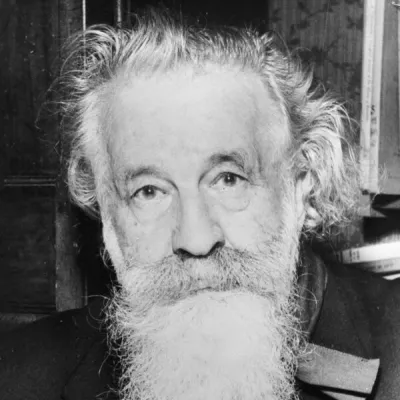
Gaston Bachelard
Human Design Chart
Biography
For Bachelard, the scientific object should be constructed and therefore different from the positivist sciences; in other words, information is in continuous construction. Empiricism and rationalism are not regarded as dualism or opposition but complementary, therefore studies of a priori and a posteriori, or in other words reason and dialectic, are part of scientific research.
What does Manifestor 2/4 mean for Gaston Bachelard?
Manifestor 2/4 — Design at a Glance
Gaston Bachelard revealed himself as someone with the inner orientation of a Pioneer, whose task was to lead the world into new directions. His design marked him similarly to an Emperor in ancient Rome: He possessed the vision of a great whole but did not fight the necessary wars and battles himself; instead, he delegated concrete actions to others to conquer foreign territories for his ideas.
This superior perspective brought with it a central conflict: Gaston Bachelard was often misunderstood because he thought further ahead than his environment. His big dreams inevitably polarized people; while some loved him and followed him, others rejected or hated him precisely due to the radical nature of his visions.
To avoid this painful point and find the right followers, it was crucial for his design to inform others about his intentions in a timely and precise manner. This strategy of informing served not only communication but was also the key to attracting those who could follow his leadership. If he followed this strategy, he was rewarded with a deep sense of inner peace. Living against his design by failing to inform led to persistent, deep anger. His path was thus marked by the tension between the isolating effect of his vision and the connecting power of clear information.
Splenic Authority
Gaston Bachelard showed a decision-making stance based on the first, spontaneous impulse – a signal of spleen authority. His design carried this authority in the defined Spleen center while the Emotional and Sacral centers remained open; only Projectors or Manifestors can have this configuration. The Spleen center functions as a health and alarm system, equipped with precise survival intelligence. This manifested for Gaston Bachelard as immediate inner knowledge about whether an environment, situation, or society was right for him. His instinct and physical well-being served as reliable indicators.
The first impulse was always the correct one and directly served his health, allowing him to rigorously distance himself from harmful influences. Since this spleen signal is subtle and occurs only once in a moment, it required high vigilance not to be drowned out by external voices. Retreats for decision-making could be helpful. Because the right thing was always only recognizable at the moment, plans changed short-term. Long-term commitments were difficult; instead, Gaston Bachelard needed much freedom and flexibility to act spontaneously without unnecessarily binding himself.
The 2/4 Profile — Hermit / Opportunist
Gaston Bachelard showed a constant pendulum movement between the deep need for withdrawal and the urge to connect. His design suggested that he acted in isolation at times, gaining inner clarity before returning to social structures. This dynamic of Profile 2/4 describes a cycle: Line 2 calls for solitary concentration and pauses to organize thoughts. During this time, Bachelard immersed himself in internal processes, creating a kind of “chamber” of reflection. Once this phase was complete, Line 4 activated the need for community. Here it wasn't about superficial small talk but exchanging with selected individuals whose motivations and gifts he could recognize.
The challenge of this design lay in communicating these shifts. To avoid misunderstandings – such as his withdrawal being seen as selfishness or his closeness as manipulation – it was crucial to clearly signal: “Now I need peace” or “I want to exchange with you.” In phases of solitude, Bachelard processed the knowledge from his network. Line 4 allowed him to place people in an inner order; Line 2 provided the space to evaluate these impressions and develop new ideas from them. Thus, a productive rhythm emerged: withdrawal for condensation, then exchange for validation. Only when both needs were respected – the right to silence as well as the need for connection – could he fully unleash his potential without his reclusiveness being seen as dangerous or his social presence as intrusive.
Single Definition — Defined & Open Centers
Gaston Bachelard was characterized by a constant internal architecture: his thinking was structured, his will stable, and his intuition reliable. His defined Ajna Center ensured continuous mental activity; he processed data continuously and formed concepts according to a fixed pattern that was difficult for external influences to alter. This mental clarity flowed directly into his defined Throat Center, allowing him to communicate his thoughts clearly and reliably at all times. His voice was not an impulse but the expression of his conceptual order.
Parallel to this, Bachelard possessed a stable will through his defined Heart Center. He knew his worth, kept promises, and acted from a strong ego that allowed him to take responsibility for his resources. His decisions were also supported by intuitive bodily intelligence: The defined Spleen Center provided spontaneous judgments about health and well-being that he did not need to rationalize but could trust. The constant pressure of his defined Root Center drove him forward, serving as a continuous energy source to material existence and existential awareness.
At the same time, Bachelard was open to external influences in other areas. His open Head Center meant that inspiration did not come from himself but rather hit him situationally from outside; he tended to engage with foreign questions or doubts when he did not trust his inner authority. Identity and direction were also variable: The open G Center made him reflect the identities of his environment without radiating a fixed personality, seeking the right place to feel belonging. His energy was unstable through his open Sacral Center; he could easily be swept away by the life force of others and had to learn to set limits rather than pushing himself to exhaustion. Emotions were absorbed over his open Solar Plexus Center, making him vulnerable to foreign moods and tending to avoid confrontation to prevent emotional waves.
Channel 17-62: Acceptance — Channels & Gates
Gaston Bachelard was characterized by a constant logical organization of details coupled with the drive to correct and perfect patterns. His design channeled energy into distinguishing what works and what does not, as well as in the translator's work of visual patterns into language.
This attitude rooted in Channel 17-62. It connects Ajna Center with Throat Center through Gate 17 (Opinions) and Gate 62 (Details). This configuration caused his mind to continuously organize details within a mental system. Everything he could not logically integrate into his worldview, he did not understand. This generated an internal pressure to communicate opinions in detail and effectively translate visual patterns into language, such as theories or hypotheses that could be tested for feasibility.
Parallel to this, the Channel of Judgment 58-18 worked. It connected Root Center with Spleen Center through Gate 58 (Vitality) and Gate 18 (Correction). This channel nourished an insatiable drive to question and perfect patterns. Gate 58 drove persistence while Gate 18 checked what was out of balance or needed correction. This led Gaston Bachelard to only accept what appeared logically consistent, feeling an external urge to correct inconsistencies or explain them precisely.
Additionally, other Gates shaped his mechanics: Gate 52 (Inactivity/Concentration) required a strong focus on pattern correction; Gate 4 (Formulation) developed formulas for clarifying suspicious patterns; and Gate 32 (Continuity) checked situations against past failures to maintain stability. These elements together formed a fundamental attitude of critical examination and precise communication.
Collective Circuitry — Circuit Signature
Gaston Bachelard's design combined innovative intuition with rational structure. The Knowledge Circuit worked through Channel 20-57, channeling flashes of insight from the Spleen Center directly into the Throat Center. This created a pulsating energy for new insights that immediately expressed themselves acoustically and creatively.
Parallel to this, the Understanding Circuit structured these impulses. Here, a part of Ajna connected with the Throat Center (Channels 17-62 and 18-58), enabling logical analysis and strategic judgment. Another separate section linked Spleen and Root Centers, ensuring focused perception and the necessary focus to carry these visions into the future. This combination allowed intuitive leaps to be underpinned by rational argumentation and made understandable.
Additionally, the Ego Circuit presented itself through the 'Money Line' (Channel 21-45), connecting Heart and Throat Centers. This emphasized the aspect of giving and taking within a community or tribe. It was less about individual self-presentation but rather exchanging resources and values through clear communication. Bachelard's design thus showed a synthesis of impulsive creativity, cold logic, and the will for cooperative value creation.
Right Angle Cross of Service 2
Gaston Bachelard's design points to a tendency towards deep dedication to the well-being of others. His inner compass was not directed at self-actualization in an isolated sense, but rather on the stance of support and helping. This corresponds with the configuration of the Right Cross of Service 2, a structure that anchors motivation and life direction fundamentally in service to others.
This mechanism describes no passing phase or learned virtue, but an existential core theme: The question of how one can be available for others without losing their own essence. It is about the quality of dedication as a central driving force. Those standing in this configuration often find their orientation only when they shift focus from 'What do I want?' to 'How can I serve?'.
For Gaston Bachelard, this meant that his inner balance and clarity were closely tied to the ability to carry and support others. It was an internal necessity to place himself in service of greater contexts or individual needs of others. This orientation shaped how he encountered the world – not as a competitor or isolated observer, but as someone whose deepest fulfillment lay in enriching and stabilizing other lives through his own dedication.
Saturn Return · Uranus Opposition · Chiron Return · 2nd Saturn Return — Life Cycles
Gaston Bachelard's design points towards cyclic phases of structuring and detachment. His chart does not show specific Gates or Channels, but refers to general life rhythms influenced by recurring planetary transits. This mechanism describes a process where internal order structures form, are challenged, and ultimately re-integrated.
The first Saturn Return marked a phase of condensation: groundwork became tangible, commitments crystallized. This was no sudden break, but the result of long-term development. Later came the Uranus Opposition, a time when established patterns were questioned. Here, there was a necessity to release old structures to make space for new impulses – not as destruction, but as necessary liberation from outdated patterns.
The Chiron Return occurred around age 49 to 51 years. From a Human Design perspective, this is no healing process in the sense of wounds, but a blooming phase: one's incarnation cross unfolds increasingly, meaning and purpose become experiential. Gaston Bachelard experienced this time as deepening his life mission, provided he had lived according to his strategy and authority beforehand.
The second Saturn Return rounded off this cycle. It brought another level of maturity and responsibility with it, where earlier experiences became a stable foundation. These transits show not individual peculiarities but universal rhythms that everyone encounters – in Gaston Bachelard's case, however, they were effective within the context of his specific design.
Manifestor · Splenic Authority — Synthesis
Gaston Bachelard seems to be guided by an inner urge to recognize patterns and formulate them precisely (Channel 17-62) to then carry them into the world – a process that is reinforced through his defined Throat Center and Ajna Center. This ability for logical organization and communication of insights appears central to his entire work, paired with deep intuition (Channel 20-57), enabling him to gain clear insights in the present moment. He acted as someone who not only thought but also instinctively knew what was relevant and could express this authentically. Through the defined Heart Center willpower, he seems to have had a strong inner direction that propelled him to pursue his visions and mobilize resources (Channel 21-45).
Simultaneously, a tension field between the need for focus and the ability to adapt reveals itself. His design points towards a strong focus on pattern correction (Gate 52), while at the same time open definitions in centers like Solar Plexus and Sacral make him receptive to external influences. This could have led to an internal struggle between the desire for clarity and the necessity of being flexible in response to new information or emotional currents – a dance between striving for order and accepting change.
4 Defined Channels
Incarnation Cross - Right Angle Cross of Service 2
Solar Return
The Solar Return shows the moment when the sun returns to its exact birth position - your personal solar year.
Life Cycles
Discover the life cycles with a detailed triple view (birth chart, cycle chart, composite).
Human Design Profile
- Type
- Manifestor
- Strategy
- To inform others before acting
- Authority
- Splenic Authority
- Profile
- 2/4 - Hermit / Opportunist
- Definition
- Single Definition
- Incarnation Cross
- Right Angle Cross of Service 2
- Date of Birth
- 26.06.1884 11:00
- Place of Birth
- Bar-sur-Aube, France
Frequently Asked Questions
What is Gaston Bachelard's Human Design type?
What Profile does Gaston Bachelard have?
What authority does Gaston Bachelard possess?
Which incarnation cross is active for Gaston Bachelard?
When was Gaston Bachelard born?
Discover your own Human Design
Are you also a Manifestor? Find out in a personal reading how to use your initiation power peacefully and dissolve resistance.
More Personalities
Back to overviewChristian-Jaque

Kesha

Lucebert

Masaccio

Papus
Petrarch