
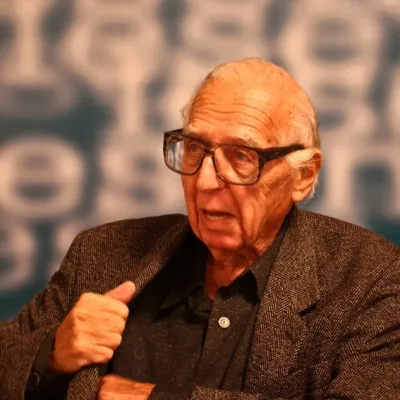
Georg Kreisler
Human Design Chart
Biography
In 1938, he was forced to flee with his parents due to increasing Nazi restrictions on Jews. In 1941, he married Philine Hollaender, daughter of Friedrich Hollaender and Blandine Ebinger. In 1943, he became an American citizen. He enlisted in the Army, and was stationed in Europe. He wrote songs for soldiers in Britain and France with the help of Marcel Prawy. After the war, he went to Hollywood and worked on movies with Charlie Chaplin. He performed at nightclubs and bars to make ends meet. In 1947, he was rejected by the record companies because his songs were "Un-American", especially songs with titles such as "Please Shoot Your Husband". In 1955, he returned to Europe, first to Vienna, then Munich in 1958, Berlin in 1976, Salzburg in 1988, Basel in 1992, and back to Salzburg in 2007.
Kreisler was considered a master of language. His songs are characterized by black humour and uncompromising criticism of society and politics. This caused him many difficulties and also contributed to appearance prohibitions in radio and television.
He died on 22 November 2011 at age 89 in Salzburg, Austria.
The Human Design of Georg Kreisler: Generator 4/1
Generator 4/1 — Design at a Glance
Georg Kreisler had immense and enduring life energy. As a Generator, his design was meant to work like a strong working horse – powerful and steady as long as he had the energy for his tasks. This sacral energy wasn't released through self-initiation but responded to impulses from the environment. His motto was: Not start, but answer.
This principle defined his approach to life. He sought signals in life and acted only when his inner voice gave a clear 'yes'. This strategy of reacting was key to his effectiveness. When he followed this inner command, he was rewarded with a deep sense of satisfaction. No one could stop him as long as he lived in harmony with this mechanism.
At the same time, his design carried two specific risks. The first stumbling block lay in wasting energy on things that did not bring him joy. Such activities, which he actually had no desire to do, quickly led to exhaustion and burnout because they blocked his intrinsic creative power. The second danger was being held back from his heart project when he still wanted to continue working with full power. An external 'end of workday' signal could then unnecessarily slow him down.
If Georg Kreisler did not live according to this design – for example, by constantly initiating himself instead of waiting for impulses – he would sooner or later encounter persistent frustration and a noticeable lack of energy. His path to fulfillment therefore always lay in reacting from the gut to life rather than forcing it from the outside.
Sacral Authority
Georg Kreisler made decisions not through intellectual analysis but waited for an immediate, physical resonance. His design established sacral authority – a mechanism exclusive to Generators that unites their strategy with inner guidance. This fundamentally simplified his decision-making process: He didn't need to think but listen to the impulses of his body.
This 'gut feeling' manifested as a surge of energy or loud grunts, hums, or affirming 'mmms' when he encountered an external stimulus. If this impulse was positive, he felt vital and energized; then he could dive into his tasks with great enthusiasm without needing external purpose constraints. His well-being depended on following this inner motor, which provided him with an inexhaustible energy source for life.
Furthermore, his activated Spleen Center acted as a supportive instance to sacral authority. This gave him the ability to react particularly quickly and spontaneously. He had direct access to his instinctive perception and physical well-being, on which he could rely reliably. This combination allowed him to make decisions in an instant, guided by deep intuitive certainty that left no room for hesitant pondering.
The 4/1 Profile — Opportunist / Investigator
Georg Kreisler showed himself as someone whose essence was deeply rooted and hardly deviated from the individual path. As a 4/1 Networker/Researcher, he had a big heart but it needed protection against injuries. Well-meaning impulses to change from outside were often rejected; those who did not completely accept him quickly found themselves excluded from his heart. This led others to sometimes perceive him as stubborn or incapable of criticism.
The fourth line required the right opportunity to express details and needed time for internal processes in ascetic retreat. Early withdrawal would have necessitated corrections. Only when the details were organized could he express them. At the same time, the first line with its uncontrollable mutation power influenced all surrounding aspects. Synthesis here required analyzing difficulties before order was achieved. Often, he only recognized his own strength later because mutations could be hidden in confusion. Once he had recognized himself and his life theme, he became as stable as a rock in the waves. This steadfastness allowed him to teach others magnificently by offering his deeply rooted nature as a secure foundation.
Triple Split Definition — Defined & Open Centers
Georg Kreisler's Human Design shows a tendency towards constant mental pressure and a clear, independent identity. He was someone who stood under the permanent drive to ask questions and form concepts, combined with a firm inner direction. This configuration described a person with defined Head and Ajna centers, which generated a reliable, specific mental function. His mind was always active, not influenced by external opinions but generating its own inspiration. However, there was no direct energy available to implement these thoughts immediately; the struggle against this led to frustration. Instead, he acted as an inspirational source for others by waiting for the right moment.
His defined Throat allowed him to clearly express his mental processes along with his emotions and willpower (through a defined Heart center). He possessed a reliable way of communicating that was shaped by his firm self-identity in the G Center. This gave him security in loving himself and others without dependency. His defined Sacral-Motor generated vital energy daily, which he used through reacting to life rather than initiating it. His defined Spleen provided spontaneous intuition in the present moment while his defined Root center delivered a constant pressure for movement and survival.
In contrast, his Solar Plexus was open. This made him vulnerable to absorbing and amplifying the emotions of his environment without recognizing them as his own. He tended to be swept away by emotional waves from others or avoid confrontations out of fear of rejection. A healthy approach required not personalizing these absorbed feelings and creating space for emotional clarity, since he lacked an inbuilt meter for his own emotions. This openness contrasted with the stability of his other centers and demanded a conscious distancing from foreign emotional states.
Channels for focus, logic, judgment, clarity and pioneering spirit.
Georg Kreisler radiated an intense, almost meditative focus on details and logical structures. This attitude resulted from Channel Concentration 52-9, a format energy between Root and Sacral center. It gave him the ability to filter out distractions through calm stillness and direct his energy precisely towards patterns to correct or perfect them. His mind was constantly engaged in ordering information into a coherent whole. The Acceptance channel 17-62 connected his Ajna Center with Throat Center; he visualized complex connections (Gate 17) and translated these into detailed language (Gate 62). This created an internal process of logical organization, where he only accepted as 'understood' what seamlessly fit into his mental worldview.
Simultaneously, a relentless drive for improvement propelled him. The Judgment channel 58-18 connected the life energy of Root (Gate 58) with the correcting intuition of Spleen (Gate 18). This manifested as sharp eyesight for errors and an impulse to question existing patterns and test their functionality. His thinking was not only analytical but also mutative. The Awareness channel 61-24 connected spontaneous inspiration from Head (Gate 61) with the rational mind in Ajna (Gate 24). Through this, he broke old thought habits with sudden insights experienced as 'Satori' or inner truth.
Additionally, the Initiation channel 51-25 shaped his way of interacting with others. It connected the competitive shock of Heart (Gate 51) with the spiritual understanding of Higher Self (Gate 25). This allowed him to initiate through provocative or challenging situations that promoted individual awareness for both himself and his environment. This combination of logical precision, corrective judgment, and mutative knowledge formed his unique expression.
Collective Circuitry — Circuit Signature
Georg Kreisler's Human Design shows a tendency towards separate, parallel functioning energetic focal points. As a Triple Defined person, he had three independent power blocks that did not flow directly into each other but operated as autonomous modules. The Understanding Circuit formed two isolated segments: one connected Ajna with Throat Center (Channel 17-62), translating logical structure into clear expression; another linked Sacral, Root and Spleen centers (Channels 9-52, 18-58) for strategic intuition. The Knowledge Circuit worked through Channel 24-61 between Head and Ajna center, promoting innovative flashes of insight. Additionally, the Centering Circuit via Channel 25-51 connected Identity with Heart Center, creating inner strength and self-worth. Since these groups were energetically separate, Georg Kreisler experienced these qualities – rational communication, intuitive strategy, creative inspiration, and inner stability – not as a continuous flow but as coexisting complete forces that shaped his actions from different directions.
Juxtaposition Cross of Detail
Georg Kreislers design points to a tendency towards precise and detail-oriented perception. This configuration, known as the Juxtaposition Cross of Details, shaped his way of not only grasping the world in its entirety but also engaging intensively with small, often overlooked elements. It was an energy that required understanding connections through the careful observation of nuances.
For Georg Kreisler, this meant that his strength lay in making complex situations or ideas tangible through meticulous analysis of their components. Instead of vague generalizations, he demonstrated a preference for accuracy and clarity in presentation. This mechanism supported an approach where understanding the whole emerged from deep engagement with details.
It was not merely a collection hobby for minutiae but a structured process: by connecting seemingly unrelated details, new insights arose. Georg Kreisler used this ability to sharpen his messages or works based on thorough observation. The energy of this cross helped him reduce confusion through precise differentiation and thus create a clear, understandable perspective. This was no coincidence but an integral part of his energetic makeup, significantly influencing his interaction with the environment.
Saturn Return · Uranus Opposition · Chiron Return · 2nd Saturn Return — Life Cycles
Georg Kreislers design points to cyclical condensations where inner maturity manifests in concrete professional steps. The first Saturn return around age 28 often marked the transition from preparation to established practice. This became effective in 1950: at age 28, he received an offer to sing at New York's Monkey Bar and performed there nightly. This step embodied typical Saturn energy, pouring years of groundwork into a sustainable structure.
Later came the Chiron return around age 49, a fulfillment cycle where one's incarnation cross unfolds and meaning becomes tangible – provided that strategy and authority have been lived out. Here it was not about healing old wounds but about blossoming in life's purpose. In 1971 at age 49, he published 'Everblacks'. This work stood for creative maturity and the realization of his specific purpose within this cycle.
The second Saturn return around age 54 brought another phase of consolidation and reorientation. In 1976 at age 54, he moved to Berlin. This relocation signaled typical Saturn dynamics: the foundation was reviewed anew and adapted to new life circumstances, transferring earlier achievements into a more stable but often also lonelier structure. These three events illustrate how astrological cycles in Georg Kreisler's design shaped concrete career turning points.
Generator · Sacral Authority — Synthesis
Georg Kreisler was a Generator whose life was marked by deeply rooted sacral energy and the drive to express this energy. The Profile as Networker/Researcher (4/1) indicates a fixity at the core of his nature, leading him to consistently follow his individual path – a path always accompanied by questions and the need for understanding due to the defined Head Center (and associated mental pressure). This combination of sacral vitality and focused concentration (Channel 52/9) created a format energy that allowed him to grasp details and transform them into creative expression.
A central paradox lay in the tension between the need for inner confirmation through the Sacral Center and the cautious nature of his profile. While he was driven by an inexhaustible energy when working on heart projects, he simultaneously protected his deeply rooted essence from external influences. The repeated turning points in his career (documented events during Saturn and Chiron returns) showed that while he was open to new impulses, he always filtered these through the lens of his sacral drive and personal inner truth.
5 Defined Channels
Incarnation Cross - Juxtaposition Cross of Detail
Solar Return
The Solar Return shows the moment when the sun returns to its exact birth position - your personal solar year.
Life Cycles
Discover the life cycles with a detailed triple view (birth chart, cycle chart, composite).
Human Design Profile
- Type
- Generator
- Strategy
- To respond - wait for something to respond to
- Authority
- Sacral Authority
- Profile
- 4/1 - Opportunist / Investigator
- Definition
- Triple Split
- Incarnation Cross
- Juxtaposition Cross of Detail
- Date of Birth
- 18.07.1922 06:00
- Place of Birth
- Vienna, Australia
Frequently Asked Questions
What was Georg Kreisler's Human Design type?
What Profile did Georg Kreisler have in Human Design?
What Authority did Georg Kreisler possess?
What incarnation cross did Georg Kreisler have?
When was Georg Kreisler born?
Discover your own Human Design
Are you also a Generator? Find out in a personal reading how to use your sacral energy correctly and discover deep satisfaction.
More Personalities
Back to overviewAaliyah

Alexia

Alizée

Angèle

Anne-Marie

Arcángel
