
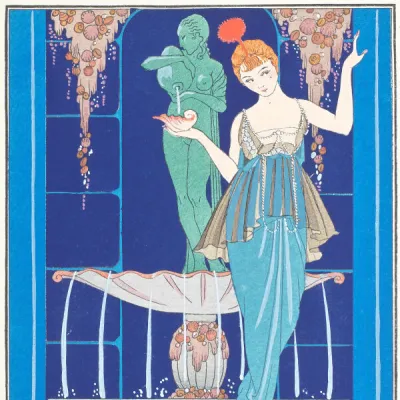
George Barbier
Human Design Chart
Biography
Barbier was 29 years old when he mounted his first exhibition in 1911 and was subsequently swept to the forefront of his profession with commissions to design theatre and ballet costumes, to illustrate books, and to produce haute couture fashion illustrations. For the next 20 years Barbier led a group from the Ecole des Beaux Arts who were nicknamed by Vogue "The Knights of the Bracelet" — a tribute to their fashionable and flamboyant mannerisms and style of dress. Included in this élite circle were Bernard Boutet de Monvel and Pierre Brissaud (both of whom were Barbier's first cousins), Paul Iribe, Georges Lepape, and Charles Martin.
During his career Barbier also turned his hand to jewellery, glass and wallpaper design, and wrote essays and many articles for the prestigious Gazette du bon ton. In the mid-1920s he worked with Erté to design sets and costumes for the Folies Bergère and in 1929 he wrote the introduction for Erté's acclaimed exhibition and achieved mainstream popularity through his regular appearances in L'Illustration magazine.
Barbier died in Paris on 16 March 1932, aged 49, at the very pinnacle of his success.
What does Generator 3/5 mean for George Barbier?
Generator 3/5 — Design at a Glance
George Barbier's design revealed a tendency towards high endurance and energy capacity. He was shown to be someone who, like a workhorse, was extremely strong – provided he invested his strength where an intrinsic impulse existed. As a Generator, George Barbier had much sacral energy that only became free when he responded to signals from life rather than initiating himself. The central mechanics of his design lay in responding from the gut: If the sacral center gave a clear 'yes', he could react through action and thus experience deep satisfaction.
If George Barbier ignored these inner signals or carried out tasks compulsively that he had no interest in, frustration would arise. His design was prone to two pitfalls: Either he wasted energy on unwanted activities, leading towards burnout, or he was kept away from his heart project although he still wanted to continue working full of power. If George Barbier did not live according to this strategy of responding, he encountered a lack of energy and persistent frustration. Only in harmony with this principle – through the response to inner impulses rather than through initiated action – could no one stop him. His fulfillment depended directly on whether he used or fought against this sacral dynamic.
Sacral Authority
George Barbier did not base his decisions on strategic planning or intellectual analysis, but on an immediate physical resonance. His design saw that he as a Generator would use the sacral authority – a decision-making instance reserved exclusively for this type and whose strategy aligned with inner guidance, simplifying the process.
This mechanism worked through a direct bodily response to external stimuli. Instead of thinking in his head, George Barbier reacted with a palpable gut feeling or sudden surge of energy. These signals often manifested as audible sounds like grunts, hums, or simple 'mmms'. As long as his emotional center was open, this physical reaction served as a reliable compass.
When his sacral motor responded to an offer, he felt vital and alive. He had access to inexhaustible energy that allowed him to complete tasks with great enthusiasm. This was not a compulsion towards performance but the expression of an innate ability to go through life with joy and satisfaction. He could immerse himself in activities without them needing to fulfill an external purpose. The joy of living itself served as an indicator for the correctness of the path taken, driven by pure pleasure in doing and the natural flow of his energy.
The 3/5 Profile — Martyr / Heretic
George Barbier was shown as someone who learned through personal experimentation and later used this knowledge to solve problems for others. His design tended towards initially being skeptical and testing everything himself before gaining authority from experience. This dynamic stemmed from his Profile 3/5, the Experimenter and Hero.
Line 3, connected with Gate 32, brought a lack of continuity and indecision. George Barbier had to experience things firsthand to understand them; failures were an integral part of his learning process. This chaotic beginning contrasted strongly with Line 5 (Gate 62), which demanded excellence and clarity in times of crisis. Here it was about chewing details until perfection before stepping forward.
The tension between the experimental failure of Line 3 and the pressure to act as a competent hero shaped his development. Only when practical experiences were gathered could he take on the role of the rescuer. This attractiveness rested on a rich treasure of lived practice that he presented to others. However, this heroic role was painful if experiments failed in public. His path lay in stepping out of the darkness of trying and offering orderly solutions once details were clear.
Split Definition — Defined & Open Centers
George Barbier's design established a massive, constant mental and energetic definition. His Head Center and Ajna Center were defined, creating a permanent internal pressure to question, form concepts, and understand connections. This unbroken thought process culminated in a defined Throat Center that reliably translated these mental impulses into communication and expression. The energy source for this lay in the defined Sacral Center, driven by the physical pressure of the defined Root Center. This created a vital basis for reaction rather than initiation: His strength did not show through hasty action from the head but through waiting on external stimuli before responding with full sacral energy. His defined G Center also gave him a firm identity and clear sense of direction independent of others' opinions.
In contrast to this stable internal architecture, open centers stood as sensitive reception antennas. The open Heart Center lacked constant willpower; it tended to prove itself through promises or seek its value in competition with others, often ending in a spiral of disappointment when the energy failed. The open Solar Plexus Center absorbed the emotional climate of his environment. George Barbier was prone to internalizing foreign moods and being swept along by emotional waves from others rather than maintaining a stable inner emotional line. Finally, the open Spleen Center reflected situational questions about health and safety. It was conditioned to seek external confirmation for well-being or warn against spontaneous decisions due to lacking reliable long-term security intuition. This openness required constant differentiation between his defined core and reflected impulses from the environment.
Channels for rhythm, resources, focus, insight and abstraction.
George Barbier revealed himself through a strong, constant presence that opened new directions for projects or people. This dynamic drew on Channel 14-2 in his personality. This channel connected the Sacral Center with Gate 14, competence in handling material resources, and the G Center with Gate 2, higher knowledge. As a 'keyholder,' he had access to essential means to transform mutative impulses into material reality. His task was to give innovative undertakings an encouraging new direction by trusting his sacral reactions – even without knowing the endpoint. Through his healthy aura and example, he initiated others and helped them find their own direction. Honesty about his own fate was crucial; pursuing external goals led to frustration, while trust in the life decisions he made mechanically reinforced others.
Alongside this mutative power, other energetic streams worked. The Channel of Structuring 23-43 connected Ajna understanding with Throat Center and allowed him to assimilate spontaneous insights (Gate 43) and express them (Gate 23). This promoted efficient, innovative thinking patterns. The Channel of Abstraction 64-47 in Head and Ajna Centers drove him to sieve experiences through a kaleidoscope of mental images to understand new perspectives and stories behind confusion (Gate 64).
Additionally, individual gates shaped his profile. Gate 32 sought continuity and tested situations for stability while performing radical changes when necessary. Gate 42 emphasized the importance of experience and closure for new commitments. Gate 62 required patience and focus on details as well as logical pattern recognition. Gate 61 searched for inner truth amidst mental noise. Gate 4 formulated logical processes for future security. Gate 59 pursued a genetic strategy of bonding and pairing. Gate 45 summed up tribal energy and expressed willpower. Finally, Gate 8 promoted individual contribution to group goals and the vitality of uniqueness.
Collective Circuitry — Circuit Signature
George Barbier's design tended towards structured identity, flanked by emotional reflection. As someone with shared definition, he did not live in a single, continuous energetic flow but navigated between two parallel power fields: a logically-strategic level and a creative-emotional sphere.
In the Understanding Circuit, his design directly connected Identity, Sacral, and Root Centers. This created a stable basis for rational strategy and focus driven by rhythm (Channel 15-5) and concentration (Channel 9-52). Here he worked with clear, emotion-free logic to improve structures or look into the future.
Parallel to this existed the Knowledge Circuit as a separate system. It connected Ajna with Throat Center (Channel 43-23), allowing him to structure thoughts and express them acoustically. A second, unconnected part of this circuit included Identity and Sacral Centers (Channel 2-14), carrying his innate beat and individual transformation. These two parts did not flow into each other; they were separate expressions of his individuality.
The Meaning Circuit rounded the picture by connecting Head and Ajna Centers (Channel 64-47). This promoted the ability to abstractly process past experiences and emotionally reflect on them. While the Understanding Circuit looked into the future, this circuit established meaning from the past. George Barbier thus moved between strategic clarity, creative expression, and emotional learning – always as separate but coexisting forces.
Right Angle Cross of Maya 3
George Barbier's design carried the structural element of the 'Right Maya 3 Cross'. This configuration marked a specific architectural feature within his Human Design chart, which was a fixed part of his energetic map. Since no additional mechanical details or accompanying events were specified in the raw content, this designation remained the sole identifiable characteristic of this aspect. It served as a neutral anchor point in the analysis without deriving any specific behavioral patterns, emotional tendencies, or practical life impacts from it. The cross thus stood for a structural fact that was part of his individual constellation but did not receive descriptive mechanics to fill its content. It was an identified element present in the overall view of his design, yet due to the lack of explanations in the available material, no further interpretation could be made. George Barbier possessed this structure; it was part of his chart configuration. Without additional information about gate interactions or center involvements, the function of this cross could not be elaborated further. It remained a pure identifying feature that confirmed its presence in his design without describing its impact on George Barbier's daily life. The analysis therefore limited itself to establishing the existence of this element as part of his individual Human Design map.
Saturn Return · Uranus Opposition · Chiron Return — Life Cycles
George Barbier's life followed a clear cyclical structure, marked by two decisive turning points. His design showed that the first Saturn Return signified the transition from preparation to established professional existence. In 1910, at the age of 28, he received his first vernissage in Salon des Humoristes under the pseudonym Édouard William Larry. This was no coincidence but a typical expression of this cycle: after about 29 years, long-term efforts and internal maturation processes solidify into a viable public form. His career did not begin as a sudden impulse but rather as the result of years of inner consolidation now manifesting outwardly.
The end of his life coincided with the Chiron Return, a period between ages 49 and 51 in Human Design, considered a phase of fulfillment and bloom of one's incarnation purpose. In 1932, George Barbier died in Paris at exactly age 50. This cycle often concludes the material or visible unfolding of a life design. His death here underscores the intensity and completion of this final great arc in his design. It marked the end of a lifespan where the essence of his design had fully unfolded. The Chiron Return is not a time for healing past wounds but rather the last peak of meaning-making and realization of what life offered. Both cycles – entering professional life and the end of life – framed his active creative phase and gave it a clear form dictated by his design.
Generator · Sacral Authority — Synthesis
George Barbier was a Generator, whose life was marked by the profound ability to generate energy through reaction and transform this into creative work. His defined Sacral Center formed the core of his vitality, while the connection to the G Center provided a clear identity and direction – he found fulfillment in expressing his unique vision and leaving a lasting impression through his work. The focus (Channel 52-9) and beat (Channel 14-2) reinforced this ability by enabling him to concentrate on details and bring innovative impulses into the world. His defined Root Center provided steady drive, while the defined Head and Ajna Centers fostered an inspiring thought process.
A central paradox in George Barbier's design lies in the interplay of constancy and mutation. On one hand, he was oriented towards a clear identity and direction through his defined G Center, an anchor point for his creative work. On the other hand, the connection via Channel 14-2 points to a drive towards innovation and change – a constant striving for new forms of expression that drove him to question conventions and forge new paths. This tension between holding onto roots and being willing to reinvent himself seems to have significantly shaped his artistic development.
5 Defined Channels
Incarnation Cross - Right Angle Cross of Maya 3
Solar Return
The Solar Return shows the moment when the sun returns to its exact birth position - your personal solar year.
Life Cycles
Discover the life cycles with a detailed triple view (birth chart, cycle chart, composite).
Human Design Profile
- Type
- Generator
- Strategy
- To respond - wait for something to respond to
- Authority
- Sacral Authority
- Profile
- 3/5 - Martyr / Heretic
- Definition
- Split Definition
- Incarnation Cross
- Right Angle Cross of Maya 3
- Date of Birth
- 16.10.1882 14:30
- Place of Birth
- Nantes, France
Frequently Asked Questions
What was George Barbier's Human Design type?
What profile did George Barbier have?
Which authority guided George Barbier?
What incarnation cross did George Barbier have?
When was George Barbier born?
Discover your own Human Design
Are you also a Generator? Find out in a personal reading how to use your sacral energy correctly and discover deep satisfaction.
More Personalities
Back to overviewAaliyah

Alain-Fournier

Alexia

Angèle

Angeli

Anne-Marie
