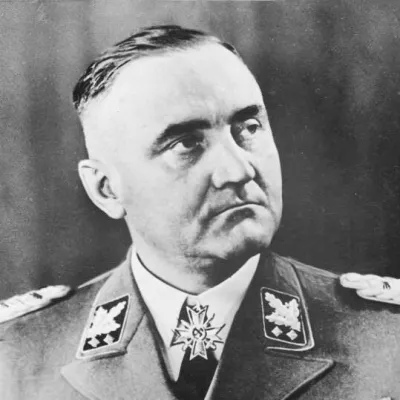
Gottlob Berger
Human Design Chart
Biography
Died on 5 January 1975.
The Human Design of Gottlob Berger: Projector 4/6
Projector 4/6 — Design at a Glance
Gottlob Berger revealed himself as someone with sharp, focused perception that immediately identified system inefficiencies and weaknesses. His design described him as a Projector whose aura acted like a bright flashlight: It illuminated precisely those areas in his environment that were still in the dark or not functioning optimally. This ability to recognize errors in the system instantly was his natural instrument for guiding others and providing clarity.
However, this intense penetration required a specific approach. Since Projectors do not have a constant intrinsic energy source but work in phases, Gottlob Berger had to conserve his strength. The direct, unmitigated confrontation with the flaws he discovered would often be felt by his environment as overpowering or aggressive – comparable to shining bright light directly into someone's face. This would quickly provoke resistance and anger rather than cooperation.
Therefore, the strategy of his design lay in waiting for an honest invitation. By obtaining this, he could convey his insights respectfully without getting into conflicts or exhausting himself. Living by this pattern rewarded him with success and made him attractive to his environment. If he missed this path and tried to impose his viewpoint against resistance, it would sooner or later lead to bitterness as an expression of his non-self. His influence was thus most effective when exercised at the request of others.
Self-Projected Authority
Gottlob Berger revealed himself as a Projector with rare authority in self. This configuration shaped a particular openness that made him vulnerable to distraction by external motoric energies. The greatest danger lay in losing himself in this receptivity and constantly seeking external energy.
His inner truth resided in his identity. Decision-making occurred through two pathways. First, spontaneous self-talk or dialogue when invited to do so. Crucial was listening: He had to distinguish whether it was his self or his mind speaking. What was spoken spontaneously without reflection expressed his true essence and made his uniqueness recognizable to others.
Secondly, a physical feeling that drew him geographically or thematically towards something or repelled him. By recognizing and following this direction, he could become a guide for others. There lay his specific potential for success. The mechanics emphasized the necessity of trusting inner guidance rather than being led by external impulses. This structure defined how he became effective in life: through authentic expression and physical resonance, not through intellectual analysis or adaptation to foreign expectations.
The 4/6 Profile — Opportunist / Role Model
Gottlob Berger's design laid out a developmental line that ran from experimental network-building in youth to wise distance and role modeling in old age. As a person with Profile 4/6 (Networker/Role Model), he was marked by the inner conflict between the Heart desire for belonging and cooperation, and the Head desire for withdrawal, reflection, and higher purpose.
During his first thirty years, Line 6 still acted like Line 3; Gottlob Berger therefore enjoyed experimenting a lot, particularly in relationships and friendships. Once Line 6 became active, he frequently experienced the contradiction between wanting to belong to a community and needing to withdraw to think about life's meaning. His life thus revolved around this conflict of Heart versus Head, which could be confusing.
The mechanics required a slow process: Line 4 needed time for asceticism and ordering details before opening up. It was crucial that Gottlob Berger had ordered these details before expressing them; pulled out of the ascetic phase too early, it would have necessitated corrections. Simultaneously, Line 6 had to learn to distill abstract wisdom from personal experiences and make it accessible to others. In later years, he was expected to meet the high standards of a wise role model through cooperation while protecting the 'big heart' of Line 4 from false attachments, all while fulfilling the expectations of a wise exemplar.
Single Definition — Defined & Open Centers
Gottlob Berger was characterized by a constant, independent mental presence and a firm inner identity. His design featured four defined centers: Head, Ajna, Throat, and G Center. This configuration created a persistent mental pressure to question and form concepts, coupled with clear but limited expressive power and a stable sense of direction. He had a reliable way of thinking and communicating, along with a deep feeling of self-love and connectedness.
This stood in stark contrast to his five open centers: Heart, Sacral, Solar Plexus, Spleen, and Root. The lack of definition meant he did not have constant energy for willpower, vital endurance, emotional stability, spontaneous intuition, or stress resistance. Instead, he took these energies situationally from the environment and amplified them. His open Heart Center made him vulnerable to the pressure to prove his worth; his open Sacral Center led him to take on foreign energy, which tended towards exhaustion. The open Solar Plexus Center absorbed external emotions, while the open Spleen Center promoted survival fears and a search for external security. The open Root Center took stress from the environment, leading to a feeling of pressure that he did not generate himself.
The dynamics of his design lay in the tension between this inner mental firmness and outer energetic permeability. The mental pressure of his defined head chain challenged him to question without directly projecting them, as there was no motor connection. Simultaneously, the open centers required discipline to avoid conditioning: he had to learn not to try proving his worth through promises (Heart), not to identify foreign energy as his own (Sacral), not to personalize emotional waves (Solar Plexus), not to cling to unhealthy dependencies out of fear of survival (Spleen), and not to misinterpret external stress pressure as personal drive (Root). His challenge was to accept the mental pressure and use his open nature as a mirror of the environment rather than interpreting it as a lack of will or energy.
Channels for inner truth, creative expression and logical order.
Gottlob Berger revealed himself through a duality of intuitive inspiration and analytical logic. His design dictated that he should act by example while simultaneously structuring complex information for communication. The Inspiration Channel 1-8 connected his G Center with his Throat Center, meaning his impact was not primarily achieved through words but rather by living and demonstrating his individual identity to inspire others to express their unique essence. This kind of leadership required patience in timing as well as recognition of his contribution since he lacked built-in social adaptability.
Parallel to this, the Accepting Channel 17-62 organized his mental world. This channel connected his Ajna Center with his Throat Center and kept him constantly engaged in ordering details into a logical system. Gate 17 visualized patterns while Gate 62 translated and named them through speech. Gottlob Berger had an ongoing pressure to precisely explain his opinions and what he understood or did not understand. He could only truly grasp information when he integrated it into his own mental picture. This ability to convert detailed visual patterns into language provided a foundation for knowledge transmission, assuming he waited for the right timing and receptivity of his listeners to avoid resistance. Both channels shaped his expression: once through authentic presence as an example, and again through logical structuring of communication.
Individual Circuitry — Circuit Signature
Gottlob Berger's design combined pulsating emotional creativity with focused, emotionless ratio. This mechanism allowed him not only to generate new insights but also to strategically prepare and clearly express them. In simple terms, he had a continuous energetic flow between Head, Ajna, Throat, and Identity Centers. This created a direct line from inspiration through logical processing to the verbal manifestation of his unique identity.
The Knowledge Circuit was marked by two separate segments in him: The first connected the Head with the Ajna Center, transforming impulsive flashes into concentrated thoughts. The second segment linked the Throat with the Identity Center (Channel 24-61
Right Angle Cross of Maya 2
Gottlob Berger exhibited a fundamental disposition marked by the right cross of Maya 2 in Human Design. This configuration points to a profound connection between material daily life and spiritual or higher values. People with this design tend to invest their life energy into areas that yield practical results while also fostering a greater purpose. It is not about abstract philosophy but rather anchoring ideals in concrete action.
The right cross of Maya 2 emphasizes the integration of economic efficiency and ethical responsibility. Gottlob Berger lived this dynamic by attempting to use his resources not only for personal benefit but also to serve the common good. This orientation often led to a careful weighing between profit-seeking and moral imperatives. His design suggested that true fulfillment lay in connecting material security with a sense of belonging to something greater.
Without specific events in the raw content, the description remains limited to this general mechanical tendency. Gottlob Berger was someone who sought ways throughout his life to use his material opportunities in service of higher principles. This tension between the concrete and the transcendent shaped his actions and decisions profoundly.
Saturn Return · Uranus Opposition · Chiron Return · 2nd Saturn Return — Life Cycles
Gottlob Berger's life followed a clear structure defined by four planetary turning points that shaped his development. At 25 years old, with Saturn Return in 1921, he solidified his private foundation through marriage and the birth of four children. This cycle marked the building of stable foundations for further life.
Ten years later, at age 40 and Uranus Opposition in 1936, a radical change occurred: Berger joined the SS as an SS Oberführer. This phase required a system-conforming career leap characterized by sudden change and adaptation to new structures.
The Chiron Return cycle at 49 years old led to the flowering of his incarnation purpose. In April 22, 1945, Berger met Hitler for the last time in the Führerbunker. This moment represented the culminating, fateful encounter where his life path fully unfolded and his role within the system reached its peak.
The second Saturn Return at age 55 finally brought legal correction. In 1951, Berger's sentence was reduced to ten years. This cycle caused an existential reordering in which the consequences of previous actions were legally solidified and life was restructured anew. Each of these cycles showed itself as a decisive moment of formation or transformation of his reality.
Projector · Self-Projected Authority — Synthesis
Gottlob Berger's chart reveals a life dynamic profoundly marked by the interplay of mental clarity and emotional openness. As a Projector with defined Head, Ajna, and Throat centers, he possessed an acute ability to recognize patterns and express them verbally (Channel 17-62). This correlated with an inner necessity to filter and interpret the world through his unique perspective (Gate 61/43), which gave him a role as observer and potential guide. The connection of Head and Ajna centers indicates a constant mental pressure driving him to understand things and share his insights – a process channeled by the definition in Throat center.
However, this mental sharpness stood in tension with undefined Solar Plexus and Root centers. His openness to others' emotions (Solar Plexus) as well as vulnerability to external influences and stress (Root) carried the risk of losing himself in environmental energies and making decisions based on foreign conditioning. This dynamic created a paradox: Gottlob Berger was both predestined to convey clarity and insight while also vulnerable to emotional confusion and external pressure – a tension reflected in documented events of his life where clear decisions were entangled with complex circumstances.
3 Defined Channels
Incarnation Cross - Right Angle Cross of Maya 2
Solar Return
The Solar Return shows the moment when the sun returns to its exact birth position - your personal solar year.
Life Cycles
Discover the life cycles with a detailed triple view (birth chart, cycle chart, composite).
Human Design Profile
- Type
- Projector
- Strategy
- Wait for the respectful invitation
- Authority
- Self-Projected Authority
- Profile
- 4/6 - Opportunist / Role Model
- Definition
- Single Definition
- Incarnation Cross
- Right Angle Cross of Maya 2
- Date of Birth
- 16.07.1896 12:00
- Place of Birth
- Gerstetten, Germany
Frequently Asked Questions
What was Gottlob Berger's Human Design type?
What Profile did Gottlob Berger have in Human Design?
What Authority did Gottlob Berger possess?
What incarnation cross did Gottlob Berger have?
When was Gottlob Berger born?
Discover your own Human Design
Are you also a Projector? Find out in a personal reading how to unfold your leadership qualities and recognize the right invitations.
More Personalities
Back to overviewSissy Spacek

Alain-Fournier

Anémone

Ann-Margret

Bourvil
Hergé