Gustav Krupp Von Bohlen
Human Design Chart
Biography
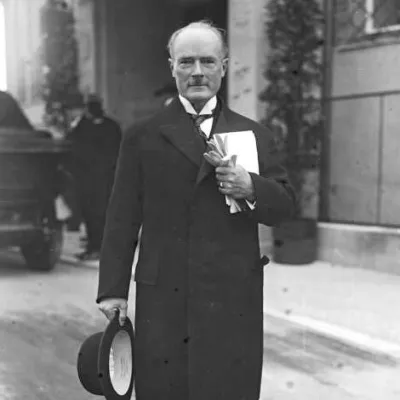
Born in The Hague into a German family with a long history in diplomatic service, Gustav von Bohlen und Halbach was the Prussian consul at the Vatican when he married Bertha Krupp, the heiress of the Krupp family, at the behest of Emperor Wilhelm II. He was allowed to add the Krupp name to his own and subsequently became chairman of the company. Under Krupp, the company had a near monopoly in heavy arms manufacture in Germany at the outbreak of the First World War, and was responsible for the production of Big Bertha, the Paris Gun and the U-boat.
Krupp took part in the German rearmament in secret shortly after the signature of the Treaty of Versailles. An avowed monarchist, he was initially opposed to the Nazis, but eventually became a fervent supporter of Adolf Hitler and offered significant financial support for the NSDAP. From the late 1930s on he was gradually reduced to a figurehead of the company due to deteriorating health, and in 1943 he was formally succeeded by his son.
Gustav Krupp Von Bohlen as a Manifesting Generator 2/4 in Human Design
Manifesting Generator 2/4 — Design at a Glance
Gustav Krupp von Bohlen was someone who possessed a hybrid energy configuration: the constant power of a Generator combined with the lightning-fast alignment of a Manifestor. His design gave him the ability to skip steps and quickly pull things into his life, but this came with two specific pitfalls. Often he acted too quickly, skipped necessary intermediate steps, and found himself having to backtrack to complete them – a process that easily led to frustration, the central suffering path for this type. Additionally, he tended to pursue multiple projects simultaneously by reacting to numerous impulses without inner consent, which soon turned his creative drive into overexertion.
The solution lay in waiting for the 'yes' signal from his Sacral Center despite this high speed. Only when his internal compass confirmed direction could he effectively use his quickness. With the correct strategy – that is, reacting rather than initiating and constantly checking inner consent – Gustav Krupp von Bohlen found deep satisfaction in creation. Parallelism was no barrier for him but a source of variety and fun. He entered into a 'play mode' where work did not appear as duty but as dynamic engagement that energized him instead of draining.
Sacral Authority
Gustav Krupp von Bohlen based his decisions on an inner, physical resonance rather than intellectual planning. His design saw the Sacral Authority as the central decision-making source, which is specific to the Generator type. This configuration simplified the process of choice since strategy and inner guidance were identical: waiting for external stimuli.
The mechanics required patience. Gustav Krupp von Bohlen did not react proactively but waited for signals from his body – a grunt, an 'mm-hm', or a noticeable surge of energy in the abdominal area. These physical feedbacks confirmed an authentic connection to the subject at hand. Once the sacral motor kicked in, vital energy was available to him. He then tackled tasks with great enthusiasm and immersed himself fully into the activity, free from constant purposefulness.
The open Emotional Center was a necessary prerequisite for this functionality. It ensured that no impulsive, emotionally driven missteps would overshadow the clear physical impulse. Through waiting for the right resonance, Gustav Krupp von Bohlen could efficiently unleash his energy and walk through life with satisfaction. The dependence on external triggers protected him from exhaustion since he only acted when his system truly said 'yes'. This was not passive behavior but an active discipline of waiting for the right moment of confirmation.
The 2/4 Profile — Hermit / Opportunist
Gustav Krupp Von Bohlen exhibited a cyclical tension between the urgent need to withdraw for internal clarification and the desire to connect with his familiar community. His design as Profile 2/4, the Natural Talent Networker Profile, dictated that he had to unfold energy not linearly but in waves. First, he withdrew to reflect on internal processes and evaluate knowledge from his network. Only after this phase of solitude was completed did he actively re-enter the social space.
This dynamic required clear communication of his availability limits. He needed to make it explicit when he sought company and when he wanted to be undisturbed. Through this transparency, his environment became a safe base that allowed him to swing between solitude and community without being misunderstood as rejection. In his 'Me-Time', he delved into himself, created clarity, and developed new ideas from the reflection of network knowledge. Line 2 challenged him to recognize leadership abilities in the context of democracy and election processes, while line 4 emphasized discretion and the right timing for directional changes. Gustav Krupp Von Bohlen thus lived in a constant oscillation that enabled brilliant ideas to emerge from the synthesis of inner depth and social connection.
Split Definition — Defined & Open Centers
Gustav Krupp von Bohlen presented himself as a personality of massive, constant presence. His structure was characterized by six defined centers: Ajna, Throat, G Center, Heart, Sacral, and Root. This configuration created a highly self-determined, energetic, and willful aura with clear identity and persistent mental activity. His energy was not situationally dependent but structurally firmly anchored.
The defined Sacral Center provided him with a constant vital energy source experienced as an inner hum or restlessness. This power was available for work and activities to which he responded. The also defined Heart Center gave him willpower and ego strength; he preferred to determine his life himself, keep promises, and seek recognition for his contribution. The connection to the G Center gave him a firm self-identity and a sense of direction as well as the ability to show others new paths. Through the defined Ajna and Throat Centers, he articulated his concepts and opinions consistently as an external authority; his mind was always active, and he spoke out what he thought or wanted. The defined Root Center generated a constant physical pressure that propelled him forward and helped him deal with stress.
In contrast, Head, Solar Plexus, and Spleen Centers were open. The open Head Center made him vulnerable to external inspiration or mental pressure; he tended to get entangled in questions that were not his own instead of trusting inner authority. The open Solar Plexus Center absorbed emotions from the environment, leading to the risk of personalizing foreign moods and making emotional decisions that he later distanced himself from. He often sought ways to avoid confrontation to prevent triggering emotional waves. The open Spleen Center carried a fundamental survival fear; he was sensitive to a lack of well-being and tended to cling to people or situations with defined Spleen energy for a sense of security, even if these bonds were not healthy. Spontaneous decisions from this center were risky for him as they often relied on conditioned fears.
Channels for inspiration, curiosity, pioneering spirit and maturation.
Gustav Krupp Von Bohlen appeared as a creative individual who attracted attention through authentic presence and bold self-presentation. His design presented him as a storyteller and seeker, sharing new perspectives but also possessing competitive power that drove others towards individuation.
Channel of Inspiration 1-8 connected the G Center with the Throat Center. This created an individual entry for transformative perspectives and contribution to the group. Gustav Krupp Von Bohlen lived his unique identity rather than explaining it. Through this exemplary life, he inspired others to express their own uniqueness. He drew attention by showing courage to stand out from the crowd.
Channel of Curiosity 11-56 connected the Ajna Center with the Throat Center. Here he constantly sought new ideas and perspectives. As a storyteller, he linked philosophical considerations to life parables that taught or entertained listeners. His stories served not just for factual transmission but stimulated imagination and emotions in the audience.
Channel of Initiation 51-25 connected the Heart Center through shock with the spirit of self. This competitive energy drove him to be first or win. He recognized potential for individuation in others and, when invited, provided the necessary impulse for their development. His personal success served as a model to encourage others to live out their own uniqueness.
Additionally, Gate 7 (Leadership) and Gate 13 (Purpose through Experience) shaped his profile. Gate 2 emphasized receptivity to new directions. Gate 54 connected worldly success with spiritual development while Gate 26 showed the ability to accept innovations within the family. Gate 29 promoted perseverance and a yes-saying to life. Gate 39 provided fuel for mutation through provocation and analysis. Gate 52 required pauses for pattern correction. Gate 45 represented the clan level and willpower. Gate 23 enabled amoral understanding and assimilation. Gate 16 fostered mastery through experimentation. Gate 27 brought caring warmth into activities. Gate 62 provided logical details and pattern recognition.
Individual Circuitry — Circuit Signature
Gustav Krupp Von Bohlen exhibited a basic attitude characterized by inner firmness: strong convictions and a solid self-image, yet not necessarily pushing outward. This resulted from the Centering Circuit, which in him connected Identity and Heart Centers. This configuration promoted courage and individuality ("I am who I am"), but lacked direct connection to Throat Center, often making it difficult or inwardly directed to express these firm convictions.
Parallel to this, the Knowledge Circuit worked through the Inspiration Channel (Gates 1-8). It connected the Throat Center with the Identity Center and drove the urge to go new ways and initiate change through inspired impulses. Here was shown the ability to creatively express one's own individuality driven by sudden inspirations.
A third aspect was the Purpose Circuit, which worked in two separate parts: On one hand, it connected Ajna and Throat Centers (Curiosity), on the other hand Sacral and Root Centers (Maturity). This configuration directed energy towards reflecting past experiences. Gustav Krupp Von Bohlen sought meaning behind events to gain emotional insights that could be shared with others – a process of maturation through collective learning from the past.
The Shared Definition emphasized the tension between these parallel forces: on one hand, inner centering and identity sense, on the other hand situational drive for external transformation and emotional processing of the past.
Right Angle Cross of the Sphinx 3
Gustav Krupp von Bohlen carried the right cross of the Sphinx, a configuration that profoundly shaped his identity and life purpose. This design created a dynamic tension between a strong desire for deep connection and trust versus a fundamental skepticism towards the world. It was less about active behavior than an inner attitude towards life characterized by this paradoxical nature.
Cross 3 connected a deep longing for intimacy and security with an instinctive defensive stance. This mechanism described a central life task: solving the internal puzzle of how to give trust without betraying or harming oneself. For Gustav Krupp von Bohlen, it meant constantly dealing with this dual energy. On one hand, he yearned for closeness and comfort; on the other, natural distance served as a protective mechanism. This configuration suggested that his path lay in finding balance between openness and reserve. It was an ongoing process of self-reflection aimed at maintaining personal boundaries while also allowing space for genuine relationships. The challenge was to reconcile these seemingly contradictory forces and thus lead an authentic existence that both protected him and allowed connection.
Saturn Return · Uranus Opposition · Chiron Return · 2nd Saturn Return — Life Cycles
Gustav Krupp von Bohlen's design shaped structural power takeovers, always strategically adapted to political constraints. This dynamic became evident in 1909: at the age of 39, he became chairman of the board of directors of his company. This step marked his first Uranus Return, a cycle often characterized by sudden breaks or new authority structures and here led to formal leadership takeover.
Ten years later, in 1920, a deeper level of development came into play: the Chiron Return at age 50. During this phase of inner maturation, Krupp secretly participated in German rearmament following the Treaty of Versailles. This cycle signals not healing but the unfolding of one's life purpose; here it expressed itself as strategic adaptation to extreme external restrictions to secure the company and restore operational capacity.
Consolidation of these structures occurred in 1924 with his second Saturn Return at age 54. Krupp became president of the board of directors of the Bank for German Industrial Bonds (Dawes Bank). The second Saturn Return condenses long-term commitments and institutional responsibility. Through this position, he not only strengthened the financial base but anchored the company sustainably in the new economic realities of post-war times, underscoring his ability to maintain structure under pressure.
Manifesting Generator · Sacral Authority — Synthesis
Gustav Krupp von Bohlen moved through life as a hybrid of an Initiator and Reactor. His design as a Manifesting Generator, fueled by a defined Throat and Heart Center along with Sacral authority, points to someone who both had the capacity to set things in motion and was deeply rooted in the present moment and inner reaction. This combination allowed him to move forward with energy and determination while being guided by gut instinct – a dynamic interplay between willpower and intuitive wisdom. The defined identity (G Center) underscored the need for authentic action and clear direction, evident in events like his assumption of leadership roles.
A central paradox lay in the tension between his ability to initiate quickly and the need to respond to impulses. His design indicated that while he could accelerate things, there was a risk of skipping important steps or getting bogged down in too many projects. The connection of defined Throat and Sacral centers implies strong expressive power, modulated by oscillation between solitude (Line 2) and community needs (Line 4) – an ongoing shift between inner reflection and exchange with others.
4 Defined Channels
Incarnation Cross - Right Angle Cross of the Sphinx 3
Solar Return
The Solar Return shows the moment when the sun returns to its exact birth position - your personal solar year.
Life Cycles
Discover the life cycles with a detailed triple view (birth chart, cycle chart, composite).
Human Design Profile
- Strategy
- To respond - wait for something to respond to
- Authority
- Sacral Authority
- Profile
- 2/4 - Hermit / Opportunist
- Definition
- Split Definition
- Incarnation Cross
- Right Angle Cross of the Sphinx 3
- Date of Birth
- 07.08.1870 06:00
- Place of Birth
- The Hague, Netherlands
Frequently Asked Questions
What is the Human Design type of Gustav Krupp Von Bohlen?
What Profile did Gustav Krupp Von Bohlen have?
What Authority guided Gustav Krupp Von Bohlen?
What incarnation cross did Gustav Krupp von Bohlen have?
When was Gustav Krupp von Bohlen born?
Discover your own Human Design
Are you also a Manifesting Generator? Find out in a personal reading how to unfold your multi-talents and direct your energy wisely.
More Personalities
Back to overviewAldair

Alizée

Angeli

Arletty

Artus

Balthus