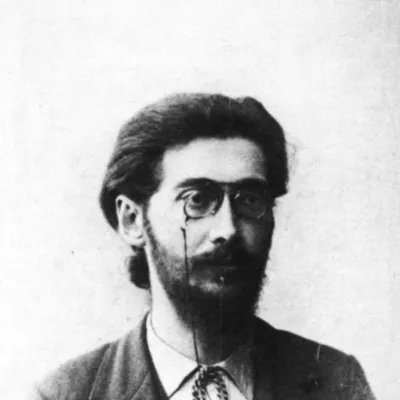
Gustav Landauer
Human Design Chart
Biography
As a student he joined the German Social Democratic Party (SPD). Due to his political activities, which led to a spell in prison, he was refused entrance to the School of Medicine at Freiburg University. Because of his extreme views, he was also one of a small group who were expelled from the SPD in 1891.
By age 21 he became the editor of a journal, The Socialist. Despite its name, Landauer espoused an anarchist philosophy that he learned and adapted from the French thinker, Pierre Proudhon and the Russian thinker, Peter Kropotkin. In 1893 and again in 1899, Landauer was imprisoned for acts of civil disobedience, serving a total of 17 months.
He continued to develop his non-violent revolutionary ideology in the years before to World War I and influenced Jewish intellectuals in search of libertarian solutions, including Ernst Bloch (see essay on Bloch), Gershom Scholem, Walter Benjamin and Martin Buber. He became a close friend of Martin Buber, who introduced him to Hasidic legends that appeared to fulfill his vision of an egalitarian society.
After the City of Munich was reconquered by the German army and Freikorps units, Gustav Landauer was arrested on 1 May 1919 and stoned to death by troopers one day later in Munich's Stadelheim Prison.
What does Manifestor 3/5 mean for Gustav Landauer?
Manifestor 3/5 — Design at a Glance
Gustav Landauer had the design of a Manifestor. This configuration established him as a pioneer and visionary whose task was to lead the world into a new future. His chart described a nature similar to an emperor in ancient Rome: He possessed the vision of a great whole but did not wage the necessary wars and battles himself; instead, he sent others to conquer foreign lands for him.
This architecture brought with it a specific pain point: Gustav Landauer was misunderstood and polarized his environment. Because he often thought further ahead than others, he encountered extreme reactions. Some people loved him because of his great dreams and found followers in him; others did not like or even hated him precisely because of these huge visions.
To find the right following, it was crucial for his design to inform others about his visions early and accurately. This formed his ideal strategy. If Gustav Landauer had followed this strategy and trusted his authority, he would have been rewarded with a feeling of inner peace. Living against this design, however, he likely felt a persistent, deep anger within himself. His chart thus depicted a person who worked effectively through information rather than direct confrontation and whose internal alignment was strongly shaped by dealing with misunderstandings and rejection.
Splenic Authority
Gustav Landauer showed an immediate, intuitive orientation towards his own health and well-being. His inner authority lay in the defined Spleen Center, meaning he did not make decisions through prolonged thinking or emotional weighing but rather through a spontaneous impulse of survival instinct. This center functioned as a fine alarm system; it signaled to him immediately whether a situation, environment, or person was useful or harmful for him.
For this spleen authority to be effective, his Emotional and Sacral Centers were open. This configuration did not allow him to trust long-term plans or emotional waves but forced the highest vigilance in the present moment. The first impulse was the only reliable guide. Landauer therefore had to rigorously distance himself from harmful influences and maintain much flexibility, as the right choice often changed short-term. Long-term commitments were difficult for his design, as they blocked the spontaneous adaptation process. He lived in the necessity of grasping the fine impulse in the moment before it was drowned out by other voices. Retreat served him as a tool to restore this clear signal effect and protect himself optimally.
The 3/5 Profile — Martyr / Heretic
Gustav Landauers' design leaned towards heroic experimentation. He appeared as someone who initially had little preconceived opinion and instead had to try everything for himself. This attitude stemmed from his third-line energy: it drove him through the trial-and-error process, spontaneous adaptation in shock situations, and courage to continue even after failures. Through these practical experiences, he gathered a rich treasure of life wisdom.
These self-acquired knowledge then became effective as help for others. His fifth-line energy conveyed generosity – the ability to offer practical solutions during crises without fearing negative consequences. Gustav Landauer presented his insights to those who wanted to learn from his experiences. This role of helper and storyteller flattered him naturally very much. Yet it could also be painful when he tried things in public and failed. Recognition for his work was crucial for his well-being. His Profile 3/5 described him as a humorous rebel who gained knowledge through personal experience and passed it on to solve others' problems.
Split Definition — Defined & Open Centers
Gustav Landauers Design created a tendency towards constant mental pressure and conceptual clarity. The definition between the Head Center and Ajna Center created a perpetual impulse to question and understand connections. This mental process was always active; he thought continuously, independent of external stimuli. This energy flowed further into the defined Throat Center, translating his conceptual thoughts directly into speech and communication. He spoke what his mind formed, giving him a reliable yet limited form of expression.
In addition to this cognitive structure, defined G Center and Heart Center shaped his essence. The G Center gave him a firm sense of self-identity and a clear sense of direction. He knew who he was and where he stood without having to rely on others. The defined Heart Center also provided willpower and ego strength. He could keep promises and use this energy to pursue his goals and control resources. His Spleen Center was also defined, giving him an intuitive, momentary perception of health and well-being.
In contrast, open Sacral, Solar Plexus, and Root Centers were evident. The open Sacral Center meant he did not have a constant supply of generative life energy. He was prone to absorbing the energy from his environment and amplifying it, which could easily overwhelm him. The open Solar Plexus Center allowed him to absorb emotions from the environment; he tended to interpret these foreign feelings as his own, potentially causing internal confusion. Additionally, the open Root Center took on external stress and adrenalized pressure. He was not designed to generate or sustain this constant drive himself over the long term. Instead, he had to learn to distinguish between his own and others' pressures to avoid exhaustion. His strength lay in clear conceptualization and willful implementation of his inner direction, not in inexhaustible physical endurance or emotional stability from his own energy sources.
Channels for intuitive form, curiosity, power and awareness.
Gustav Landauer revealed himself as someone whose actions were marked by a deep intuitive adaptability. His design connected the Spleen and G Centers through the Channel of Perfect Form 57-10. This connection allowed him to react to the acoustic quality of his environment—he heard more in tonalities than in words. This created spontaneous clarity, enabling him to move through the world existentially unburdened and secure his survival in the present moment through authentic behavior.
Parallel to this, the Channel of Curiosity 11-56 between Ajna and Throat Centers influenced Gustav Landauer to constantly seek new ideas and retell them as stories or parables. His focus was less on dry facts and more on stimulating and teaching others through imaginative storytelling.
Another influence came from the Channel of the Money Line 21-45, connecting Heart with Throat Center. Here, a strong will to control material resources for his "tribe" was evident. Gustav Landauer had to take responsibility while maintaining autonomy to avoid exhaustion. This channel challenged him to find balance between the desire for power and the necessity of service to others.
Mentally, he was structured by the Channel of Awareness 61-24, linking Head with Ajna Center. This did not mean logical analysis but rather waiting for sudden insights (Satori). His mind sought silence to process inspirations that lay beyond rational patterns.
Additionally, Gates like 54 and 51 contributed to seeing worldly success as a prerequisite for spiritual development, while Gate 53 enabled him as a pioneer to forge new paths. Gate 62 in Personality supported this through patient detail work and pattern recognition to logically organize facts.
Individual Circuitry — Circuit Signature
Gustav Landauers design points to a tendency towards isolated, disconnected energetic streams, characterized by his Split Definition. This meant that various aspects of his experience existed in parallel without directly overlapping each other. His Knowledge Circuit connected the Head Center with the Ajna Center. Here it was about awareness and the expression of a unique identity through innovative flashes of insight. A separate piece formed with the Meaning Circuit, which linked the Ajna Center to the Throat Center. This stream served to reflect on past experiences and emotions and share these insights with others. Another independent flow emerged in the Ego Circuit through the connection between Throat Center and Heart. Here the accumulation of resources and mutual support were key, while pauses for regeneration were necessary. Finally, the Integration Circuit connected his Identity with the Spleen Center. This channel channeled power from reactions to life through intuitive knowledge and correct behavior, making it effective in the present moment. These four separate streams – Head-Ajna, Ajna-Throat, Throat-Heart, and Identity-Spleen – did not form a single cohesive experience for Gustav Landauer but rather acted as independent, coexisting forces in his life.
Right Angle Cross of Penetration 1
Gustav Landauer's design indicated a tendency towards deep, often painful inner work. He was someone who sought an intense confrontation with his own shadows and wounds throughout life, not to overcome them but to understand their transformative power. This attitude stemmed from the configuration of the right cross of penetration 1 in his chart.
This specific orientation describes a process where external experiences and internal conflicts served as necessary tools for self-discovery. Gustav Landauer used the friction and tensions of his existence to establish a more authentic connection with himself. It was not about passive suffering but an active, often arduous integration of pain into his self-image.
The mechanics of this cross suggest that true growth for him could only be achieved through direct confrontation with unpleasantness. Surface-level solutions or quick fixes were in opposition to his inner structure. Instead, he sought depth, even when it was associated with pain. His willingness to face the darker aspects of himself shaped his entire life and understanding of truth and humanity. It was a path of constant penetration of personal boundaries to develop an unbreakable inner integrity.
Saturn Return · Uranus Opposition · Chiron Return — Life Cycles
Gustav Landauer's design indicated profound turning points that were often accompanied by a search for stability and partnership. This became evident in 1899, at the age of 29: With his first Saturn return, years of internal work crystallized into a clear life step. Landauer met Hedwig Lachmann, who would become his second wife; both decided to stay longer in England. This cycle marked the transition from searching for stability to forming a firm bond and building a new life foundation abroad.
Later, in 1919, at age 49, he reached his Chiron return. In Human Design mechanics, this is a fulfillment cycle where the incarnation cross – if strategy and authority are observed – fully unfolds and the purpose of life becomes tangible. For Landauer, this peak of inner maturity coincided with his murder. The design shows no healing in a medical sense but rather absolute completion of his personal path; his death was the final expression of this cycle, revealing his existence in its ultimate consequence.
Manifestor · Splenic Authority — Synthesis
He was a Manifestor whose defined Head Center (and associated mental pressure) constantly inspired him to ask questions and understand things. This paired with an open Sacral Center and authority in the Spleen allowed him intuitive access to recognizing harmony and boundaries – inner knowledge that guided him spontaneously. His Profile as Explorer/Hero (3/5) indicates that he learned through personal experiences and shared this knowledge, creating a presence that attracted and inspired others.
A central paradox in his design lay in the interplay of Pioneer energy and the need for boundaries. As a Manifestor, he was destined to pioneer new paths and initiate changes, yet the channel of Perfected Form (57/10) emphasized the importance of self-love and behavior based on intuitive awareness – an inner compass that protected him from overextension while preserving his authenticity. The placement of Saturn return at the beginning of a relationship and Chiron return with death shows how cycles of connection and dissolution shaped his path.
4 Defined Channels
Incarnation Cross - Right Angle Cross of Penetration 1
Solar Return
The Solar Return shows the moment when the sun returns to its exact birth position - your personal solar year.
Life Cycles
Discover the life cycles with a detailed triple view (birth chart, cycle chart, composite).
Human Design Profile
- Type
- Manifestor
- Strategy
- To inform others before acting
- Authority
- Splenic Authority
- Profile
- 3/5 - Martyr / Heretic
- Definition
- Split Definition
- Incarnation Cross
- Right Angle Cross of Penetration 1
- Date of Birth
- 07.04.1870 01:45
- Place of Birth
- Karlsruhe, Germany
Frequently Asked Questions
What was Gustav Landauer's Human Design type?
What profile did Gustav Landauer have in Human Design?
Which authority guided Gustav Landauer?
What incarnation cross did Gustav Landauer have?
When was Gustav Landauer born?
Discover your own Human Design
Are you also a Manifestor? Find out in a personal reading how to use your initiation power peacefully and dissolve resistance.
More Personalities
Back to overviewAlain-Fournier

Angeli

Christian-Jaque
Juninho

Kesha

Lucebert