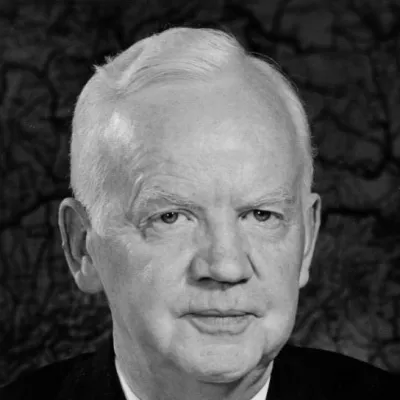
Heinrich Lübke
Human Design Chart
Biography
After serving in World War I he was able to unify many small German farmers’ organizations into the German Farmers Federation, serving as the federation’s director from 1926 to 1933. Politically inactive throughout the National Socialist era (1933–45), Lübke helped to organize the Christian Democratic Union (CDU) in Westphalia after World War II and was a member of the North Rhine–Westphalia Landtag (provincial diet) from 1946 to 1952. Between 1947 and 1952 he also served as the North Rhine–Westphalia minister of food, agriculture, and forestry.
In 1949–50 and later from 1953 to 1959, he sat in the federal Bundestag (lower house of parliament), and in 1953 he entered the cabinet of Chancellor Konrad Adenauer as federal minister of food, agriculture, and forestry. As a federal minister he played an important role in modernizing West German agriculture. In 1959 he was chosen as the CDU’s candidate for the federal presidency after Adenauer had declined to run. He was elected president in July 1959 and was reelected in 1964. He resigned from office in early 1969.
He died 6 April 1972, Bonn.
Human Design Analysis: Heinrich Lübke as Manifestor 6/3
Manifestor 6/3 — Design at a Glance
Heinrich Lübke was designed as a Manifestor, a type with the inherent task of leading the world into new futures. His design marked him out as a trailblazer and visionary, comparable to a Roman emperor: He possessed the broad perspective for great goals but delegated the operational implementation to others. This structure inevitably led to polarization; his forward-thinking designs were followed enthusiastically by some, rejected or even hated by others. Misunderstanding was thus a central pain point in his life conduct, as his visions did not always immediately resonate with everyone.
To minimize these friction points and find the right following, his design required the strategy of informing. By communicating his intentions and plans timely and clearly, he could prevent resistance and attract those who were ready to follow him. Living this strategy faithfully rewarded him with a sense of inner peace. Deviating from it and acting without prior information resulted in deep, lasting anger. His internal state thus served as a direct indicator whether he was moving in harmony with his natural function as a leader or fighting against the resistance of uncertainty.
Ego Authority
Heinrich Lübke's design inclined towards will-based authority that manifested in spontaneous, uncensored speech. His truth did not lie in analytical thinking but in what intuitively and directly came out of his throat. This configuration required him to listen to himself while speaking to distinguish when his mind spoke – influenced by open emotional, sacral, and spleen centers – and when his inner truth of the defined ego center emerged. The mind often served other interests or the environment, whereas spontaneous expression pointed towards his true direction.
Consistently following what truly mattered to him could appear egotistical in his surroundings but was essential for his authenticity and success. This applied both to the will for material possession and the drive to transcend boundaries and leave conventional paths behind. A central mechanism of his design involved a mandatory pause after achieving a goal. Persistent work without these regenerative phases risked unhealthy exhaustion and illness. His design thus demanded a balance between the powerful expression of will and the necessary rest to maintain his energy.
The 6/3 Profile — Role Model / Martyr
Heinrich Lübke's design inclined towards an intense search for the extraordinary. He was someone who did not settle for everyday standards but aspired to live far from conventions. This attitude stemmed from his Profile 6/3, the role model and experimenter.
In the first three decades of life, he lived the energy of Line 3. This meant a phase of trial and error marked by numerous self-experiments and pressing buttons to make unusual discoveries. Mistakes were accepted as an integral part of the learning process. Uranus symbolized the extraordinary here and promoted mutative changes and innovative detail work.
With Saturn's return, around age 30, Line 6 integrated. The gathered, often chaotic experiences condensed into wisdom, clarity, and humorous authority. Responsibility became natural. Yet experimentation never fully ended as Line 3 remained permanently present. This generated an inner restlessness and a continuous striving for the 'extraordinary perfect'. Intuition had its limits; in survival situations, Heinrich Lübke focused on the best possible outcome even if no perfect solution existed. His unusual experiences ultimately served to become a far-sighted role model that inspired others through his integration of knowledge and preservation.
Single Definition — Defined & Open Centers
Heinrich Lübkes Human Design profile was characterized by a stable internal structure supported by four defined centers. His defined Ajna Center enabled consistent, conceptual thinking that he articulated reliably through his defined Throat Center. This connection created a clear expression style and the ability to translate thoughts directly into words or actions. Additionally, his defined G Center provided a firm sense of self-identity and clarity about life direction, while the defined Heart Center supplied available willpower and ego strength. This marked him as someone who could promise what he held true and advocate for his own path with conviction.
In contrast, six centers remained open: Head, Sacral, Solar Plexus, Spleen, and Root were undefined. This openness did not provide a permanent energy source in these areas but rather high sensitivity to environmental impulses. His open Head Center tended to absorb mental pressure or inspiration from the environment, leading to doubts if he did not trust his inner authority. The open Sacral Center made him susceptible to amplifying others' vital energy and overloading himself due to lacking a consistent personal life force.
Emotionally, he was affected by the open Solar Plexus Center's constant exposure to absorbed feelings, causing him to experience environmental moods as his own. His open Spleen Center carried a fundamental survival anxiety and made him sensitive to the well-being of his environment, often leading to risky spontaneous decisions. Finally, his open Root Center absorbed external stress and adrenaline, potentially creating a sense of pressure that did not belong to him. The challenge lay in utilizing defined resources for thinking, will, and identity without identifying with borrowed energies from open centers.
Channels & Gates
Heinrich Lübke was someone who could distill complex information into understandable narrative structures. His design combined the gift of storytelling with logical organizational skills, enabling him to convey insights not just as dry facts but as illustrative parables.
This expressive style was significantly influenced by Channel 19-56, which connects Ajna and Throat Centers and drives a constant search for new ideas. Heinrich Lübke used this energy to transform experiences into stories designed to entertain and teach listeners. Rather than strict fact repetition, he aimed to fill gaps in information through a transformative voice that engaged the audience's imagination. The attitude of 'Look what I discovered' shaped his communication as he collected ideas to pass on and inspire others to think.
Additionally, Channel 18-62 complemented this approach by connecting Ajna with Throat Centers but focusing on logical order of details. While Gate 56 sought curiously, Gate 62 organized visual patterns into clear language. Heinrich Lübke could thus mentally structure complex relationships and verbally articulate this organization. This combination allowed him to accept detailed information fitting his internal worldview and then explain it precisely. The synthesis of curious discovery and logical processing resulted in presentations that had a magical effect: facts came alive through the narrative power of stories, while underlying logic ensured comprehension.
Circuit Signature
Heinrich Lübke exhibited a personality marked by strong inner substance. His design linked Identity with Heart Center (Channel 25-51), leading to firm convictions and clear self-worth. This energy acted individualistically: 'I am who I am'. Since this Centering Circuit lacked a connection to the Throat Center, these deep internal truths were often not verbally expressed but conveyed through mere presence. The Format Energy was pulsating and grounded in the present.
Parallel to this, there was a clear ability to communicate rational content. His Understanding Circuit linked Ajna with Throat Centers (Channel 17-62), enabling focused articulation of logical strategies and future-oriented ideas free from emotional coloring. Additionally, his Meaning Circuit also connected Ajna with Throat Center (Channel 11-56). This was about sharing experiences from the past and finding meaning in past events, where emotional waves shaped expression.
Another aspect was material cooperation. His Ego Circuit linked Heart with Throat Centers (Channel 21-45), promoting joint creation of resources and prosperity through exchange ('Give and Take'). Since there was no direct connection to the Sacral Center, rest periods for energy regeneration were necessary. All these defined centers – Ajna, Throat, Heart, and Identity – formed a cohesive energetic unit as Lübke was simply defined.
Left Angle Cross of the Clarion 2
Heinrich Lübke's design pointed towards a tendency toward a deep, spiritual or collective dimension of self-understanding. His inner nature was marked by the 'Left Cross of Fanfare', which indicated an identity that transcended pure individuality. This configuration defined less concrete action impulses than a specific kind of radiance and internal focus.
The Left Cross of Fanfare is a particular geometry in Human Design, arising when certain channels and gates are in harmonious relation to each other. It often connects the need for personal perception with a larger, almost mythic or collective resonance. For Heinrich Lübke, this meant that his life energy was colored by this cross. He did not primarily define himself through external actions but as someone whose self-image was shaped by a subtler, almost archetypal quality.
Since no specific events are documented in the raw content, the emphasis remains abstract. It was less about the 'what' of action and more about the 'how' of presence. The Fanfare Cross implies a kind of inner clarity or sound that does not have to be loud but deeply resonates. Heinrich Lübke appeared as someone whose identity rested in this spiritual or collective anchoring. His design did not offer an explicit roadmap for external success, but created a background tone influencing his entire life course and interaction with others. It was a silent power that was not necessarily visible but palpable – an identity expressed through its depth and connection to something greater.
Saturn Return · Uranus Opposition · Chiron Return · 2nd Saturn Return — Life Cycles
Heinrich Lübke's design pointed towards structural consolidation, especially evident in phases of increased responsibility. His inner authority did not unfold through spontaneous impulses but by translating personal convictions into stable, long-term societal roles. This configuration describes a process where individual integrity and systemic order intertwine to create sustainable structures.
This mechanism became concretely effective in 1953 at the age of 59 when he was appointed Federal Minister for Food, Agriculture, and Forestry. This marked his second Saturn return, a phase often condensing years of groundwork and inner maturation into a solid outcome. For his design, this was not a random career step but the peak of structural densification. The appointment reflected how his internal responsibility fully translated into a public function requiring stability and continuity. It revealed that his life task lay in stabilizing complex systems through clear stances and reliable structures, with the external position serving as an expression of inner coherence.
Manifestor · Ego Authority — Synthesis
He was a Manifestor who moved through life constantly feeling a deep inner restlessness. This resulted from constant experimentation (Line 3) paired with a pronounced sense of responsibility and wisdom that intensified after reaching a certain stage in life. The ability to develop concepts and implement them (defined Ajna Center) seemed to drive him to share new ideas and perspectives – an expression of curiosity (Channel 11-56), which continually led him to seek inspiration. This resulted in his acting as a pioneer, inspiring or prompting others to think, even if this did not always meet with agreement.
A central paradox lay in the connection between inner openness and the need for authentic expression. Ego authority required precise listening of one's will while speaking, while simultaneously the defined Ajna Center fostered a consistent, specific way of thinking. This tension between impulsive honesty and conceptual thought created an internal contrast that prompted him to continually reassess and adapt his perspectives – a process strengthened by the energy of the Centering Circuit, giving him a solidified personality.
4 Defined Channels
Incarnation Cross - Left Angle Cross of the Clarion 2
Solar Return
The Solar Return shows the moment when the sun returns to its exact birth position - your personal solar year.
Life Cycles
Discover the life cycles with a detailed triple view (birth chart, cycle chart, composite).
Human Design Profile
- Type
- Manifestor
- Strategy
- To inform others before acting
- Authority
- Ego Authority
- Profile
- 6/3 - Role Model / Martyr
- Definition
- Single Definition
- Incarnation Cross
- Left Angle Cross of the Clarion 2
- Date of Birth
- 14.10.1894 03:30
- Place of Birth
- Enkhausen (Sundern), Germany
Frequently Asked Questions
What is the Human Design type of Heinrich Lübke?
What profile did Heinrich Lübke have?
What authority did Heinrich Lübke have?
What incarnation cross did Heinrich Lübke have?
When was Heinrich Lübke born?
Discover your own Human Design
Are you also a Manifestor? Find out in a personal reading how to use your initiation power peacefully and dissolve resistance.
More Personalities
Back to overviewChristian-Jaque
Kesha

Laurent-Eynac
Lucebert
Masaccio
Papus