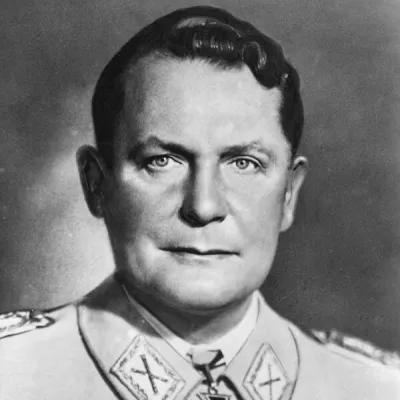
Hermann Goering
Human Design Chart
Biography
He was born in Rosenheim, Bavaria. A veteran World War I fighter pilot ace, Göring was a recipient of the Pour le Mérite. He served as the last commander of Jagdgeschwader 1 (JG I), the fighter wing once led by Manfred von Richthofen. An early member of the Nazi Party, Göring was among those wounded in Adolf Hitler's failed Beer Hall Putsch in 1923. While receiving treatment for his injuries, he developed an addiction to morphine that persisted until the last year of his life. After Hitler became Chancellor of Germany in 1933, Göring was named as minister without portfolio in the new government. One of his first acts as a cabinet minister was to oversee the creation of the Gestapo, which he ceded to Heinrich Himmler in 1934.
Following the establishment of the Nazi state, Göring amassed power and political capital to become the second most powerful man in Germany.
The Human Design of Hermann Goering: Manifesting Generator 2/4
Manifesting Generator 2/4 — Design at a Glance
Hermann Goering revealed himself as a hybrid being combining the constant energy of a Generator with the lightning-fast execution power of a Manifestor. His design inclined him to skip steps and quickly pull things into his life, enabling him to push multiple projects forward simultaneously. However, this speed was a double-edged sword: Often his actions were too hasty, leading him to miss important stages that he had to return to later to make up for the missing pieces. Such detours led quickly to frustration, which was his specific non-self theme in his configuration.
The mechanics of his manifesting generator required a clear strategy: Not initiating himself but reacting to external impulses. Only when his sacral center – the source of his life energy – gave a clear “yes” did action become fruitful. Reacting impulsively or trying to handle too many things at once without inner consent tipped his creative drive into exhaustion. When this alignment worked, however, Hermann Goering found deep satisfaction in parallel work and a playful mode. His energy was not a linear band but a broad stream that needed variety to avoid stagnation or self-blockage.
Sacral Authority
Hermann Goering was a Generator whose decision-making was marked by sacral authority. This inner leadership manifested not as a mental process, but as a physical reaction to external stimuli: an intuition in the gut, a surge of energy, or loud sounds like grunts and hums. When his sacral motor kicked in, he had vital energy and inexhaustible enthusiasm that enabled him to immerse himself fully in activities – without them needing to be bound by an external purpose. His strategy was to wait for these inner signals, simplifying his process since strategy and authority were one and the same. A prerequisite for this clear leadership was an open emotional center ensuring decisions weren’t made based on fleeting moods. Additionally, his activated spleen center served as a supportive instance, giving him the ability for quick, spontaneous reactions and immediate access to instinctive perception and physical well-being. This configuration allowed him to reliably be guided by these deep physiological impulses, characterizing his actions through a direct connection between instinct and energy output.
The 2/4 Profile — Hermit / Opportunist
Hermann Goering was marked by Profile 2/4, characterized by a constant oscillation between the need for withdrawal and the urge towards community. This design created tension: On one hand, he sought solitude to gain clarity within his own four walls and delve into the mystery – a trait described as “natural brilliance.” On the other hand, there was a strong desire to spend time with chosen people and maintain his network.
During his alone times, he reflected on knowledge from his environment, evaluated it, and developed ideas. This phase of withdrawal was essential for him to separate himself from the outside world and order inner processes. Once this calm was achieved, he re-emerged to bring in his insights. Often appearing impressive during these moments, his design also pointed to the risk of being perceived as a “paper tiger” – making more impression than actual talent.
Goering used this dynamic to unleash inspiration and spark others. At the same time, his stance showed opportunistic flexibility: He stood by his principles as long as it was safe to do so. Line 4 promoted adaptability to social structures while line 2 gave him inner strength to appear enduring when not threatened. Law and power were tools for him to project his position outward, always torn between the necessity of isolation for regeneration and the desire for social inclusion.
Split Definition — Defined & Open Centers
Hermann Goering was someone who constantly felt mental pressure to ask questions and understand things. This tendency stemmed from his definition between the Head Center and Ajna Center. He had a fixed way of thinking and was always engaged in a mental process, which made him an inspiration for others but could also lead to inner concern when he tried to alleviate this pressure through direct action. His communication was clear and consistently marked by the connection of his Ajna with Throat Center; he spoke out what his mind conceptualized.
As a Generator, Hermann Goering possessed an enormous vital energy source in his defined Sacral Center. This power required reaction rather than initiation to avoid frustration and exhaustion. Simultaneously, his Spleen Center was defined, giving him a strong intuitive awareness of health and well-being in the moment.
At the same time, his design revealed specific vulnerabilities. His open G Center meant the absence of a fixed identity; he tended to blend with his environment and sought direction through external initiations rather than providing it himself. The open Heart Center drove him into proving his worth through promises and competition, often ending in cycles of self-doubt as he did not have the consistent energy for such contests. Additionally, his open Solar Plexus absorbed the emotions of his surroundings, making him vulnerable to emotional conditioning and a desire to avoid conflict. Finally, his open Root Center amplified external stress, leading to a feeling of restlessness as he tried to release pressure that was not his own.
Channels for intuition, clear mind and caring values.
Hermann Goering showed himself through a combination of intuitive depth and the ability to logically organize complex patterns. His design laid the foundation for a deep understanding of connections, which he transformed into concrete skillfulness through repeated experimentation and refinement. This occurred over Channel 48-16: Gate 48 sought life-critical information from an inner intelligence while Gate 16 perfected this through technical mastery and precision. Goering needed recognition and resources to nurture this talent; his success depended on identifying with something he truly enjoyed, thereby developing his ability into a powerful expression.
Parallel to this, he had a unique thinking style that did not rely on logical derivation but rather sudden insights. The Channel of Awareness 61-24 connected the inspiration from Gate 61 with the rational mind of Gate 24. Goering could not control his thoughts; knowledge entered when it wanted – often as Satori or mutative insight. He relied on distinguishing these inner truths and communicating them to others, where silence and music helped ease mental pressure.
Another central aspect was his role as provider and protector of the community structure. The Channel of Preservation 27-50 gave him an aura of trustworthiness. Through Gate 27 he showed care and a need to nourish others while Gate 50 defended traditional values and laws to maintain order in the tribe. Goering took responsibility for those who could not provide for themselves, acting instinctively to secure the community's existence.
Additionally, individual Gates shaped his profile: Gate 62 brought patience, logic, and detail precision to translate patterns into formulas. Gate 32 sought material continuity and stability for the tribe, undertaking radical changes when security was threatened. Gate 42 emphasized closing processes through sacral power to take on new commitments. Gate 11 allowed a harmonious assessment of the situation before acting, fueled by visual memory and collective ideas. Gate 64 helped interpret past experiences to gain clarity for decisions. Gate 18 discriminated between necessary corrections in the collective process without taking it personally. Gate 28 demanded immediate decisions even with risks to live one's personal meaning. Finally, Gate 44 through vigilance and accommodation facilitated transformations in relationships, fueled by cellular memory.
Individual Circuitry — Circuit Signature
Hermann Goering's design inclined towards strategic clear communication and instinctive preservation. He was someone who directly articulated rational insights into words to improve or protect structures. This configuration consisted of separate energetic blocks: One block connected the Throat Center with Spleen Center via the Understanding Circuit (Channel 16-48). This enabled a focused, emotionless ratio that visually clarified logical strategies. Parallel to this, another block worked in the Protector Circuit connecting Sacral Center with Spleen Center (Channel 27-50). Here flowed ancient energies of survival protection and preservation of genetics or family. These two areas were not directly connected in Hermann Goering; they existed as separate, side-by-side forces. A third isolated area consisted of the Knowledge Circuit linking Head Center with Ajna (Channel 24-61). This brought innovative flashes of insight and a search for new awareness without directly flowing into his communicative or protective energy. The shared definition meant that these energies – strategic articulation, instinctive protection, and intellectual innovation – worked in parallel but did not form one continuous flow. Hermann Goering utilized the focused logic of the Understanding Circuit for direct expression while the Protector Circuit provided deeper motivation for preservation and defense. The Knowledge Circuit acted as an independent impulse generator for new ideas, separate from the other two functional areas.
Right Angle Cross of Maya 4
Hermann Goering's Human Design profile was marked by the right cross of Maya 4. This configuration established a specific energetic alignment that was not defined by spontaneous impulses or arbitrary decisions, but rather through a deep, often unconscious dedication to a higher mission or destiny. The structure of this cross described a path less influenced by individual freedom in everyday terms and more by a necessary adaptation to external circumstances and historical currents.
The mechanics of this design were evident in a tendency to always place personal goals at the service of a greater whole. It was an energy that found strength in fulfilling its role within a system, even if it meant putting aside one's own desires. Hermann Goering lived this dynamic not as a voluntary choice in the modern sense but as an inherent part of his energetic architecture. The right cross of Maya 4 often combined a certain hardness with a near fatalistic acceptance of what was deemed necessary.
This orientation created a person who felt comfortable in structures that offered clear hierarchies and definitions. The energy of this design acted like an anchor, binding him to specific paths from which he could hardly detach himself or wanted to. It was a configuration that prioritized efficiency and purposefulness, where the individual often appeared as an instrument of a larger plan. Hermann Goering thus emerged as someone whose actions were strongly determined by this deeply rooted necessity to find his place in the order of things and fill it.
Saturn Return · Uranus Opposition · Chiron Return — Life Cycles
Hermann Goering's design showed a tendency towards structural adaptation that was significantly condensed through external events. In 1921, at age 28, he enrolled at the University of Munich but dropped out. This occurred during his first Saturn return, a time when inner maturity and outer reality often collide; the interruption marked the end of one phase to make way for new, less academic structures.
In 1933, at age 40, he was appointed Reich Minister without Portfolio as well as several Reich Commissioners. This happened during the Uranus opposition, a cycle that forces profound shifts in power and authority changes. His design mechanics responded to this sudden external elevation with a rapid takeover of control over air traffic and Prussian interior ministry, demonstrating the ability to establish new hierarchies in moments of systemic breakdown.
In 1942, at age 49, Goering further lost influence within the Luftwaffe. This fell during his Chiron return, a fulfillment cycle that puts one's incarnation task on trial. Instead of healing, this was revealed as confrontation with the limits of his own strategy. The decline in influence was not a random crisis but the result of a life path conflicting with his inner authority; the Chiron return exposed here the untenability of the previously established position since it did not rest on authentic self-determination.
Manifesting Generator · Sacral Authority — Synthesis
He was a Manifesting Generator with sacral authority, whose life seemed marked by constant readiness to react and accelerated action (Design Perspective). This energetic endowment was reinforced by the defined Head Center, which generated an ongoing urge to question and understand (Centers), driving him into deep engagement with themes. The profile as a natural talent and networker pointed towards a dynamic between the need for withdrawal into internal processes and the search for connection within communities (Profile Role). Through the connection of Spleen Center and Throat Center via Channel Wave, he was always seeking new opportunities to perfect skills and find solutions.
A central paradox lay in the tension between his ability to initiate things quickly – a trait of Manifesting Generators – and the risk associated with skipping important steps (Design Perspective). This correlated with cycles that showed both career ascents (Uranus opposition) as well as crisis phases (Chiron return), where a renewed 'return' was necessary. The Knowledge Circuit emphasized his ability for transformation and individuality (Circuit), while the right cross of Maya 4 pointed towards a life style marked by constancy and expression of his unique identity (Cross).
3 Defined Channels
Incarnation Cross - Right Angle Cross of Maya 4
Solar Return
The Solar Return shows the moment when the sun returns to its exact birth position - your personal solar year.
Life Cycles
Discover the life cycles with a detailed triple view (birth chart, cycle chart, composite).
Human Design Profile
- Strategy
- To respond - wait for something to respond to
- Authority
- Sacral Authority
- Profile
- 2/4 - Hermit / Opportunist
- Definition
- Split Definition
- Incarnation Cross
- Right Angle Cross of Maya 4
- Date of Birth
- 12.01.1893 04:00
- Place of Birth
- Rosenheim, Germany
Frequently Asked Questions
What was Hermann Goering's Human Design type?
What Profile did Hermann Goering have in Human Design?
What Authority did Hermann Goering possess?
What incarnation cross did Hermann Göring have?
When was Hermann Göring born?
Discover your own Human Design
Are you also a Manifesting Generator? Find out in a personal reading how to unfold your multi-talents and direct your energy wisely.
More Personalities
Back to overviewAldair

Alizée

Angeli

Arletty

Artus

Balthus