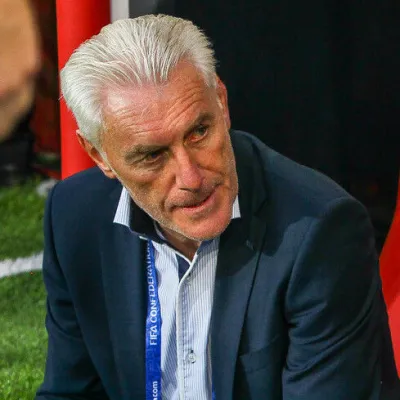
Hugo Broos
Human Design Chart
Biography
Hugo Broos as a Projector 6/2 in Human Design
Projector 6/2 — Design at a Glance
Hugo Broos revealed himself as someone who could instantly identify weaknesses in systems. His Projector Design created an aura that worked like a focused flashlight: it shed light precisely on those areas that were dark or not functioning in others. This ability to pinpoint errors in the system was his core strength. However, this direct perception, when expressed abruptly, could trigger resistance in others – akin to a blinding light in the face.
The mechanics of his design suggested that the most effective approach was not immediate correction but shining his own light. By radiating harmony and competence, he became attractive. People would then come to him of their own accord, driven by the pull of his clear gaze, to seek advice. His strategy was to wait for an honest, appreciative invitation before taking on a leadership role.
Since Projectors do not have a constant, intrinsic energy center, phases of high activity were followed by necessary rest periods to avoid burnout. Ignoring this rhythm often led to bitterness, while life according to this design was rewarded with success. Hugo Broos’ impact, therefore, did not rely on constant, independent energy production but on the precise, inviting leadership he offered others once they asked for it.
Emotional Authority
Hugo Broos revealed himself as someone who never made decisions immediately but consciously delayed them. His design required him to distance himself from the first emotional reaction before acting. This resulted from his emotional authority, carried by the defined Solar Plexus Center. In Human Design mechanics, this authority always takes precedence over all other defined centers, regardless of further configurations.
This structure meant that Hugo Broos was subject to a natural wave of emotions that showed constant ups and downs. The world appeared to him always colored by his current mood: the same situation could be inspiring in one moment and negative in the next. Since the immediate feeling was only a snapshot and not necessarily the truth, spontaneous decisions based on emotion were often problematic.
Instead, his system required patience and multiple reconsiderations of choices. The more time he took, the deeper he could see. By delaying and asking himself multiple times, intense feelings subsided. Only with this emotional distance did the necessary clarity and calmness set in. This process was particularly crucial for long-term, life-defining decisions, as he had to go through an inner maturation process.
The 6/2 Profile — Role Model / Hermit
Hugo Broos revealed himself as someone who, in his early years, learned through intense experimentation and the principle of trial and error. His design as a 6/2 Line ("Role Model / Natural Talent") indicated a tendency to gather many personal experiences before the age of 30, with retreats after failures being the driving principle. This phase served the acquisition of willpower and the overcoming of challenges through separation and isolation to overcome shocks.
After the age of 30, with the activation of the sixth line, this dynamic shifted. Hugo Broos likely retreated into an inner "cave" to look back at his earlier experiments from a distance. This period of intense reflection was also a phase of healing and deep self-awareness. From this isolation, he developed a wisdom that he later made accessible to others.
His design also included the "natural brilliance" of Gate 61, Line 2. This described a personality that uses its mind to penetrate the mystery and acts as an inspiration source. Although this manifestation could sometimes appear like a "paper tiger" – impressive but possibly less talented than expected – there was a willingness to unleash inspiration. The 6/2 Line learned that not every inspiration is automatically valuable and developed the ability for deep introspection, which others later sought to partake in these life insights.
Triple Split Definition — Defined & Open Centers
Hugo Broos demonstrated a consistent, trustworthy mental function. His defined Ajna Center provided a clear way of conceptual thinking, which he could reliably translate into communication and action through his defined Throat Center. This connection allowed him to not only form concepts but also make them articulate and effective.
His design was also characterized by a firm internal structure. The defined G Center gave him a clear sense of self-identity and direction, while the defined Heart Center provided direct access to willpower and ego. He could make promises and keep them, which strengthened his self-esteem. This was complemented by the defined Spleen Center, which gave him spontaneous, intuitive intelligence in the moment, as well as the defined Solar Plexus Center, which offered emotional depth and authority that required time to gain clarity. The defined Root Center provided a constant push to move forward and process stress.
At the same time, Hugo Broos was susceptible to certain vulnerabilities. His open Head Center made him susceptible to external mental pressure and doubt that did not originate from him. He tended to get entangled in questions he did not actually need to answer and sought inspiration to alleviate this pressure. Particularly noticeable was his open Sacral Center. Without a consistent generative energy, he was prone to absorbing and amplifying the energy of his environment, leading him to easily overstep his limits, exhaust himself, or feel the false need to work constantly when he actually needed rest. The challenge was to not sink into the borrowed energy of others but to trust his inner authority to know when enough was enough.
Channels for pioneering spirit, intuition, logic and emotional release.
Hugo Broos was someone who guided his behavior moment by moment through deep intuitive impulses. This attitude came from the Channel of Perfect Form 57-10, which connects the Spleen Center with the G Center. Through the intuitive insight of Gate 57 and the self-action in Gate 10, a spontaneous adaptability emerged. He acted appropriately on everything perceived as out of order in his environment, free from unfounded future anxieties. This allowed him to existentially and unburdenedly go through the world, inviting others to live life as themselves.
Parallel to this, his mind constantly organized details in an internal mental system. The Channel of Accepting 17-62 connected the Ajna Center with the Throat Center. Gate 17 visualized patterns, while Gate 62 translated these into language and details. Hugo Broos had a need to precisely explain his opinions and what he understood or did not understand. New data had to be logically integrated into his worldview to be considered understood. This gave him the ability to present complex visual patterns as formulas or theories, provided he waited for the invitation to speak to ensure clarity and effectiveness.
His nature was also marked by a deep competitiveness that was connected with universal love. The Channel of Initiation 51-25 connected the Heart Center through the Gate of Shock (51) and the Gate of Self Spirit (25). He liked to awaken and strengthen competitiveness in others to encourage them to expand and test their limits. Each triumph fostered a mystical sense of uniqueness. However, he did not actively seek initiation; it had to find him so that he could survive the shock of individuation and encourage others.
Additionally, he experienced a pulsating emotional wave between joy and melancholy. The Channel of Emotions Release 39-55 connected the Root Center with the Solar Plexus Center. Through provocation (Gate 39) and the spirit (Gate 55), he teased out the nature of the spirit in others to find the right people. His impact depended heavily on his current mood. When he lived authentically and embraced his emotional depth, he transmitted a seductive warmth or passionate sadness, often creatively expressed.
Individual Circuitry — Circuit Signature
Hugo Broos was marked by a triple definition that formed three separate, parallel operating energetic strands. A first strand connected the Solar Plexus with the Root Center. Here, the channel 'Emotions Release' translated emotional waves into immediate action impulses. This generated a pulsating, acoustic energy focused on the present.
A second, isolated strand connected the Identity with the Heart Center. Through the channel 'Initiation', an energy of self-confirmation and individual firmness flowed here. This configuration fostered inner confidence and the courage to clearly assert one's identity without necessarily articulating it outwardly.
A third strand connected the Ajna with the Throat Center. The channel 'Accepting' enabled logical strategies and structured thoughts to be directly translated into words. This served the sharing of rational insights, free from emotional coloring, to improve things.
Additionally, a channel connected the Identity with the Spleen Center. The energy of 'Perfect Form' channeled intuitive insights and power from the reaction to life into concrete implementation in the present.
These three groups – emotional impulsivity, inner firmness, and rational communication – were not directly connected in Hugo Broos. They existed as independent energy fields that fueled his actions from different, not always integrated sources. The separate nature of these definitions meant that these energies worked alongside each other without forming a single, continuous flow.
Left Angle Cross of the Clarion 1
Hugo Broos revealed himself through an internal tension between the desire for clear, truthful communication and the need to underscore this message with a certain drama or "fanfare." His design tended to not only convey information but to present it in a way that would capture attention and leave a lasting impression. He was less concerned with dry fact delivery than with formulating a truth that would resonate emotionally and intellectually.
This configuration, the left cross of Fanfare 1, describes a specific way of self-presentation. It connects the integrity of truth with the power of rhetoric. Hugo Broos tended to express his convictions not quietly but with a certain volume and clarity that was always based on solid grounds. It was important to him that his words were not only heard but also understood and acknowledged. This energy shaped his interactions: he sought exchange but on a level that demanded respect and clarity. The "fanfare" was no empty show but the means to make his voice heard in a often noisy environment without sacrificing the substance of the message.
Saturn Return · Uranus Opposition · Chiron Return · 2nd Saturn Return — Life Cycles
Hugo Broos structured his life phases through clear, measurable results. His design tended towards cyclical confirmations, where inner maturation translated into outer recognition.
In 1981, at the age of 29, he won his last master title with RSC Anderlecht. This fell into the first Saturn Return, a phase where years of groundwork often condenses into a solid, structural result. It marked the transition from development to established performance.
Ten years later, in 1992, he was named Belgian Trainer of the Year. This occurred during the Uranus Opposition, a time often associated with sudden turns or the recognition of new, innovative approaches. Here, the effectiveness of his approach across the board was evident.
The Chiron Return around 2004, when he won the Belgian championship with RSC Anderlecht, represented a fulfillment cycle. In this phase, the individual's incarnation cross unfolds increasingly; meaning and purpose become experiential. The success was no coincidence but the bloom of a long-term alignment.
In 2007, during the second Saturn Return, he was again honored as Belgian Trainer of the Year. This cycle solidifies the achievements of the first return and anchors the attained position sustainably. The repeated confirmation underscores the stability and continuity that emerge from his design.
Projector · Emotional Authority — Synthesis
Hugo Broos' design is characterized by a deep ability to recognize patterns and see potential in others (Projector Type, Channel 57-10). This recognition occurs through a steady, conceptual thinking (defined Ajna Center), which allows him to grasp the essence of situations and people. Emotional authority, however, demands a maturation of these insights, a letting go of decisions before they are spoken. This combination of intuitive perception and emotional depth, reinforced by the 6/2 Profile line, points to a life path from initial experimentation to profound wisdom and role modeling.
Central to Hugo Broos is the tension field between the need to project his insights – pointing out improvement potentials (Projector) – and the necessity to do so in harmony with his own emotional wave (emotional authority). The Knowledge Circuit emphasizes the ability to effect transformation through personal experiences and insights, while the cyclical successes (Saturn Returns, Uranus Opposition, Chiron Return) show that the maturation and sharing of this wisdom come with recognition and positive results.
4 Defined Channels
Incarnation Cross - Left Angle Cross of the Clarion 1
Solar Return
The Solar Return shows the moment when the sun returns to its exact birth position - your personal solar year.
Life Cycles
Discover the life cycles with a detailed triple view (birth chart, cycle chart, composite).
Human Design Profile
- Type
- Projector
- Strategy
- Wait for the respectful invitation
- Authority
- Emotional Authority
- Profile
- 6/2 - Role Model / Hermit
- Definition
- Triple Split
- Incarnation Cross
- Left Angle Cross of the Clarion 1
- Date of Birth
- 10.04.1952 00:20
- Place of Birth
- Laeken, Belgium
Frequently Asked Questions
What is Hugo Broos' Human Design type?
What Profile does Hugo Broos have in Human Design?
What Authority governs Hugo Broos?
What incarnation cross is Hugo Broos associated with?
When was Hugo Broos born?
Discover your own Human Design
Are you also a Projector? Find out in a personal reading how to unfold your leadership qualities and recognize the right invitations.
More Personalities
Back to overviewSissy Spacek

Alain-Fournier

Aldair

Anémone

Ann-Margret

Bourvil