
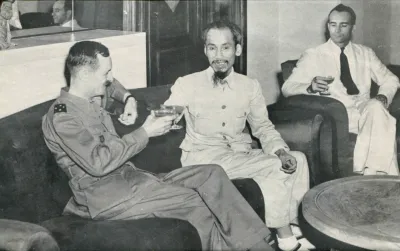
Jean Sainteny
Human Design Chart
Biography
He died on 25 February 1978.
What does Manifesting Generator 1/4 mean for Jean Sainteny?
Manifesting Generator 1/4 — Design at a Glance
Jean Saintenys design marked him as a hybrid being that combined the constant energy of a Generator with the lightning-fast alignment of a Manifestor. He had a defined Sacral Center, which gave him a steady power source but required him to react to life impulses rather than initiate them himself. This configuration allowed him to skip steps and quickly pull things into his life. However, this speed carried risks: Often he acted too quickly, overlooked necessary intermediate steps, and later had to backtrack to fill in the gaps – a process that rapidly led to frustration if he ignored his inner authority.
Furthermore, his design tended to juggle multiple projects simultaneously, driven by various impulses. Without confirmation from his Sacral Center and his inner guidance, this creative drive could easily turn into overwhelm. However, when the strategy worked – responding to the internal “yes” impulse – Jean Sainteny found deep satisfaction. He did not thrive in linear task completion but rather in a playful mode with variety. The demand to finish one thing before starting another stood against his natural rhythm. Instead, he drew strength from diversity and the joy of creation itself as long as his inner center approved each endeavor.
Emotional Authority
Jean Saintenys' inner authority was emotional, carried by his defined Solar Plexus Center. This configuration fundamentally shaped his decision-making: He was subject to a constant wave of emotional ups and downs. The world appeared colored by his current mood; enthusiasm could shift into deepest skepticism within the same moment. His immediate feeling was only a provisional snapshot, not yet his final truth. Spontaneous decisions made directly from this emotional heat often proved problematic and had negative consequences.
The mechanics of his authority required time. The longer he let a decision rest, the clearer his perspective became. This process demanded patience and conscious reflection on important questions. By hesitating and re-evaluating decisions multiple times, he gained emotional distance. The initial intensity of feelings subsided over time, making room for calmness and deep insight. Only then was the inner process complete and the decision ripe. This was especially true for long-term decisions that significantly influenced his life path. Emotional authority always took precedence over all other defined centers in his design; it determined the rhythm of his clarity independent of further energetic conditions. Jean Sainteny learned that his truth did not lie in the first impulse but in the calm after the emotional storm.
The 1/4 Profile — Investigator / Opportunist
Jean Sainteny was someone who combined deep research with a need for familiar community. His 1/4 profile design inclined him to thoroughly explore things and share this knowledge within a network of close people. Line 1 brought a desire for profound understanding, while line 4 fostered a longing for a group where these insights could be shared. This created a dynamic in which he could influence others through his expertise, yet was often accompanied by the fear of not knowing enough before loved ones and being exposed. A loving environment with deep trust was therefore crucial for him; only then did his abilities come to the fore and he likely became an authority in his heart themes.
On the level of lines, specific patterns emerged. Line 1 at Gate 16 described a lifelong process of identifying with experiments and developing skills. Daydreams allowed him to play through skills mentally and recognize patterns. This process was creative but also led to self-deception as it remained open when plans were realizable. Parallel to this, line 4 at Gate 37 emphasized leadership through exemplary behavior. It was about providing resources for the family and manifesting highest principles in daily life. Here a tension field arose between traditional leadership and the one with most resources, which led Jean Sainteny to respect recognized leadership roles while acting as an example himself.
Triple Split Definition — Defined & Open Centers
Jean Sainteny was someone who operated under constant mental pressure to question and understand connections. His defined Head and Ajna centers generated a continuous stream of inspiration but did not provide direct energy for implementation; he relied on others being inspired by his thoughts rather than taking the first step himself. This mental configuration marked him as a thinker seeking clarity, rather than immediately putting it into action.
His defined G Center gave him a reliable sense of self-identity and direction. He knew who he was and where his path led, allowing him to provide guidance without being dependent on others' expectations. This was complemented by his defined Heart Center, which endowed him with willpower and the ability to keep promises. He sought recognition for his contributions and preferred controlling his own resources, making him a strong, independent figure.
As a Generator with a defined Sacral Center, he possessed an enormous vital energy source. His strategy was not to initiate but to respond to questions or offers from the environment. Only through this sacral response did he know if he had the energy for a task. His defined Solar Plexus served as his inner authority; he needed to wait out his emotional wave to gain clarity, rather than acting impulsively. This created deep emotional intelligence that required time.
In contrast, his open centers revealed areas of conditioning. His open Spleen Center made him vulnerable to fundamental survival fears and the need for external security. He tended to cling to things that did not serve him just to maintain a sense of well-being. Additionally, his open Root Center absorbed stress from his environment, often leading to cycles of adrenalized pressure and attempts to escape through hyperactivity, making him susceptible to burnout if he didn't learn to distinguish between external and internal pressures.
Channels for rhythm, clarity, emotional truth and connection.
Jean Sainteny's design was characterized by a deep connection with the natural flow of life. The Rhythm Channel 5-15 connected his Sacral Center with his G Center, giving him an inner rhythm that effortlessly propelled him forward and magnetically drew others into his energy field. This mechanism relied on fixed habits (Gate 5) and universal love for human diversity (Gate 15), endowing him with intuitive timing unaffected by either intellect or emotional waves.
Mentally, Jean Sainteny was an individual thinker influenced by the Awareness Channel 61-24 between his Head and Ajna Centers. Here, spontaneous inspiration (Gate 61) transformed into rational answers (Gate 24). His mind did not seek logical patterns but waited for mutative insights – a sudden 'knowing' that arose without control and helped him discern the knowable from the unknowable.
Emotionally, he was driven by the search for new experiences embodied in the Transience Channel 36-35. This connected his Solar Plexus and Throat Centers, urging him to explore boundaries and use crises (Gate 36) as a catalyst for change (Gate 35). He learned through fully experiencing emotional waves and sharing these intense moments with others, deepening his wisdom but also subjecting relationships to the highs and lows of his mood.
Socially, Jean Sainteny acted as a bridge-builder within groups. The Community Channel 37-40 connected his Solar Plexus Center with his Heart Center. He sought recognition (Gate 37) and was ready to work for those he loved (Gate 40), but needed clear, fair agreements. His energy served to hold individuals together in a harmonious whole, valuing mutual respect and contribution to the collective rather than hierarchy. Additional influences like the detail-oriented nature of Gate 9 or the mutative potential of Gate 16 rounded out his profile by fostering an experimental spirit and precise focus.
Collective Circuitry — Circuit Signature
Jean Sainteny's design presented itself as a Triple Definition, meaning three separate, parallel operating energetic blocks. These were not connected to each other but existed as independent fields of experience.
In the Knowledge Circuit, Channel 24-61 linked his Head Center with his Ajna Center. This generated pulsating energy for new ideas and awareness that operated in isolation from the other centers.
A second block formed in the Understanding Circuit through Channel 5-15 between Sacral and Identity Centers. Here, constant life force flowed directly into self-understanding, creating a focused rhythmic approach to logical structures and future-oriented strategies – completely independent of emotional waves or intuitive leaps.
The third block united in the Meaning-Finding and Ego Circuit Throat, Solar Plexus, and Heart Centers. Channel 35-36 connected Throat and Solar Plexus, guiding cyclical past emotional experiences through expression. Parallel to this, Channel 37-40 linked Heart with Solar Plexus, merging willpower and emotional resonance into community work and mutual support. This connection of feeling and will in expression did not directly exchange with the isolated thought processes of the Head-Ajna area or the pure logical strategy of the Sacral-Identity block. Jean Sainteny navigated between these three distinct worlds: creative inspiration, rational structuring, and emotionally-mediated community building.
Right Angle Cross of Planning 2
Jean Saintenys Design showed a tendency towards strategic planning and careful preparation. He was someone who did not act impulsively but rather thought through actions in advance and structured them accordingly. This attitude stemmed from the influence of the right cross of Planning 2 in his Human-Design chart.
This aspect describes an internal mechanism aimed at clarity and organization. Those carrying this configuration tend to analyze situations before engaging, aiming to find the right time and path to achieve goals efficiently. Instead of being driven by external environments, Jean Sainteny sought internal guidelines for his actions. This allowed him to break down complex challenges into manageable steps.
The energy of this cross promoted a calm but decisive approach to decision-making. It helped reduce confusion and focus on what was essential. Jean Sainteny lived this ability to plan ahead by taking time to weigh consequences, creating a foundation for sustainable results as his actions were based on solid deliberation. The structure of this design supported him in bringing order to his environment and advancing projects purposefully without being distracted by short-term disruptions. His strength lay in the connection between vision and practical implementation through precise planning.
Saturn Return · Uranus Opposition · Chiron Return · 2nd Saturn Return — Life Cycles
Jean Sainteny was someone who, in crisis situations, created structural order and took long-term responsibility. His design showed a tendency towards strategic action under pressure, combined with the ability to pour complex power dynamics into stable forms. This attitude became particularly effective at age 39: In 1946, he negotiated a ceasefire agreement between French colonial forces and the Vietnamese independence movement. This event marked the beginning of his Uranus phase, a period often defined by sudden turning points and the need for realignment. Sainteny used this dynamic energy not for chaotic rupture but to negotiate temporary stability in an unstable environment.
Later, this structural alignment deepened during the second Saturn return. At age 55, he became Minister of Veterans Affairs in 1962. This cycle demands maturity, authority, and taking on burdens for the community. Saintenys appointment to this role perfectly matched this mechanical logic: He took a position based on experience that required long-term commitments to a specific part of society. His life exemplified the transition from adaptive crisis management in middle age to institutional anchoring and responsibility in later years.
Manifesting Generator · Emotional Authority — Synthesis
Jean Sainteny was a Manifesting Generator, whose life was marked by a dynamic interaction between sacral energy and mental pressure. The constant availability of sacral energy (defined in the Sacral Center) created a natural readiness to respond to the flow of life, while his connection to the Throat Center gave him the ability to quickly advance initiatives – a hybrid of Generator and Manifestor. This drive was reinforced by a defined Head Center that generated an unceasing urge for understanding and inspiring others, with a focus on the rhythm of life (Channel 15/5). The profile as Researcher/Networker underscored his deep thirst for knowledge and desire to share this knowledge in a familiar environment, leading him to form connections and exert influence.
A central paradox in Jean Saintenys design lay in the interplay between speed and thoroughness. As a Manifesting Generator, he could initiate things quickly but also tended to skip important steps. This corresponded with his emotional authority, which required letting decisions mature – a tension between the impulse for quick action and the necessity of experiencing emotions fully. The Uranus opposition at age 39, marked by negotiating an agreement, as well as the Saturn return at age 55, coupled with a career as Minister of Veterans Affairs, showed how he both pursued innovative paths and transformed established structures.
4 Defined Channels
Incarnation Cross - Right Angle Cross of Planning 2
Solar Return
The Solar Return shows the moment when the sun returns to its exact birth position - your personal solar year.
Life Cycles
Discover the life cycles with a detailed triple view (birth chart, cycle chart, composite).
Human Design Profile
- Strategy
- To respond - wait for something to respond to
- Authority
- Emotional Authority
- Profile
- 1/4 - Investigator / Opportunist
- Definition
- Triple Split
- Incarnation Cross
- Right Angle Cross of Planning 2
- Date of Birth
- 29.05.1907 04:20
- Place of Birth
- Le Vésinet, France
Frequently Asked Questions
What was Jean Sainteny's Human Design type?
Which Profile did Jean Sainteny have in his Human Design?
What Authority guided Jean Sainteny's decisions?
What incarnation cross did Jean Sainteny have?
When was Jean Sainteny born?
Discover your own Human Design
Are you also a Manifesting Generator? Find out in a personal reading how to unfold your multi-talents and direct your energy wisely.
More Personalities
Back to overviewAldair

Alizée

Angeli

Arletty

Artus

Balthus
