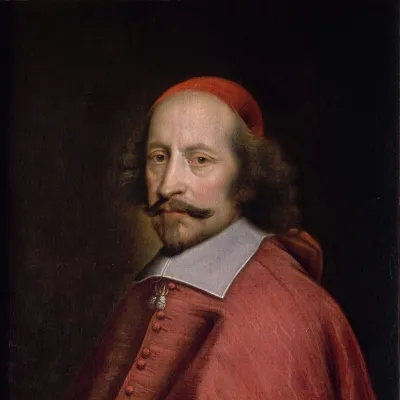
Jules Mazarin
Human Design Chart
Biography
Born Giulio Raimondo Mazzarino, his father, Pietro, was a Romanized Sicilian in the household of the constable Fillippo I Colonna. His mother, Ortensia Bufalini, was from a noble Tuscan family. He had one brother and four sisters, and even as a child, he recognized that having powerful patrons was an advantage in life. Mazarin attended Jesuit School in Rome, where he excelled, and he went on to study law at the University at Alcalá de Henares. In 1624, he obtained a captaincy in the papal army.
On 25 December 1624, he had an unusual mystical experience that profoundly affected his life. He entered the diplomatic service, and in 1628, was appointed secretary to the papal legate of Milan, G. F. Sacchetti, where he finally had the opportunity to play an active role in politics.
In January 1630, he was sent to France where he met Cardinal Richelieu. Fascinated by the powerful man, Mazarin resolved to devote his life to him. Later that year, on 26 October 1630, he gained an international reputation when he bravely rode between opposing armies about to engage in battle, risking his life in an effort to stop the fighting. Although completely dedicated to Richelieu, he obtained the patronage of Cardinal Barberini who made him an ambassador to the French court from 1634-36. He left the papal service to enter the service of France in 1640 and was given his cardinal’s hat by the Pope on 16 December 1641.
Mazarin’s ambition was to end the rivalry between the Catholic powers of Europe, and he was instrumental in bringing about the Peace of Westphalia in October 1648, a settlement that established peace in Germany. By the 1650s, however, the Fronde revolts were in full force due to his attempts to raise taxes and centralize policy.
Jules Mazarin — Projector with Profile 2/4
Projector 2/4 — Design at a Glance
Jules Mazarin appeared as someone who radiated with a dense, focused aura – comparable to a bright light beam that targeted weaknesses in his surroundings. As a Projector, he did not have a constant intrinsic life energy source due to an undefined Sacral Center. Instead, he operated in phases of high intensity followed by necessary rest periods for regeneration. This structure shaped his actions: He immediately identified systematic flaws or imbalances in others. However, directly addressing these shortcomings often provoked resistance, similar to shining a bright light into someone's face. More effective was his strategy of passive attraction. By radiating harmony and competence himself, he became a magnetic center that drew others in willingly. His optimal positioning came from waiting for honest, appreciative invitations from his environment before deploying his leadership skills. This wait time was not passivity but a strategic necessity to ensure the acceptance of his advice. If he followed this strategy, he was rewarded with success; if he ignored it and acted against the will of others, it led sooner or later to the bitterness theme of non-self. His design thus did not call for constant action, but rather targeted, invited influence to make his unique insights effective without wasting energy or provoking conflicts.
Splenic Authority
Jules Mazarin showed decision-making based on a fine, immediate impulse. His inner authority lay in the defined Spleen Center, which presupposed that both the Emotional and Sacral Centers were open – a configuration only Projectors or Manifestors exhibit. The Spleen functioned here as a health system and alarm; it provided spontaneous knowledge about whether a situation or environment was beneficial or not. This instinct directly served his physical well-being and enabled Jules Mazarin to rigorously distance himself from harmful influences. The first impulse was considered the right path, as it immediately protected personal health. However, this signal was very subtle and only appeared once at each moment, posing a risk of being drowned out by external voices. This required high vigilance and sometimes a short retreat to hear the true impulse. Long-term planning proved difficult since knowledge became available only in the moment of decision. Plans could therefore change suddenly. Jules Mazarin needed much flexibility and freedom rather than being tied down, to follow this spontaneous intelligence.
The 2/4 Profile — Hermit / Opportunist
Jules Mazarin appeared as someone who oscillated between a deep need for withdrawal and the urge towards community. His Profile 2/4 created an inner tension: On one hand, he withdrew into his
Split Definition — Defined & Open Centers
Jules Mazarin was characterized by a constant mental tension. His defined Head and Ajna Centers created a permanent internal pressure to question and understand connections. This state was not a choice but his natural way of thinking: he processed information conceptually, creating a mental field that inspired or put others under pressure. However, since these centers did not have a direct energy flow for implementation, the attempt to immediately turn thoughts into actions often led to frustration. His strength lay in enduring the mental process without hastily acting and giving others the clarity they sought.
This intellectual structure culminated in his defined Throat Center. Here, what was thought became speech. His communication was reliable and followed a firm inner logic; he spoke out what his mind had conceptualized. This gave his words a certain authority as they were not arbitrary but sprang from a coherent mental structure.
At the same time, Jules Mazarin possessed a defined Spleen Center and a defined Root Center. The Spleen provided him with spontaneous intuition and a sense of well-being in "the now." It warned him of dangers that his mind had yet to rationally grasp. The Root Center supplied the necessary adrenalin pressure to advance in the material world and endure stress. This combination allowed him to remain physically present and responsive despite high mental activity.
In contrast, his G-, Heart-, Sacral-, and Solar Plexus Centers were open. His open G-Center meant that he did not have a fixed identity or direction but rather absorbed it from the environment. He tended to lose himself in relationships or seek a fixed place instead of waiting for the right environment to initiate him. His open Heart Center made him vulnerable to trying to prove his worth through promises and performance, often leading to a spiral of self-doubt when he failed. The lack of consistent life energy in his open Sacral Center meant that he was dependent on others' energy and tended towards exhaustion if he ignored boundaries. Finally, his open Solar Plexus absorbed the emotions of his surroundings, making him emotionally vulnerable and causing him to experience other people's moods as his own rather than observing them objectively.
Channels for clarity, rational insight and persistent ambition.
Jules Mazarin revealed himself as someone whose thinking felt light-years ahead of its time. His design showed a tendency towards mutative insights that often met resistance when not communicated at the right moment. This dynamic was shaped by the Channel of Structuring 43-23: Spontaneous breakthroughs from the Ajna Center (Gate 43) had to be assimilated and clearly explained in the Throat Center (Gate 23) to foster efficiency. Without patience and strategy, this innovative knowledge appeared foreign or off-putting.
Parallel to this, the Channel of Awareness 61-24 formed his mental disposition. Inspirations from the Head Center (Gate 61) were rationalized in the Ajna Center (Gate 24), until a moment of "Satori" – sudden inner truth – occurred. Mazarin could not control his thinking; he had to wait for knowledge to ripen at its own pace. This process of mutation broke old patterns and offered new perspectives, but required the ability to distinguish what was truly worthwhile.
On the level of action, the Channel of Transformation 54-32 propelled him forward. Driven by ambition (Gate 54) and an instinct for continuity (Gate 32), he sought ways to improve his position and secure the well-being of his "tribe" – whether family or organization. His success depended on recognition of his talent and receiving support; only then could he prove his worth and rise.
Additionally, Gates like 62 (Logic, Details) and 42 (Completion of Processes), which demanded a methodical approach, were at play. While Gate 18 pointed to political correctness and human rights, Gate 57 helped navigate the present with intuitive clarity. Mazarin's challenge was to translate these complex inner processes – from deep pattern recognition to political correction – into coherent outer action without being led astray by fear of failure or rejection. His design called for a balance between radical innovation and patient integration into the existing system.
Individual Circuitry — Circuit Signature
Jules Mazarin's design inclined towards a clear and structured way of imparting knowledge. His split definition revealed two parallel but not directly connected energetic poles: an intellectual flow and a physical transformative power. In the Knowledge Circuit, he linked Head, Ajna, and Throat Centers. This created a direct line from inspiration through mental processing to verbal expression. Channel 24-61 (Awareness) promoted innovative flashes of insight, while 43-23 (Structuring) brought these into clear forms. Mazarin used this connection to transform new knowledge and articulate it individually through the Ajna flow. Parallel to this, in the Ego Circuit, channel 32-54 (Transformation) between Spleen and Root Centers was active. This connection served for practical implementation and survival in the here and now, driven by instinct and urgent necessity. Since there was no direct link to the Sacral Center, this configuration required pauses for resource regeneration to maintain energy for communal creation within the tribe. The separation of groups meant that intellectual creativity and physical urgency existed as separate forces without a continuous energetic flow. Thus, Mazarin demonstrated someone who precisely formulated intellectual innovation verbally while simultaneously reacting with instinctive sharpness to immediate challenges, always mindful of necessary rest between efforts.
Right Angle Cross of Maya 2
Jules Mazarin showed a fundamental attitude based on a deep search for hidden truth. His design suggested that he did not keep insights to himself but felt the need to share them with others. This configuration describes a life task: uncovering hidden connections and passing them on in such a way that they are actually accepted by others. The focus was less on merely accumulating knowledge than on bringing what is essential out of the hidden and making it accessible. It was a process of discovery and mediation, where the connection between the individual and the collective took center stage. Jules Mazarin lived within this dynamic of revelation and exchange, with his actions always aimed at building bridges between what had not yet been seen and the awareness of those ready to understand it. This orientation significantly shaped his interactions and inner drive.
Saturn Return · Uranus Opposition · Chiron Return · 2nd Saturn Return — Life Cycles
Jules Mazarin's design indicated a tendency towards strategic waiting before opportunities crystallized. His first Saturn Return marked the transition into maturity: in 1630, at age 28, he gained international recognition through bold intervention between two opposing armies. This event demonstrated how years of preparation and internal structuring led to a solid outcome – a typical expression of Saturn's influence, which emphasizes stability and responsibility.
At age 40, the Uranus Opposition hit his design, often bringing sudden changes or new roles. In 1642, he assumed the role of ruling minister after Cardinal Richelieu's death. This takeover was no coincidence but followed a long-term development: Uranian energy brought about a necessary transformation that led him into a position of power – not through impulsiveness, but by his ability to act at the right moment.
The second Saturn Return around age 57 further deepened this structure. In 1659, he received the Duchies of Nevers and Rethel and was made Duke of Mayenne. This was no mere title gain but a confirmation of long-term work on himself and his role in the world. Jules Mazarin lived according to his strategy: he waited for the right moments, acted with clarity, thus building a stable foundation for his work – a pattern that emerges from his Human Design chart.
Projector · Splenic Authority — Synthesis
Jules Mazarin was a Projector who took a special place in his environment through his ability to recognize patterns (defined Head Center) and communicate them precisely (Channel Structuring). His Spleen Center as Authority pointed to an acute intuition, helping him quickly assess situations and make decisions that suited his well-being. The Profile Natural Talent/Networker revealed an inner rhythm of phases of withdrawal for self-discovery and the need for exchange with selected reference persons – a dynamic that strengthened his ability to form connections and use them towards his goals.
A central paradox in his design lay in the interplay between intuition and the drive to pass on knowledge. The Spleen Authority challenged him to react spontaneously to inner signals, while Channel Structuring inspired a clear, thoughtful articulation of inspired insights. This likely created tension between the need for internal solitude (Line 2) and the desire to lead others and initiate change (Knowledge Circuit), especially evident in moments of success and career development.
3 Defined Channels
Incarnation Cross - Right Angle Cross of Maya 2
Solar Return
The Solar Return shows the moment when the sun returns to its exact birth position - your personal solar year.
Life Cycles
Discover the life cycles with a detailed triple view (birth chart, cycle chart, composite).
Human Design Profile
- Type
- Projector
- Strategy
- Wait for the respectful invitation
- Authority
- Splenic Authority
- Profile
- 2/4 - Hermit / Opportunist
- Definition
- Split Definition
- Incarnation Cross
- Right Angle Cross of Maya 2
- Date of Birth
- 14.07.1602 19:05
- Place of Birth
- Pescina, Italy
Frequently Asked Questions
What is Jules Mazarin's Human Design type?
Which Profile did Jules Mazarin have?
What Authority did Jules Mazarin possess?
What incarnation cross did Jules Mazarin have?
When was Jules Mazarin born?
Discover your own Human Design
Are you also a Projector? Find out in a personal reading how to unfold your leadership qualities and recognize the right invitations.
More Personalities
Back to overviewSissy Spacek

Alain-Fournier

Anémone

Ann-Margret

Bourvil
Hergé