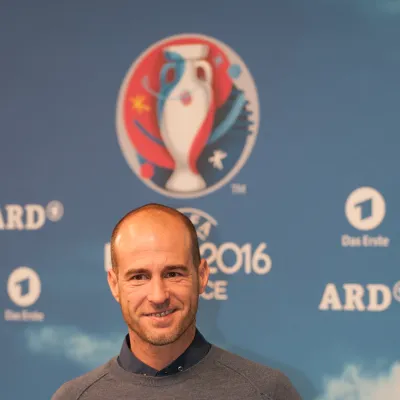
Mehmet Scholl
Human Design Chart
Biography
He retired at the end of the 2006–07 Bundesliga season as one of the most successful German football players of all time.
What does Generator 2/4 mean for Mehmet Scholl?
Generator 2/4 — Design at a Glance
Mehmet Scholls design points to a tendency towards great endurance and inner strength, comparable to a workhorse that unleashes its power when used for the right task. As a Generator, he had plenty of sacral energy, but it was released not through self-initiative, but by responding to signals from his environment. This mechanism means: don't push things forward, but wait until life poses a question or an impulse arises, and then respond from the gut.
Living in harmony with this strategy – that is, reacting only to what his sacral center confirmed with a clear 'yes' – led to deep satisfaction and a sense of true fulfillment. Conversely, frustration and energy loss threatened when he acted against this principle. Two specific pitfalls shaped his dynamics: on one hand, the risk of investing energy in tasks that did not bring intrinsic joy, which could lead to long-term exhaustion. On the other hand, the difficulty of being held back from his heart project despite still having plenty of power and wanting to continue working. His success thus depended on feeling this inner resonance and acting upon it rather than being guided by external expectations or the need for constant pushing forward.
Emotional Authority
Mehmet Scholls design points towards emotional wave movement: his inner truth does not show as a static certainty, but as a dynamic process that requires time to find clarity. As an Emotional Authority, he was subject to permanent fluctuations in feelings – moments of intense enthusiasm alternating with phases of negative coloring. This emotional wave does not mean the current mood represents the final reality; it is merely a snapshot, a first impression that may not yet reflect the deeper truth.
For Mehmet Scholl, therefore, it was crucial to protect himself from quick, spontaneous decisions based on acute emotions, as these often had negative consequences due to the lack of emotional distance. The mechanics of his inner authority required patience: long-term decisions shaping his life could not be made in the heat of the moment. Instead, he needed to take time for a decision to mature – ideally by sleeping on it multiple times and enduring uncertainty. Only when intense feelings subsided and emotional distance was gained did calmness set in. This process of 'taking one's time' and waiting was no sign of weakness but rather the necessary strategy to reach true clarity. Only through this delay could he ensure that his choice was based on a stable, deep-seated insight and not just on transient excitement or depression.
The 2/4 Profile — Hermit / Opportunist
Mehmet Scholl showed himself as someone constantly swinging between two fundamental needs: the urge for withdrawal and the longing for community. His design suggests a tension requiring clear communication of when company is desired and when silence is needed. In his 'me-time', he immersed in internal processes to find calmness and clarity. Only after this need was fulfilled did he emerge from his retreat to spend time with his favorite people.
This dynamic reflects the Profile 2/4, known as 'Natural Talent / Networker'. Line 2 embodies the hermit who must deal with projection and control, while line 4 seeks community. Without maturity, this projection can lead to frustration, as the second line often tries to control finances or power dynamics, which can be strenuous. At the same time, the fourth line waits for the right opportunity to express details. It needs time for its inner process and should be left undisturbed until it can appear harmoniously and simply. Being pulled out of this asceticism too early requires corrections. Ideally, Mehmet Scholl uses his alone-time to reflect on and evaluate the knowledge of his network, developing brilliant ideas before sharing them with others.
Triple Split Definition — Defined & Open Centers
Mehmet Scholl's Human Design profile suggests a tendency to stand under constant mental pressure, asking questions and forming concepts. The definition between the Head Center and Ajna Center creates this permanent inspiration, but it does not offer direct energy for implementation; instead, it serves to inspire others to think rather than executing tasks himself. This mental process was complemented by his defined Sacral Center, which provides a reliable source of vital energy. Here lies the power in reaction: By waiting on initiatives and responding with an internal 'yes' or 'no', he could use his energy efficiently and avoid frustration.
Simultaneously, the defined Solar Plexus Center created emotional depth, requiring decisions not to be made impulsively but rather to wait for the emotional wave until clarity emerged. This patience was supported by his also defined Spleen Center, whose spontaneous intuition acted in 'now' and ensured well-being. The defined Root Center provided the necessary stress pressure to move forward and master existential challenges.
In contrast, the open G Center revealed a flexibility of identity: Mehmet Scholl tended to adapt himself to his environment and align with the right place and people rather than following a fixed inner direction. The open Heart Center meant that he was not designed to prove willpower or keep promises to demonstrate value; instead, he learned not to get entangled in competitive dynamics. Similarly, the open Throat Center showed vulnerability to pressure to force attention through speaking. Healthy communication involved waiting for an invitation rather than actively seeking recognition, ensuring authentic and stress-free conversation.
Channels for intimacy, logical scrutiny and inner clarity.
Mehmet Scholl's Human Design profile suggests a tendency towards intense, time-bound intimacy. Channel of Union 59-6 connects sacral sexuality with emotional wave; clarity emerges only after waiting out the feeling cycle, making relationships deep but prone to misunderstandings. Parallelly, there was a sharp corrective instinct: Channel of Judgment 58-18 drove the urge to examine and perfect patterns. This mechanism requires invitation to work constructively rather than critically. Mentally, he showed sudden insight through Channel of Awareness 61-24, which transforms inspiration into rational answers – knowledge here appears spontaneously, not through deliberate thought.
Additionally, individual Gates shaped his orientation: Gate 32 sought continuity and material success for the clan, while Gate 42 saw experience as a key to development. Gate 62 promoted patient detail work and logical fact-finding. On the personality level, Gate 48 with deep pattern recognition and Gate 44 through awareness in interactions were active. Gate 50 preserved traditional values, Gate 55 brought emotional mood swings, and Gate 14 handled power skillfully. This configuration was marked by a mix of impulsive intimacy, analytical sharpness, and spontaneous insight, where the timing of emotional waves was crucial for the quality of connections.
Individual Circuitry — Circuit Signature
Mehmet Scholl's Human Design profile suggests a tendency towards three separate yet parallel acting energetic focal points. As someone with triple definition, these forces did not exist as a continuous flow but rather as independent blocks: emotional life force, instinctive clarity, and creative intuition.
The Knowledge Circuit connected his Head Center to the Ajna Center via Channel of Awareness (Gates 61–24). This promoted innovative flashes of insight and the ability to transform new knowledge free from external conditioning. Parallel to this, the Understanding Circuit worked through Channel of Judgment (Gates 18–58), linking Spleen and Root Centers. Here, a focused rational energy emerged that utilized logical structures for future development improvement – emotionless and strategically clear.
A third isolated block formed the Archer Circuit via Channel of Union (Gates 59–6), which connected Sacral and Solar Plexus Centers. This configuration brought together primal energies of protection, care, and emotional pulse directed towards the well-being of family or close surroundings.
Since these three groups were not interconnected, Mehmet Scholl had to learn to integrate these different impulses – creative inspiration, rational strategy, and instinctive protective drive – as separate experiences rather than forcing them into a single life stream. Each of these energies worked time-limited or situational without constant feedback on other areas of his design.
Right Angle Cross of Maya 3
Mehmet Scholl's Human Design reveals a tendency towards a deep, almost mystical connection to inner truth. His chart displays the 'Maya 3 Right Cross', a configuration that does not seek external fame or quick success but rather aims at grasping and authentically radiating the essence of things. This structure describes someone whose authority comes from within – not through titles or positions, but through the integrity of their own experience.
In Human Design, this cross represents a specific kind of 'knowledge' that is felt and lived directly rather than intellectually analyzed. It's about understanding complex connections in their essence and conveying this clarity to others without imposing it. For Mehmet Scholl, this means a life task unfolding less in the noise of public attention and more in the quiet of personal conviction. He is guided to listen to his inner voice and trust it even when it diverges from common opinion. This configuration fosters humility before the greater whole, coupled with the strength to make this insight visible in daily life. It's a path of internal affirmation where the true goal isn't recognition by others but authenticity and genuine connection to life itself.
Saturn Return · Uranus Opposition · Chiron Return — Life Cycles
Mehmet Scholl's Human Design points towards visible confirmation through external successes that often crystallize in collective triumph moments. This was evident at age 26 in 1996: winning the UEFA European Cup with the German national team marked his first Saturn Return. During this phase, it usually becomes clear whether years of discipline and integration into larger structures are sustainable; here, his place on the team was validated by a historic success.
Later, during the Uranus Opposition around age 40, there was a shift from active execution to strategic observation. In 2010, he took over as an expert after Günter Netzer. This cycle often demands letting go of old identities in favor of a new, freer perspective – Scholl moved from playing the field to analysis, where he now comments on his experience rather than implementing it.
The Chiron Return phase starting at age 47 brought confrontation with his life task. In 2017, his contract with ARD ended amid controversy around doping issues. This cycle is not a healing process but an achievement cycle: here, the inner truth's anchoring in external life is tested. The separation signaled a need to clarify his position and integrity, independent of institutional ties.
Generator · Emotional Authority — Synthesis
A central red thread in this design is the dynamic interaction between internal perception and external expression. Emotional authority demands time for clarification, while the defined Head Center generates constant mental pressure to question and seek inspiration – a process often linked with uncertainty. This combination is reinforced by Line 2/4 in Profile Role, which oscillates between the need for withdrawal and the desire for community to gain clarity and share energy. The sacral energy of the Generator constantly seeks fulfilling engagement that aligns with inner processes.
The central paradox lies in the tension between a deep need for authenticity and the ability to influence others through inspiration. The Knowledge Circuit drives one to forge their own path and generate new insights, while Channels of Partnership seek an intense connection to others. Cycles show both successes (1996, 2010) and crises (2017), hinting at balancing individual expression with environmental expectations.
3 Defined Channels
Incarnation Cross - Right Angle Cross of Maya 3
Solar Return
The Solar Return shows the moment when the sun returns to its exact birth position - your personal solar year.
Life Cycles
Discover the life cycles with a detailed triple view (birth chart, cycle chart, composite).
Human Design Profile
- Type
- Generator
- Strategy
- To respond - wait for something to respond to
- Authority
- Emotional Authority
- Profile
- 2/4 - Hermit / Opportunist
- Definition
- Triple Split
- Incarnation Cross
- Right Angle Cross of Maya 3
- Date of Birth
- 16.10.1970 05:25
- Place of Birth
- Karlsruhe, GER
Frequently Asked Questions
What is Mehmet Scholl's Human Design type?
What Profiles does Mehmet Scholl have?
Which Authority does Mehmet Scholl possess?
What is Mehmet Scholl's Incarnation Cross?
When was Mehmet Scholl born?
Discover your own Human Design
Are you also a Generator? Find out in a personal reading how to use your sacral energy correctly and discover deep satisfaction.
More Personalities
Back to overviewAaliyah

Aldair

Alexia

Angèle

Anne-Marie

Arcángel